

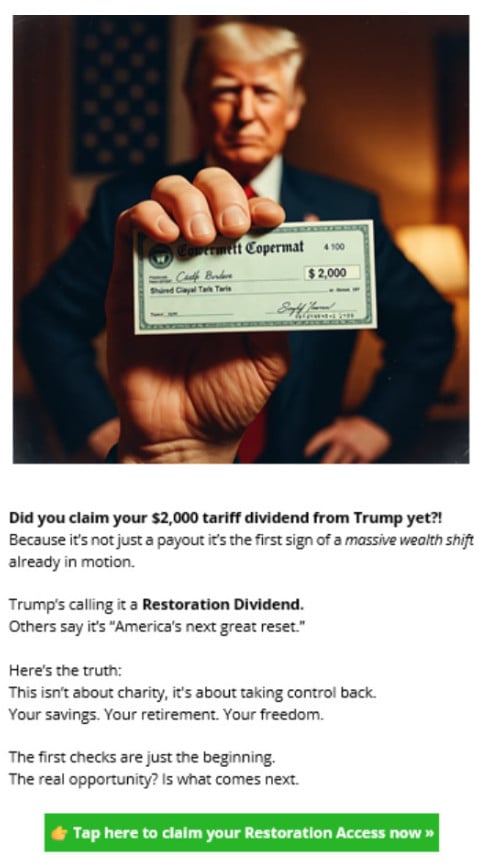
The $6000 Trump Tariff Refunds scam is built to look timely, patriotic, and financially tempting.
It shows up in text messages, emails, and social media ads that claim you qualify for a large refund tied to tariffs, economic relief, or a Trump-backed payout. The wording changes, the dollar amount changes, and the branding changes. The goal does not.
This is not about helping consumers collect legitimate money.
It is about getting people to click links, hand over personal information, and in some cases enter credit card or banking details under the excuse of verifying a payment or covering a small processing fee.
That is what makes this scam dangerous. It borrows the language of real headlines, then turns that confusion into a trap.
Scam Overview
What the $6000 Trump Tariff Refunds scam claims
The core pitch is simple.
A message arrives saying you may be eligible for a $6000 Trump tariff refund, tariff rebate, tariff relief payment, or tariff dividend. Sometimes it says your payment is pending. Sometimes it says your claim is approved. Other times it says you must act now or lose the money.
The message may come as:
- A text message with a suspicious link
- An email that looks official
- A sponsored post on Facebook or Instagram
- A social media ad promising a fast payout
- A fake government-style website with a short form
The amount may be $6000, but that number is part of the bait.
Scammers regularly swap in whatever amount sounds believable enough to trigger action. Public reporting and official warnings have already documented fake tariff-related claims involving $2,000 texts, and fake social ads promising amounts like $750 and $5,600. That pattern makes the $6000 version look less like a unique program and more like a recycled scam template with a larger number attached.
Why the scam feels believable
This fraud works because it is not invented out of thin air.
It piggybacks on real public debate around tariffs, proposed tariff dividends, court fights over tariff collections, and confusion about whether consumers might ever see some sort of payment. Reuters reported in 2025 that Trump said some Americans could get a distribution from tariff revenues, and later reported that the White House was committed to exploring a $2,000 dividend funded by tariff income.
That background matters.
Once people hear enough headlines about tariffs, rebates, or government money, a fake message about a “tariff refund” stops sounding ridiculous. It starts sounding possible. Scammers do not need perfect credibility. They only need enough familiarity to get someone to click.
The key fact scammers want you to miss
There is a major gap between real policy discussion and these scam messages.
Reuters reported in March 2026 that Customs and Border Protection was building a refund system tied to tariffs deemed unconstitutional, but that system was aimed at importers through the ACE system, with Treasury payments going to eligible importers. It was not a random consumer payout program delivered through text messages, Facebook ads, or email links.
That distinction is the heart of the scam.
Scammers take a real headline about tariffs and refunds, remove the context, and convert it into a fake direct-to-consumer offer. A person hears “refund” in the news, sees “refund” in a text, and assumes the two must be connected. They are not.
There is no reason a real refund would arrive this way
Both the FTC and the IRS have been clear about how refund scams operate.
The FTC warned in January 2026 that texts and emails about a “tax refund” can be phishing scams, and it specifically said that the real IRS and state tax offices will not reach out by text, email, or social media to get your information. The IRS also says it does not send direct social media messages and warns about phishing and smishing scams that try to steal personal information or trick people into claiming fake refunds.
That guidance maps neatly onto the tariff-refund version of the fraud.
A scammer may swap “tax refund” for “tariff refund,” but the structure stays the same. The promise of money is just a hook. The real mission is data theft, payment fraud, or both.
Officials have already warned about the tariff version
This is not theoretical.
The Idaho Attorney General warned in late 2025 about fraudulent texts claiming recipients had to act urgently to receive $2,000 tariff rebate checks. According to that warning, the messages were not from any government agency, and no government payment would require a text response to qualify.
That warning is important even if the scam you saw mentioned $6000 instead of $2,000.
The amount is flexible. The tactic is not. Urgent language, a fake payout, and a demand for immediate action are classic scam components.
Social media has made the scam easier to spread
Scammers do not rely only on text messages.
Deceptive Facebook and Instagram ads promoted fake “tariff relief” benefits, including bogus payments and vouchers, and that these ads appeared designed to gather personal information or funnel users into marketing or call-center schemes. Meta removed some of the ads after being alerted, but the broader lesson is obvious: the presence of a polished sponsored post does not make the offer real.
That matters because social ads lower suspicion.
People are used to seeing real banks, stores, and public agencies advertise online. Scammers know that. So they mimic the visual language of legitimate campaigns: clean layouts, patriotic colors, official-sounding claims, and words like “approved,” “qualify,” “benefit,” or “act now.”
Why the $6000 amount is especially effective
A number like $6000 hits a psychological sweet spot.
It is large enough to create excitement, but not so absurd that it automatically feels fake to everyone. A promise of $50,000 might trigger skepticism. A promise of $6000 can feel just plausible enough, especially during a period when people are hearing about tariffs, tax changes, inflation, and government-related payments.
That is part of the engineering.
Scammers choose amounts that feel meaningful but believable. They want victims thinking, “This could be real,” not “This is obviously nonsense.”
In some cases, the number may also blend with unrelated real news. In 2026, for example, news coverage discussed a new $6,000 senior tax deduction under the One Big Beautiful Bill Act, entirely separate from any tariff-refund claim. That kind of headline clutter can make a fake $6000 “refund” sound even more familiar to someone skimming quickly on a phone.
What the scammers really want
The $6000 promise is bait.
The real targets are usually one or more of the following:
- Your full name and address
- Your date of birth
- Your Social Security number
- Your driver’s license details
- Your banking information
- Your credit or debit card number
- Your email login or phone verification code
- Your willingness to pay a “small fee”
In some versions, the scam ends with identity theft. In others, it ends with unauthorized card charges. In still others, the victim gets dumped into a lead-generation funnel where their information is sold to shady marketers, fake call centers, or other scam operators.
Why this scam keeps mutating
Scam operators rarely care about one fixed script.
They test and retest. One week it is a $2,000 tariff rebate. The next week it becomes a $5,600 tariff relief payment. Then it becomes a $6000 Trump tariff refund. The names change because the underlying psychology stays strong.
That adaptability is why this scam can travel so well across platforms.
A text can sound urgent. An email can look official. A social ad can look modern and trustworthy. A fake site can look polished enough to pass a quick glance. Each format reaches a different kind of victim, but the back-end objective stays the same.
Why ordinary people fall for it
A lot of scam coverage makes victims sound careless. That misses the point.
People fall for scams like this because the context is messy. Tariffs are complicated. Refund policy is confusing. Politics is noisy. Social feeds are full of half-truths, rumors, and sponsored content. Many people are also under financial pressure, which makes any message about a pending $6000 payment much harder to ignore.
That is not stupidity.
That is a scammer exploiting timing, confusion, and economic stress all at once.
How the Scam Works
Step 1: The scammer uses a real-world headline as camouflage
The first move is credibility.
Scammers build their pitch around real tariff news, public political statements, or confusing refund chatter. As long as the victim has seen enough headlines to think “I vaguely remember hearing something about this,” the scam has a foothold.
That partial familiarity is enough to disarm people.
The message does not need to be perfect. It only needs to sound connected to a real issue already floating around in the public mind.
Step 2: The victim gets an unsolicited message
Next comes delivery.
A text may say your $6000 Trump Tariff Refund is waiting. An email may say your claim was approved. A social ad may say thousands of Americans are already receiving “tariff relief” and you need to verify your eligibility before the deadline.
The message is usually brief, emotional, and urgent.
It does not explain policy in any real detail because that would create friction. Instead, it focuses on action words: claim, verify, unlock, release, respond, confirm.
Step 3: Urgency is used to shut down skepticism
This is one of the most important parts of the scam.
The victim is told there is a narrow deadline, a final notice, or a pending cancellation. The Idaho Attorney General’s warning about fake tariff rebate texts specifically described messages telling recipients they had to act urgently or their check would not be sent.
Urgency works because it changes the victim’s mental posture.
Instead of asking, “Is this real?” they start asking, “What if I miss out?” That shift is exactly what the scammer wants.
Step 4: The link leads to a fake portal
Once the victim clicks, they are usually sent to a site dressed up to look official.
It may use:
- Government-style language
- Patriotic colors
- Seals or symbols
- Progress bars
- Countdown timers
- Fake approval notices
- Phrases like “secure verification” or “release processing”
The page only needs to survive a few seconds of scrutiny.
Most victims do not sit down and audit the page line by line. They look quickly, see the right keywords, feel the time pressure, and continue.
Step 5: The site asks for “verification” information
The fake portal then requests personal data.
The victim may be told the information is needed to verify identity, prevent fraud, or confirm payment method. But this is where the fraud starts paying off. The FTC has warned that refund-related phishing messages try to collect personal and financial information, and the IRS warns taxpayers not to click links in unexpected messages asking them to verify details or claim refunds.
This step can expose victims to:
- Identity theft
- Account takeover attempts
- Fraudulent applications
- Future phishing attacks
- Broader criminal data sharing
Even if no money is taken immediately, the information itself has value.
Step 6: A small fee may be introduced
Some versions go a step further.
The site says your $6000 refund is approved, but a small fee is required to process, release, or validate it. The fee might be only a few dollars. That is deliberate. The smaller the fee, the more likely the victim is to think it is harmless.
This is a classic move.
The small fee is not there because the refund is real. It is there to capture card data, test whether the card works, and sometimes trigger additional unauthorized charges later. The IRS explicitly warns that if a website charges you for something the government provides directly, you should contact your bank or card company and report the incident to the FTC. (IRS)
Step 7: Some victims are pushed into a second scam layer
Not every fake tariff-refund site steals directly on page one.
Some collect personal details and then redirect the user to another page, a call center, or a form for unrelated “benefits.” The Washington Post’s reporting on fake tariff-relief ads found that some schemes seemed designed to funnel users into lead-generation or call-center systems rather than a genuine payment program.
That makes the scam harder to recognize.
A person may think, “Nothing was stolen yet,” when in reality their information has already been monetized.
Step 8: Follow-up contact keeps the pressure going
After the victim engages once, the scammers often keep going.
They may send more emails, more texts, or even phone calls. The new contact might say:
- Your claim is incomplete
- Your identity could not be verified
- Your card validation failed
- You need one final document
- The payment is ready for release
This serves two purposes.
First, it squeezes more data or money from the same victim. Second, it identifies responsive people who are more likely to fall for future scams.
Step 9: The money never arrives
This part is simple and brutal.
There is no $6000 refund waiting. There is no payout queued for release. There is no secret processing center holding your Trump tariff money until you confirm your details.
The site may stall with excuses. It may say the claim is pending. It may vanish. The email may stop working. The phone number may go dead. The ad may disappear.
That disappearance is typical scam behavior, not a technical glitch.
Step 10: The real damage may show up later
One of the hardest things about scams like this is that the consequences are not always immediate.
A victim might click today and not discover the damage until later, when they notice:
- Strange card charges
- A wave of scam emails
- Password reset attempts
- Calls from unknown numbers
- New account applications
- Identity verification notices
- Subscription charges they never intended to authorize
That delay can make the connection less obvious.
Victims sometimes forget the fake tariff-refund site entirely until the downstream fraud begins.
Red Flags That Expose the Scam
You do not need to decode every fake message from scratch.
The most reliable warning signs are consistent.
Common red flags include:
- An unsolicited text, email, or social media message about money
- A claim that you qualify for a $6000 tariff refund
- A demand to act immediately
- A warning that your payment will expire
- A suspicious or shortened link
- A request for Social Security or banking details
- A demand for a small fee before money is released
- A vague agency name that sounds official but does not quite make sense
- Poor grammar mixed with urgent, authoritative language
- A social ad that promises easy money with almost no explanation
The FTC and IRS guidance on refund scams strongly reinforces this checklist: do not respond, do not click unexpected links, and do not trust texts, emails, or social messages claiming to help you collect a refund.
What To Do If You Have Fallen Victim to This Scam
1. Stop interacting immediately
Do not reply. Do not click again. Do not keep filling out the form to “see what happens.”
The moment you suspect fraud, end the interaction.
2. If you entered card information, call your bank or card issuer now
Tell them you may have entered your card details on a fraudulent tariff-refund site.
Ask them to:
- Review recent activity
- Block suspicious charges
- Replace the card if needed
- Watch for recurring transactions
- Flag the account for fraud monitoring
Do this even if the only charge was small.
3. If you shared bank details, contact your bank immediately
Banking information can be misused in different ways, and speed matters.
Explain that the information was given to a fake refund website and ask what protective steps are available for your specific account.
4. If you gave out personal identity information, assume identity theft is possible
If you entered your Social Security number, date of birth, address, or driver’s license information, treat the situation seriously.
Monitor your credit and financial accounts closely. Consider a fraud alert or security freeze if the exposure was significant. The FTC and IRS both warn that refund-related phishing schemes are often designed to steal personal information, not just payment data. (Consumer Advice)
5. Change passwords if you reused any credentials
If the fake site asked you to log in, create an account, or confirm your email password, change that password right away.
Start with your email account first. Then change any other accounts that use the same or a similar password.
6. Report the message properly
For suspicious tax-related or IRS-related messages, the IRS says not to reply or click links. It directs people to forward suspicious texts or emails through its fraud-reporting channels. The FTC also advises forwarding scam texts to 7726, which helps carriers identify spam campaigns. (IRS)
Reporting is not just symbolic.
It can help block the same campaign from reaching more people.
7. Save evidence before deleting anything
Take screenshots of:
- The original text or email
- The sender information
- The website URL
- Any payment screen
- Confirmation pages
- Card charges
- Follow-up calls or messages
This will help if you need to dispute transactions or document the fraud later.
8. Watch for follow-up scams
This is a big one.
Once you respond to one scam, you may be targeted again by someone claiming to fix the problem, recover your funds, or complete your refund. Those follow-up contacts are often scams too.
Do not pay anyone who contacts you out of the blue promising to get your money back.
9. Keep monitoring for several months
Scam damage can unfold slowly.
Watch your statements, email, credit activity, and account alerts for signs that your information is being reused or sold.
Do not assume you are safe just because nothing happened on day one.
The Bottom Line
The $6000 Trump Tariff Refunds scam is not a real government payment program.
It is a phishing and payment trap that exploits public confusion around tariffs, refunds, and political headlines. Official warnings have already documented fake tariff-rebate texts, and reputable reporting has shown how scammers also use social media ads to push fake tariff-relief offers. At the same time, the real tariff refund mechanism reported by Reuters involves importers, not random consumers being told by text or Facebook ad to claim a payment.
That is the key point to remember.
A real refund does not depend on a surprise text. A real government payment does not require you to click a suspicious link from a social ad. And a legitimate agency does not ask you to pay a small fee to unlock money supposedly owed to you.
When you see “$6000 Trump Tariff Refund” in a text, email, or ad, do not treat it like an opportunity.
Treat it like a scam until proven otherwise.
FAQ
What is the $6000 Trump Tariff Refunds scam?
The $6000 Trump Tariff Refunds scam is a fake scheme that claims you are eligible for a large refund, rebate, or relief payment linked to tariffs.
Scammers use text messages, emails, and social media ads to lure people into clicking links and sharing personal or financial information.
Is there really a $6000 Trump tariff refund for consumers?
Scam messages claim there is, but these offers are used to trick people.
If you receive a random text, email, or ad saying you qualify for a $6000 tariff refund, you should treat it as highly suspicious.
How does the scam usually begin?
It usually starts with an unsolicited message.
You may get a text saying your refund is ready, an email telling you to verify your payment, or a social media ad claiming you can claim $6000 in tariff relief.
Why are scammers using the words “tariff refund”?
Because the phrase sounds believable.
Scammers often attach their fake offers to real-world political or economic topics so the message feels more credible and gets more clicks.
What do scammers want from victims?
They are usually trying to steal one or more of the following:
- Full name
- Address
- Date of birth
- Phone number
- Email address
- Social Security number
- Bank account information
- Credit or debit card details
In some cases, they are also trying to sign victims up for recurring charges or sell their personal data to other shady operators.
Why do some scam sites ask for a small fee?
Because it makes the scam feel more realistic.
The victim may be told they need to pay a small processing, release, or verification fee before receiving the $6000 refund. That fee is part of the scam, and in many cases the real goal is to steal the card details.
Are text messages about tariff refunds legitimate?
A random text message claiming you qualify for a large government-related refund is a major red flag.
Real money claims should never be trusted just because they arrive by text, especially when they include urgency, suspicious links, or demands for personal information.
Are Facebook or Instagram ads for tariff relief safe?
Not necessarily.
Scammers often use polished sponsored ads that look official or professional. Just because an ad appears on a major platform does not mean the offer is real.
What are the biggest warning signs of this scam?
Common red flags include:
- A message that arrives out of nowhere
- A promise of $6000 or another large payout
- Urgent language such as “act now” or “final notice”
- A request to click a link
- A request for personal or banking details
- A demand for a small upfront fee
- A suspicious website address
- Vague government-style wording
What happens if I click the link but do not enter any information?
If you clicked but did not submit anything, close the page right away and do not go back.
You should also keep an eye on your device and accounts, especially if the site tried to get you to download anything or log in somewhere.
What should I do if I gave them my card details?
Contact your bank or card issuer immediately.
Tell them your card information may have been entered on a fraudulent refund website. Ask them to monitor the account, block suspicious charges, and replace the card if needed.
What should I do if I gave away personal information?
Take it seriously.
If you shared sensitive details like your date of birth, address, or Social Security number, monitor your accounts closely and consider identity theft protections if needed.
Can scammers use my information later?
Yes.
Even if nothing happens right away, your information may be used later for identity theft, phishing, account fraud, or other scams.
Will I actually receive any $6000 refund after paying the fee?
No.
The payment is the bait. Once the scammer gets your information or your card details, the promised refund never arrives.
Can this scam come back under a different name?
Yes, very easily.
The same scam may appear under slightly different titles such as tariff rebate, tariff relief payment, Trump tariff check, import relief refund, or consumer reimbursement claim.
How can I protect myself from scams like this in the future?
Use a simple rule: never trust unsolicited messages promising money.








