

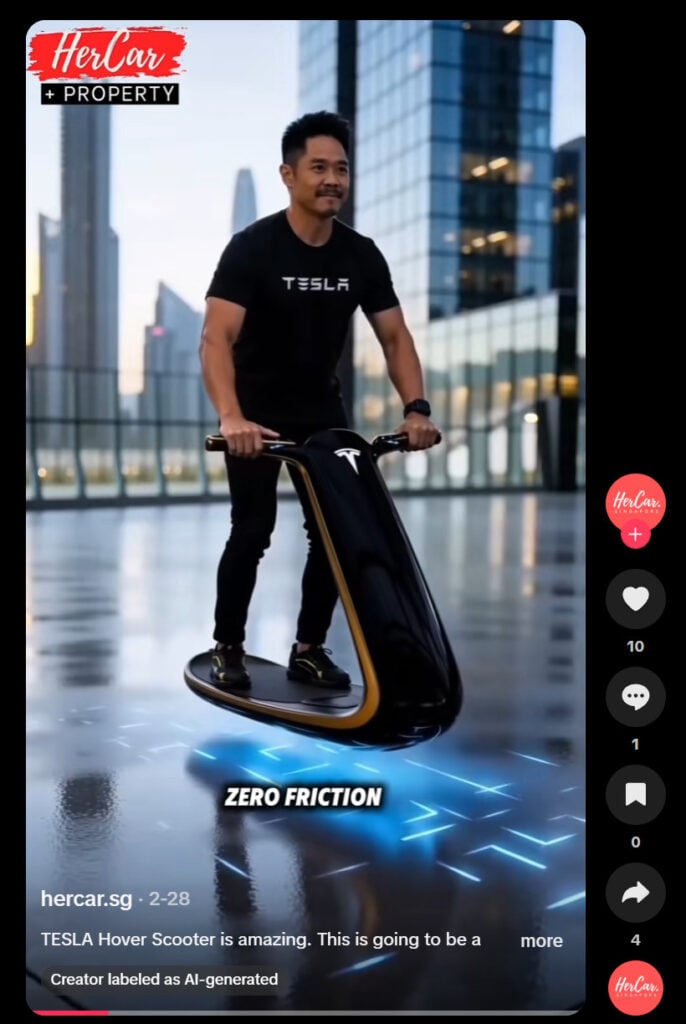
At first glance, the Tesla Hover Scooter video looks like a futuristic product reveal. The styling feels polished, the branding looks familiar, and the captions push a simple message: this is the next big thing in personal mobility.
But the product shown in these clips is not real.
The videos are an AI-generated concept videos dressed up like a genuine Tesla innovation. It is not evidence of an actual Tesla hover scooter launch, and it should not be treated like a legitimate product announcement.
The short verdict
The Tesla Hover Scooter video is not legit as a real product reveal.
What you are looking at is best understood as AI-generated engagement bait. In some cases, videos like this are posted just to farm views, likes, comments, and followers. In other cases, they can become the first step in something worse, such as fake preorder pages, impersonation accounts, giveaway scams, or other social media fraud funnels. The FTC has repeatedly warned that scams frequently start on social media, including through ads and product offers, and that brand impersonation can lead users to fake sites where they may lose money or personal information.
Why this Tesla Hover Scooter video is not real
1. The video is labeled as AI-generated
One of the biggest clues is already on the screen.
The post carries a visible label saying “Creator labeled as AI-generated.” TikTok’s own policy explains that this label is used when content is completely generated or significantly edited by AI. TikTok also says it may automatically apply an AI-generated label in some cases when it identifies such content.
That does not automatically prove malicious intent. But it does destroy the illusion that this is a real product demo captured from an actual Tesla launch.
2. There is no official Tesla Hover Scooter product announcement on the Tesla pages reviewed
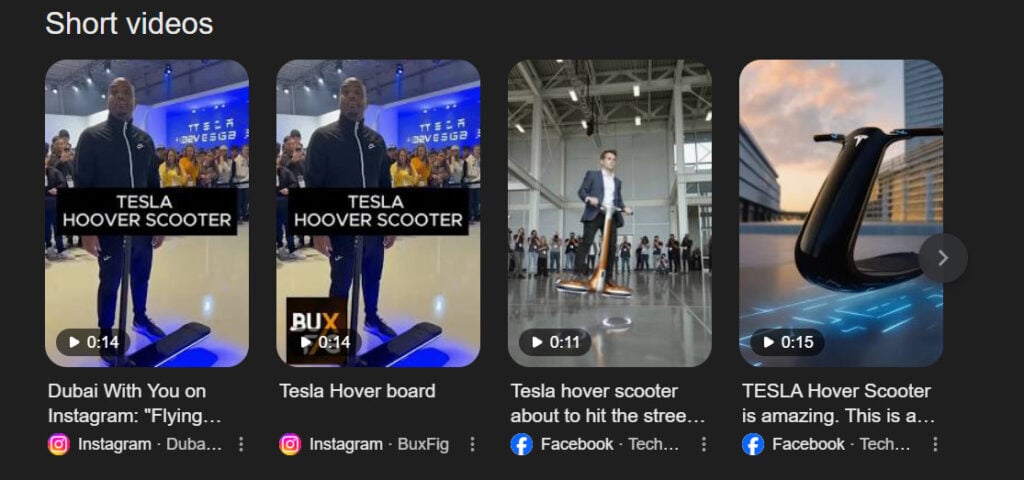
When you look at Tesla’s official shop, you see real categories like charging products, vehicle accessories, apparel, and lifestyle items. The shop page also lists known products such as the Cyberquad for Kids and other branded merchandise. On the official Tesla pages reviewed here, there is no official “Tesla Hover Scooter” product listing or launch announcement. That is an inference from Tesla’s own shop pages, which show actual retail categories and products but not this hover scooter.
That matters because real Tesla products do not arrive through random viral clips first. They show up through Tesla’s official channels, product pages, event announcements, or credible news coverage tied to verifiable releases.
3. The claims in the clip are classic fantasy-tech bait
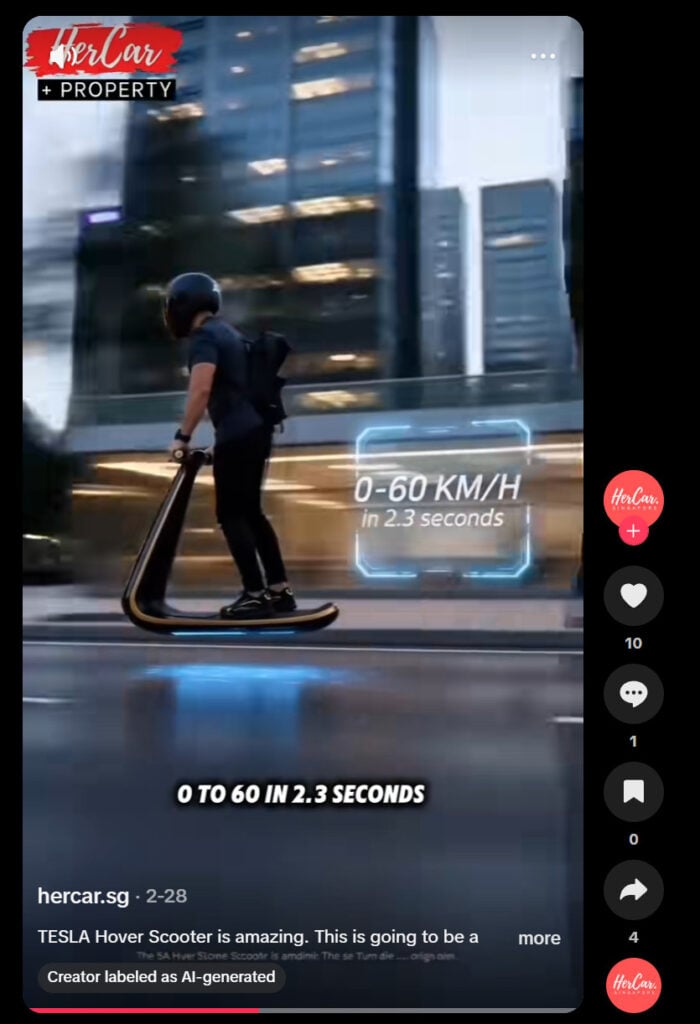
The captions shown with most videos include lines like:
- “Zero friction”
- “Top speed 80 KMH”
- “0 to 60 in 2.3 seconds”
- “The future rides here”
This is exactly the kind of language used to maximize shares and comments. It sounds cinematic, bold, and headline-ready. But it is not how legitimate consumer product marketing usually looks when a real vehicle is being introduced.
The point is not to inform. The point is to trigger amazement.
4. The visuals look engineered for virality, not proof
The scooter design itself looks like a sci-fi concept object, with glowing underlighting, impossible smooth motion, and staged urban backdrops that feel more like a rendered ad than a field test.
That alone does not prove fraud. But when you combine cinematic visuals, vague claims, AI labeling, and the lack of any official Tesla product trail, the conclusion becomes straightforward: this is not a real hover scooter launch.
So is it a scam?
The product claim is fake
If the question is, “Is there really a Tesla Hover Scooter like the one shown in the video?” the answer is no, not based on the evidence here.
The video is presenting fiction as if it were product reality. In that sense, the core claim is deceptive.
The post itself may be engagement bait first, scam second
Not every fake AI product video is immediately tied to a payment scam. Some accounts post this kind of material simply because it performs well. Futuristic fake tech gets attention. Tesla-branded fantasy products get even more attention. People comment, argue, tag friends, and follow the page for more.
That is valuable on its own.
But the real risk is what happens next.
An account that builds attention with viral fake videos can later pivot into:
- fake giveaways
- fake preorder links
- affiliate funnels
- impersonation pages
- crypto or investment pitches
- dropshipping junk presented as breakthrough technology
That broader risk is not hypothetical. The FTC says one in four people who reported losing money to fraud since 2021 said it started on social media, and reported losses to scams originating on social media reached $2.7 billion during that period. The agency also says the most frequently reported losses tied to social media were from people trying to buy items marketed there, often involving undelivered goods. (Federal Trade Commission)
So while this exact clip may be “just” fake AI content today, it fits neatly into the kind of environment scammers exploit.
What makes videos like this so effective
Tesla is a perfect bait brand
Tesla has a built-in advantage in fake viral content because the brand already sits at the intersection of:
- innovation
- futuristic design
- electric mobility
- hype culture
- strong public curiosity
People are far more likely to believe a fake “Tesla Hover Scooter” video than a fake hover scooter video from an unknown brand.
That is why scammers and engagement farmers often piggyback on trusted or famous names. The FTC specifically warns that scammers sometimes impersonate real companies on social media and lure people into fake websites, where victims may pay for a fake product, receive a cheap imitation, or lose personal information. (Consumer Advice)
AI makes fake product videos easier than ever
A few years ago, creating something this polished would have taken a serious production budget. Now it can be done with generative tools, editing software, and enough sense of what people want to believe.
The result is a new category of content that looks “almost real” to casual viewers. Not perfect, just convincing enough to spread.
That is often all the creator needs.
Social media rewards spectacle, not verification
A real product announcement requires proof.
A viral fake product video only requires attention.
That difference is important. Platforms reward content that gets watched, shared, and discussed. They do not always reward content that is accurate. The FTC has warned about the surge of deceptive advertising and fraudulent products on social media and video platforms, and has pushed platforms for more information on how they screen and monitor such material. (Federal Trade Commission)
In other words, the system is already favorable to this kind of fake futuristic clip.
Red flags to watch for in fake AI product videos
If you see more posts like this, look for these warning signs:
1. No official source
If the product is supposedly from a major brand, check the official site, official social accounts, and real press coverage.
2. Vague but exciting claims
Phrases like “revolutionary,” “zero friction,” “next-gen mobility,” and “coming soon” sound impressive but often say nothing concrete.
3. No real-world specs
Legitimate products usually come with clear details, pricing, availability, safety information, and actual product pages.
4. Cinematic visuals with no proof
Highly polished visuals can be used to hide the fact that nothing real exists.
5. AI-generated labels or obvious render artifacts
If the platform itself says the content is AI-generated, take that seriously.
6. Comment sections full of “Where can I buy this?”
That is often a sign the post is optimized to generate demand, even when no real product exists.
Could someone use this kind of video in a real scam?
Yes.
A fake AI concept video can become the top of a scam funnel very easily.
The usual progression looks like this:
Step 1: Post a jaw-dropping fake clip
The goal is attention.
Step 2: Build followers and credibility
The account starts to look popular and active.
Step 3: Introduce links, preorders, or giveaways
Now the audience is warmed up and curious.
Step 4: Monetize the trust
That can mean fake stores, phishing pages, bogus deposits, or counterfeit products.
This is why even “harmless” fake tech videos should not be dismissed too casually. The content may begin as a view trap, but it can evolve into something more dangerous.
How to protect yourself
If you come across a video like this, do the following:
- Do not assume branding means authenticity. A Tesla logo in a video is not proof Tesla made it.
- Check the platform label. If it says AI-generated, treat it as synthetic content unless proven otherwise.
- Verify through official sources. Go to the company’s real website and official accounts.
- Do not click preorder or giveaway links from repost accounts.
- Avoid entering payment or personal information for products that only seem to exist in viral clips.
- Be extra cautious if the account later pivots into investment offers, exclusive access, giveaways, or miracle products.
- Report deceptive posts if they are clearly misleading people into believing a fake product is real.
The bottom line
The Tesla Hover Scooter video is not legit as a real Tesla product.
The content is labeled as AI-generated, and TikTok says that label is used for content that is fully generated or significantly edited by AI.
Just as importantly, the official Tesla pages reviewed here show real Tesla shop categories and real products such as the Cyberquad for Kids, but not an official Tesla Hover Scooter. That strongly supports the conclusion that this viral hover scooter is fictional, not an authentic Tesla release.
So the safest conclusion is this:
It is a fake AI concept video made for attention, not a real mobility breakthrough. And while some people post this kind of content just to collect views and followers, the same tactic can easily feed into impersonation scams, fake stores, or other social media fraud later on. The FTC’s data shows that social media is already a major starting point for scams, especially product and shopping scams.








