


Birhana puts a reassuring promise above its clothing offer: plenty of time to return an order, without paying to send it back.
Before that promise persuades you to buy several dresses, follow the order beyond the sale banner and into the rules governing a refund.

Overview
A generous headline meets a much shorter deadline
Birhana advertises 90-day free returns across the top of its website. Its refund policy tells a different story: returns within 14 days of purchase.
The same policy makes customers pay ordinary return postage. Those conditions are not a minor explanation of the banner. They change its central promise.
That matters before you judge the dress, its fabric, or its fit. The advertised safety net already disagrees with the instructions for using it.
The delivery estimate makes the refund clock especially important
Standard delivery is listed as 15–20 days, with another one to three business days for processing. The return rule starts at purchase, not delivery.
Follow those published timings literally and the stated return deadline can pass before the package arrives. Paying for faster shipping does not clarify the contradictory guarantee.
The policy does promise seller-paid remedies for defective or incorrect goods. That exception should not be confused with a genuinely free, 90-day change-of-mind return.
The problem is the offer, not a proven outcome for every order
- The header promises a 90-day free-return period.
- The detailed rule instead says 14 days from purchase.
- Ordinary returns require customer-paid, tracked shipping.
- Defective or wrong items have a separate seller-paid remedy.
- The clothing storefront uses policies describing kitchenware and home goods.
This is a documented misleading-offer concern, not proof that every customer loses money. It is enough to make this particular purchase unsuitable to recommend.
The Return Promise Changes When You Open the Policy
A free-return banner usually answers two practical questions: how long you can assess an order and who pays to send an unwanted item back.
Birhana’s headline gives reassuring answers to both. Ninety days sounds generous; free sounds like the seller will absorb the ordinary cost of returning unsuitable goods.
The refund page then says the item must be returned within 14 days of the purchase date. That is a different starting point and duration.
It also requires the item to remain unused, undamaged, and unwashed, with its original labels, packaging, accessories, and gifts intact.
Items marked final sale or nonrefundable are excluded too. The sale banner should not lead you to assume every discounted selection receives the same return treatment.
Check whether that exclusion is attached to the item before placing an order. Preserve the product page if a later support response introduces a condition absent there.
Further down, the buyer must arrange a tracked return to an address supplied by support. The customer pays that postage for an ordinary return.
Original shipping and return shipping are excluded from reimbursement unless the problem is the seller’s error, such as sending a defective or wrong item.
Put those passages together and the attractive headline becomes a conditional, potentially costly return. A shopper should not have to discover that after paying.
The contradiction even appears within the same refund page: the repeating header offers 90 days while the body supplies the shorter rule.
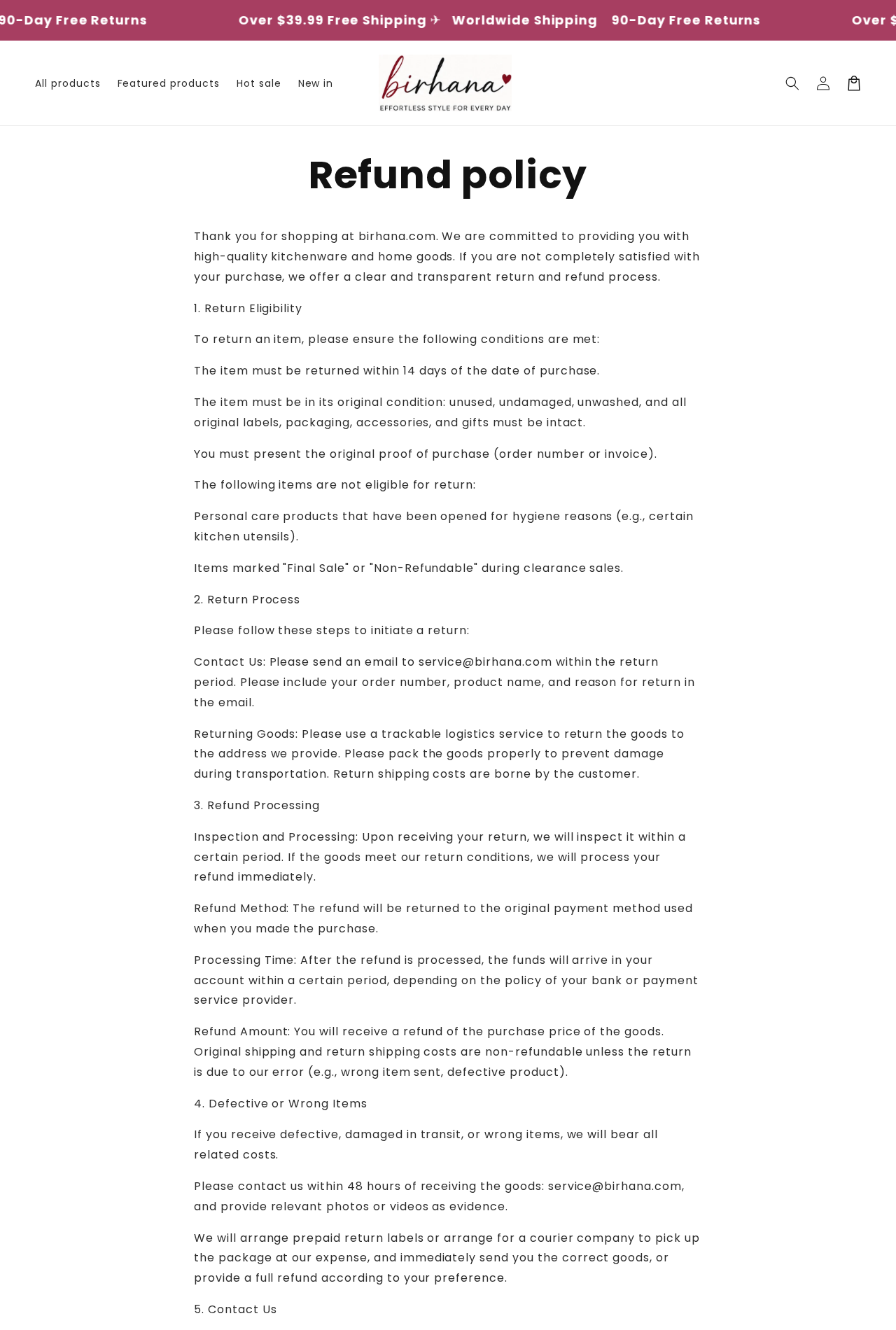
Do not assume the larger promise automatically overrides the smaller one in a support conversation. Preserve both passages and request a written explanation tied to your order.
These are the seller’s published conditions, not a complete account of your legal rights. Your location, payment method, and the actual problem can affect available remedies.
A Return Window That Can Run Out Before Delivery
The purchase-date wording is more serious when placed beside Birhana’s delivery information. Its standard shipping estimate is 15–20 days.
The shipping page separately allows one to three business days for processing after payment confirmation. Weekends and holidays are excluded from that processing estimate.
Consider a simple example: you order on the first day of a month and receive the parcel on the eighteenth. Fourteen days have already elapsed.
Under the policy’s literal wording, the return deadline has passed before you could inspect the fabric, check the size, or discover missing pieces.
That example illustrates the policy conflict; it is not a claim about a tested Birhana delivery. The site’s own published timings create the problem.
The seller needs to explain whether it really means purchase date, delivery date, a return-request deadline, or the day the parcel must reach its warehouse.
Each answer creates a different practical obligation. Mailing an approved return within a period is not the same as ensuring it arrives before that period ends.
The express option is advertised at $15.99, but the policy does not supply a corresponding express delivery range. A higher charge is not a guaranteed solution.
For standard shipping, the policy prints $5.99 and a free-delivery threshold of $40. The header instead refers to orders over $39.99.
Save the loaded order summary rather than assuming every banner describes the same charge. A few cents at the threshold should not obscure the larger return contradiction.
The Dress Bundle Needs a Clear Itemized Order
The featured item is a lounge dress with built-in shorts and pockets. Its promotional graphic advertises eight colors and an eight-pack price of $24.95.
The page also offers individual colors and a range of sizes. A photograph of eight dresses does not, by itself, identify every selectable option’s contents.
Match the selected color or package label with the quantity and total. One bundle containing eight garments differs from eight separately purchased units.
The captured storefront displayed prices in Hong Kong currency while retaining the $24.95 lettering inside the promotional image. Those amounts must not be treated as interchangeable.
A localized page may legitimately change currency. A fixed advertising graphic still needs to make clear which offer and currency it describes.
Before any payment, the summary should identify the number of dresses, their colors, the selected size, delivery charge, optional extras, and final payable amount.
If those details disagree, stop. Do not rely on a later support explanation to decide what you were purchasing in the first place.
There is no verified evidence here that Birhana changes quantities after payment or enrolls every buyer into recurring charges. The demonstrated issue is unclear promotional presentation.
For sizing, preserve the chart attached to the exact dress. Compare measurements with a garment you already wear, rather than relying only on letter sizes.
If a parcel later differs materially from the advertised measurements or selected contents, those saved details help explain the dispute precisely.
How the Birhana Offer Moves From Reassurance to Return Restrictions
Step 1: The headline makes ordering feel reversible
The sale artwork attracts attention, while the 90-day free-return message reduces the perceived risk of trying unfamiliar clothing.
That combination can encourage a larger purchase: if the dresses disappoint, the banner suggests there will be time and an inexpensive way out.
Step 2: The package image focuses attention on apparent value
The eight-color graphic makes the offer look like a wardrobe bundle rather than one uncertain garment. The important question becomes what the selected option actually includes.
Do not let a low advertised unit cost replace an itemized total. Shipping and optional services belong in that comparison too.
Step 3: Processing and transit consume time after payment
The buyer waits for dispatch and delivery. Those stages matter because the detailed return period is tied to purchase rather than receipt.
An order-confirmation email, a tracking number, and a carrier’s acceptance scan are different events. Keep the actual dates rather than assuming one proves another.
Step 4: The detailed policy governs the requested remedy
A buyer seeking an ordinary return encounters condition requirements, postage costs, a support-supplied address, and the much shorter deadline.
This is why the contradiction belongs before the buying decision. It should not become a surprise only after the dress has arrived.
Seller Identity, Delivery, and Support
The About page describes a different kind of store
Birhana’s About page introduces an online supermarket focused on home, cleaning, storage, and decorative products. Its shipping and refund pages also describe home or kitchen goods.
The visible sales page, however, promotes a clothing bundle. That mismatch makes the policies look poorly adapted to the actual purchase being encouraged.
It does not establish where the dress was manufactured. It does mean the seller has not provided a consistent, clothing-specific explanation of its service.
The return destination comes after contacting support
The refund procedure requires buyers to obtain an address before posting the goods. The advertised free-return promise therefore supplies neither a prepaid label nor a usable destination.
Ask for a complete address and written confirmation of who pays. Do not send clothing to a location found in an unrelated store’s article.
Manufacture, dispatch, business registration, and return handling are separate questions. An answer to one should not be used to fill in the others.
Fast-response promises are not completed refunds
The contact page promises quick weekday replies and next-business-day handling of messages received outside working hours. That is a service claim, not a tested response record.
Its stated target is two hours during weekday operating hours. If support misses that target, record the dates without letting repeated follow-ups consume an external dispute deadline.
No order, support conversation, or completed refund was conducted for this article. The warning rests on conflicting published terms, not an invented customer experience.
If you contact support, preserve the reply with its timestamp. A promise to review a request is not the same as approving or paying it.
International delivery can affect the final cost
The shipping policy allows international orders and places import duties, taxes, and related customs fees on the recipient. It does not identify every parcel’s dispatch location.
Those possible charges belong in the buying decision. They should not be confused with evidence that all stock originates in a particular country.
Defective or Incorrect Goods Are a Different Case
Birhana’s policy says it will bear related costs for defective, transit-damaged, or wrong items. It asks buyers to provide photographs or video within 48 hours.
It describes prepaid return labels or collection at the seller’s expense, followed by replacement or a refund according to the customer’s preference.
That written exception matters. If the wrong size was supplied, identify the ordered size and the received label rather than describing the issue as changing your mind.
Similarly, photograph missing garments, broken stitching, or damage clearly. Keep packaging until the contents and any shipping damage have been documented.
Do not invent a defect to qualify for free postage. Explain the real mismatch and ask support to apply the appropriate part of its policy.
If you missed the seller’s requested reporting period, contact your payment provider promptly anyway. Ask about its own process rather than assuming the store controls every remedy.
What to Do If You Ordered From Birhana
-
Save the advertisement, selected bundle, size chart, order confirmation, and final charge. Capture both the 90-day banner and the detailed return terms before either changes.
-
If you want cancellation, request it immediately through the order contact. Include the order number and ask for written confirmation, not an alternative product recommendation.
-
Record purchase, dispatch, and delivery dates separately. Explain any conflict between the 14-day purchase-date rule and the delivery estimate when requesting a remedy.
-
Inspect the parcel promptly. Photograph the shipping label, garment labels, contents, measurements, and any damage without exposing your personal details in public posts.
-
State whether the problem is an ordinary return, incorrect goods, damage, or material misdescription. Ask about postage, authorization, destination, deadline, and the amount to be refunded.
-
Keep proof of posting if an authorized return is required. Ask whether the proposed resolution is money back to your payment method or merely store credit.
-
Contact the payment provider if goods never arrive, differ materially, or an agreed refund fails. Present the specific facts and ask about applicable deadlines.
The FTC’s online-shopping guidance explains why keeping purchase records and reading return costs matters. Payment protections vary; a reimbursement is not guaranteed.
Simply visiting this clothing site does not establish a malware infection. Focus on the order and payment problem unless a separate account or software exposure occurred.
Frequently Asked Questions
Does Birhana really offer 90-day free returns?
The banner says so, but the detailed policy requires returns within 14 days of purchase and makes customers pay ordinary postage. The published terms conflict.
Can the return deadline expire before the dress arrives?
Yes, under the literal policy wording. Standard delivery is estimated at 15–20 days, while the return clock starts at purchase and processing takes additional time.
Who pays if Birhana sends the wrong or damaged item?
The policy says the seller bears those costs and describes prepaid labels or collection. It requests photographic evidence within 48 hours of receipt.
Does the eight-pack picture mean every option contains eight dresses?
No. Confirm the selected package and itemized summary. Individual color choices and a promotional bundle image do not automatically describe the same contents.
Is this proof that every Birhana order is fraudulent?
No. The supported finding is a misleading return promise and inconsistent store information. That is a strong buying warning without inventing universal delivery or refund outcomes.
What should I do if support keeps delaying my refund?
Preserve correspondence, request the refund amount and payment reference, and contact your payment provider about its deadline. Do not wait indefinitely on a general reassurance.
The Bottom Line
Do not order through this Birhana offer. A 90-day free-return headline is not an adequate safety net when the detailed rules demand 14-day, customer-funded returns.
Already paid? Save both promises, act promptly on cancellation or a documented remedy, and take an unresolved delivery or misdescription dispute to your payment provider.

Join the discussion
0 commentsShare your experience or ask a question about this article.
Discussion
Start the conversation
Have a question or something useful to share? Add the first comment.