

You’re walking home when a stranger asks a friendly question. Within minutes, the conversation turns to someone you love and a problem you never knew existed.
The blessing scam, sometimes called the ghost or Chinatown scam, starts with that unsettling shift. Understanding the next few requests helps you recognize the danger early.
Overview
A family worry becomes a demand for valuables
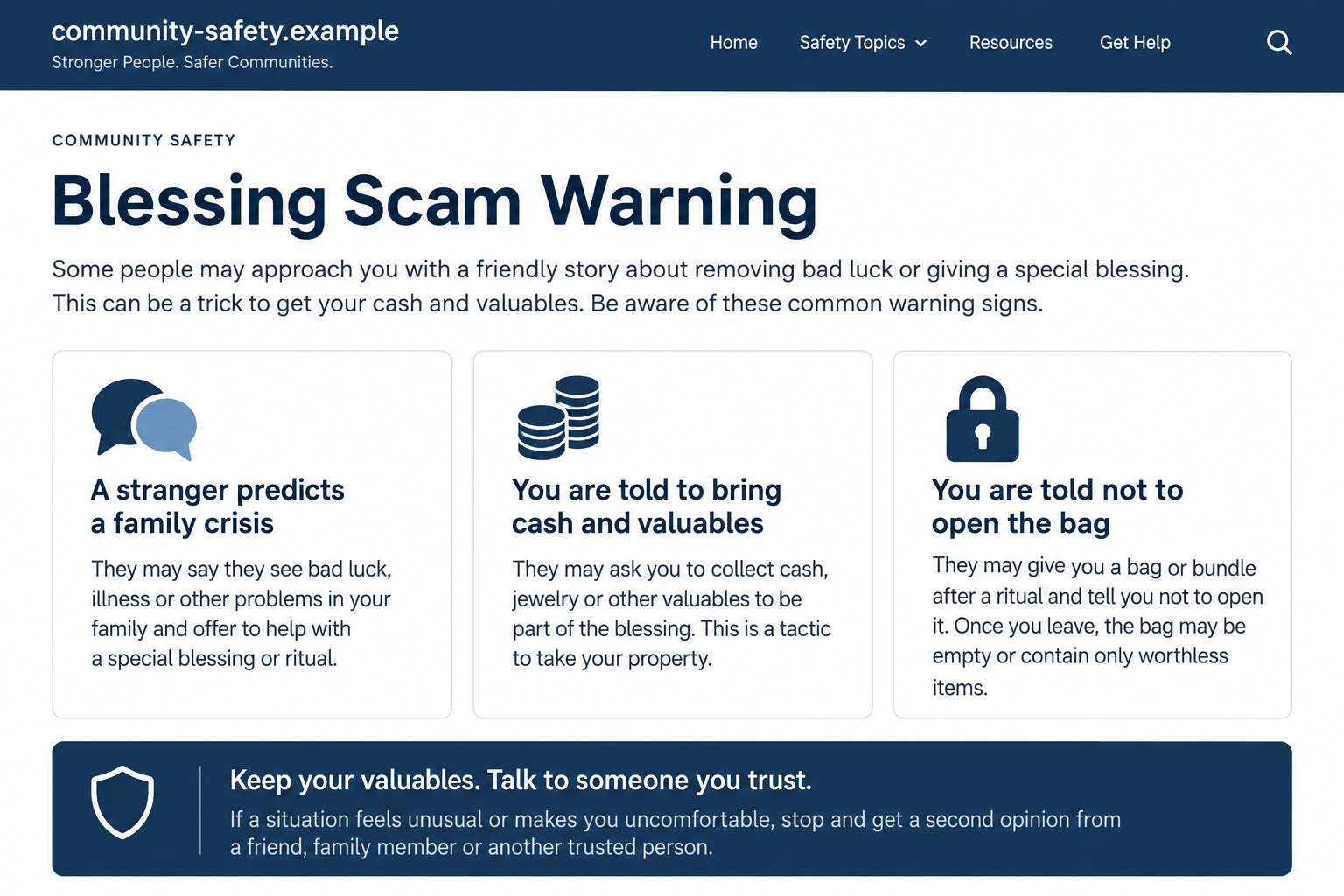
The blessing scam is a street confidence trick. Strangers claim a curse, evil spirit, or illness threatens a family member and offer a special intervention.
The proposed solution involves collecting cash and jewelry, placing them in a bag, and handing over control during a supposed blessing or purification.
The victim receives a bag and instructions not to open it until later. By then, the valuables may have been replaced with worthless contents.
San Francisco police have documented this theft pattern, including cases described in a January 2025 warning. It is not a new supernatural danger.
The deception is the threat and property switch
This warning is about an unsolicited stranger manipulating fear and taking property. It is not a judgment about faith, cultural traditions, or legitimate community gatherings.
Police warnings have focused on people targeted in Chinese-speaking communities. That does not mean a person’s language, appearance, or background identifies them as an offender.
Anyone can be approached, and a person who falls for the story deserves practical help. Shame makes it harder to tell someone what happened.
Nor does a nervous feeling establish that a curse is real. The caller or stranger is supplying the threat and then selling control over its supposed solution.
The requests reveal the trap
The most useful warning signs concern what the stranger wants you to do, not whether they seem warm, polite, or familiar.
- Accept a sudden prediction that a loved one faces illness or death.
- Follow strangers to another location or let them accompany you to a bank.
- Gather savings, jewelry, or other valuables for a ritual.
- Keep the encounter secret from relatives or trusted friends.
- Leave a returned bag unopened so you cannot promptly check its contents.
You can leave before proving the story false. A stranger does not need to agree with your decision for you to keep your property.
Why the Encounter Can Feel So Convincing
The conversation starts somewhere ordinary
An approach in a familiar shopping area can feel less threatening than a suspicious online message. You may already be relaxed and thinking about everyday errands.
A request for directions or help creates a small social obligation. After answering kindly, it can feel rude to end a conversation that suddenly becomes personal.
That feeling is understandable, but it is not a reason to accept further demands. Helping with a question does not commit you to hearing a threat.
You can use a simple exit: “I need to go.” There is no benefit in supplying your home address, family names, or plans to justify leaving.
Other strangers can appear to confirm the story
Some documented versions use multiple participants. One introduces a concern while another appears to know a healer or confirms the frightening explanation.
What looks like independent agreement can be a coordinated performance. Several confident voices are not several independent reasons to trust the prediction.
Pay attention when people you have just met rapidly agree that only one urgent remedy will work. The agreement may be steering the conversation, not checking facts.
A trusted person outside the encounter provides a different perspective. Someone who walks into the same conversation and endorses it may still belong to the setup.
Concern for family makes delay feel risky
The story makes leaving seem like abandoning a loved one. That is why an otherwise implausible demand can suddenly feel like a protective duty.
A person can think, “What if there is even a small chance?” The scammer turns that uncertainty into permission to take increasingly valuable property.
If there is a real health concern, contact the family member or appropriate medical help yourself. A stranger’s ritual demand should not direct that decision.
How the Blessing Scam Works
Step 1: A stranger opens a helpful-looking conversation
The approach may begin with a question, an introduction to a supposed healer, or a story about someone needing assistance. Different groups can use different openings.
The first exchange does not have to mention cash. Its purpose is to make continued conversation seem natural before the demand becomes obvious.
Once you pause, the stranger can learn what worries you or infer what might hold your attention. You do not have to answer personal follow-up questions.
A person who speaks your preferred language may feel easier to understand and more familiar. Shared language helps communication; it does not establish their intentions.
If another stranger joins and supports the first person, do not automatically treat that person as a neutral witness. You have not independently established either identity.
Keep the errand your own. Stay in a safe public place and leave rather than letting strangers redirect you to another location.
Step 2: The conversation produces a frightening family prediction
The story shifts toward a curse, an evil spirit, or a loved one facing serious harm. The supposed expert claims special knowledge or a unique remedy.
The threat may be vague enough to fit many households. Most people can think of a relative whose health or safety already worries them.
If you volunteer a detail, the stranger can fold it into the prediction. That can make a general claim feel uncannily personal.
You do not need to argue about beliefs to interrupt this stage. Say you will talk to your family and make decisions privately.
A refusal to let you consult someone is an important signal. The stranger needs the fear to stay inside the encounter, where they control its interpretation.
Step 3: Cash and jewelry become part of the supposed cure
The proposed intervention requires valuables to be collected and placed in a bag. Their connection to family safety gives the demand an emotional purpose.
Bringing savings may be framed as temporary, with the property returned after the blessing. That promise can make the risk seem smaller than an outright payment.
But allowing someone to handle property creates an immediate opportunity for theft. You do not retain practical control merely because they promise to give it back.
SFPD safety guidance advises against bringing strangers home, following them, or withdrawing money at a bank with them.
The safer action is to end the encounter before gathering anything. Calling a trusted relative can break the urgency without sharing where your valuables are kept.
If you already withdrew money, that does not obligate you to complete the ritual. Put your safety first and seek assistance without returning to the strangers.
Step 4: The ritual creates a chance to switch the bag
The bag changes hands or leaves the victim’s clear control during the supposed purification. Distraction, handling, or multiple participants can make the exchange difficult to follow.
The specific movement differs between cases. The central point is that a bag coming back does not establish that the original contents came back with it.
A similar weight, shape, or wrapper can be reassuring without being meaningful. Checking the exterior cannot substitute for knowing who controlled the contents.
The victim may be discouraged from watching closely because questioning the ritual supposedly interferes with its effect. This turns normal caution into something they feel guilty about.
Do not attempt to outsmart the group by bringing fake valuables or secretly testing the exchange. Staying in the encounter can expose you to further pressure.
The goal is not to win a confrontation. It is to retain your property and leave safely before strangers obtain control over it.
Step 5: Secrecy and delayed opening give the group time to leave
The returned bag comes with a condition: do not open it yet. The supposed blessing is said to depend on waiting or telling nobody.
That instruction postpones discovery. If the theft is found hours or days later, identifying where the group went becomes more difficult.
It also cuts off help. A family member might question the demand immediately, but cannot do so if the victim has been told to remain silent.
After discovering missing property, do not go searching alone for the people who approached you. Preserve what remains and report the encounter.
A replacement bag can still help describe the event. Do not throw it away simply because its contents are disappointing or embarrassing.
How to Help a Relative Without Making Them Feel Blamed
Ask about the encounter, not their intelligence
Start with “Tell me what happened” rather than “How could you believe that?” The second question can make someone hide details you need to help.
Acknowledge the family threat. The person may have acted because they cared deeply, not because they wanted a bargain or ignored everyone’s advice.
Write down the sequence together while it is fresh. Let them describe uncertainty rather than pushing for an answer about every face or movement.
Make a practical plan before the next approach
Agree on one trusted person to contact before a large withdrawal or unexpected request involving jewelry. Make the contact easy to find.
The rule can be simple: unexpected family predictions and valuables requests get discussed first. It does not require abandoning cultural practices or treating every stranger as dangerous.
For someone who prefers another language, discuss the plan in that language. Clear instructions are more useful than a warning they cannot comfortably read.
Do not take over an adult’s finances automatically because they reported a scam. Offer specific help and discuss appropriate support with their consent.
Keep warnings focused on behavior
A neighborhood warning should describe the approach, the demand, and how to leave. Do not turn an uncertain recollection into an accusation against a random passerby.
If you share images or descriptions with police, explain their source. Avoid adding details based on assumptions about nationality, age, gender, or occupation.
The illustrative safety screen in this article summarizes the pressure pattern. It is not a photograph of offenders or a record of one person’s loss.
What to Do if You Have Fallen Victim to This Scam
-
Get to a safe place and stop the encounter. Do not follow the group, visit another location, or return with more property.
If a crime is happening or someone is threatening you, contact emergency services. Otherwise use your local police reporting channel.
A trusted person can stay with you while you make the report. You do not need to solve every detail before seeking help.
-
Keep the bag and remaining contents. Preserve the wrapping and anything returned, and follow police instructions about handling possible evidence.
Do not discard the items or try to recreate the switch. Tell officers if you opened, moved, or handled the contents after discovering the loss.
-
Record the route and timeline. Note where the first approach occurred, subsequent locations, approximate times, and any vehicle or direction you actually observed.
Write descriptions in your own words. If you are unsure about a detail, say so rather than filling the gap with someone else’s suggestion.
Nearby businesses may have useful recordings, but let police coordinate evidence requests. Do not publicly demand footage containing unrelated customers.
-
List what was taken. Record the cash amount and describe each item of jewelry, including distinctive marks, photos, receipts, or appraisals you already have.
Explain whether an amount is exact or an estimate. Keep the private inventory for police and any relevant insurer rather than posting it online.
Ask your insurer whether a claim is available under your policy. Coverage and documentation requirements vary; reimbursement is not automatic.
-
Contact the bank if a related transaction needs attention. Explain any recent withdrawal, transfer, or disclosed account information connected with the approach.
A voluntary cash withdrawal followed by physical theft is different from an unauthorized card purchase. Ask what assistance is possible without expecting a chargeback for stolen cash.
If no banking details were shared, do not assume the group now controls your account. Describe the actual exposure so the bank can respond appropriately.
-
Ask for language assistance and emotional support. San Francisco police guidance tells residents to state their preferred language when requesting help.
Elsewhere, ask your local agency what interpretation services are available. A relative can support you, but you should still be able to describe events accurately.
Tell someone you trust what happened. The scam’s secrecy instruction no longer deserves a place in your decisions.
-
Decline anyone promising paid recovery or another cleansing. A second stranger cannot undo the theft by charging for a stronger ritual.
Also avoid upfront payments to people claiming they can locate the jewelry or guarantee an arrest. Verify genuine follow-up through the agency handling your report.
This is primarily physical property fraud. Antivirus software cannot recover a switched bag, so concentrate on safety, evidence, and reporting.
Frequently Asked Questions
What is the blessing scam?
Strangers invent a family threat, request cash or jewelry for a ritual, and exploit control of a bag to take the property.
Is every spiritual blessing or cultural ceremony a scam?
No. This warning concerns unsolicited threats, secrecy, valuables demands, and deception. Faith or cultural identity does not establish wrongdoing.
Why do scammers tell people not to open the bag?
Waiting delays discovery of missing valuables and gives the group time to leave. The instruction protects the theft, not your family.
Should I confront someone I recognize afterward?
No. Move somewhere safe and share your observations with police. Confrontation can increase danger and a mistaken identification can harm an uninvolved person.
Can the bank refund cash stolen during the ritual?
There is no automatic cash-theft chargeback. Tell the bank about related transactions or disclosed information, and ask police and any insurer about appropriate next steps.
What if my relative is embarrassed to report it?
Offer to listen and help organize the timeline. Avoid blame, ask for language assistance if needed, and explain that the family-threat story was deliberate manipulation.
The Bottom Line
Do not hand over cash or jewelry to strangers promising to remove a family curse. The blessing scam uses fear and delayed checking to enable theft.
If property is missing, preserve the returned bag, contact local police, and involve someone you trust. You do not owe the scammers secrecy or another meeting.








