


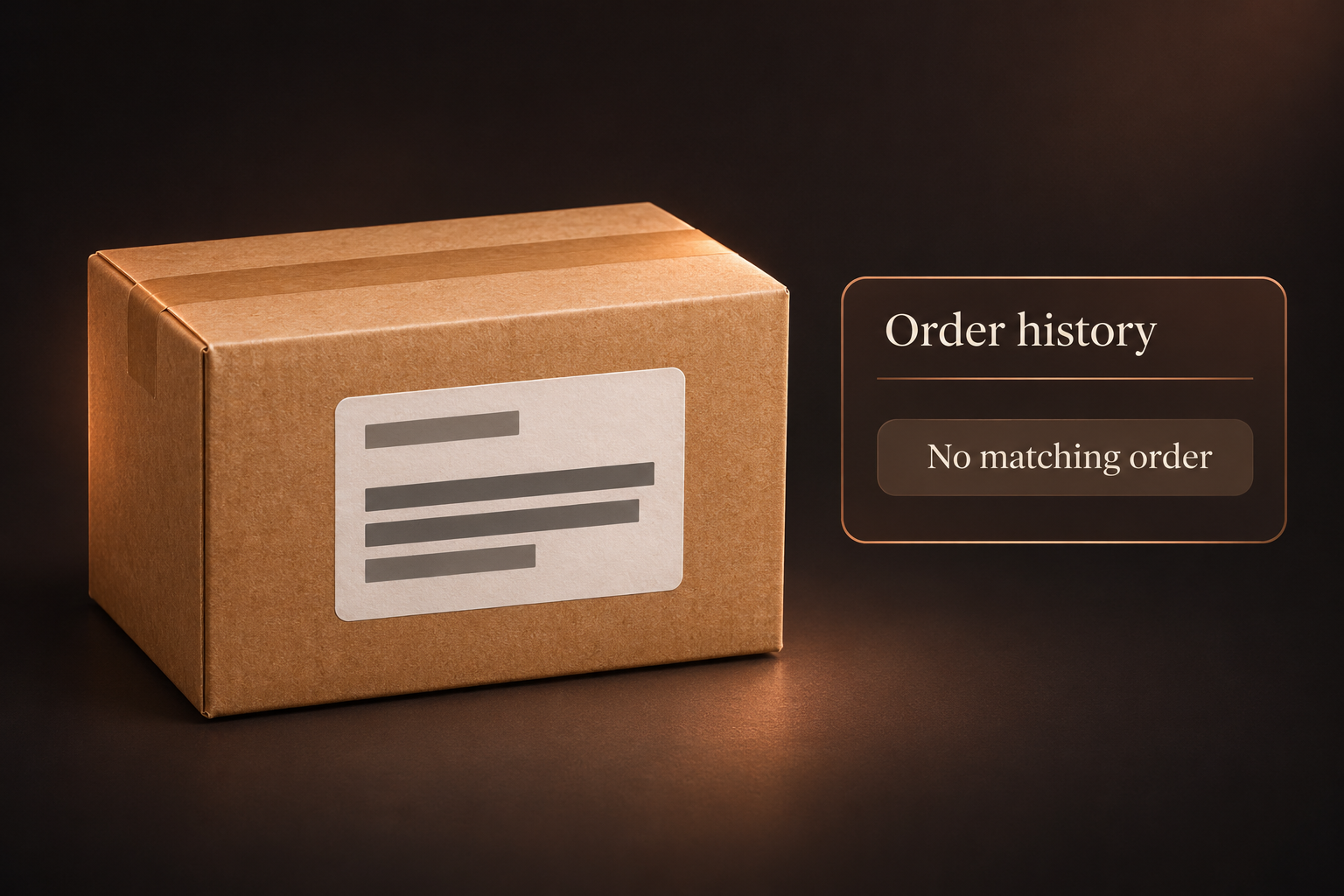
The parcel has your name on the label, but you can’t find a matching order. A note inside might make it look like a gift.
Before you follow the note or try to return the parcel, check what connects it to you. Your name on a label is only one piece of evidence.
Overview
Start with the name and shipping address
An unexpected parcel isn’t automatically a brushing scam. It might be a gift, part of a split shipment, a delivery error, or a purchase you forgot about.
If the label names someone else or shows another address, treat that as a possible delivery mistake. Contact the carrier through an official channel and leave the parcel unopened.
If it names you, match the tracking number and contents to order records you opened yourself. Don’t use a code or website printed on an unsolicited insert.
A real delivery can still be part of a fake purchase
The US Postal Inspection Service describes brushing as sending unordered items so someone can post reviews tied to apparent sales. The parcel can be real even when the shopper isn’t.
That doesn’t mean anyone signed into your account. A seller or intermediary may already have a deliverable name and address without knowing your password or collecting your card number.
The FTC identifies a separate danger: an insert can make you think you need to scan a code to identify the sender, opening a possible phishing page instead.
Match your response to what actually happened
The useful question isn’t whether the contents look cheap. It is whether you can find an actual order, an unauthorized charge, or evidence that someone used your account.
- Nothing in your accounts: Preserve the label and ask the retailer or carrier to verify the shipment through its own support route.
- An order or charge you don’t recognize: Open a case with the marketplace and contact the financial institution if your money or card details are involved.
- A code you used: What you entered or installed matters more than the act of seeing a web page. Don’t go back to find out what you missed.
How a Brushing Scam Works
Step 1: Your address is used for a shipment you didn’t request
A shopper normally creates an order before an item is sent. In a brushing scheme, the recipient didn’t request the product, even though a parcel reaches a real address.
Names and addresses circulate through public records, past purchases or data leaks. A label doesn’t tell you where the sender found them.
People can sell or send things from a different location than their company address. An unfamiliar warehouse on a label is a reason to check the facts, not a verdict.
Step 2: A genuine delivery makes the transaction look credible
The item is not necessarily counterfeit or harmful. Its purpose in this scheme is to support the appearance of a transaction you never asked for.
A delivered scan establishes that the carrier recorded a shipment. It doesn’t establish that you chose the seller, paid for anything, wrote a review, or endorsed the product.
You may not be able to find the listing from a label. Give the marketplace what it can use to identify the order without sharing the label publicly.
Step 3: A review or a later message takes advantage of the delivery
The FTC’s brushing alert explains why the sender may want the delivery to count as a sale. The resulting review isn’t evidence that you bought or liked the item.
A parcel may include a note asking you to identify the sender, confirm an address, pay for a return, or sign in to claim something.
That follow-up isn’t required for a brushing scheme, and a suspicious insert doesn’t reveal whoever mailed the parcel. You can decline the request without solving the sender’s identity.
How to Check an Unexpected Delivery Without Using the Insert
Match the shipment before you match the product
Look at the tracking number, recipient and destination on the outside. If you know an order is expected, compare those details with the tracking record inside the retailer’s app.
A box with a familiar logo can be reused. It may not identify the seller or the order, and a third-party fulfillment center can ship for several businesses.
If the label names a relative or housemate, ask them privately before opening it. There is no need to photograph another person’s address or send it to a group chat.
Retailers sometimes split an order into more than one box. Compare each shipment in the account rather than assuming only the first tracking number belongs to your purchase.
A forgotten return replacement can also arrive separately. Look for an earlier case in the retailer’s message center, especially after a warranty claim or a replacement request.
Confirm a plausible gift through a different channel
Ask the person you think sent it in a conversation you already trust. They can often confirm the item or timing without you revealing what’s printed on the label.
A genuine gift can still be difficult to trace when the purchaser ordered from another account. Lack of a match in your history isn’t proof that no valid order exists.
If a stranger says the parcel is theirs, don’t send card details, a code, or a shipping fee. Ask the carrier to handle the delivery error.
Give the retailer enough evidence to act
Photograph the label, order slip and contents if you can do so safely. Keep originals private and redact full addresses, tracking numbers and barcodes before sharing outside support.
For Amazon, use its unwanted-package reporting guidance if the parcel appears to have come through Amazon. If you see an unauthorized purchase, open the actual order instead.
Explain what failed to match: no order number, no corresponding charge, or a listing you never purchased. Ask the marketplace what its support team can actually verify.
Don’t assume a review with the same display name belongs to you. Report a review attached to your own account or to a transaction support has identified as misuse.
Keep the case number and preserve follow-up messages. If another parcel shows up, connect it to the existing case rather than repeating every detail.
Amazon asks for the number of unwanted packages and at least one tracking reference. Give that information privately so the investigator can connect the shipments.
A retailer may recognize a tracking number without being able to identify who placed the order. Ask whether the case requires any action on your account.
Use the Evidence to Separate Three Lookalike Situations
Your name is on the package, but your accounts are quiet
Suppose the parcel contains a small accessory and none of your retailers lists that shipment. A useful report says you couldn’t match it, without claiming an account was hacked.
If support can’t identify the sender, keep the case number and date. An unanswered case doesn’t mean you owe a return or that someone stole your identity.
Let people in your household know not to respond to notes about the parcel. One person can accidentally pay a charge while another is trying to clarify who ordered.
An order appears, but you don’t recognize it
Don’t cancel automatically before checking whether someone with legitimate access placed it. Compare the destination, payment method and purchase time without sharing a verification code with anyone who contacts you.
If the platform confirms an order you didn’t make, ask how to flag unauthorized activity and whether shipment can be stopped. Keep the transaction reference for the issuer.
One unfamiliar charge can belong to an ordinary transaction with another merchant name. Look for a matching amount and date, then ask the issuer if you still can’t place it.
The package is followed by an official-looking message
An outsider who mentions the right item or delivery date still hasn’t proven they’re from the carrier. Start a new conversation through a contact route you already know.
After finding a real delivery reference, don’t use it to justify an unrelated request. Verify the return, cancellation or fee against the actual order instead of the caller’s description.
The distinction is useful even after the item is gone. Screenshots of a payment demand and any account activity may matter more than the contents of a discarded box.
Decide Whether to Keep It, Return It, or Leave It Alone
Merchandise properly addressed to you but never ordered
The FTC’s US guidance on unordered merchandise says companies can’t send you goods you didn’t order and then require payment. You don’t have to return genuinely unordered merchandise.
That doesn’t give you permission to keep another person’s misdelivered package. A shipment sent for an actual purchase or replacement also calls for a different check.
If you’re outside the United States, consult local consumer guidance before relying on the same rule. A demand for payment sent by the unknown sender doesn’t settle your obligations.
A parcel intended for someone else
Don’t use the contact details on an unexpected payment or return note. Tell the carrier what’s on the outer label and follow the carrier’s verified instructions.
If a text says you owe postage to return the box, don’t pay through the message. Ask the carrier whether a legitimate return is pending.
If an unknown person turns up, you don’t have to invite them inside or discuss who lives there. Let the delivery company handle collection, and prioritize your safety.
Strange contents or a parcel that appears unsafe
Avoid handling unknown liquids, powders or other suspicious contents. If there appears to be an immediate hazard, step away and use the appropriate local emergency channel.
Don’t plant or distribute unsolicited seeds. The USDA’s guidance on unsolicited seed shipments explains where Americans can ask for instructions about preserving the package and reporting it.
Keep the label available without posting it online. For some reports, knowing the packaging and destination matters more than having a better photo of the contents.
What to Do After a Suspected Brushing Scam
- Check for the indicators that change your response. Compare the parcel with your order history, recent account activity and payment statements before treating it as account theft.
- Take the report to the right place. Use the retailer’s support channel for a marketplace parcel and the Postal Inspection Service for suspected fraud involving US Mail.
- If you found an unauthorized order, secure the account. Change its password through the real service, review recent sessions and purchases, and enable additional sign-in protection.
- If you see a charge, contact the issuer. Use your bank’s own app or the number on the card, then keep the statement and any dispute reference.
- If you entered information on a suspicious page, act on what you shared. Replace compromised credentials and contact the card issuer if the page collected payment data.
- If you discover evidence of identity theft, make a recovery plan. In the United States, use IdentityTheft.gov instead of accepting help from a stranger who contacts you first.
If a scan only opened a page, don’t enter anything else or grant permissions. If you gave a password, don’t wait to see whether the shipment turns up again.
Don’t wipe a device, replace a credit card, or reset every password solely because your mailing address is on a parcel. Escalate when a specific exposure gives you a reason.
For the insert itself, see our guide to QR codes in unexpected packages. It separates opening a page from signing in or handing over payment details.
Frequently Asked Questions
Does a parcel with my name mean someone hacked my account?
No, the label only shows that someone had a name and delivery address. Look for unexpected orders, changes to your account or payment entries before concluding there was a takeover.
Does a tracking number prove I placed the order?
It shows that a shipment was recorded, not that you authorized it. Match the number against order history you opened independently, then ask the retailer if you need help.
Can I keep a package another person was supposed to receive?
Don’t treat a delivery mistake as a gift. If the label identifies someone else or another address, contact the carrier and keep the package unopened.
Why would someone send a parcel without charging me?
A shipment can support a fake sale or review. It can also be a genuine gift or mistake, so the parcel’s existence doesn’t establish the sender’s motive.
Should I scan the code to figure out who sent the parcel?
Use official retailer or carrier routes instead. A printed code can lead to a lookalike page, and you’re not required to share account information to identify a gift.
Is a credit freeze the first step after an unexpected delivery?
Review your accounts and credit information for signs of misuse first. A freeze is an available US precaution, but a parcel alone doesn’t prove anyone opened credit in your name.
The Bottom Line
If the parcel doesn’t match an order, ignore the insert and ask the retailer or carrier directly. Hold on to the label while you check.
Act quickly on an actual unauthorized order, charge, or exposed password. If the package alone is the only thing you can verify, document it and don’t pay an unfamiliar sender.

Join the discussion
0 commentsShare your experience or ask a question about this article.
Community experiences
Did this happen to you?
Your experience could help someone recognize the same scam. Submit a private report for our team to review.
I experienced this tooReports are reviewed before publication. Sharing publicly is always your choice.
Discussion
Start the conversation
Have a question or something useful to share? Add the first comment.