


You deposit a cashier’s check for a private sale. The next morning your banking app says the money is available, and the buyer asks when someone can collect the furniture.
Before opening the garage, it helps to know exactly what changed in your account overnight and which question that new balance cannot answer.
Overview
What your bank means by available funds
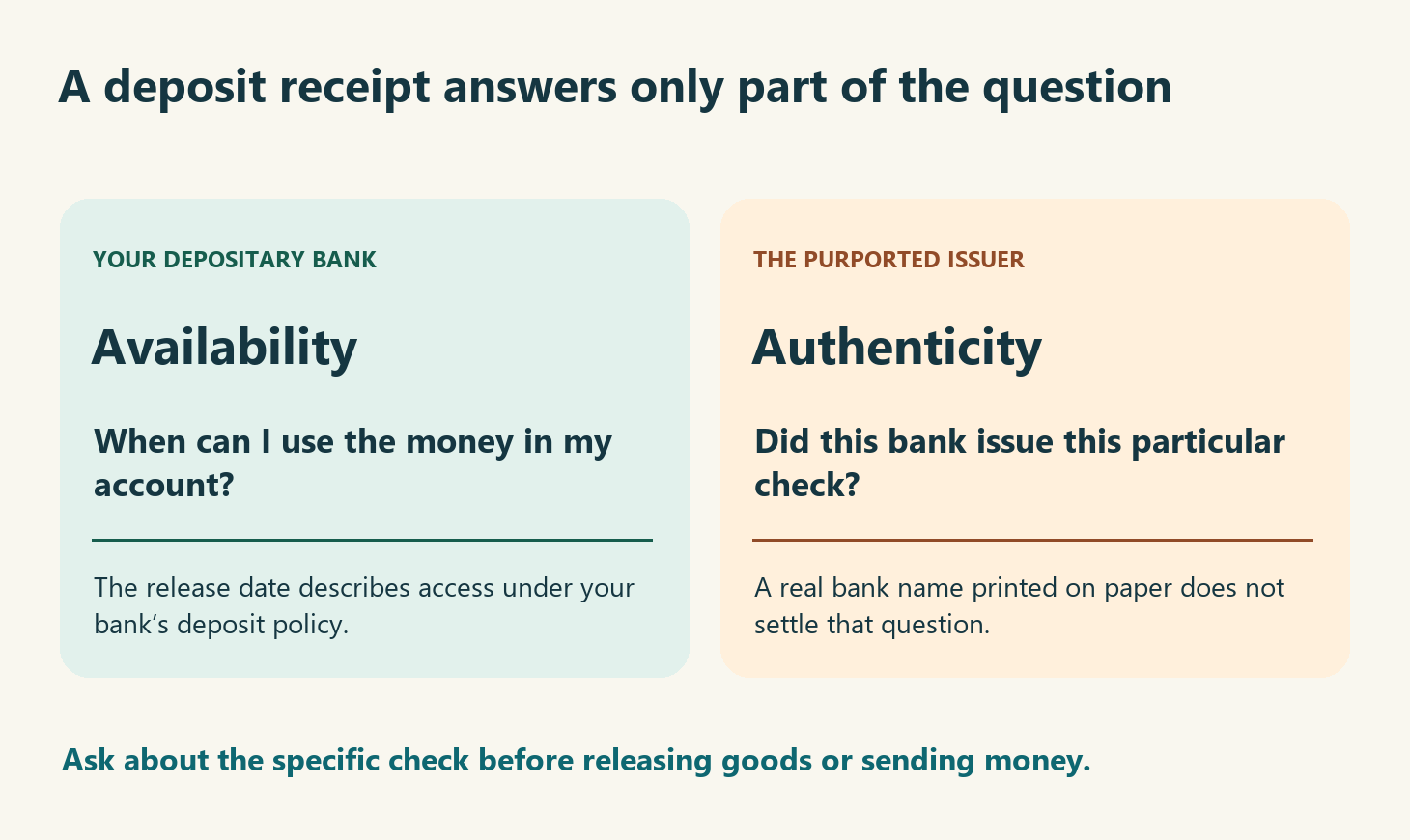
An available balance tells you what the bank currently allows you to withdraw or spend. It can include money from a deposited check that later turns out to be counterfeit.
A deposit receipt records that you handed over an item. A hold notice tells you when some money should become accessible. Neither document certifies the signature on the paper.
The OCC explains the difference between availability and verification: your bank may release money before it learns that the apparent cashier’s check is fraudulent.
What the issuing bank actually promises
A genuine cashier’s check is the bank’s own obligation, not merely the buyer’s personal promise. That is the reason people request one when selling something valuable.
The bank’s promise applies to genuine checks. A real name can appear on counterfeit paper, just as a real return address can appear on a letter its owner never sent.
A bank’s existence, the name on the paper, and the existence of that particular instrument are three different facts. Verifying the first does not establish the third.
Which decision cannot wait for more evidence
The immediate decision is whether to release property or send your own money elsewhere. You do not need to settle every technical question to decline an unsafe request.
- If a stranger sends more than the agreed price, do not forward the difference to a mover, assistant, or supposed payment service.
- If you already deposited a suspicious check, tell your bank what happened and leave the disputed money untouched while asking what it can verify.
- If you made a separate transfer, report that transaction to its provider immediately. A return of the incoming check will not automatically reverse your outgoing payment.
Follow the check instead of the screen label
The first bank involved may be the institution where you deposit the paper. It can accept the item and record the amount without being the institution that issued it.
Collection is the process of sending the item through banking channels for settlement or payment. It is not a name for the moment your balance switches from pending to available.
Regulation CC defines the instruments and bank roles. A cashier’s check is drawn on a bank and signed on the bank’s behalf as its direct obligation.
A certified check is a different instrument: the bank certifies a check drawn by a customer. A deposit slip referring to an official check need not tell you which kind.
If someone sends a photograph headed “cashier’s check,” the image is not evidence that you possess a genuine, properly issued instrument. Do not deposit it to test the claim.
Ask your own bank what it received and what its staff can actually see. If a representative confirms the deposit amount, that still may describe only your account record.
A useful follow-up is whether the representative is describing access under the bank’s deposit policy or reporting specific information from the institution named as issuer.
The answer could be that the bank cannot yet establish the item’s authenticity. That uncertainty is information you can act on without treating the employee’s caution as an accusation.
Why a next-day balance is possible
Federal availability rules prevent banks from keeping certain deposited money inaccessible indefinitely. They are schedules for customer access, not a promise that fraud will be discovered by the release date.
For qualifying cashier’s checks, the next-day availability rule generally applies when the deposit goes into an account held by the person named as payee.
The customer must deposit it in person with a bank employee and use any special deposit slip or envelope the institution requires for that treatment.
Suppose a customer deposits a genuine qualifying cashier’s check with a teller on Monday before cutoff. Assume an established qualifying account, no holiday, and no applicable exception.
Under those assumptions, Tuesday is generally the availability day. The rule explains the timing; it is not a test you can run on a suspicious check by waiting until Tuesday.
Change the deposit channel and the assumptions no longer match. ATM deposits, night deposits, and mobile images should not inherit the teller example because they display Monday’s date.
The Federal Reserve’s worked availability examples illustrate why the intake method and cutoff matter. Its teller-versus-ATM example involves a certified check, not a blanket guarantee about every deposit.
A branch might be open Saturday, yet Saturday does not count as a business day for this Regulation CC schedule. The calendar on the wall is not the whole rule.
A deposit accepted after the bank’s posted cutoff can be treated as received on the next banking day. Use the deposit receipt and the bank’s disclosure to identify that day.
Read the reason for a hold
A hold means the bank is delaying access to some or all deposited funds. It can result from ordinary availability rules or an exception, even if the check is genuine.
A new account, a large aggregate deposit, certain redeposited checks, or repeated overdrafts can affect timing. The applicable facts matter more than a rule of thumb from another account.
The current Regulation CC exceptions also address reasonable cause to doubt collection. That exception requires a factual basis; it is not the same as finding a counterfeit.
A large-deposit exception can concern the combined amount of checks deposited on one banking day. Looking at one small check in isolation can therefore miss the reason for the notice.
For covered exception holds, read the amount delayed, reason given, and expected availability. A notice covering part of a deposit does not necessarily withhold the entire check.
Imagine depositing several checks together and seeing a partial release. Ask which deposit or portion the notice describes before attributing that release to one buyer’s particular check.
If the explanation does not match the receipt, ask for the bank’s availability policy and clarification about your item. A bank should answer that question separately from authenticating a signature.
Work out what a reversal would do to your own money
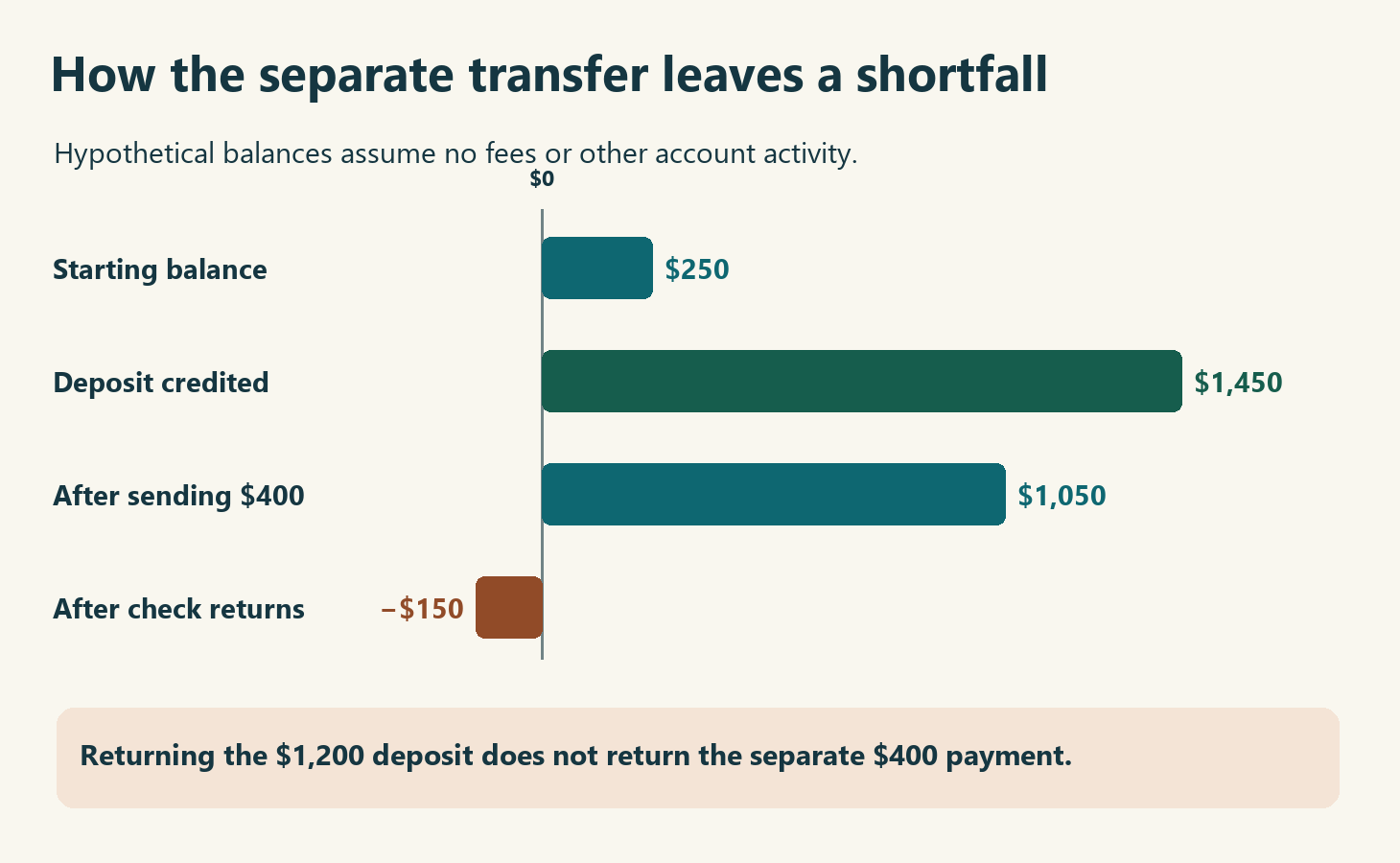
Suppose you have $250 of your own money and agree to sell a table for $800. The buyer instead sends a purported cashier’s check for $1,200.
The buyer wants you to send $400 to a mover. They say your balance will show that you have been paid for the table and reimbursed for the delivery.
For this hypothetical, assume the entire deposit becomes available, the transfer goes through, and no fees or other transactions occur. These are example amounts, not a bank’s actual records.
| Account event | Change | Illustrative balance |
|---|---|---|
| Before the deposit | Starting amount | $250 |
| Provisional deposit credit | +$1,200 | $1,450 |
| Payment sent to mover | −$400 | $1,050 |
| Full deposited check returned | −$1,200 | −$150 |
After the reversal, the account is $150 below zero. Relative to the $250 you began with, you are $400 worse off, exactly the amount sent to the mover.
The bank did not deduct the mover’s payment twice. One debit was the payment you sent; the other removed the earlier credit for the full unsuccessful deposit.
If you had kept the check money untouched, the same hypothetical reversal would bring the balance back to $250. That comparison assumes no goods, fees, or other funds changed hands.
If you released the table too, losing possession is a separate consequence. Its agreed price was not cash you already had in the account and should not be counted twice.
Do not test an overpayment: Decline the instruction to send part of the deposit elsewhere. A buyer who owes a mover can settle that obligation without using your account.
Verify the item through a channel the payer did not supply
Identify the supposed issuing bank, then obtain its contact details independently from its official website or a known branch. Do not call the number printed on suspicious paper.
Someone who supplies both the check and the verification number controls both pieces of evidence. A polished recorded greeting at that number would add no independent confirmation.
The FDIC’s consumer guidance on counterfeit checks explains that the issuing institution may need the check number, issue date, and amount to investigate.
Provide those details privately to the verified institution if appropriate. Do not post a check image in a selling group or send account information to a stranger offering verification.
Ask what the bank can confirm about the exact item. Confirmation that it sells cashier’s checks or has a branch in the city is not confirmation that it issued yours.
If the institution cannot verify it over the phone, that does not prove counterfeiting. It does mean you still lack the confirmation needed to release property on that basis.
Contacting the alleged issuer and notifying your own bank are not interchangeable. Your bank controls the deposit in your account; the named issuer can examine what it actually issued.
Choose the situation that matches what happened
I have the check but have not deposited it
Decline any overpayment or onward transfer request. Independently contact the purported issuing bank if the item is in doubt, and do not deposit it just to see what happens.
My available balance includes the suspicious deposit
Leave those funds alone and call your own bank through a known channel. Ask its fraud staff to review the specific deposit, not merely read back the balance.
I sent the buyer or mover some money
Contact the outgoing payment provider immediately and request available recall or reversal options. Give your bank the separate references for the deposit and the payment you sent.
A debit has already reversed my deposit
Ask for the return information, compare the amount with your receipt, and discuss any negative balance or fees with the bank. Preserve records of separately released goods or payments.
Ask the bank questions that have useful answers
Start with the check amount, deposit date, and where you presented it. A teller receipt, ATM receipt, and mobile confirmation may correspond to different intake procedures.
Ask whether the date printed on your notice relates to release of a hold or some separately confirmed payment event. Avoid the single word “cleared” unless both sides define it.
If the bank says it received a return, ask which item was returned and what explanation it can provide. Several checks deposited together may appear as one initial credit.
For example, a total deposit of $1,300 might include an unrelated $100 personal check. Knowing that one item was returned is not enough to identify which payer is involved.
If the uncertain check is supporting scheduled bills, tell the bank about commitments that might be affected by a reversal. Ask the billers about alternatives before the due dates arrive.
If you already released property, retain the sale agreement, pickup communications, and any shipping receipt. Those documents describe a loss the bank’s account statement cannot show.
When reporting an outgoing payment, identify the method accurately. A wire receipt, gift card purchase and payment-app transfer lead to different providers; none can guarantee that recovery is possible.
The FTC’s fake check guidance describes recovery contacts by payment type. Act promptly instead of waiting for the check dispute to finish first.
What to Do Before Treating the Deposit as Payment
- Compare the check with the agreed sale price and payee. Refuse any arrangement that requires passing part of an unexpected overpayment to someone else.
- Contact the purported issuing institution independently and ask about the specific item when authenticity matters. Keep an unresolved check out of a time-pressured exchange.
- If already deposited, notify the bank holding your account and ask what information is confirmed about the check, apart from the availability of funds.
- Save the deposit receipt, any hold or return notice, and the separate outgoing payment reference. Keep account and check images out of public messages.
- If money has left or goods have shipped, contact the relevant provider promptly. Record what can still be stopped or recalled without assuming a successful reversal.
Frequently Asked Questions
Why did a teller accept the check if it might be fake?
Accepting a deposit starts processing; it does not establish that every visible detail was authenticated. Report the concern to your bank even if a teller accepted the paper.
Can I wait a week and then safely send the difference?
There is no universal waiting period that makes an overpayment arrangement safe. The OCC warns that a counterfeit can take weeks to discover; decline the separate transfer.
Does a hold mean the buyer committed fraud?
An availability hold can reflect deposit circumstances or account history. Ask what reason applies to your deposit rather than accusing the payer solely because funds are delayed.
Is a check for the correct amount always genuine?
Matching the price removes one warning sign but does not authenticate the instrument. A counterfeit for the exact amount could still leave a seller without the goods or payment.
Should I rely on a photograph of the buyer’s bank receipt?
A photograph supplied by the payer is not independent verification. Reach the named institution yourself and ask about the particular instrument before treating the sale as settled.
Who should I call after depositing a suspected counterfeit?
The OCC advises contacting your own bank immediately. If you also sent money elsewhere, contact that provider about the separate transaction without waiting for the bank’s investigation.
The Bottom Line
Available funds are permission to use money now, not proof that a cashier’s check is genuine. Never forward a buyer’s supposed excess or release goods solely because the balance rose.
If you have already acted, preserve the deposit and outgoing payment records separately, notify your bank promptly, and contact the payment provider about any transfer you sent.

Join the discussion
0 commentsShare your experience or ask a question about this article.
Community experiences
Did this happen to you?
Your experience could help someone recognize the same scam. Submit a private report for our team to review.
I experienced this tooReports are reviewed before publication. Sharing publicly is always your choice.
Discussion
Start the conversation
Have a question or something useful to share? Add the first comment.