


A collection notice arrives in your child’s name. You recognize the last name and street address, but nobody in your household remembers opening that account.
Before sending anyone a birth certificate, find out which question you need answered: whether a credit file exists, what it contains, or who can see it.
Overview
A letter is a reason to check, not a diagnosis
Most children in the United States do not have credit reports. Finding one is worth investigating, but it does not settle whether anyone stole the child’s identity.
A teenager may appear on a parent’s credit card as an authorized user. A lender may also report someone else’s information under a child with a similar name.
A third possibility is that someone actually borrowed using the child’s information. The next step depends on the entries behind the file, not just its existence.
A search, a freeze, and a correction do different jobs
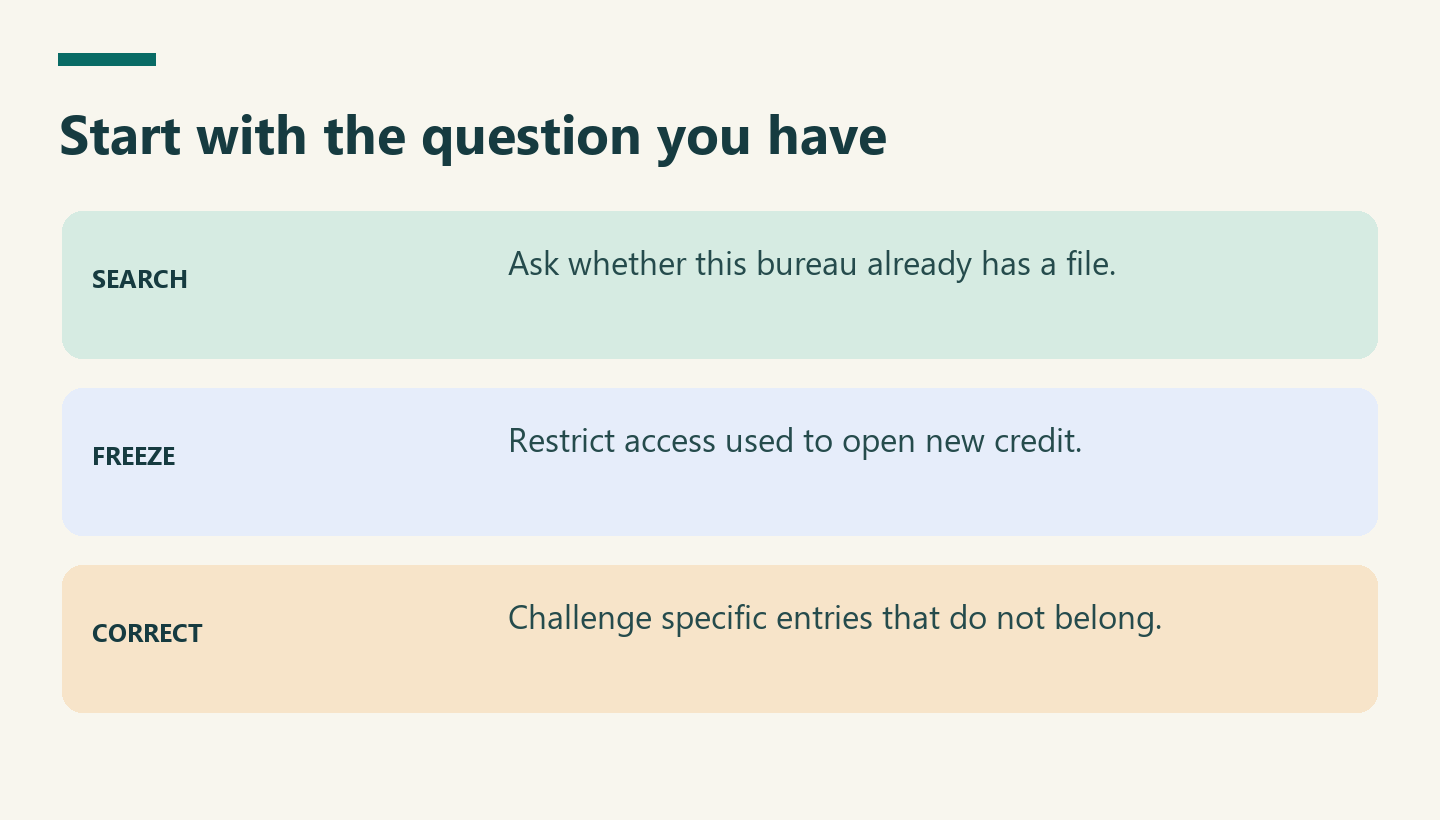
A manual search asks a credit bureau to look for a file associated with the child. It is not a request to calculate the child’s credit score.
A security freeze limits access to a credit report, making it harder for someone to open credit using the child’s identity. It does not erase what was already reported.
- Ask for a file search when you need to know whether this bureau has a record.
- Request a protected consumer freeze when you want to restrict future access for a qualifying child.
- Dispute the specific entry when information belongs to somebody else, and contact the creditor if an account was opened fraudulently.
Choose a route that matches the child’s age
For someone under 16, a parent or authorized representative can request a free protected consumer freeze. You do not need to wait until a fraudulent account appears.
At ages 16 and 17, teenagers may request and remove their own security freezes. That does not mean every bureau lets a minor create an adult online account.
A birthday can change who may make the request without undoing a freeze already in place. Keep the confirmations somewhere the teen can find when access is legitimately needed.
Start with what the family already knows
Keep the envelope or electronic notice privately and note the claimed creditor, date, and type of account. Treat contact details supplied inside an unexpected demand as unverified.
Look up the company independently before discussing a child’s information. A genuine company can verify its process without requiring you to send identity documents to an unconfirmed email address.
Ask the adults authorized to handle the child’s affairs about legitimate arrangements. An authorized-user card held by the parent may explain an account the child has never physically used.
For example, a parent may have added a teenager to an existing card but kept the extra plastic in a drawer. The issuer name may differ from the shop name.
That explains one possible entry, not the entirety of a report. A familiar card and a completely unfamiliar utility collection can appear in the same set of records.
A preapproved offer is weaker evidence than an actual account statement. TransUnion notes that promotional mailing lists may contain children’s names even without a credit application.
Other warning signs deserve attention even when no credit bureau finds a file. An agency might deny benefits because somebody is already using the child’s identifying information.
Contact that agency through its official channel about the specific claim. Credit bureaus do not administer benefits or resolve a tax notice merely by freezing a credit report.
Ask all three bureaus to search
The FTC’s child identity theft guide recommends asking each nationwide credit bureau for a manual search using the child’s Social Security number.
A search at TransUnion does not search Equifax or Experian. One bureau can hold information another does not, especially when an entry is inaccurate or incomplete.
Write down which request you made at each bureau. “Requested a search” and “received confirmation of a freeze” should never occupy the same checkbox in your records.
A parent or guardian can ask for a minor’s report. The CFPB’s guidance for checking a child’s credit report also addresses caseworkers responsible for children in foster care.
If you are a caregiver rather than the legal parent, don’t claim parentage to finish a form. Ask the bureau which document establishes your authority.
That distinction protects families whose children have more than one caregiver. A school emergency contact or permission to collect a child after practice is not necessarily financial representation.
Prepare evidence for the request you actually selected
A bureau generally needs to establish three things: who you are, who the child is, and why you have authority to make this particular request.
A parent’s driver’s license may establish the adult’s identity without proving parentage. A child’s birth certificate can answer a relationship question without proving the adult’s current address.
Read the request-specific list before copying records. When a bureau accepts one of several adult identification documents, sending all of them creates more exposure without answering another question.
If your name differs from one on a court document, ask the bureau what additional proof it accepts. An unexplained mismatch is not fixed by sending unrelated financial statements.
Use legible copies when the instructions request copies. Do not mail the only original birth certificate or Social Security card to an address copied from a social post.
If an address document contains irrelevant transactions, ask about an acceptable alternative such as a utility bill. Do not obscure information the bureau explicitly needs to verify.
Privacy boundary: Send required evidence only through the bureau’s stated process. You never need to send a child’s documents to this article, a public forum, or another parent.
Store the minimum useful case record: submission date, bureau, request type, documents supplied, response, and any follow-up deadline. The log itself need not contain full identity numbers.
Follow the bureau’s own minor procedure
Experian distinguishes younger children from older requesters
Experian’s minor request page distinguishes a report search, fraud alert, and security freeze. Read the request description before assuming the same form selection performs all three.
For a parent seeking information about a child aged 13 or younger, Experian directs the parent to write. It says those children’s credit reports cannot be accessed online.
Its instructions list the adult’s government identification and address evidence, the child’s birth certificate and Social Security card, and guardianship proof when the requester is not named on the certificate.
Experian also describes its own process for minors aged 14 or older to request a report, alert, or freeze. That bureau-specific allowance does not change the other bureaus’ instructions.
The page describes mailing paperwork and an official electronic document route for applicable requests. An upload link in an unsolicited message is not a substitute for navigating there yourself.
Equifax requires a mailed protected-minor request
The Equifax child freeze instructions call for its form and legible copies sent by mail. Check its current dedicated mailbox directly before filling out the envelope.
For the adult’s identity, Equifax lists alternatives such as government identification, a Social Security card, or a birth certificate. For the child, it asks for two specific documents:
- Provide a copy of the child’s Social Security card for the child identity requirement.
- Include a copy of the child’s birth certificate as the other required child identity document.
Proof of authority is a distinct requirement. Equifax lists options including the child’s birth certificate, a court order, a valid power of attorney, or foster care certification.
Equifax may confirm the freeze by letter or request more information. A postal delivery receipt shows delivery to a mailbox, not that the bureau has accepted every document.
TransUnion separates its online search from its written freeze
TransUnion’s child identity theft page links to a secure inquiry for checking whether a file exists. It says it will respond at the email address the requester provides.
The CFPB notes that getting a copy of a located report may require a separate request by mail. An initial email about a file is not necessarily the report.
For a protected consumer freeze, TransUnion instructs the representative to send a written request, proof of authority, and identification for both people to its dedicated mailing address.
Its examples of authority include a government-issued parentage document, an appropriate court order, or current guardianship paperwork. It accepts copies and tells consumers not to send originals.
Keep the inquiry website and protected-freeze mailing address distinct in your notes. Opening the online inquiry does not automatically place a freeze or file an account dispute.
Read a bureau response without jumping to conclusions
A reply saying no file was located describes that bureau’s search using the information supplied. Save it, finish the other searches, and compare their actual responses.
A preventive freeze can still make sense without existing credit history. Equifax explains that it creates a record for the child when needed so it can place the freeze.
That newly created record serves the restriction. It does not mean someone took out a loan, and it is not a reason to accuse a family member.
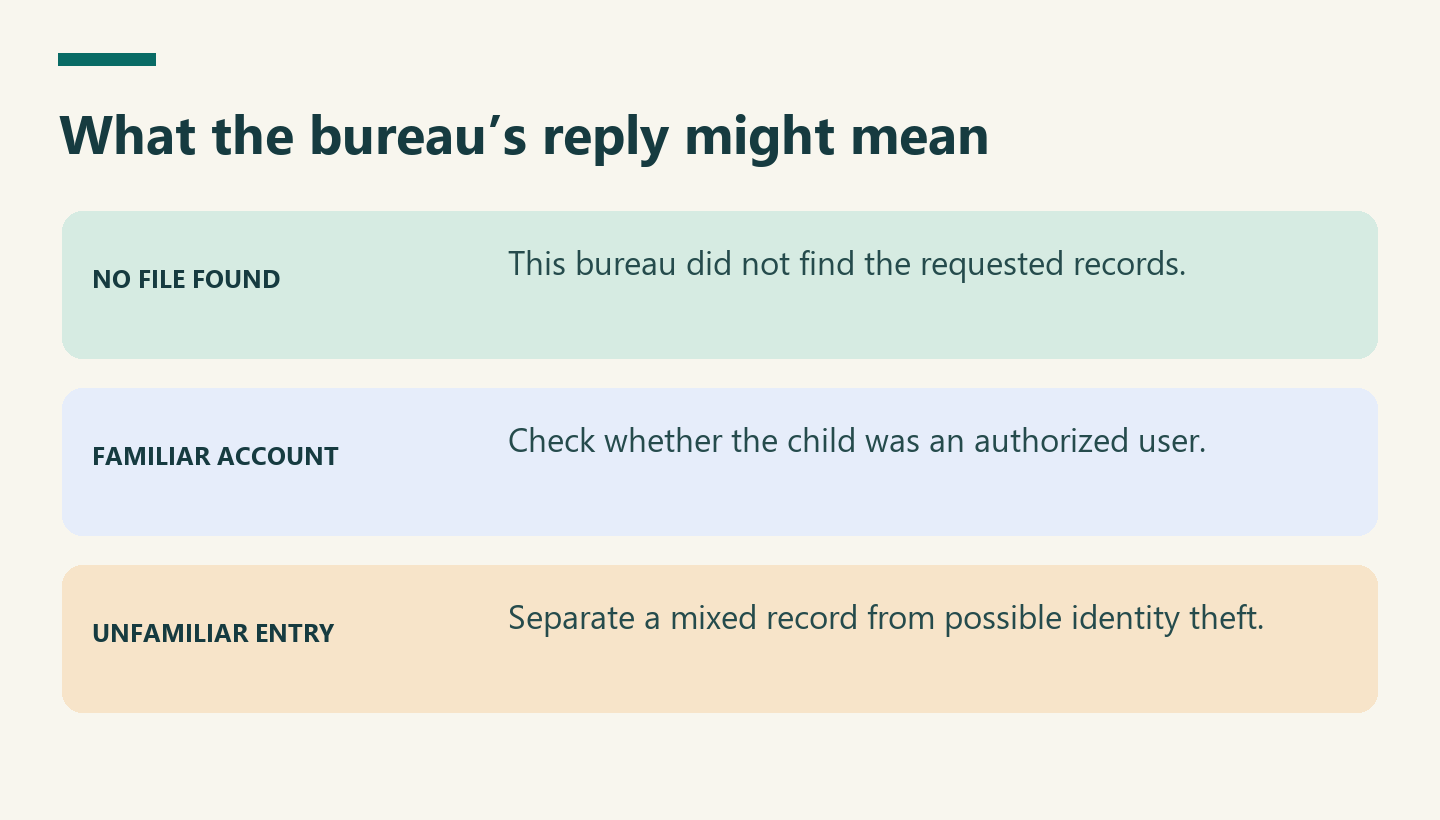
If a report exists, match each entry against known household arrangements. Compare issuer, account role, and relevant dates before deciding which entries you recognize and which require explanation.
A parent and child sharing a name may be mixed in a database. Explain which identifiers or account details point to the other person when disputing the incorrect entry.
If the account looks genuinely unauthorized, contact the creditor’s fraud department separately from the credit bureau. A request to restrict future access leaves the existing account unresolved.
Choose the next action from the reply you received
This bureau did not find a file
Keep the dated response and check the other two bureaus independently. A no-file answer does not prevent you from requesting an appropriate protective freeze.
The entry appears to be an authorized-user account
Ask the adult account holder to confirm the issuer, role, and dates. Do not classify a recognized family arrangement as theft simply because the child has a record.
The creditor appears to have the wrong household member
Dispute the inaccurate information with the bureau and the company that reported it. Identify the specific entry and explain the mismatch through their verified channels.
A creditor confirms an account nobody authorized
Contact its fraud department about closing that account and obtain written confirmation regarding the child’s responsibility. Notify the bureaus and report the theft through the FTC.
When a teenager needs to manage an existing freeze
Consider a 17-year-old whose parent arranged a freeze several years earlier. A legitimate application is approaching, but nobody remembers which bureaus acknowledged the original requests.
Find the three confirmations and identify the bureau the prospective lender expects to consult if it can tell you. Decide whether temporary access will meet that actual need.
At Equifax, a 16- or 17-year-old may request a personal freeze by phone or mail. Equifax requires users to be 18 to create its online account.
The TransUnion freeze FAQ instructs teenagers aged 16 or 17 to mail their own freeze request. It separately explains removing an existing protected freeze with appropriate identity proof.
Check the mailing destination for the requested action rather than assuming an ordinary teen freeze, a protected freeze, and a dispute all go to the same office.
A parent’s login is not an identity shortcut for the teenager. Help them assemble the correct documents, understand the confirmations, and keep their own private record going forward.
What to Do If a Fraudulent Account Is Confirmed
- Contact the company’s fraud department using independently verified details. Explain that the account was opened using the child’s information and ask for closure.
- Request written confirmation that the child is not responsible for that account. Save it with the correspondence identifying the exact entry.
- Contact each nationwide bureau about the fraudulent information, identifying the affected account rather than requesting removal of every legitimate family account.
- Use the FTC’s IdentityTheft.gov recovery service for reporting and next steps. Handle tax, benefits, or utility misuse with the agency or provider actually involved.
- Request the appropriate free freeze at all three bureaus. Continue checking for responses to the separate account closure and correction requests.
Frequently Asked Questions
Can a child have a credit report without identity theft?
A legitimate authorized-user or joint account may explain a record. A filing error can also mix two people’s information, so inspect the entries before concluding that someone committed fraud.
Does a parent’s credit freeze protect their child?
Your own freeze restricts access to your own credit file. For a qualifying child, follow each bureau’s separate protected consumer procedure and retain confirmations naming the correct person.
Can I freeze a record that does not exist yet?
A child need not already have a loan or credit account. Equifax explains that it can create the record necessary to apply the protective restriction.
Must all three requests include identical supporting documents?
The bureaus publish different procedures and evidence lists. Assemble each packet from its current instructions, particularly when the requester is a guardian or the child is already 16.
Does a freeze stop purchases on a stolen card?
A credit freeze restricts certain access to a credit report. Contact the card issuer directly about transactions on an existing account; the freeze does not block those purchases.
Should I pay for monitoring to request the freeze?
The child credit freeze itself is free. A bureau may also advertise monitoring, but purchasing a subscription is not a required step for the protected freeze.
The Bottom Line
Ask all three bureaus to search when a child’s identity may have been used, then choose the freeze process appropriate to the child’s age and your authority.
When an entry is wrong, address that entry with the creditor and bureau. Reserve sensitive documents for their verified channels, and keep the confirmations for your child’s future use.

Join the discussion
0 commentsShare your experience or ask a question about this article.
Community experiences
Did this happen to you?
Your experience could help someone recognize the same scam. Submit a private report for our team to review.
I experienced this tooReports are reviewed before publication. Sharing publicly is always your choice.
Discussion
Start the conversation
Have a question or something useful to share? Add the first comment.