


The gym offers to switch you to monthly invoices. Your banking app still shows the usual withdrawal coming up on Friday. Which conversation needs to happen before then?
Stopping an ACH debit gets easier once you know who starts the transfer and what your agreement says about the next bill.
Overview
Find out who sends the payment instruction
When you enrolled, did you give the gym permission to withdraw money, or did you tell your bank to send the gym a payment each month?
Both arrangements can pay the same bill on the same date. The difference is where you left the instruction that makes the next payment happen.
This guide covers a company collecting recurring ACH payments from a personal bank account in the United States. ACH stands for Automated Clearing House, an electronic payment network.
If you set up the payment through your bank’s bill-pay service, look there for the scheduled instruction. Withdrawing permission from a company cannot remove an instruction it never held.
A business checking account, a charge to a credit card, and a wire you sent yourself raise different questions. Ask your bank to identify an ambiguous entry.
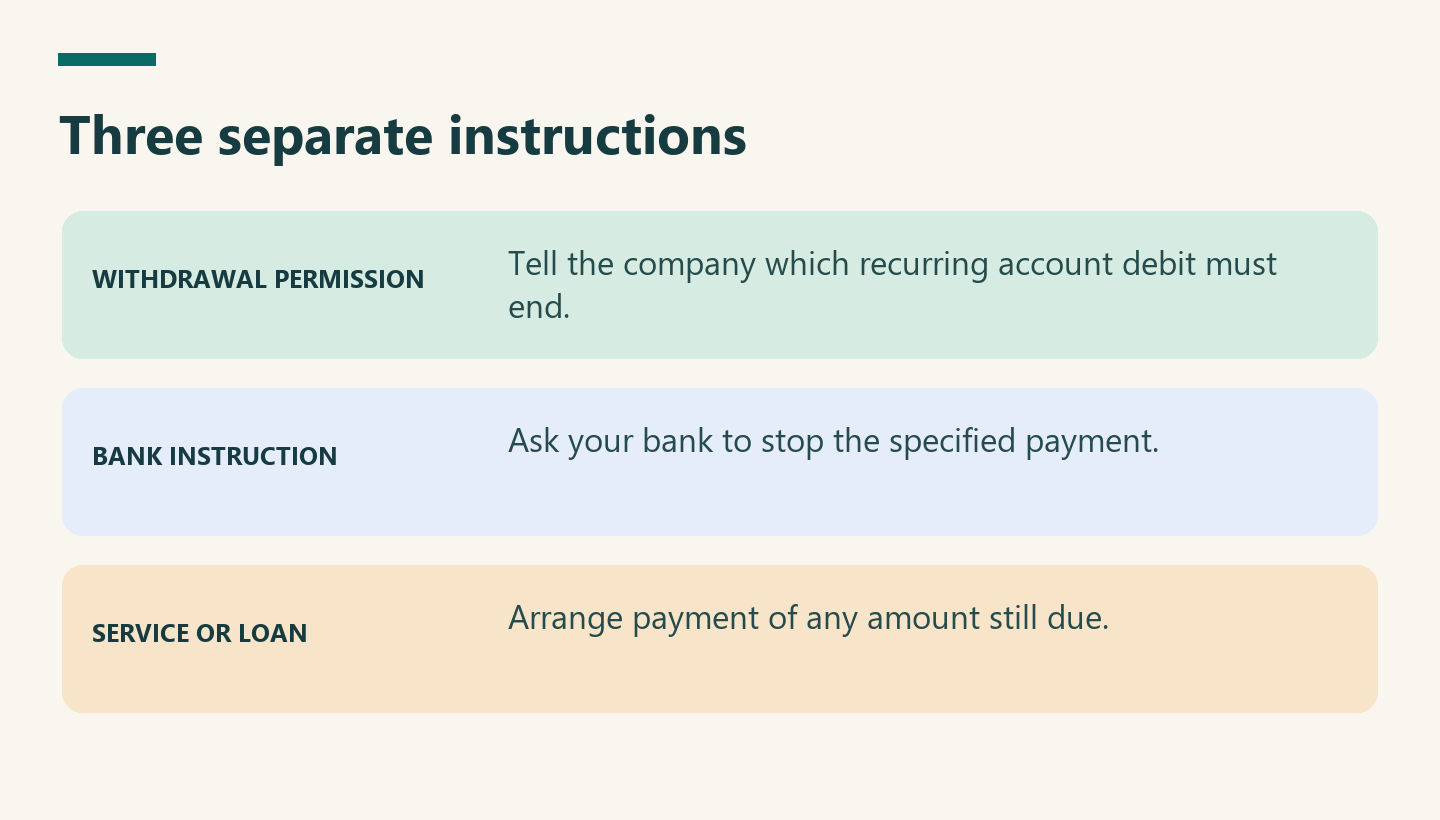
Choose what you actually want to end
The word “cancel” can describe three different requests. A customer service representative who receives only that word may reasonably hear something other than what you mean.
- Withdraw permission when you want the company to stop collecting recurring payments from your bank account.
- Request a stop-payment order when you want your bank to stop a particular scheduled withdrawal.
- Follow the contract’s cancellation instructions when you want the underlying membership, service, or other agreement to end.
You can need all three, but they go to different places. Your bank cannot choose the last day of a gym membership on the gym’s behalf.
Check the status before choosing the remedy
A scheduled withdrawal, a pending entry and a completed debit deserve different conversations. Look at the actual transaction history rather than relying on an upcoming-bill reminder.
For a scheduled debit, tell the bank when payment is due. For an entry already posted, identify the payment and explain why you believe it was taken in error.
A pending status calls for a question, not a guess. Ask the institution whether it can still act on that item and when you should check again.
Look at the authorization you originally gave
The service agreement tells you what you bought. The debit authorization tells you how the company may collect payment. Both might have arrived in one enrollment email.
Under Regulation E’s preauthorized-transfer rule, qualifying debits require a writing signed or similarly authenticated by the consumer. An electronic agreement can meet that requirement.
The party obtaining permission must give you a copy. If you cannot find yours, ask the company for the authorization, including the amount or method for determining it.
Look for the frequency, account description, and company collecting payment. If the statement uses a billing name you do not recognize, compare it with the enrollment confirmation.
A familiar amount alone cannot identify the source. Two subscriptions might cost the same, and a utility payment might vary considerably from the amount you saw last month.
A variable amount does not by itself make a recurring debit unauthorized. A bill for electricity can change with use while payment still occurs under one continuing agreement.
Different amounts generally require advance written notice of the amount and date at least ten days beforehand. Consumers can choose qualifying arrangements that limit when variation notices are necessary.
For example, someone might elect notices only when the amount exceeds an agreed range. Check your election before treating a different bill as evidence of a broken agreement.
If you have to initiate each payment individually, earlier payments do not establish that you authorized an ongoing series. Tell the bank which arrangement you actually made.
Tell the billing department exactly what should change
Use the company’s usual contact details from a bill, contract, or independently opened account. State which agreement you mean and whether you want the service itself to continue.
For someone keeping the service, original wording could be: “I withdraw permission for future automatic withdrawals from my checking account. Please send invoices so I can pay separately.”
Someone leaving a membership needs a second instruction. Ask the company to end the membership under its terms, confirm the effective date, and identify any legitimate final bill.
If a payment is very close, contact the bank promptly as well. The company’s customer-service queue is a poor place to spend the remaining bank-notice window.
After a call, send written confirmation through the company’s accepted channel. Save what you sent and the acknowledgment separately, because one proves your request and the other its receipt.
A reply saying your payment method was removed is useful evidence about the collection arrangement. It says nothing definite about the last day of service unless it addresses that too.
If the company offers a pause instead, look at the restart date. Agreeing to pause until September is different from withdrawing permission for all future withdrawals.
Give the bank enough detail to act
Contact the institution holding the account through its normal app, statement number, or branch. Explain that you have withdrawn the named company’s authority to initiate the recurring debit.
Provide the billing description and any relevant scheduled date. If one merchant collects for two accounts, identify which agreement you mean instead of asking the bank to stop everything.
The official interpretation says that, after notice authorization is no longer valid, the bank must block future payments for the specified debit from that originator, subject to confirmation requirements.
It cannot simply wait for the company to switch off collections. It may ask for confirmation that you notified the company, such as a copy of your written revocation.
A separate stop-payment order can target an upcoming payment even if you have not already withdrawn the authorization. Explain whether you mean one item or the continuing series.
If the same stopped item is presented again, the bank must continue honoring a qualifying stop order. That does not mean every unrelated purchase from the company is prohibited.
Ask whether there is a fee for a stop order and how the bank identifies the affected withdrawal. Do not assume another institution’s fee or order duration applies here.
The CFPB’s instructions for stopping automatic payments include separate sample letters for the company, the bank, a stop order, and an unauthorized transfer.
Work backward from the scheduled bank debit
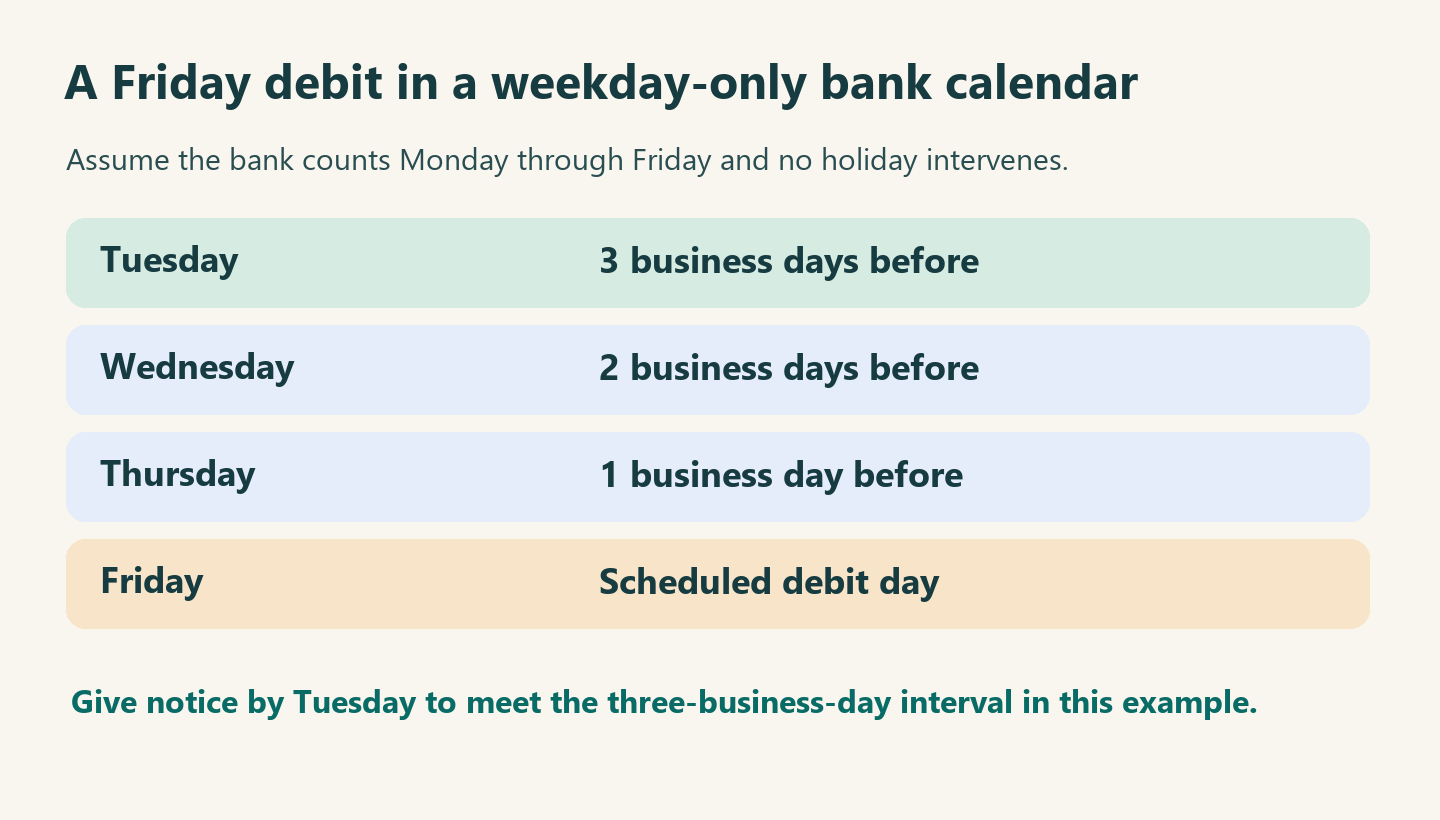
For a qualifying scheduled preauthorized transfer, notify the bank orally or in writing at least three business days before the scheduled date to exercise the federal stop-payment right.
Suppose your bank performs substantially all its business functions Monday through Friday. There are no holidays in this example, and the debit is scheduled for Friday.
Thursday is one business day before Friday, Wednesday is two, and Tuesday is three. Giving notice on Tuesday meets that interval; earlier notice gives you more breathing room.
Change just one fact and the answer changes. If Monday is the scheduled debit under the same assumptions, the previous Wednesday is three business days beforehand.
A banking app that works on Sunday is not a bank doing substantially all its business that day. Limited Saturday teller hours also need not make Saturday count.
Regulation E’s business-day definition looks at the institution’s functions, not your working week. Ask the bank how the dates apply to your scheduled payment.
If the debit is tomorrow, call now with the actual date. The bank may be able to help, but do not depend on a last-minute request stopping that item.
A bank may require you to confirm an oral stop order in writing within 14 days. At the time of the oral request, it must explain that requirement.
It must also give you the address for confirmation. If the required writing is not provided, the oral order stops being binding after those 14 days.
Two different clocks: The three-business-day rule looks backward from the scheduled debit. The 14-day confirmation period starts with your oral stop order, when written confirmation is required.
Write both dates beside the bank’s instructions. A letter to the gym cannot substitute for the written confirmation requested at the bank’s specified address.
Work through a bill that still needs paying
Imagine a household changing banks halfway through a monthly fitness membership. The family wants to use the gym through summer, but no longer wants collections from the old account.
Their account dashboard says automatic payments are disabled. That is the time to check the next invoice and how much remains due, not to assume the balance disappeared.
Suppose the upcoming bill is $48 and the company confirms the old debit has already posted. A manual $48 payment for that same bill could pay it twice.
Instead, compare the merchant’s invoice period with the posted transaction and ask how the credit was applied. Similar dates are not always the same billing period.
If no debit posted and the amount remains due, arrange another accepted way to pay on time. Keep the receipt for the replacement payment with the invoice it covers.
Now consider a borrower switching from automatic withdrawals to manual loan payments. Ask about the next due date and whether a disclosed autopay discount changes with the payment method.
The CFPB’s loan-debit guidance makes the distinction explicit: ending collection through the account does not cancel the loan. A payment arrangement may still need renegotiating.
A consumer disputing the debt has a different message again. Explain which amount is disputed instead of treating an instruction to stop withdrawals as a decision on that dispute.
Choose the situation that matches your account
Open the description closest to what your statement shows. Each answer explains which department or company to contact and what evidence would help that conversation.
I want the service but not automatic collection
Request invoices or another accepted payment method from the company. Ask for the first manually payable due date so the transition does not create a missed payment.
I canceled the service but another withdrawal is scheduled
Find the cancellation effective date and compare it with the service period covered by the bill. Tell the bank about withdrawn permission and the actual scheduled debit date.
The company collected after I notified both parties
Report the specific posted entry to the bank as a possible error. Supply the earlier notices, the company’s acknowledgment if available, and the amount taken.
Nobody on our account recognizes this withdrawal
Ask other authorized account users if appropriate, then promptly report a payment nobody authorized. Do not describe a fictional past agreement just to fit a cancellation form.
When the withdrawal already appears on a statement
Tell the bank you believe there is an error, not simply that you would like a balance update. Identify the merchant description, transaction date and amount as precisely as possible.
Explain why the transaction was wrong: perhaps you never authorized the company, it collected the wrong amount, or it collected after being told its permission had ended.
Under Regulation E’s error-resolution procedure, the bank generally must receive notice within 60 days after it sends the first periodic statement showing the error.
The clock ordinarily follows that first statement, not whichever later statement finally caught your eye. A reminder to check next week should not delay reporting an entry you recognize today.
The bank may request written confirmation of an oral error report within ten business days. That is a separate request from written confirmation of a stop-payment order.
Ask where it should go and keep a copy. The institution should begin investigating promptly rather than wait to receive the writing before starting its work.
If the bank calls a credit provisional, it has not yet made a final determination. Keep the case reference and ask how and when the result will reach you.
If it determines no error occurred, request its written explanation and the documents it relied on. Compare the authorization or transaction it identifies with your own dated records.
What to Do Before the Next Withdrawal
- Identify the account, billing company, and payment arrangement using a real invoice or account history rather than an unexpected message.
- Tell the company which debit permission you withdraw and separately state whether the service should end or continue.
- Notify your bank promptly, identifying the originator, the intended scope, and the next scheduled date if you know it.
- Record any confirmation requirement, address, reference number, deadline, or applicable stop-order fee while you have the representative available.
- Match the next statement to the merchant’s bill and any replacement payment. Report a later incorrect withdrawal with its own date and amount.
Frequently Asked Questions
Can the ACH network trace my withdrawal?
Nacha explains its role as the network rules association. It cannot look up an individual debit; your financial institution and the initiating organization are the useful contacts.
Is turning off reminders enough to stop collection?
A reminder only tells you a bill is coming. Look for the actual payment authorization or bank instruction, then confirm a change with the party responsible for that instruction.
Do I have to close my checking account?
Closing an account is not the ordinary first step for a named recurring debit. Ask about withdrawing authorization and stopping the specific payment while preserving your other account activity.
Can I still pay the company manually?
Ask which manual payment methods the company accepts and whether any discount changes. Confirm the old debit did not already pay the same invoice before sending its replacement.
What if the amount changes every month?
Review the authority you gave and any agreed notice range. A variable bill may still be preauthorized, while an amount outside the agreement deserves a specific explanation.
Does the bank decide whether I owe the gym?
The bank handles the account instruction and investigates qualifying payment errors. The service agreement, cancellation date, and invoices govern your separate discussion with the gym about its bill.
The Bottom Line
To stop ACH debits, tell the company its withdrawal permission has ended and notify the bank holding the account. Address the service contract or remaining balance separately.
If money has already left, report the exact entry promptly and preserve the notices behind your claim. Arrange payment of legitimate outstanding bills without paying the same invoice twice.

Join the discussion
0 commentsShare your experience or ask a question about this article.
Community experiences
Did this happen to you?
Your experience could help someone recognize the same scam. Submit a private report for our team to review.
I experienced this tooReports are reviewed before publication. Sharing publicly is always your choice.
Discussion
Start the conversation
Have a question or something useful to share? Add the first comment.