


The rent office says your envelope never arrived. You still have a receipt from the Post Office, but the number beside the purchase does not work in package tracking.
A missing USPS money order leaves two questions on the table: where the envelope went, and what happened to the payment inside it.
Overview
First identify the issuer on the paper
A postal money order is a payment issued by the United States Postal Service. Mailing another issuer’s money order in a USPS envelope does not turn it into one.
Look at the purchase receipt before choosing a website. This guide concerns domestic USPS money orders, not bank cashier’s checks, international orders, or money transfers purchased from another provider.
A single domestic postal money order cannot exceed $1,000. A receipt for a larger counter purchase may cover several separate orders, along with their individual issuing fees.
Keep the payment record apart from the mailing record
The purchaser is the person who bought the order. The payee is the person or organization named to receive payment. They may have entirely different pieces of evidence.
The purchaser might have a money order receipt and an envelope tracking number. The payee might instead hold the unopened envelope, the actual paper order, or a payment account statement.
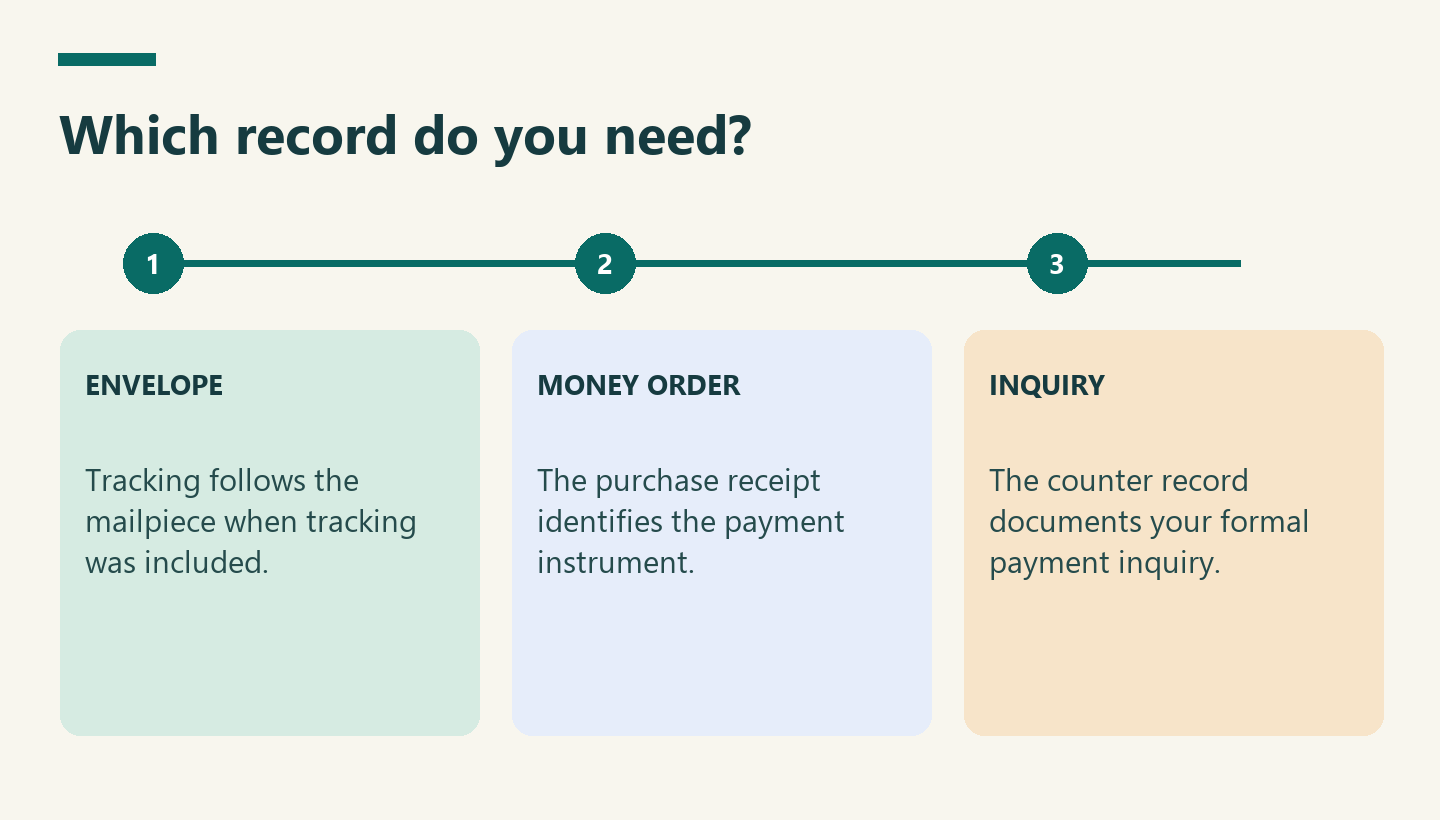
- Use the mailing receipt and any tracking number to ask what happened to the envelope.
- Use the purchaser’s money order receipt to identify the specific instrument and look up its status.
- Use the inquiry record to follow a formal payment inquiry already opened with a postal retail associate.
Decide whether the paper is missing or damaged
If the order is still in your hand, start there. A damaged original and its matching receipt call for a different conversation from an envelope nobody can locate.
If somebody else is waiting for the money, ask what they actually checked. A missing envelope, an unrecorded payment, and a payment credited to the wrong invoice are different problems.
A calendar reminder that the rent is overdue does not distinguish them. Record the facts you can show without labeling the order stolen simply because it arrived late.
Find the three details on your receipt
The USPS money order status application asks for the serial number, the Post Office number, and the issued amount. These fields identify the money order you bought.
The serial number belongs to the payment, not the envelope. A mailing label number, an inquiry reference, or a card transaction reference answers a different question.
The Post Office number belongs to the issuing office. Do not substitute the recipient’s ZIP Code or the number of the branch nearest the recipient’s home.
The issued amount means the face value of that one order. It does not mean everything you spent at the counter, even if one card payment covered the purchase.
Consider a fictional transaction involving one $120 money order, its issuing fee, and postage for a separate envelope. The issued amount for the payment lookup is $120.
The receipt total would be higher, but that difference does not indicate that someone altered the order. It tells you that several purchases went through the register together.
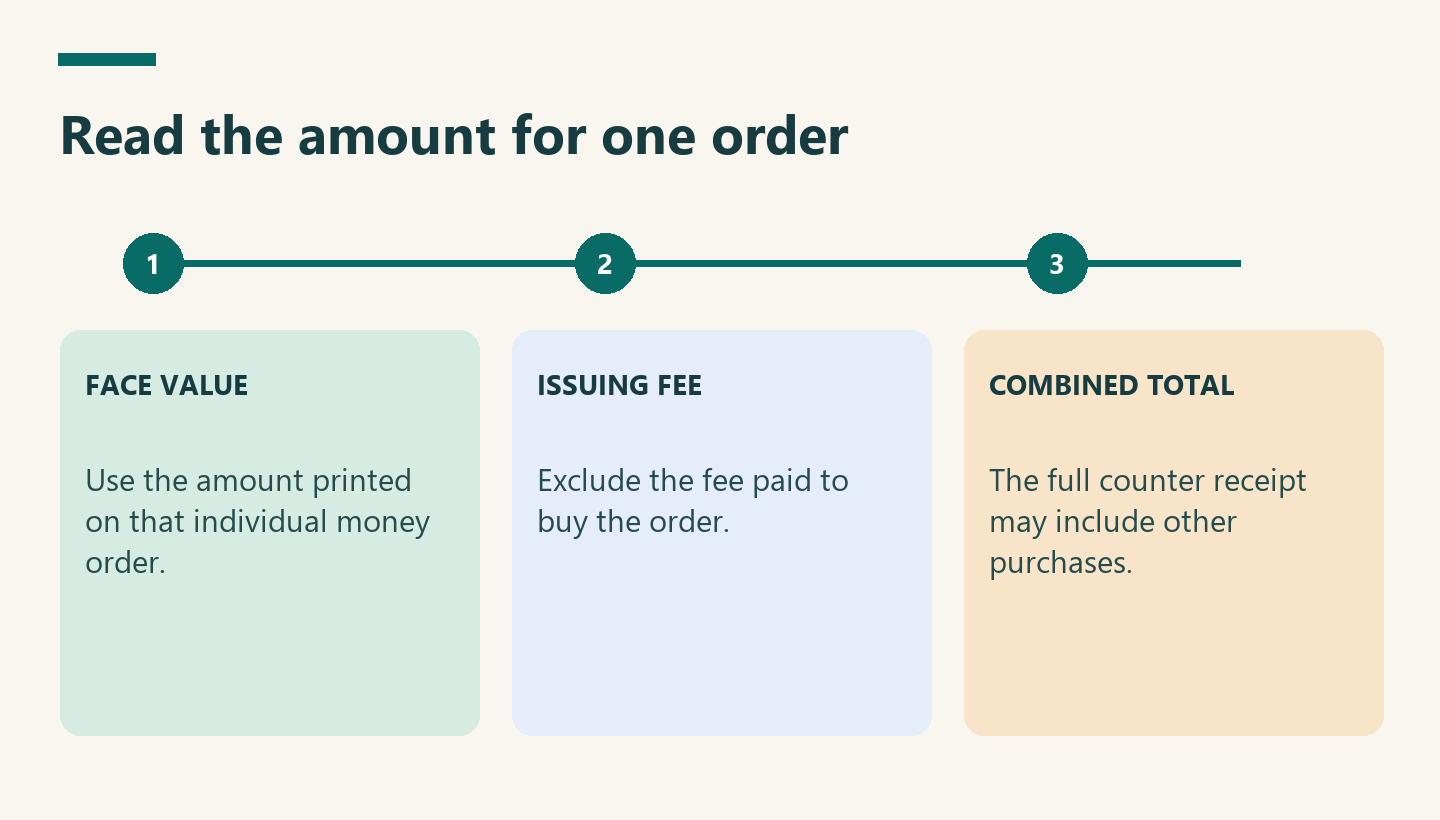
Now suppose you purchased two orders, one for $120 and another for $85. A search for $205 would not describe either instrument, even before considering the fees.
Match each amount with its own serial number. Keep the receipts in separate labeled folders or sleeves if the figures are easy to mix up.
If a digit is hard to read, ask the counter associate for help with the original. A guessed number and an inconclusive search are not evidence of theft.
What a status check can actually tell you
Open the official application from the USPS money orders page. Its fields concern an issued payment; the tracking box in the site’s general navigation concerns mail.
Enter the three receipt details privately on the official site. The page reports the most recent information available to USPS rather than offering continuous tracking of the physical paper.
Keep the date and substance of the result. If you check again tomorrow, that note lets you compare observations without mistaking yesterday’s information for a fresh answer.
A result indicating payment is a reason to ask the intended recipient how it was recorded. It does not, by itself, show that a particular rent invoice was credited.
Conversely, a result that does not establish payment does not show where the envelope is sitting. It could be awaiting delivery or already sitting unopened in an office.
If the details are accepted but you still cannot reconcile the answer, keep the receipt and speak with USPS. A public comment thread cannot see the underlying accounting record.
The application includes an Accounting Help Desk contact for money order questions. Retrieve its details from the official page instead of trusting a phone number sent by an interested stranger.
When the envelope is the missing piece
Start with any tracking purchased for the mailpiece. Photographing the order before mailing might help identify it later, but a photograph does not create a tracking service.
If tracking reports delivery, confirm the address used and ask the recipient whether incoming payments go through a front desk, lockbox, or separate accounts office.
Suppose a property manager checks only the tenant ledger. Asking whether its mailroom received an envelope on the reported delivery day may answer a question the ledger cannot.
Keep this request narrow: give the date, intended recipient, and invoice reference through your usual channel. Do not circulate the whole receipt among everyone who handles building mail.
If the mailpiece itself remains missing, the USPS Missing Mail instructions allow a search request starting seven days from mailing. That timing belongs to the mail search.
Have the mailing date, sender and recipient addresses, and a description of the envelope available for USPS. Use a tracking number when one exists.
USPS may locate the mailpiece, but it does not promise recovery. A mail-search reference is useful evidence of that effort; it is not a money order inquiry reference.
If you have both open, write the names of the two requests beside their references. Otherwise, a phone update about an envelope can sound like progress on a replacement.
Take the right question to the postal counter
Bring the original money order receipt to any Post Office and ask a retail associate to begin a Money Order Inquiry. You need not return to the issuing office.
The Domestic Mail Manual, section 509.3.3.9, allows the purchaser, payee, or endorsee to inquire about payment of a domestic money order at any time.
An endorsee is someone to whom the payee endorsed the order. Merely knowing the serial number does not mean anyone who found it is entitled to act for the payee.
The manual specifies completing, signing, and filing PS Form 6401 and paying the applicable fee. For an ordinary customer, each separate money order requires its own form and fee.
If two items went into the same envelope, tell the associate which instrument each receipt identifies. The envelope may be one missing object while the accounting records require two inquiries.
USPS lists a processing fee for lost or stolen replacements. Check the current amount on its official page and ask the associate what applies before paying.
Do not assume that every named fee is cumulative. Ask what today’s charge covers and keep the receipt for that charge distinct from the original money order purchase receipt.
Important distinction: USPS cannot stop payment on a postal money order. Opening an inquiry does not instantly void the original or authorize you to spend a replacement.
Before leaving, ask how to follow progress, what record identifies this particular filing, and whether more information is needed from you or the intended recipient.
After an inquiry starts, the official money order application also lets you check its progress. A status check that you made earlier was not itself a filed inquiry.
Read the waiting periods without losing a month
USPS says confirming a loss or theft can take up to 30 days. Its investigation of a lost or stolen order may take up to 60 days.
Neither statement instructs every customer to wait 30 days before asking about payment. The manual expressly permits the formal payment inquiry at any time.
Nor do the two estimates create an automatic 90-day countdown to a check in your mailbox. The outcome depends on what USPS establishes about the actual order.
When loss or theft is confirmed, USPS describes issuing a replacement money order. That is different from immediately putting cash back into the bank account used at purchase.
If a deadline with your landlord or another payee comes first, contact that person separately. USPS cannot agree to extend a private bill’s due date for you.
Describe what you have done, using a private reference if needed. Ask how they want a possible duplicate handled before committing more money to the same obligation.
Choose your situation before making another payment
I bought the order and the payee never received it
Keep your original receipt, check the instrument with USPS, and separately check any mail tracking. Bring the receipt to the Post Office if a formal inquiry is needed.
I am the intended payee and do not have the receipt
Contact the purchaser through a known channel to identify which order was sent. The manual lets payees inquire; ask USPS what evidence it needs for your circumstances.
I still have the damaged money order
Keep the negotiable paper itself and its matching receipt together. Take both to the Post Office, and explain whether it was damaged later or spoiled during completion.
A payment appears to have been made to someone else
Avoid accusing the recipient on the basis of a status screen. Explain the discrepancy to USPS and ask about a payment inquiry and evidence appropriate to a disputed endorsement.
What changes if you lost the receipt too?
Start by separating what remains: an actual purchase receipt, an image of the receipt, proof of a counter purchase, or nothing beyond a recollection of its date.
A bank entry can help place the purchase in time. It does not necessarily establish the individual order’s serial number, issuing office number, amount, and intended payee.
Describe the records you actually have when speaking to USPS. The manual specifically does not guarantee a full refund for a stolen order when the customer receipt is missing.
That qualification is not a promise that a photo always substitutes for the original. It is also not a reason to abandon a potentially useful inquiry without asking.
If your receipt and the payee’s copy of the paper disagree, do not quietly correct one image to match the other. Keep the originals for the postal associate.
Label each private image by what it depicts. The payee might have the instrument while the purchaser has the stub; calling both a receipt obscures that distinction.
Damaged paper is not the same as a canceled payment
USPS directs customers with a defective or damaged money order to take the damaged instrument and receipt to a local Post Office. Do not throw away the negotiable portion.
The manual specifically provides free replacement for a defective order or one spoiled during imprinting or customer completion when both the negotiable portion and matching receipt are returned.
If a pen slipped while you filled out the payee’s name, explain that fact. Trying to overwrite the name before getting help can make the original mistake harder to show.
If a missing original later turns up, keep it separate from any replacement. Ask USPS what to do with the original before cashing, depositing, or sending either item.
Domestic postal money orders do not expire or earn interest. An old date therefore does not make a rediscovered original worthless or establish that it was never paid.
What to Do If Your Postal Money Order Is Missing
- Confirm USPS issued the domestic order, locate its original receipt, and identify who bought it and who was supposed to receive it.
- Check the individual issued amount, issuing office number, and serial number against the receipt before using the official status application.
- Track the envelope separately when tracking exists, and ask the recipient whether an incoming payment might still await posting.
- Take the receipt to a Post Office for a formal inquiry when needed. Ask about individual forms, applicable fees, and the next progress check.
- Handle the underlying bill with its recipient, keeping any replacement arrangement separate from the postal inquiry so neither party treats two payments as one.
Frequently Asked Questions
Does the tracking number show whether the order was cashed?
A tracking number follows the mailpiece when tracking is available. Payment status comes from the separate money order application, which asks for the details on the purchase receipt.
Do I have to wait a month to ask USPS?
A purchaser, payee, or endorsee may inquire about payment at any time. The confirmation and investigation periods describe the work that may follow, not a universal filing delay.
Can my bank block the missing postal money order?
USPS says payment on its money orders cannot be stopped. A bank statement for the original purchase will not turn the issued instrument into a personal check.
What if several orders went to the same person?
Separate them by serial number and issued amount. Each formal payment inquiry requires a separate form and applicable fee, even when the intended recipient is the same.
Can someone check my status from a receipt photo?
The official tool uses the three identifying receipt fields. Keeping the receipt private avoids giving strangers the information required to make the same lookup without helping resolve your inquiry.
Will a replacement arrive as soon as I file?
Filing opens the inquiry, not an immediate payout. USPS describes issuing a replacement money order after it confirms the instrument was lost or stolen.
The Bottom Line
Use the original receipt to trace the domestic USPS money order and the mailing record to trace the envelope. One record cannot answer both questions.
If the status remains unexplained, bring the receipt to a Post Office and request a payment inquiry. Discuss any pressing bill with the payee before sending more money.

Join the discussion
0 commentsShare your experience or ask a question about this article.
Community experiences
Did this happen to you?
Your experience could help someone recognize the same scam. Submit a private report for our team to review.
I experienced this tooReports are reviewed before publication. Sharing publicly is always your choice.
Discussion
Start the conversation
Have a question or something useful to share? Add the first comment.