


RonanRx presents prescription weight-loss care as an online conversation, followed by a doctor’s review and pharmacy delivery. Its pages also offer a tempting monthly starting price.
For someone comparing GLP-1 options, the difficult questions begin beyond that headline. The medication, the company arranging care, and the pharmacy filling a prescription need separate attention.

Overview
The FDA warning concerns specific earlier marketing
The RonanRx FDA warning dated October 30, 2026 challenges representations about compounded semaglutide and tirzepatide reviewed during September.
FDA identified misleading impressions about who compounded the drugs, their approval or evidence status, and domestic ingredient origin. Those are material questions when choosing prescription care.
The current website makes important distinctions
RonanRx now expressly describes itself as a technology platform rather than a pharmacy. Its current pages say compounded medications are not FDA-approved.
It also describes independent prescribing decisions, partner-pharmacy preparation, and pharmacist release. Those current statements must not be replaced with a description of the earlier advertising.
Patients still need three concrete answers
The changes help clarify the offer, but they do not establish whether a particular compounded prescription is appropriate for you.
- Ask why your medical needs require a compounded preparation.
- Identify the prescriber, actual compounder, and dispensing pharmacy.
- Get the complete medication and recurring program charges before paying.
This is a prescription-marketing and buyer-risk investigation, not a finding that every RonanRx patient received defective medication or that the company committed criminal fraud.
What FDA Challenged in the Earlier RonanRx Advertising
FDA’s letter identifies three related problems with the earlier presentation. Each affects a different part of a patient’s understanding of the treatment.
First, pictured tirzepatide labels identified RonanRx in a way that suggested it compounded the drugs. FDA said RonanRx was not the compounder.
Second, approval-related headings and references to established branded treatments implied that the compounded preparations had received approval or equivalent safety and effectiveness evaluation.
Third, FDA challenged American made
and farm-to-table drugs
representations. Its records did not identify a registered U.S. manufacturer of the relevant compounding ingredients.
The letter requested corrective information, including the producing entities and representative labeling, within 15 working days of receipt. It gave the company an opportunity to respond.
These are FDA’s stated regulatory findings, not a criminal conviction. The letter does not provide a laboratory result establishing contamination in every patient’s medication.
For patients, the practical distinction is straightforward: where a product is advertised, where it is dispensed, and where its ingredients originated are different facts.
A domestic business address cannot answer all three questions. Neither can a photograph of pharmacy equipment or a reassuring label bearing the platform’s name.
What Has Changed on the Current Website
The current RonanRx compliance page describes prescribing and pharmacist release as separate decisions. It says an intake request is not medication fulfillment.
Its lower disclosures identify RonanRx as a technology platform, name Elite Care Pharmacy LLC as an optional pharmacy, and state that compounded drugs are not FDA-approved.
The homepage likewise attributes preparation to partner pharmacies and delivery to the dispensing pharmacy. That is materially different from suggesting RonanRx itself makes the medication.
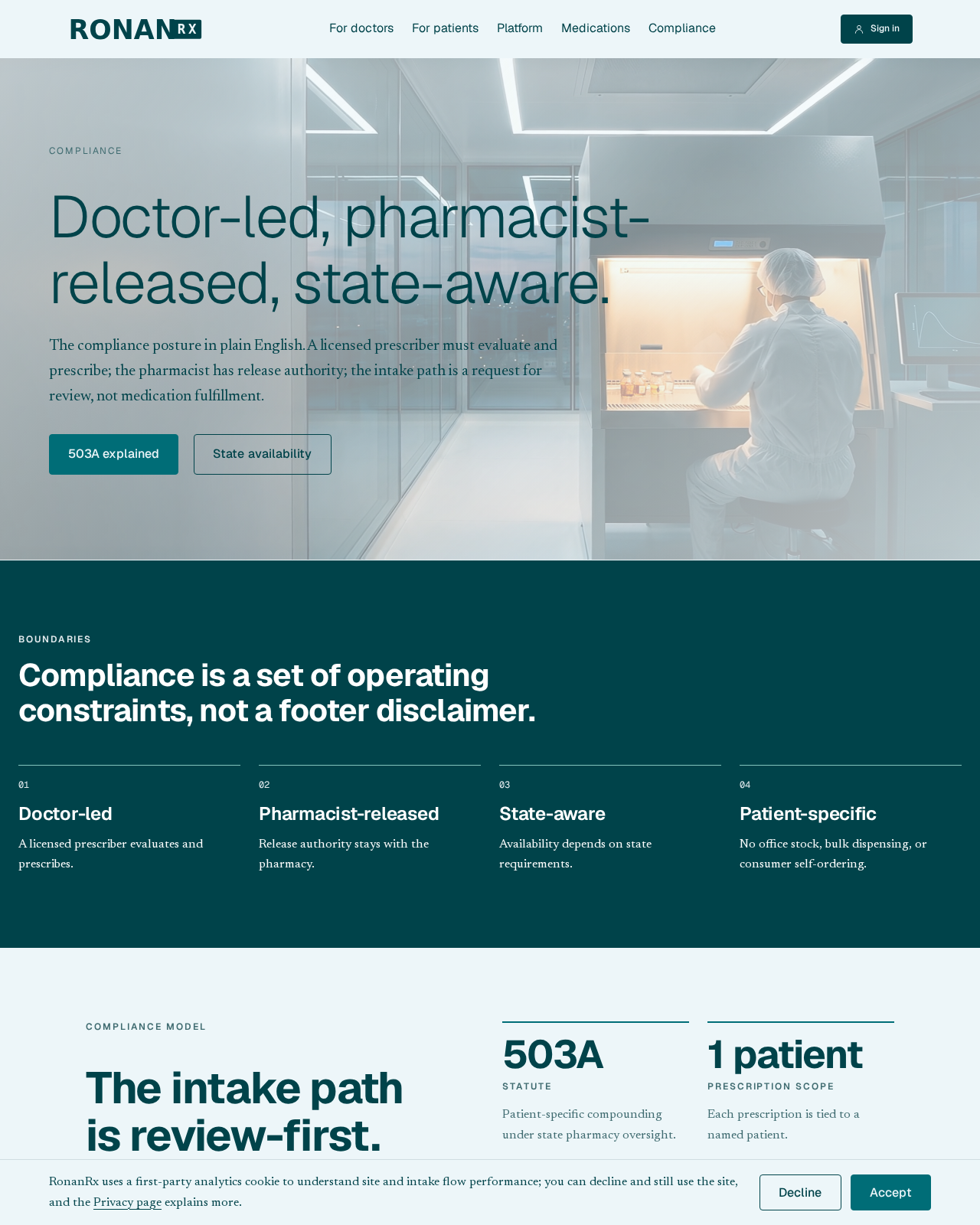
These revisions deserve acknowledgment, but a changed webpage is not an FDA clearance letter. Patients should evaluate the actual prescription and pharmacy, not assume regulatory endorsement.
RonanRx’s current terms also say compounded drugs are not generic equivalents and should not be evaluated using branded-drug trial data.
That distinction matters more than whether two treatments share an ingredient name. Evidence about an approved product does not automatically validate every preparation containing that ingredient.
How RonanRx Describes the Current Prescription Path
Step 1: Submit information for a clinician’s review
The website describes an intake process covering treatment goals, medical history, and existing medication. A request begins evaluation rather than guaranteeing a prescription.
Before providing sensitive information, identify the treating practice and its privacy process. The platform’s brand does not by itself identify the clinician responsible for your care.
Step 2: A prescriber decides whether treatment fits
RonanRx says a licensed doctor determines whether to prescribe and selects the medication and strength. Its terms distinguish that clinical decision from the platform’s administrative services.
Ask the prescriber to explain the reason for compounding and the available approved alternatives. A convenient enrollment process is not a clinical explanation.
Step 3: Pharmacies prepare, check, and dispatch medication
The homepage says the compounding pharmacy may differ from the dispensing pharmacy. Its shipping policy assigns shipment to the dispensing pharmacy, not RonanRx.
Therefore, ask for both pharmacy identities when they differ. The business sending a package does not necessarily identify the facility that prepared its contents.
This describes the advertised pathway, not a completed patient test. No prescription, dispensing event, delivery, or customer-service response was independently tested for this article.
Company, Pharmacy and Billing Details That Matter
The platform’s name does not identify every provider
RonanRx’s footer names RonanRx, Inc., at an Elgin, Texas address that also appears in FDA’s letter. That establishes the identity being discussed here.
The current terms assign intake, scheduling, payments, communication, and care coordination to the platform. They assign clinical decisions to doctors and pharmacy work to licensed pharmacies.
Keep those roles separate when asking for help. A payment question belongs with the billing party, while a treatment question needs the responsible clinician.
Do not assume the published platform address is a compounding facility. The current website itself says the platform does not prepare or dispense medication.
Elite Care is named, but the actual compounder still matters
RonanRx identifies Elite Care Pharmacy LLC in Hockley, Texas, and publishes Texas pharmacy license number 36002.
The website describes it as a separately licensed community pharmacy and says patients may choose another pharmacy. Those are the company’s current disclosures.
The Texas board’s public pharmacy data independently lists the matching Hockley pharmacy as active, with an expiration date of January 31, 2028.
That confirms a matching pharmacy credential, not FDA approval of a compounded drug. It also does not establish who prepared a particular patient’s prescription.
Confirm the pharmacy that will actually prepare your prescription, its authority to serve your state, and the dispensing pharmacy shown on your records.
A named dispensing partner is useful information, but it does not automatically resolve the separate question FDA raised about identifying the producing entity.
The advertised monthly price needs a complete billing explanation
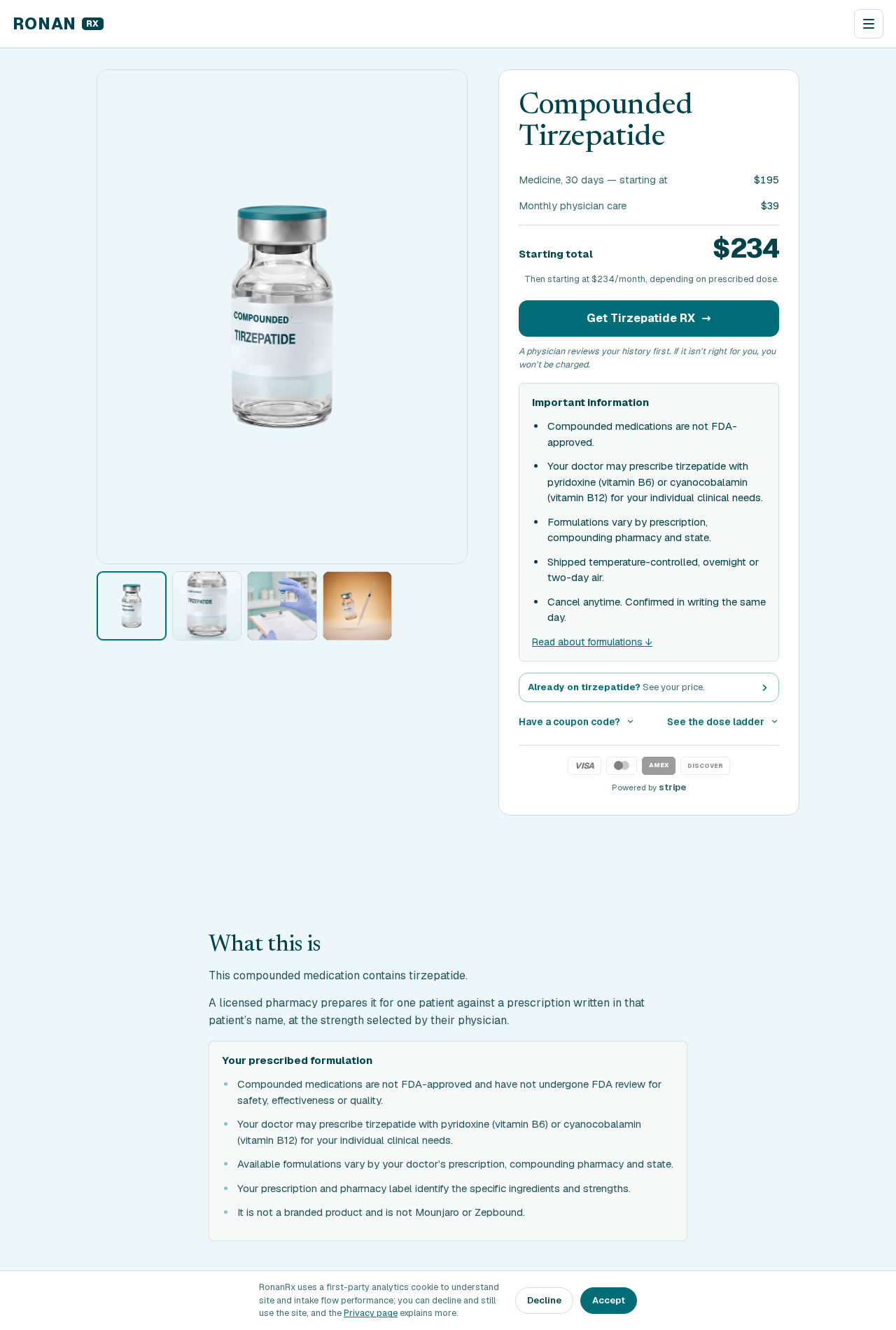
The RonanRx homepage lists compounded tirzepatide at $195 per month. That figure alone does not explain every possible charge associated with care.
The product page itemizes starting medication at $195 and monthly physician care at $39. Its displayed starting total is $234 per month.
It says the price depends on the prescribed dose. This is a published starting offer, not a completed checkout quote for an individual patient.
The payment policy describes a recurring RonanRx program subscription. It says medication is charged separately by the dispensing pharmacy when prescribed.
The subscription covers platform services such as intake and coordination, while the dispensing pharmacy sets and collects its medication charge. Enrollment does not guarantee a prescription.
The policy says the program renews automatically until canceled, at the enrollment price or a price updated with notice. That is disclosed recurring billing, not evidence of hidden refills.
Before authorizing payment, obtain the program price, medication price, renewal dates, and cancellation process together. Ask whether the advertised figure includes each item.
Also ask what changes if the prescription changes or no medication is prescribed. A starting price should not become your substitute for an individualized written quote.
Refund terms distinguish subscription use from dispensing problems
The refund policy says canceling the recurring program stops future charges but does not retroactively refund a term already used.
It says patients are not charged for medication a doctor does not prescribe. A program charge where no service occurred is reviewed separately for an appropriate refund.
Dispensed medication is not returnable under the stated policy. However, it promises a replacement or refund for dispensing errors, damage, or shipments outside required temperatures.
These are the company’s published commitments, not verified outcomes from a refund test. A no-return rule should not be confused with its separate order-problem remedy.
Keep the confirmation identifying what was canceled. Stopping a program subscription, resolving a pharmacy charge, and deciding how treatment continues are separate tasks.
What Independent Compounding Guidance Adds
FDA’s compounding guidance explains that compounded drugs lack premarket approval review. They are also different from FDA-approved generic medicines.
Compounding can meet a medical need that an approved product cannot meet, such as a necessary change for an individual patient. That does not establish universal treatment equivalence.
FDA generally places day-to-day oversight of ordinary state-licensed pharmacies with state boards, while retaining its own inspection and enforcement roles.
A pharmacy license therefore answers an important identity and oversight question. It does not turn a compounded preparation into an FDA-approved product.
RonanRx’s quality page promises ingredient documentation, lot linkage, pharmacist checks, and issue escalation. Those workflow descriptions are not independent test results for your prescription.
Ask the pharmacist how your preparation is identified, what its label should show, and whom to contact about quality concerns. General quality language cannot replace that connection.
The origin issue also needs precision: the warning challenges domestic-origin representations, but it does not establish a particular foreign country or prove a shipment unsafe.
Questions about sourcing belong with the actual compounder. An American flag, a U.S. dispensing address, or an ingredient’s nationality alone cannot establish the preparation’s quality.
Patient-Specific Does Not Mean Automatically Permitted
FDA’s current GLP-1 compounding policy explanation describes restrictions on regularly making products that are essentially copies of commercially available drugs.
For the patient-specific pathway discussed there, a prescriber may document a change producing a significant difference for an identified patient. Merely saying personalized
does not supply that documentation.
FDA specifically explains that adding another ingredient, including vitamin B12 in its example, may still leave a preparation essentially a copy.
That is relevant because RonanRx’s tirzepatide page says some prescriptions may include vitamin B6 or B12, depending on individual needs.
Do not assume an added vitamin proves either superior treatment or a lawful exception. Ask the prescriber and pharmacist to explain the specific medical and dispensing basis.
These rules involve facts about the actual prescription and operation. The public pages alone do not establish that every current RonanRx prescription meets or violates them.
Medication Questions Deserve More Than a Billing Reply
FDA’s GLP-1 safety guidance identifies dosing errors and shipping-temperature concerns with compounded products generally. It does not attribute every reported problem to RonanRx.
Before using a preparation, ask the pharmacist to explain its concentration, your prescribed amount, the supplied measuring device, and the administration instructions.
Do not calculate a replacement dose from another product’s instructions. A familiar medication name does not establish that a different vial has the same concentration.
FDA recommends not using injectable GLP-1 medication that arrives warm or insufficiently refrigerated. Contact the dispensing pharmacy about the shipment and the appropriate replacement process.
What to Do If You Are Considering or Already Using RonanRx
-
Reject any promise of compounded-drug FDA approval. Use the current disclosures, and ask how the proposed preparation differs from an available approved option.
-
Identify everyone responsible for your particular prescription. Obtain the prescriber’s identity, the producing pharmacy, the dispensing pharmacy, and the appropriate contact for each concern.
-
Verify pharmacy credentials through the relevant state board. Match the legal name, address, and license number rather than relying only on a badge or platform label.
-
Request the full recurring and medication costs. Keep the quote and enrollment terms showing who bills each charge and how future billing can stop.
-
Raise existing charge and order problems specifically. Distinguish a subscription cancellation from a medication refund request, and retain written confirmation of the outcome.
-
Bring the label and instructions to your care team. Resolve concentration, storage, administration, and treatment-continuity questions with the prescriber or pharmacist, not a promotional page.
If a billing problem remains unresolved, explain the specific disputed charge to your payment provider. Preserve the relevant records without circulating your medical history publicly.
Suspected medication quality problems or adverse events can also be reported through FDA’s MedWatch route linked in its safety guidance. Reporting does not replace medical attention.
Frequently Asked Questions
Does the FDA warning prove RonanRx is a scam?
No, it documents FDA’s specific marketing and misbranding findings. It is not a criminal conviction or a laboratory verdict on every patient’s medication.
Does RonanRx currently claim compounded drugs are FDA-approved?
The current pages examined expressly state the opposite. The historical approval impression described in FDA’s warning should not be presented as unchanged current wording.
Is the named dispensing pharmacy necessarily the compounder?
Not necessarily, because RonanRx says those roles may differ. Ask which facility prepared your actual prescription and which pharmacy dispenses and ships it.
Does the $195 headline settle my complete monthly cost?
The product page shows a $234 starting total, including $39 physician care. Get the prescribed-dose price and any recurring program charges in writing.
Does adding a vitamin automatically justify GLP-1 compounding?
No, FDA explains that an added ingredient may still leave an essentially copied product. The patient-specific medical and dispensing basis needs an actual explanation.
Should existing patients immediately stop their prescribed treatment?
Discuss the actual prescription with your prescriber and pharmacist before changing treatment. For compromised medication or urgent symptoms, seek prompt pharmacy or medical help.
The Bottom Line
Do not order compounded GLP-1 treatment on an FDA-approval or generic-equivalence promise. The RonanRx FDA warning explains why those distinctions matter, despite the website’s current corrections.
Only proceed after the prescriber explains the patient-specific need, the pharmacies are identified, and the full billing arrangement is clear. A monthly headline cannot answer those questions.
If you already receive treatment, review your label and plan with your care team. Handle cancellation and refund requests separately while arranging appropriate continuity of care.

Join the discussion
0 commentsShare your experience or ask a question about this article.
Community experiences
Did this happen to you?
Your experience could help someone recognize the same scam. Submit a private report for our team to review.
I experienced this tooReports are reviewed before publication. Sharing publicly is always your choice.
Discussion
Start the conversation
Have a question or something useful to share? Add the first comment.