


Psyched Wellness CALM arrives in a dropper bottle, wrapped in promises of relaxation, better rest, and carefully prepared mushroom extracts. Its polished presentation invites a closer look.
Beyond the soothing language, buyers need to understand the regulatory record, the testing behind those promises, and the purchase terms attached to a bottle.
Overview
CALM is an Amanita extract, not an ordinary sleep supplement
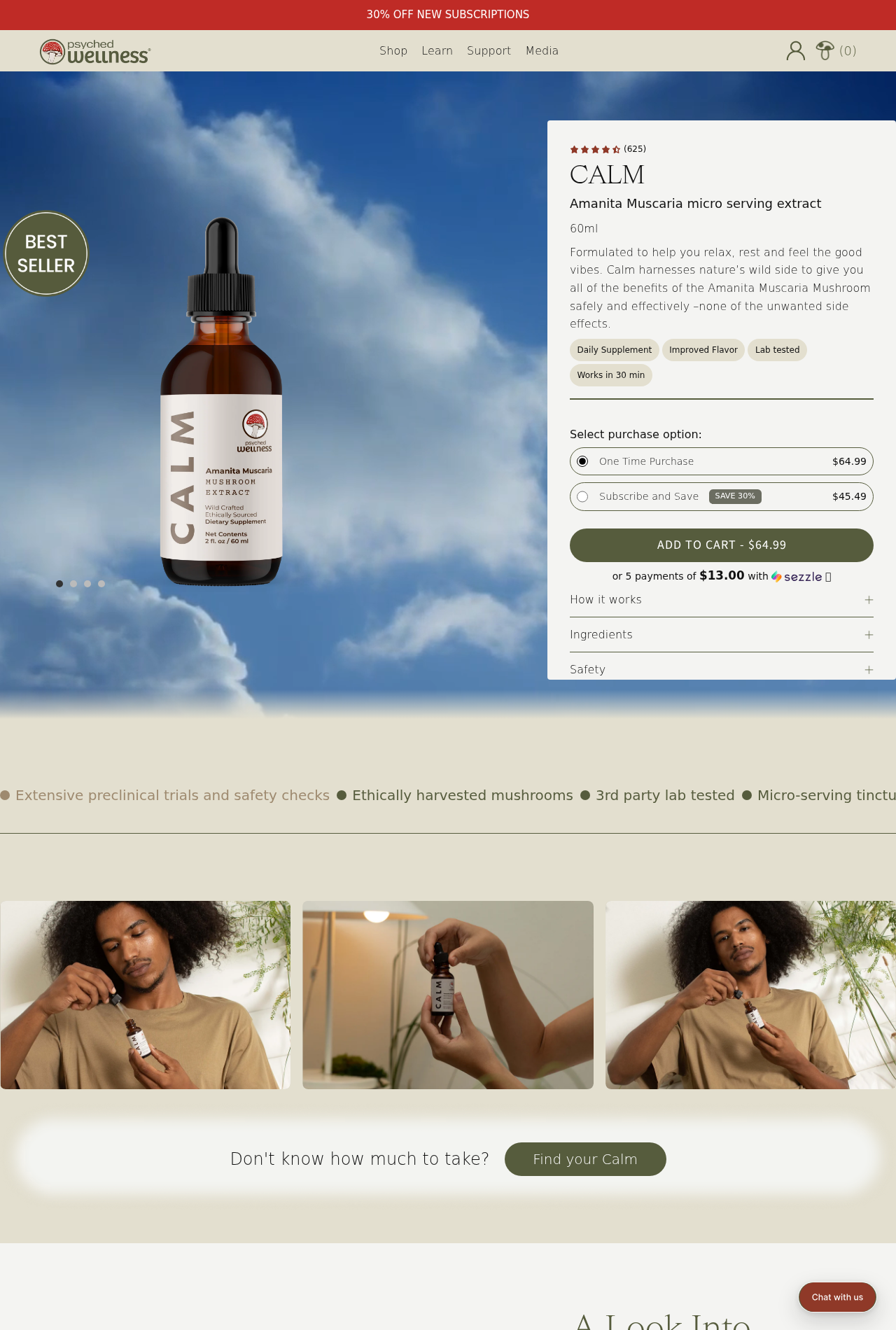
The product page identifies CALM as a 60ml Amanita muscaria extract. The company calls its proprietary mushroom extract AME-1 and promotes it for rest and relaxation.
Its marketing emphasizes processing, laboratory testing, and a controlled experience. Those assurances matter because the ingredient itself has drawn specific FDA safety concerns.
FDA directly named the product in a warning letter
FDA’s September 29, 2026 letter names Calm, Calmer, and Santa. It identifies inadequate safety information under the rules governing new dietary ingredients.
The letter calls those products adulterated on that basis. It does not describe finding an undisclosed prescription medicine in a tested CALM bottle.
- The named regulatory concern involves Amanita safety evidence, not merely a missing disclaimer.
- The seller continues to publish strong safety assurances alongside its product offer.
- The visible purchase options separate a selected one-time order from an optional subscription.
- The store’s return and refund pages give buyers different instructions.
The safety question comes before the discount
Do not buy CALM on the strength of these marketing assurances. The named FDA safety finding is more consequential than a laboratory badge or subscription saving.
If you already ordered, preserve your product and transaction records. Address any health concerns promptly, then clarify cancellation and refund arrangements in writing.
Bundle and refill warning
The 60ml offer shows one-time purchase selected at $64.99 and an optional $45.49 subscription. These displayed item prices are not a verified final checkout total.
The subscription is optional, not hidden. Its selected delivery interval, later renewal amount, and cancellation cutoff were not verified in a loaded subscription checkout.
Check your receipt, request written cancellation when needed, and preserve refund deadlines. Don’t consume CALM merely to satisfy the store’s conditional money-back policy.
What the Current CALM Offer Actually Promises
The CALM product page describes an Amanita muscaria tincture and identifies muscimol as its active ingredient. Its appeal is calmness without unwanted effects.
The ingredient description lists mushroom-cap extract, natural flavors, and purified water. That is the seller’s formula description, not an independent analysis of a purchased bottle.
The presentation emphasizes preclinical safety work and third-party laboratory testing. It also claims that processing reduces unwanted compounds while preserving muscimol.
This is not simply a bottle of culinary mushrooms. It is a prepared extract being sold for noticeable effects, with a proprietary process central to its reassurance.
Judge the preparation and proposed use, not the mushroom’s natural origin. The description of a proprietary process is not itself safety evidence.
The website’s safety language is stronger than a modest statement that research is continuing. Buyers are being encouraged to expect benefits without the mushroom’s unwanted risks.
The company FAQ similarly presents AME-1 as safe after processing. It says the extract has undergone toxicological testing and points readers toward its science page.
These are meaningful representations by the company, but they remain company representations. FDA’s separate assessment needs to be read alongside them, not replaced by them.
What the FDA Warning Says About CALM
In its warning letter to Psyched Wellness Ltd., FDA says it reviewed the company’s website in May 2026 and identified products represented as containing Amanita.
The agency identifies Amanita muscaria extract in Calm, Calmer, and Santa as a new dietary ingredient. The letter explains the safety-information standard applicable to that classification.
FDA concludes that the available information does not provide reasonable assurance against significant or unreasonable illness or injury risks. It also states that serious safety concerns exist.
Its adulteration finding follows from that safety-information problem. In this letter, the term does not mean FDA found a secretly added drug or proved contamination.
That narrower meaning is still serious for a buyer. You do not need evidence of hidden ingredients before declining a product with this named regulatory safety concern.
The letter gave the company an opportunity to respond with corrective steps or supporting arguments. It warned that failure to address the matter could lead to enforcement action.
A warning letter is not a criminal conviction or, by itself, a recall announcement. Neither distinction turns it into a routine approval notice.
The important buying question is whether the safety concern has been adequately resolved, not whether the bottle still appears for sale online.
Calmer Is Also Named, but It Is a Different Product
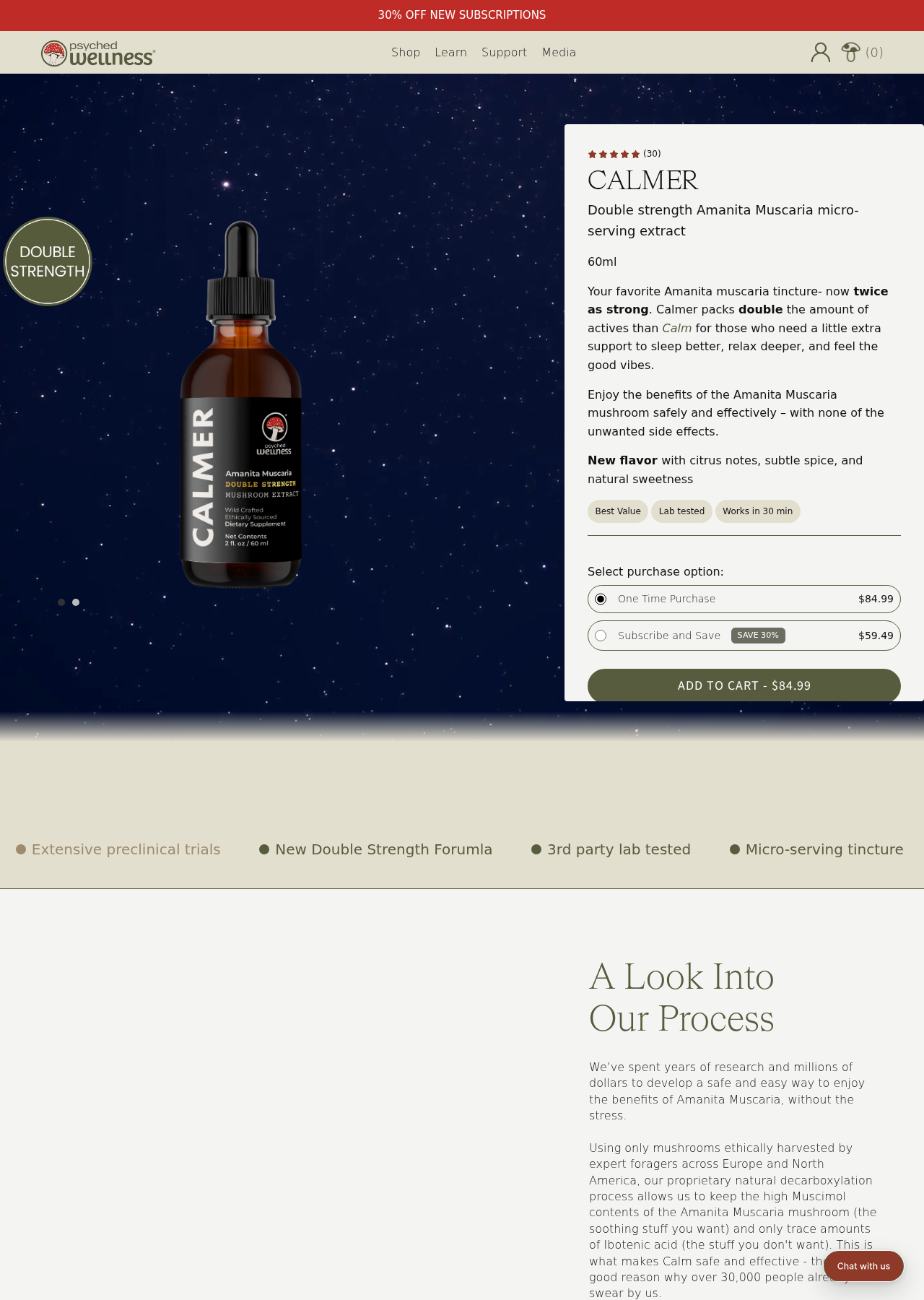
The same store sells Calmer as a separate 60ml extract marketed as double strength. That description belongs to Calmer, not the standard CALM bottle.
Its loaded product page shows one-time purchase selected at $84.99 and an optional subscription at $59.49. These are that product’s displayed item prices.
FDA’s letter names both products, so switching between them does not avoid the named Amanita concern. No ingredient-amount or dose equivalence is assumed here.
NDI 1417 Records a Submission, Not an Approval
The FDA’s notification index lists AME-1 under NDI notification 1417. It records a July 8, 2025 submission and a September 18, 2025 response.
Those dates establish a regulatory exchange, not an endorsement. A public entry in the notification list does not mean the ingredient received FDA approval.
In an October 9, 2025 investor update, Psyched Wellness acknowledged that FDA found the submitted data insufficient to demonstrate AME-1 would reasonably be expected to be safe.
The company maintained confidence in its safety studies and historical-use arguments. It also argued that selling the product did not require a favorable FDA response.
That is the company’s stated position, not FDA’s conclusion. It deserves accurate attribution rather than being presented as an independent clearance.
The update also predates the September 2026 warning letter. It therefore cannot be treated as the company’s response to that later enforcement notice.
The original 2025 response document could not be retrieved through the linked public search. Its detailed contents are not established here beyond the company’s own acknowledgment.
FDA’s new dietary ingredient background makes the continuing responsibility clear: companies must evaluate safety and ensure their supplements are not adulterated, regardless of notification requirements.
For a shopper, a notification number and a safety conclusion are different things. Ask for the actual current determination instead of accepting the existence of paperwork.
What the Linked Laboratory File Can and Cannot Establish
The product page links an eight-page laboratory file. It includes a branded summary, an Amanita-profile report, and laboratory pages covering contaminants and other sample characteristics.
This is more substantive than a testing logo alone. Readers can inspect sample descriptions, report dates, listed analytes, methods, and the limits attached to results.
The Amanita-profile page identifies its sample as a concentrate and reports analysis in March 2025. Other pages describe a 30ml water-extract sample.
The current offer, by comparison, is a 60ml bottle. Different sample descriptions do not prove the reports are false, but they require a careful product-and-lot match.
A document posted beside today’s product cannot automatically verify the contents of every bottle currently shipped. A buyer needs the record corresponding to the actual lot.
The laboratory pages also concern particular measurements on submitted samples. They are not a human clinical study establishing that CALM safely improves sleep or relaxation.
Likewise, a reported contaminant result does not settle the broader safety of the intended ingredient. These questions address different kinds of evidence.
The company’s science page describes preclinical work and manufacturing controls, but provides no current FDA resolution of the named product warning.
No bottle was purchased or independently tested for this article. The recommendation rests on the regulatory record and the limits of the supporting material actually available.
Why the Broader Amanita Guidance Matters
FDA’s Amanita consumer and industry update describes safety concerns involving the mushroom, its extracts, and constituents including muscimol, ibotenic acid, and muscarine.
That December 2024 communication focuses on conventional foods. It concludes that these uses do not meet the applicable food-safety standard and recommends avoiding foods containing them.
The same update separately reminds supplement manufacturers of their safety responsibilities. CALM’s later warning letter supplies the product-specific supplement finding.
Keeping those documents separate matters because conventional-food rules and supplement requirements are not interchangeable. The CALM recommendation does not depend on pretending they are identical.
FDA’s accompanying industry letter discusses poisoning reports, neurological effects, and uncertainty about detoxification methods. These are broader ingredient concerns, not a CALM-specific illness count.
The company’s claim that its process reduces certain compounds needs evidence addressing its actual preparation. Simply pointing to processing cannot establish that FDA’s concern has disappeared.
This article does not provide a safer serving size or instructions for experimenting with the extract. A smaller suggested amount cannot resolve missing safety assurance.
The Purchase Choices Are Separate From the Safety Finding
The loaded CALM offer shows a one-time purchase selected at $64.99. A separate Subscribe and Save option displays $45.49 beside its selection control.
That visible distinction does not support calling the subscription mandatory or hidden. An optional recurring offer still deserves close attention before anyone authorizes it.
| Observed offer detail | What it establishes for buyers |
|---|---|
| Selected one-time purchase at $64.99 | The initial visible selection is not a subscription. |
| Optional subscription displayed at $45.49 | The discounted alternative requires a separate purchase choice. |
| Final recurring checkout not inspected | The renewal total, chosen interval, and cutoff remain unverified. |
The displayed discount should not be assumed to remain unchanged on every renewal. Confirm the later charge, delivery interval, and cancellation timing in the actual agreement.
The site’s navigation offers subscription management, but an account was not accessed to test cancellation. No card information was entered and no order was placed.
For an existing order, the receipt and account record are more important than today’s default. A different purchase date or selection may have different terms.
A one-time order and a subscription both involve the same unresolved safety question. Choosing the nonrecurring button does not make the product medically suitable.
Who Sells CALM, and Which Policies Apply?
The operator is named, but its address is not a return instruction
The website terms identify Psyched Wellness Ltd. and a Toronto mailing address. FDA addressed its letter to the same company at that location.
That is a documented operator identity, not an anonymous seller inferred from branding. It does not establish where your bottle was manufactured or should be returned.
The refund page specifically tells customers not to send products back to the manufacturer. Obtain written instructions before posting anything to a corporate address.
The published sourcing story is not an independently traced shipment
The company describes mushrooms sourced through foragers in Europe and North America. Its science page also presents manufacturing and quality-assurance claims.
Those statements do not identify the full manufacturing and fulfillment path for a particular delivered bottle. This article does not assign an unverified country of manufacture.
If your bottle requires investigation, its lot code, packaging, and corresponding laboratory records are more useful than assumptions based on the company’s mailing location.
Support channels are published, without a tested response promise
The contact page supplies a message form. The policies also publish info@psyched-wellness.com for order questions and damaged-product reports.
These are contact routes, not proof that a particular cancellation or refund will succeed. No call, message, or customer-service test was conducted for this article.
Existing buyers should use a written channel and keep the response with their order records. Ask separately about future renewals and the charge already paid.
Three policy pages tell buyers different things about returns
The FAQ says returns are not accepted, while allowing possible exchanges for damaged products. The separate refund policy also says physical returns cannot be accepted.
However, that refund page offers a conditional money-back guarantee for orders made within 30 days. It limits the policy to a single product, excluding original shipping.
It also asks for consistent use and a detailed account of the customer’s experience, with requests reviewed individually. That is not an unconditional whole-order refund promise.
The shipping policy gives different instructions: returns within 30 days after delivery, customer-paid return postage, and a conditional refund based on product experience.
A buyer could follow one page and still conflict with another. Both the return procedure and the applicable deadline need written confirmation.
Ask which rule covers your order and request the answer in writing. Don’t consume a product with a regulatory safety concern to satisfy a refund condition.
These inconsistencies are a practical recovery problem, not proof that every customer is refused a refund. Preserve all relevant versions before the pages change.
What to Do If You Bought Psyched Wellness CALM
-
Put health concerns ahead of refund conditions. If you suspect a serious reaction, FDA advises stopping the supplement and seeking appropriate medical advice.
Seek emergency help for severe symptoms such as seizures, breathing difficulty, or loss of consciousness. Don’t wait for a merchant to approve a return.
-
Keep the bottle and its identifying information. Photograph the complete packaging, lot number, label, and expiration details, and retain your purchase confirmation.
These records can help a clinician, the seller, or FDA identify the actual product involved. A generic screenshot of today’s listing is not enough.
-
Check whether your order includes recurring deliveries. Read your receipt and subscription account independently, rather than assuming today’s one-time default describes your purchase.
If you want renewals stopped, request cancellation and a written confirmation. Ask whether an already processing shipment or charge needs a separate request.
-
Request the refund route before sending anything. Cite the conflicting return instructions and ask which deadline, eligibility conditions, and shipping arrangements apply.
State that your concern involves the named FDA safety finding. Do not agree to consume more product merely to document an unsuccessful experience.
-
Preserve the policies and the merchant’s replies. Save the relevant page text, purchase details, cancellation request, and refund response in one place.
If a charge remains disputed, ask your payment provider about its applicable process and deadline. Describe the actual transaction without promising a guaranteed reversal.
-
Report suspected adverse effects through FDA’s official route. Its supplement problem-reporting guidance explains the Safety Reporting Portal and information useful to an investigation.
Include the product identity and event details you actually know. Reporting a concern is not the same as proving that the product caused it.
Frequently Asked Questions
Did FDA actually name Psyched Wellness CALM?
Yes, its September 29, 2026 warning letter names Calm alongside Calmer and Santa. The finding concerns insufficient safety assurance for their Amanita dietary ingredient.
Does adulterated mean CALM contains a hidden prescription drug?
Not in this letter’s stated finding, which concerns inadequate safety information under the new dietary ingredient standard. It does not report a hidden-drug laboratory result.
Does NDI notification 1417 mean FDA approved AME-1?
No, the index records a submission and response. The company’s earlier update acknowledged FDA’s unfavorable safety-data assessment while maintaining its own confidence in AME-1.
Are the posted laboratory reports enough to resolve the concern?
No, submitted-sample measurements do not establish clinical safety or resolve FDA’s named finding. The actual preparation, intended use, and bottle lot still matter.
Is the CALM subscription automatically selected for every buyer?
No, the observed product page had one-time purchase selected and presented subscription separately. Your own receipt determines what you authorized, not that single observed default.
Can I return CALM and receive a full refund?
The posted policies conflict, and the money-back terms contain conditions and limits. Request written instructions promptly rather than assuming an unconditional refund or using the product.
The Bottom Line
Do not buy Psyched Wellness CALM. FDA’s named safety-information finding outweighs the seller’s reassuring language, and neither a notification number nor posted testing establishes approval.
If you already ordered, preserve the bottle and receipt, address health concerns first, and request written cancellation or refund instructions without consuming more product.
The optional subscription and conflicting return policies deserve separate attention. They affect what happens to your money, but they do not settle the ingredient’s safety.

Join the discussion
0 commentsShare your experience or ask a question about this article.
Community experiences
Did this happen to you?
Your experience could help someone recognize the same scam. Submit a private report for our team to review.
I experienced this tooReports are reviewed before publication. Sharing publicly is always your choice.
Discussion
Start the conversation
Have a question or something useful to share? Add the first comment.