


Your online order still says processing, and the shipping date has passed. Another message asks for patience without making your choices especially clear.
Before answering, separate the original promise from the latest update. Small differences in those messages can change what happens when you wait or cancel.
Overview
The important question is whether the seller shipped
This guide covers United States cancellation rights for covered merchandise orders that have not shipped, not every purchase arriving later than expected.
Under the FTC rule, shipment means physically handing merchandise to the carrier. Delivery to your address is a separate event, sometimes occurring considerably later.
The shipping promise sets the starting point
A seller generally needs a reasonable basis for its stated shipping time. Without a clear shipping statement, the usual deadline is 30 days.
That period starts with receipt of a properly completed order. Specific exceptions, including certain applications for seller-provided credit, can change the calculation.
- Find the shipping promise that applied when you ordered.
- Check whether the carrier actually received your merchandise.
- Identify whether this is the first delay notice.
- Read the cancellation choice before agreeing to wait.
Your response matters differently at different stages
For one qualifying first delay, silence can count as consent. A later delay generally needs your express agreement rather than another unanswered message.
The FTC business guide explains these distinctions. A required refund follows the rule’s cancellation conditions, not simply disappointment with an estimated arrival date.
Find the Shipping Promise Before Counting Days
Start with your confirmation and the offer you accepted. Look for shipment timing, processing periods, preorder wording, and any updated information supplied during checkout.
A promise to ship within five days does not become a 30-day promise merely because the longer period would be easier for the seller.
Conversely, a clear, supported promise to ship a preorder in eight weeks is not automatically unlawful because it exceeds the usual 30-day default.
Updated shipping information given when taking your order can supersede an earlier advertisement. Keep both versions rather than relying on today’s revised product page.
Separate a dispatch promise from transit language. A five-day processing period followed by a delivery estimate describes different stages, not necessarily five-day shipment and delivery.
If the wording is ambiguous, ask the seller which shipment date governed your purchase. Save its answer alongside the original terms, without quietly replacing them.
Before the shipping deadline, changing your mind does not automatically create this rule’s delay-based cancellation right. Check the seller’s separate cancellation policy too.
When the order clock actually starts
The seller must have the necessary order information and the accepted payment or authorization. A complete shipping address and the merchandise selection matter here.
Authorizing an existing charge account can satisfy the payment requirement. The merchant cannot ordinarily postpone the clock merely by waiting to process or deposit payment.
A payment failure can change matters. If a check is dishonored or credit is refused, the clock restarts when the qualifying payment or credit problem is resolved.
Ask what specific information or payment issue prevented completion. A vague processing label does not explain whether your order was actually incomplete.
The narrower 50-day credit exception
If you apply to the seller for credit to fund the order and no shipping time is stated, the default can be 50 days.
The FTC describes this as allowing time for a new in-house account or increased credit line. Merely paying with an existing credit card is different.
A stated shipping promise still matters even with that application. The seller should account for credit processing when making its promised shipment representation.
Follow the Order From Checkout to Delivery
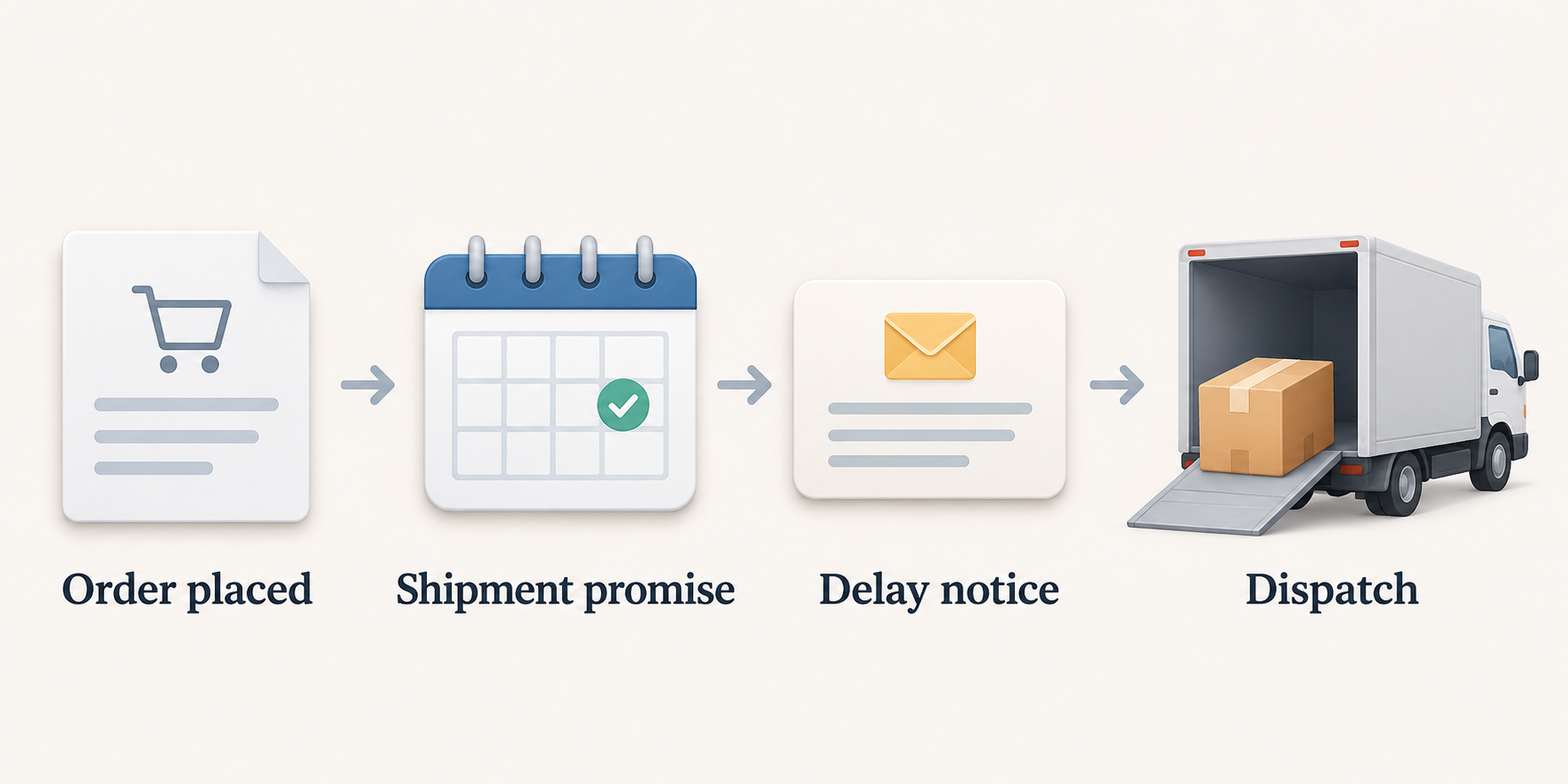
These milestones show where the shipping rule operates. They are a conceptual sequence, not a promise that every seller or carrier uses identical status labels.
-
Completed order: The seller receives the information and qualifying payment or authorization needed to process and ship your selected merchandise.
-
Shipping deadline: The applicable promise or default period establishes when shipment or the required delay response must occur.
-
Delay invitation: If shipment cannot happen on time, the seller offers the required choice between waiting and cancellation.
-
Actual dispatch: The merchandise enters the carrier’s physical possession, which is shipment under the federal rule.
-
Delivery: The carrier brings the package to its destination, a different stage with different possible problems.
A tracking number by itself does not prove physical handoff. A label can exist before the carrier has the package, so read the tracking events carefully.
If tracking only shows label creation, ask for confirmation of actual carrier possession. Missing scans can also occur, so avoid treating one status as conclusive.
Read the First Delay Notice Closely
The seller should notify you reasonably promptly after learning it cannot ship on time. The notice cannot come later than the applicable shipping deadline.
You should receive a meaningful opportunity to choose, not discover a backorder message buried on an order-status page after the deadline has passed.
The notice needs a revised shipping date or an explanation that no date can be given. It must also explain cancellation and a full, prompt refund.
The seller must provide an adequate cancellation method at its expense. Simply asking customers to remain patient does not explain the required options.
The seller can also cancel instead of seeking your consent to a delay. It must notify you and provide the required prompt refund.
If the deadline passes without shipment or the required timely delay notice, the rule requires cancellation and a prompt refund.
A first extension of 30 days or less
Compare the revised date with the original shipping deadline, not with the day the email arrived. That difference determines which first-notice procedure applies.
For a definite first extension of 30 days or less, a proper notice can say your nonresponse will count as agreement to that extension.
The notice must actually explain that consequence. Silence is not a general permission to keep changing dates, nor does every shipping update qualify.
If you reject this proposed delay, use the cancellation method before shipment and before the revised deadline. Request confirmation that the cancellation was received.
A longer first extension or no shipping date
Different conditions apply when the proposed first extension exceeds 30 days, or the seller cannot provide a definite revised date.
Without your express consent, the seller must cancel and refund if it has not shipped within 30 days after the original shipping deadline.
Shipment during that additional period is possible if you have not canceled. Therefore, an unanswered long-delay notice does not necessarily mean immediate automatic cancellation.
You can reject the delay instead of waiting for automatic cancellation. Send that decision while the merchandise remains unshipped, using the offered cancellation route.
An indefinite-delay notice must explain the reason for the delay. It must also describe your continuing cancellation right if you expressly agree to wait indefinitely.
That continuing right applies after the original shipping deadline and before actual shipment. Keep your consent and the seller’s explanation together.
| Delay situation | What silence can mean |
|---|---|
| First definite extension, no more than 30 days | A proper notice may treat nonresponse as consent to that extension. |
| First extension beyond 30 days, or indefinite | Without express consent or timely shipment, cancellation follows at the original deadline plus 30 days. |
| Further delay beyond an agreed definite date | Silence cannot supply consent for another extension. |
For illustration, suppose the original shipping deadline is June 10. A first revised date of June 25 falls within the shorter-extension category.
A revised date of July 20 does not. Without express agreement or shipment by July 10, the longer-delay procedure requires cancellation and a prompt refund.
Those dates illustrate the rule’s trigger only. They are not calculations for your order, and they assume an otherwise proper, timely first notice.
Why a Second Delay Needs a New Answer
Suppose you accepted the June 25 date, either expressly or through a qualifying first notice. The seller then discovers it still cannot ship.
It must offer a renewed choice reasonably promptly, no later than that existing revised deadline. Another extension needs your specific consent before that deadline.
If the seller neither ships by the existing deadline nor obtains your express agreement to wait longer, it must cancel and provide the required refund.
The new notice should explain the next date, or the absence of one, and your cancellation option. An indefinite proposal also needs the delay reason.
Your earlier willingness to wait does not automatically authorize every later postponement. A customer who accepted one date has not necessarily accepted another.
There is an important exception when you already expressly consented to an indefinite extension. The FTC guide says additional delay notices are then unnecessary.
Your continuing cancellation right remains important in that situation. After the relevant existing deadline passes, notify the seller before actual shipment if you no longer want to wait.
If you expressly agreed in advance to a further specific date, that agreed date can replace the earlier revised deadline. Read the wording of your actual reply.
Do not assume the indefinite-delay cancellation rule automatically applies to every fixed-date agreement. Other cancellation terms or state protections may matter to your particular purchase.
Choose the Situation That Matches Your Order
Use the branch that fits the shipment record and notices you received. These explanations require no order number, account access, or personal information.
The shipping deadline passed without any proper delay notice
Ask the seller to address the missed deadline and required cancellation. A later generic apology does not replace the timely notice the rule required.
The merchant asked me to accept its first delay
Locate the original deadline and compare the proposed extension. Read the notice’s nonresponse language before deciding whether silence matches your intended choice.
If you want to cancel rather than wait, communicate that clearly before shipment. Keep proof of the request and its receipt.
The merchant cannot give me any shipping date
Check whether you expressly accepted an indefinite delay. Without that consent, the first-notice automatic-cancellation conditions still include the possibility of shipment within the additional 30 days.
If you did consent, check the continuing cancellation option after the relevant deadline. You do not need to wait indefinitely once that option applies.
The seller has moved an already revised date
A further delay beyond an agreed definite date requires express consent. Look for your actual agreement, not merely another email that you never answered.
The carrier already has my package
Switch from unshipped-order questions to a nondelivery inquiry. Ask the seller to address the tracking record, delivery commitment, and any available replacement or refund route.
What a Required Refund Should Include
When the rule requires cancellation and nothing shipped, the refund covers everything paid for that order, including shipping, handling, insurance, and other charges.
The seller cannot replace a rule-required refund with store credit for future purchases. This is different from voluntarily accepting a separate goodwill offer.
Partial shipments need a more careful calculation. The refund is the difference between your total payment and what the shipped items alone would have cost.
Use the seller’s ordering terms for that comparison. A flat shipping charge might remain unchanged, while a quantity-based charge may need adjustment.
- Hypothetical total paid
-
The buyer paid $80 for merchandise plus a $5 flat shipping charge, totaling $85 for the original order.
- Hypothetical shipped portion
-
Under the same ordering terms, the shipped item alone would cost $30 plus the unchanged $5 flat shipping charge.
- Illustrative required difference
-
Subtracting that $35 shipped-order cost from the original $85 payment leaves a $50 refund for the unshipped portion.
This example assumes no discounts or other charges change the comparison. It does not create a universal shipping-fee deduction for partially fulfilled orders.
Promotional proofs of purchase and coupons can require reasonable compensation rather than identical cash treatment. Preserve the original promotion terms if those funded your order.
The refund clock depends on the payment arrangement
For most payment methods, including credit where a third party is the creditor, the seller’s required refund action is due within seven working days.
That clock runs from when the right to the refund arises. A merchant’s internal approval queue does not provide an extra open-ended waiting period.
When the seller itself is the creditor, the rule instead allows one billing cycle for the appropriate account credit or notice preventing a charge.
The rule describes refund actions, including notices and instructions to payment intermediaries. A credit appearing on your bank statement may involve additional processing.
For refunds subject to the seven-working-day rule, an unavailable original payment route has a specific fallback: cash, check, or money order.
That fallback is due within seven working days after the seller discovers it cannot use the original method, not after an unspecified processing review.
Ask when the seller sent the refund or credit instructions and for the amount and confirmation. That makes a missing refund easier to trace.
Check Whether This Federal Rule Covers the Purchase
The rule covers most merchandise ordered online, by mail, or by telephone. It is not a universal cancellation rule for every transaction.
It excludes seeds and growing plants, collect-on-delivery orders, and later serial subscription deliveries after the initial compliant shipment.
The initial subscription shipment remains subject to the rule, unless another exclusion applies. Do not confuse that first order with later serial deliveries.
Transactions governed by the FTC’s prenotification negative-option-plan rule are also excluded. That is a specific category, not a reason to exempt every subscription.
Services are outside this merchandise rule. The FTC also distinguishes approval sales and certain invoice-on-receipt arrangements without qualifying prepayment or a prior credit arrangement.
Exclusion from this rule does not erase other protections. The federal regulation preserves qualifying state and local rights rather than replacing every remedy.
This explains the federal shipment framework, not individualized legal advice. For unusual transactions or disputed rights, seek help from an appropriate state consumer agency.
What to Do If Your Order Has Not Shipped
-
Identify the shipment deadline for your order. Read your confirmation and checkout terms, then separate processing time, dispatch, and estimated arrival.
Write down the completed-order date and any accepted revised date. Do not calculate everything from the latest customer-service reply.
-
Check the shipment record with the carrier. Review carrier events rather than assuming a label means dispatch, and ask the seller to clarify uncertainty.
If only part shipped, identify the remaining merchandise before requesting the amount owed for cancellation.
-
Make your cancellation or waiting choice unmistakable. If rejecting an offered delay, send a clear cancellation request while the merchandise remains unshipped.
Use the merchant’s supplied cancellation route and retain confirmation. If accepting a date, state that date rather than offering unlimited patience.
-
Track any refund that becomes due. Ask for the cancellation date, refund amount, payment route, and confirmation of the seller’s required action.
If the seller says the order cannot ever ship, request cancellation and a prompt refund instead of another unsupported estimated date.
-
Protect your separate payment-dispute rights without delay. If a charge remains unresolved, contact your payment provider before merchant correspondence consumes its applicable dispute window.
The FTC consumer guidance distinguishes credit-card billing-error protections from debit-card protections. The shipping rule does not create one universal bank deadline.
For qualifying credit-card billing errors, the FTC describes written disputes within 60 days after the first statement showing the error was sent.
Debit-card and other payment routes differ, and some issuer protections are voluntary. Ask about your exact transaction rather than treating that credit-card period as universal.
A merchant refund request and a payment dispute are separate routes. Tell the provider if a refund arrives so the same loss is not reimbursed twice.
Frequently Asked Questions
Does every online order have to ship within 30 days?
No, a clear shipping promise can establish a different period. The usual 30-day default applies when there is no clear, conspicuous shipping statement.
Can the seller assume I agreed because I never replied?
Only a qualifying first short-extension notice can use that procedure. A later delay beyond an agreed definite date requires your express consent.
Does a missing revised date mean immediate cancellation?
Not necessarily under the first-notice procedure. Without express consent, the seller may still ship within 30 days after the original deadline unless you cancel first.
Can I cancel after accepting an indefinite delay?
The rule preserves a continuing cancellation option after the relevant existing deadline and before actual shipment. Notify the seller rather than assuming silence communicates your choice.
What if a shipping label exists but nothing moves?
A label alone does not establish physical carrier possession. Ask the seller to clarify dispatch before deciding whether this is an unshipped order or a transit problem.
Can the merchant offer only store credit instead?
It cannot substitute future-purchase credit for a refund required by this rule. Whether a refund is required depends on the covered order and cancellation conditions.
The Bottom Line
For an online order that has not shipped, identify the governing shipment deadline first. Then match the delay notice to the correct consent procedure.
If you reject a qualifying delay, cancel clearly before shipment. If a refund becomes due, request its amount and confirmation while protecting separate payment-dispute deadlines.
Do not treat another unanswered message as unlimited permission to postpone. Once the carrier actually has the package, address nondelivery through the appropriate separate route.

Join the discussion
0 commentsShare your experience or ask a question about this article.
Community experiences
Did this happen to you?
Your experience could help someone recognize the same scam. Submit a private report for our team to review.
I experienced this tooReports are reviewed before publication. Sharing publicly is always your choice.
Discussion
Start the conversation
Have a question or something useful to share? Add the first comment.