


You turn a supplement bottle around, find the ingredient amount, and then notice a serving contains several capsules. The familiar-looking panel suddenly needs another look.
Perhaps you’re comparing two bottles, checking a purchase, or preparing a question for your pharmacist. Reading Supplement Facts becomes easier when each number keeps its proper meaning.
Overview
The serving size gives the numbers their context
On a United States supplement label, one serving can contain several capsules. Start with the serving-size line before interpreting the quantities underneath it.
A bottle’s capsule count describes individual pieces inside the package. The amount-per-serving column describes ingredients in the labeled serving, which may group those pieces together.
Neither number, considered alone, tells you how often a product should be used or whether it’s appropriate for your circumstances.
Ingredient amounts and Daily Values answer different questions
An ingredient amount identifies a quantity, usually with a unit such as milligrams. The % Daily Value compares a nutrient’s serving amount with a labeling reference.
A proprietary blend can disclose its combined weight without showing each component’s share. An ingredient without an established Daily Value needs a different interpretation again.
- Read the complete serving-size statement before comparing any ingredient amounts.
- Follow each row across its own amount and Daily Value columns.
- Match symbols beside ingredients with their corresponding footnotes below.
- Keep the directions, package count, and ingredient information together.
A careful comparison does not become a prescription
This guide explains label conventions and transparent arithmetic, not which supplement to use. It does not evaluate a particular brand or recommend a dose.
Use the information to describe a bottle accurately and ask focused questions. Don’t change a medicine or supplement regimen because a calculation looks straightforward.
Start at the Top, Not at the Biggest Number
The first ingredient that catches your eye might have a prominent number beside it. That number still belongs to the serving basis printed above the rows.
Under federal Supplement Facts labeling rules, serving size uses a term appropriate to the product, such as capsules, tablets, packets, or teaspoonfuls.
If the line says two capsules, read the main serving amounts as quantities for those two capsules together. Don’t automatically assign the full listed amount to each capsule.
Read the column heading as well. A label may provide additional per-unit or per-day information, and those columns must be identified separately.
Covering the other columns with a finger can help you follow one heading downward. Then check the ingredient name and amount across the same row.
This matters especially when a curved bottle, small print, or an online image separates headings from values. A cropped ingredient row can lose its essential context.
If you’re viewing a product online, look for a complete panel rather than an isolated ingredient list. Include the directions when saving a reference image.
A Bottle With 60 Capsules Can Contain 30 Servings
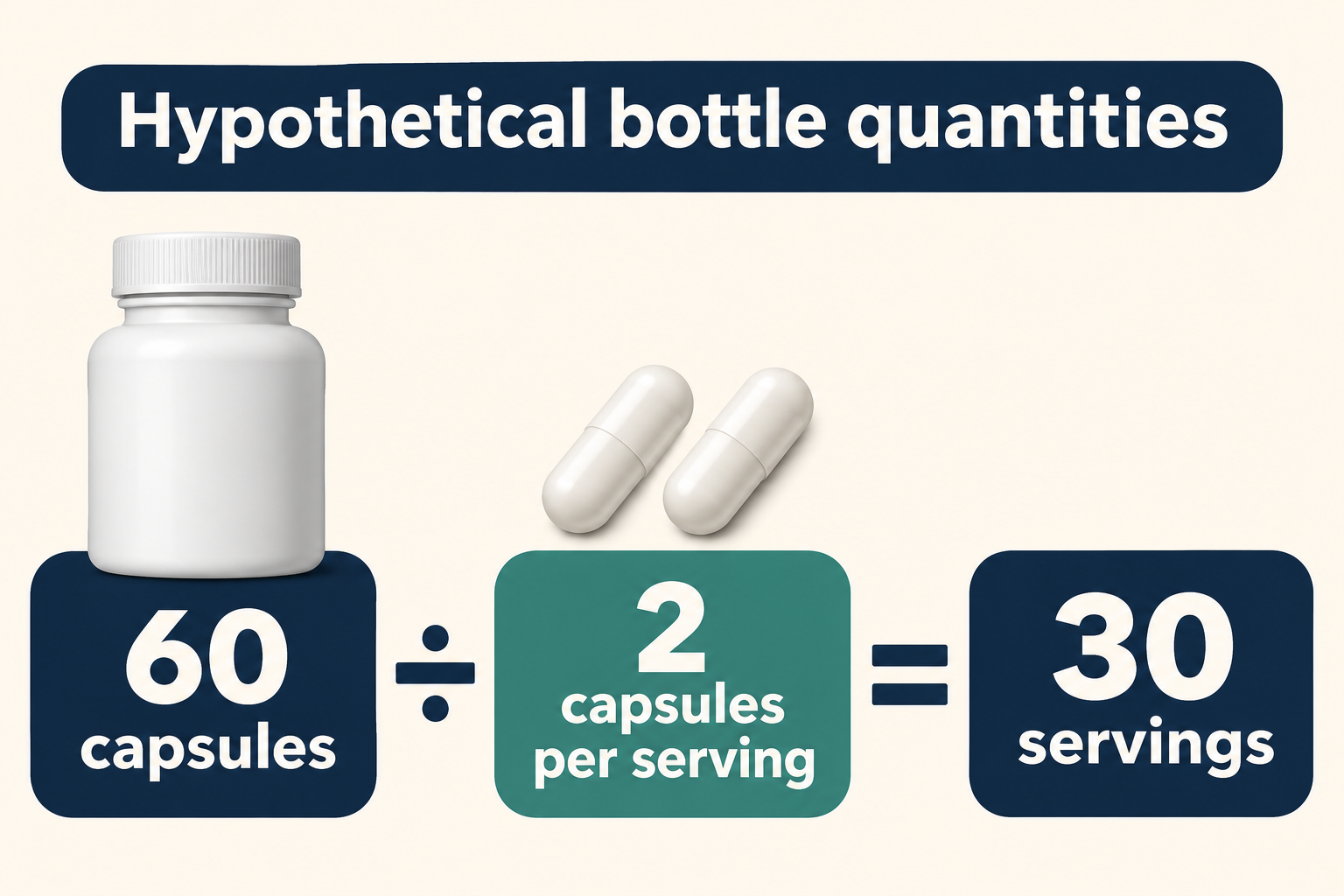
Consider a hypothetical bottle containing 60 capsules, with a serving size of two capsules. These invented inputs illustrate counting, not a product or suggested dose.
- Individual pieces inside the bottle
- The example bottle contains 60 individual capsules altogether.
- Individual pieces in each labeled serving
- The example serving contains two capsules grouped together.
- Total number of labeled servings
- Dividing 60 capsules by two capsules per serving gives 30 servings.
The unit remaining after division is servings, not days. You haven’t included any information about frequency, so the calculation cannot produce a calendar duration.
To understand a duration claim, you also need the applicable directions and the pattern of use being described. Don’t supply a missing schedule yourself.
The distinction also helps when comparing package sizes. Sixty capsules and sixty servings describe different quantities whenever one labeled serving includes more than one capsule.
Read a printed servings-per-container figure alongside the capsule count. If your arithmetic disagrees, first check whether you copied the serving size or package variant correctly.
Keep the Amount, Unit, and Serving Basis Together
A useful ingredient note needs three parts: its name, its quantity with units, and the serving basis. Leaving out one part can change the meaning.
For example, imagine an unnamed dietary ingredient listed as 400 mg per serving of two identical capsules. The number describes the two-capsule serving collectively.
Dividing that stated amount by two produces an arithmetic average of 200 mg per capsule. It doesn’t independently measure either capsule or verify the contents.
The following comparison keeps that distinction visible without presenting a real supplement formula.
| Hypothetical label or calculation | What the number describes |
|---|---|
| 400 mg per two-capsule serving | The stated ingredient amount covers both capsules together. |
| 200 mg arithmetic average per capsule | The calculation divides the stated serving amount by two. |
| 800 mg assumed for two capsules | This mistaken total counts the serving amount twice. |
If you write down the calculated average, label it as a calculation. Otherwise, someone reading your notes could mistake it for a separately printed declaration.
Units need just as much attention as capsule counts. A milligram and a microgram are different quantities, even when the printed numbers look similar.
One milligram equals 1,000 micrograms, commonly abbreviated mg and mcg. Before comparing amounts, confirm that both labels use matching units for the same ingredient.
Some nutrient names include additional measurement terms, such as dietary folate equivalents. Preserve the full notation rather than removing unfamiliar letters to simplify your notes.
Also read words in parentheses beside the ingredient. They may identify its source, rather than describe another ingredient amount that you should add.
For example, a calcium row can identify calcium carbonate as its source. The declared calcium amount refers to calcium, not the entire source compound’s weight.
What % Daily Value Can Tell You
The FDA’s Daily Value explanation distinguishes a nutrient’s Daily Value from the percentage contributed by one serving of a product.
The percentage is a comparison with that reference amount. It isn’t the percentage of your capsule occupied by the nutrient or a predicted improvement in health.
A row showing 50% Daily Value supplies half the applicable reference amount per labeled serving. That reference isn’t a personalized assessment of what you need.
If a serving contains two capsules, the percentage in its main serving column applies to that serving too. Don’t read it as the percentage for each capsule.
Keep the amount and percentage from the same column together. Mixing a per-capsule amount with a per-serving percentage creates a comparison the label never made.
Daily Value labeling also distinguishes population groups. Some panels identify separate columns for children or for pregnancy and lactation, rather than using one column for everyone.
Follow the heading that actually appears on the label. Don’t substitute an adult reference for a differently identified group or use this guide to choose children’s supplements.
A high percentage doesn’t automatically make one bottle preferable. Your food, other products, health circumstances, and professional advice matter beyond this single labeling reference.
Likewise, reaching 100% is not an instruction to take additional capsules until every row reaches that figure. Different rows on the panel describe different nutrients.
If you want help assessing overlapping products, bring their complete labels to your pharmacist or clinician. Include fortified products rather than discussing supplement names alone.
Follow the Footnote When No Daily Value Is Established
You may see an asterisk or another symbol instead of a numeric percentage. Follow that symbol to the matching statement at the bottom of the panel.
A footnote saying the Daily Value is not established means there isn’t an established labeling reference for that ingredient. It does not mean the amount is zero.
It also doesn’t supply a safety rating or prove that an ingredient works. A missing reference percentage answers a narrower question about how the label reports it.
Don’t calculate a percentage by borrowing the Daily Value of a different nutrient. Similar names or nearby rows do not make those reference amounts interchangeable.
The ingredient can still have a stated amount per serving. Read that quantity separately, while recognizing that a proprietary blend may limit individual quantity information.
A Proprietary Blend Total Is Not Every Ingredient’s Amount
A blend can have an individual name followed by a combined weight, with component ingredients listed underneath. The indentation helps show which ingredients belong to that blend.
The FDA labeling guide’s proprietary-blend discussion explains the combined declaration. Current regulations preserve separate declaration requirements for nutrients with established Daily Values.
For the other dietary ingredients grouped in a proprietary blend, its stated total covers their combined weight. The component list follows descending predominance by weight.
That ordering provides relative information, not a full recipe. A first-listed component does not acquire the entire blend’s amount simply because its name appears first.
Imagine a hypothetical 600 mg blend containing three named components. You cannot conclude that each contributes 200 mg, because equal shares have not been disclosed.
You also cannot assign 600 mg to all three components separately. Doing so turns one combined amount into three amounts that the panel never reports.
Dividing a blend total by the capsule count does not uncover its recipe either. The calculation changes the serving basis, not the missing component-level information.
If a comparison depends on one component’s precise quantity, record that quantity as undisclosed. Ask the manufacturer for the exact information rather than filling in an estimate.
An undisclosed share limits the comparison you can make. It does not, by itself, establish that the ingredient is absent, ineffective, or dangerous.
Pay attention when a product contains both separately quantified ingredients and a blend. A number beside one nutrient should not be reassigned to an ingredient underneath.
Use Label Examples Without Treating Them as Product Advice
The FDA provides reference examples of Supplement Facts panels, including a format with separate per-caplet and per-day columns.
In that example, the per-day heading identifies three caplets while the serving-size line identifies one caplet. The headings explain why the two columns contain different amounts.
It illustrates a reporting format, not a recommended product or schedule for you. Its caplets are separate from this guide’s hypothetical two-capsule serving.
When using any example, carry its headings along with its rows. An ingredient crop without its column title cannot reliably teach you which quantity you’re reading.
FDA’s older labeling guide also contains historical nutrient examples. Use current FDA reference information when checking Daily Values rather than copying old example percentages.
This is especially important if you find a label image through search results. Check the actual document and version instead of assuming every familiar panel is current.
Read the Whole Supplement Facts Label Before Comparing Products
The Supplement Facts panel isn’t the complete label. Directions, warnings, other ingredients, and the net quantity statement provide additional context that one nutrition table cannot replace.
The FDA’s dietary supplement questions and answers describes other ingredients such as gelatin, starch, stabilizers, preservatives, and flavors.
Those entries serve a different purpose from the dietary ingredient quantities in the panel. Don’t assume that ingredients outside the panel are absent or unimportant.
If you are comparing prices, first confirm the number of labeled servings in each bottle. A larger capsule count can still provide fewer servings.
Cost per labeled serving is one purchasing comparison, not a clinical value score. It cannot resolve ingredient differences, undisclosed blend shares, or suitability.
Use the same product version throughout your notes. An online photo, an older bottle, and a different package size should not be silently combined into one label.
When a received bottle differs from the online panel, preserve photographs of both versions. Ask which label belongs to your exact product before relying on the listing.
Choose the Label Detail You Need to Understand
Keep the complete panel and directions available while reading these branches. None asks for health information or calculates a recommended amount.
My label lists an amount per serving
Match the amount with the serving-size line and its column heading. If several capsules form that serving, the main amount covers them together.
My label lists a proprietary blend
Identify the combined blend weight and its indented ingredients. Treat an individual component’s amount as unknown unless the label or manufacturer actually discloses it.
My ingredient has no established Daily Value
Read its symbol and matching footnote, then check any stated quantity separately. The missing percentage does not answer whether you should use that ingredient.
What to Do When a Supplement Label Is Unclear
-
Collect all the available product label information. Photograph the full Supplement Facts panel, directions, warnings, other ingredients, and product name without cropping away column headings.
Keep those images with the package version you are checking. A shopping page’s updated photograph may not describe the bottle already in your cabinet.
-
Write the complete serving statement exactly as printed. Include the capsule count and any additional wording, rather than shortening the line to a number without units.
Then copy the ingredient amount from its corresponding column. This small transcription step often reveals where an apparent contradiction began.
-
Separate disclosed amounts from missing information. Mark a blend’s total as combined, and leave undisclosed component quantities unknown instead of dividing them equally.
Preserve footnotes and units in the same note. That gives the person helping you the information needed to interpret the question accurately.
-
Ask the manufacturer a precise label question. Identify the exact product and ask whether the printed amount refers to the serving or an additional column.
If a particular blend component matters, request its quantity directly. A general ingredient description doesn’t answer a question about its amount.
-
Take personal use questions to a health professional. FDA advises discussing supplements with a doctor, pharmacist, or another appropriate professional before purchasing or using them.
Bring complete labels for other supplements and medicines you use. Don’t independently change prescribed treatment or take extra capsules to match a percentage.
Frequently Asked Questions
Does one capsule always equal one serving?
No, the serving-size line can identify several capsules together. Read that statement before interpreting the ingredient amounts listed in the main serving column.
Can I divide the serving amount by the capsule count?
For identical capsules, division gives an arithmetic average based on the label. It does not test the contents or establish an appropriate amount to take.
Does 100% Daily Value tell me my personal dose?
No, it compares the labeled nutrient amount with a reference value. Personal needs and suitability cannot be determined from that percentage alone.
Does a missing Daily Value mean an ingredient is missing?
No, a matching footnote can indicate that no Daily Value has been established. Check the ingredient declaration and any stated amount separately.
Can I work out each proprietary blend ingredient’s amount?
The combined weight and ingredient order do not disclose exact component shares. Unless those quantities are provided separately, you cannot reconstruct them reliably.
Does a bottle containing 30 servings last 30 days?
Not automatically, because servings count labeled portions rather than calendar days. Duration also depends on the applicable directions and the use pattern being described.
The Bottom Line
Read Supplement Facts as a connected label: serving size first, then the matching amount, units, Daily Value column, and footnotes. Keep capsule counts distinct from servings.
If your bottle remains unclear, save its complete label and ask a specific question. Take decisions about use to your pharmacist or clinician, not an arithmetic shortcut.

Join the discussion
0 commentsShare your experience or ask a question about this article.
Community experiences
Did this happen to you?
Your experience could help someone recognize the same scam. Submit a private report for our team to review.
I experienced this tooReports are reviewed before publication. Sharing publicly is always your choice.
Discussion
Start the conversation
Have a question or something useful to share? Add the first comment.