


A frightening computer warning can lead to a support purchase within minutes. By the time a card statement arrives, the payment’s business names may look unfamiliar.
The Nuvei FTC case follows the companies behind that payment route. It explains why the business accepting a charge matters alongside the person making the pitch.
Overview
The case concerns payment processing for disputed merchants
The FTC alleged that Nuvei-related businesses processed payments for merchants using deceptive practices, including historical Reimage technical-support offers. The complaint examines warnings, merchant accounts, and chargeback patterns.
A court order entered September 9, 2026 imposes a $4.85 million judgment and restrictions on specified processing practices.
The defendants neither admit nor deny the allegations, apart from jurisdictional matters. The settlement is not a finding that every Nuvei customer or transaction was fraudulent.
The payment chain can conceal the relationship a consumer expects
Consumers typically remember the advertised software or support service. A card statement may instead identify a billing intermediary, merchant account, or related legal company.
The FTC’s complaint describes several processing channels used for Reimage. The agency alleges those arrangements continued despite warning signs about the underlying sales practices.
A recognizable card network does not endorse a merchant’s claims. Payment acceptance tells you a charge can travel through the system, not that the pitch was independently validated.
Use the case to explain a charge, not assume a refund
- Match the statement entry with the original purchase.
- Separate the merchant’s promises from the processor’s role.
- Keep invoices and descriptions of the support offered.
- Explain the actual billing problem to your card issuer.
- Follow official updates without paying a recovery intermediary.
The judgment does not establish an automatic payment for every former customer. An individual dispute still depends on the transaction, available evidence, and applicable deadlines.
Why a processor became part of a consumer-protection case
A payment processor helps businesses accept money through financial networks. That role can seem distant from the advertisement or telephone conversation that prompted a purchase.
Distance does not make the role unimportant. If a merchant cannot collect payments, it cannot easily turn a misleading sales pitch into revenue.
The FTC complaint alleges the defendants kept providing that access despite information indicating unlawful conduct by certain merchants.
Its theory is more specific than saying a processor handled a controversial sale. The agency points to onboarding information, network warnings, testing, and unusually persistent disputes.
That distinction protects against guilt by association. Ordinary processing for a merchant is not, by itself, proof that a processor knew about a misleading claim.
The FTC says more than $30 million was processed for Reimage during the relevant historical period. That figure is not the same as the settlement amount.
It also should not be described as a guaranteed refund pool or a total owed to United States consumers. Different figures in a case can measure different things.
The Reimage sales history described in the complaint
The complaint alleges Reimage used misleading computer warnings and purported diagnostic results to sell software, followed by telephone pitches for more expensive technical support.
The initial software purchase and subsequent support sale were separate parts of the alleged path. A relatively modest first payment could lead into a larger commitment.
Historical exhibits show support packages priced in the hundreds. Those examples explain the complaint’s allegations; they are not a current offer or a recommendation to buy.
The agency also describes testing involving a clean computer and communications from Microsoft and card-network participants. It alleges these supplied warnings about the merchant’s conduct.
For a consumer, the practical lesson is to assess what the seller actually demonstrated. A frightening browser message cannot independently diagnose the condition of your computer.
Likewise, a person claiming to represent Microsoft needs verification through Microsoft’s own channels. A sales conversation does not establish the claimed affiliation.
This article follows the payment-processing case rather than diagnosing a particular device. A historical purchase alone does not establish that your computer currently contains malware.
If you also gave someone remote access, describe that separately when seeking trusted technical help. The software-access issue and the disputed payment require different questions.
The processing routes behind a familiar merchant name
The complaint’s payment diagram places cardholders, networks, acquiring businesses, and merchant-facing intermediaries within several routes. Reimage appears at the merchant end of those historical arrangements.
The diagram helps explain why a receipt and statement can show different names without representing different purchases. It does not establish misconduct by every organization depicted.
Its labels describe the FTC’s account of the relationships. Read those labels alongside the complaint’s specific allegations rather than treating the diagram as a universal payment map.
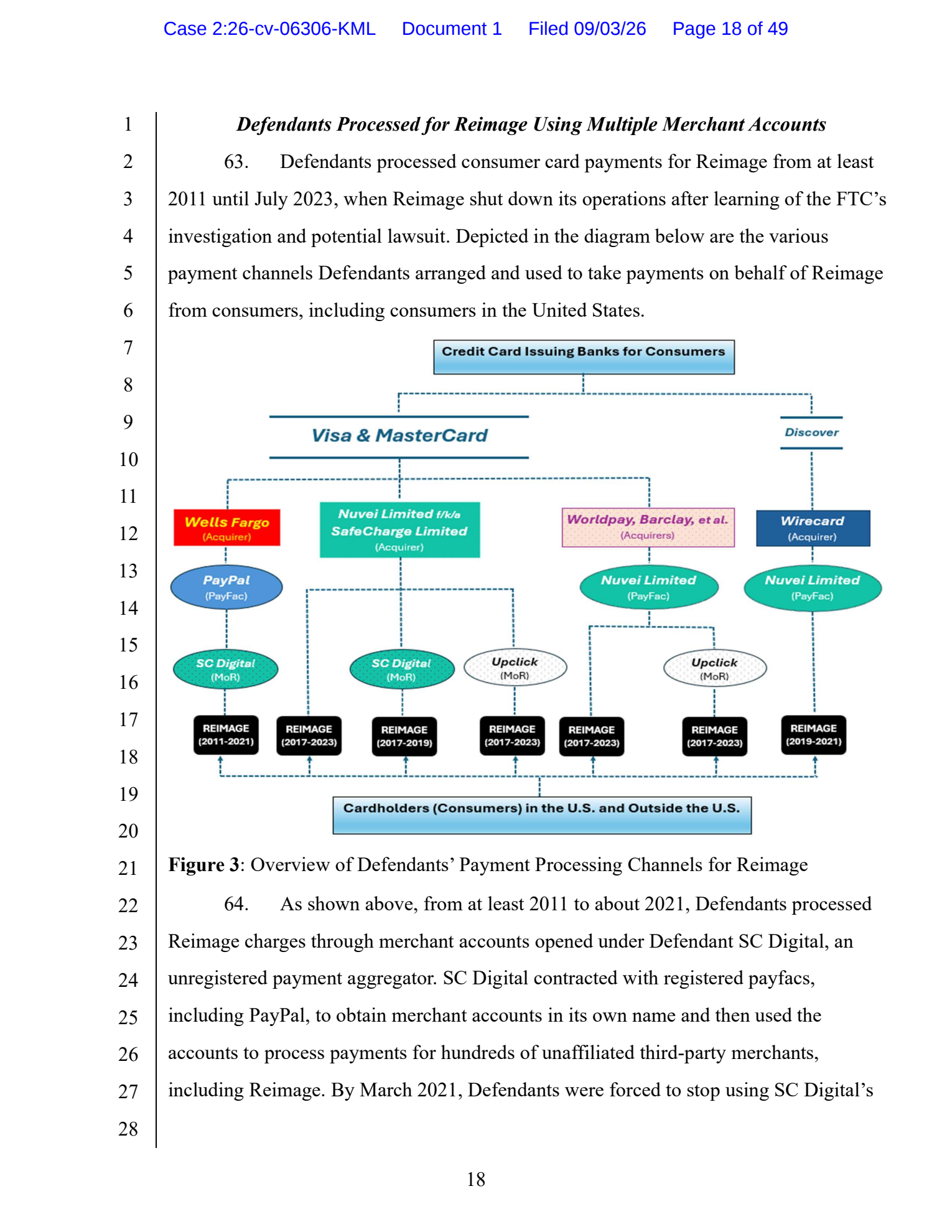
A card issuer is the institution serving your card account. A merchant’s processor or acquiring bank generally serves the payment-acceptance side of the transaction.
A merchant of record may appear as the seller responsible for a payment. That label does not automatically identify the person who made the original sales claim.
These distinctions help when describing a dispute. Supply the advertised name, invoice name, and exact statement entry instead of insisting they must all be identical.
| Record you have | What it can clarify | What it does not prove alone |
|---|---|---|
| Advertisement or support pitch | The promise that prompted your purchase. | The legal identity behind every payment step. |
| Invoice or order confirmation | The named seller, product, amount, and date. | Whether every sales claim was accurate. |
| Card statement descriptor | The entry your issuer can locate. | An endorsement by the processor or network. |
| Cancellation or refund correspondence | The remedy requested and response received. | That funds actually reached your account. |
Do not publish full card details to identify an unfamiliar entry. Your issuer can investigate through its private account channels without involving strangers.
Which Nuvei businesses were named?
The parent and subsidiaries have distinct legal names
The defendants include Nuvei Corporation, Nuvei International Group, Nuvei Limited, SafeCharge Digital, and Nuvei Technologies. The complaint identifies their respective corporate roles and jurisdictions.
Some entities previously used SafeCharge or Pivotal-related names. Historical paperwork may therefore use a name different from the one a reader recognizes today.
The FTC alleges a common enterprise among the named defendants. That allegation rests on the complaint’s described relationships, not simply similar branding or a shared address.
The merchant and processor are not interchangeable
Reimage made the underlying technical-support offers described in the complaint. The Nuvei defendants are addressed for their alleged role in enabling and maintaining payment acceptance.
Confusing those roles can produce an unhelpful complaint. Explain which promise concerned the service and which payment detail concerns the way money was collected.
The case also discusses other merchants, but their inclusion does not justify broad accusations about every business using a particular processor.
The statement name deserves a transaction-specific explanation
The complaint describes multiple merchant accounts and descriptors within its historical allegations. A descriptor can be a useful clue without proving who operated an entire business.
Ask your issuer to connect the posted charge with its transaction information. Compare that result with the invoice before deciding an unfamiliar name means an unauthorized purchase.
If you recognize the purchase but dispute deception or nonperformance, say so. Calling a recognized transaction completely unknown can obscure the actual problem.
Consumer contact is different from regulatory compliance contact
The order requires information and cooperation for enforcement purposes. Contacts supplied for that process should not be treated as an announced consumer claims desk.
Use your existing merchant correspondence and card issuer for a specific billing problem. Follow an official refund announcement if one later provides separate instructions.
No passage in the settlement authorizes a stranger to collect an advance fee from you in exchange for releasing money.
Why repeated chargebacks mattered to the FTC
A chargeback is a payment dispute handled through the card system. It can arise for several reasons, so a single dispute does not establish deception.
The FTC instead describes sustained patterns and the defendants’ alleged responses. It alleges account arrangements helped merchants continue processing while obscuring the scale of disputed activity.
One issue is spreading transactions among accounts without addressing why customers dispute them. Changing how a rate looks is different from fixing the underlying sales practice.
Ordinary multi-account or international processing is not automatically unlawful. The complaint focuses on alleged evasion and knowledge within the particular merchant relationships it describes.
The entered order consequently addresses both merchant screening and ongoing monitoring. Its requirements are not limited to collecting a penalty after a merchant has disappeared.
It prohibits specified processing for technical support marketed through telemarketing or pop-ups, and it restricts practices designed to evade monitoring or misrepresent merchant information.
For covered clients, the order calls for review of relevant risk information and continuing checks. Detailed compliance thresholds govern the defendants, not a consumer’s refund eligibility.
A reader therefore should not apply a chargeback percentage from the order as a personal entitlement test. Your own billing issue needs its own explanation.
The settlement amount and the case’s current status
The entered judgment is $4.85 million. Its consumer-relief provisions leave room for how money may ultimately be used, rather than promising every customer a payment.
The September 9 order directs the clerk to close the case while retaining enforcement jurisdiction. Some summary case information can lag behind an entered court document.
That is why the settlement should not be described merely as an unapproved proposal. The actual signed order determines the status of these obligations.
The order’s no-admission language also matters. An agreement to restrictions is not the same as a criminal finding or an admission about every allegation.
For a former customer, the most useful next step is to identify a specific unresolved payment. A large case total cannot replace your receipt and account history.
What to Do If You Recognize a Related Charge
-
Locate the purchase confirmation and exact statement entry. Note whether the payment concerned software, a support package, or another service.
Keep the original documents privately, including any advertisement or representation you relied on. A brief timeline will help you explain the disputed promise.
-
Check whether you previously requested cancellation or a refund. Compare any approval message with actual credits on your card account.
A promise to refund is not the same as a posted credit. If the promised date passed, include that fact when contacting the merchant or issuer.
-
Contact the card issuer through the number or secure channel you already trust. Describe the transaction accurately and ask about available dispute procedures.
Do not assume the FTC settlement restarts an expired deadline. The issuer should explain what options remain for the specific charge.
-
Separate device concerns from payment concerns when requesting assistance. Explain whether you installed software, supplied passwords, or permitted remote access, rather than assuming all three occurred.
If someone still has access you did not intend, seek trusted technical assistance through an independently reached provider. Avoid returning to an alarming pop-up’s telephone number.
-
Monitor official FTC updates about any consumer relief. Ignore unsolicited claims that a fee, cryptocurrency transfer, or verification code is required to release settlement funds.
Report a misleading payment or recovery approach through the appropriate official channel. Keep the account details out of public comments and social posts.
Match the next action to the problem
The statement name is unfamiliar but the amount looks familiar
Compare the date and amount with your invoice, then ask the issuer to identify the transaction. An unfamiliar descriptor does not automatically mean your card was stolen.
I recognize the purchase but the service was misrepresented
Explain the particular claim and why the delivered service differed. Supply your original sales record rather than relying solely on the existence of the FTC case.
I received a message promising a settlement payment
Check official case updates independently before responding. Do not send money or account codes to somebody who claims to control your refund.
Frequently Asked Questions
Did Nuvei admit the complaint’s allegations?
The order says the defendants neither admit nor deny them, with a jurisdictional exception. Its injunction and monetary obligations nevertheless took effect through the entered settlement.
Is every merchant using Nuvei implicated?
No, the case concerns specified conduct and merchant relationships. It does not establish that every customer, transaction, or business using Nuvei was deceptive.
Is the $4.85 million a guaranteed refund pool?
No, the judgment does not establish each consumer’s eligibility or payment. Follow official consumer-relief instructions if an applicable program is announced.
Why might my statement show another business name?
The payment route can involve a merchant of record or other intermediary. Compare your invoice and ask your issuer to identify the particular transaction.
Does a historical Reimage payment prove current malware?
No, a payment record cannot diagnose your device. Describe any installation or remote access separately when seeking appropriate technical assistance.
Should I wait for the FTC before contacting my issuer?
No, raise an unresolved billing issue promptly through your issuer. A regulatory case does not automatically pause the deadlines applying to your account.
The Bottom Line
The Nuvei FTC settlement shows why the payment chain deserves scrutiny alongside a sales pitch. It does not condemn every merchant using that chain.
If you have an unresolved related charge, connect the invoice, statement entry, and disputed promise. Seek a transaction-specific remedy without paying anyone to unlock supposed settlement money.

Join the discussion
0 commentsShare your experience or ask a question about this article.
Community experiences
Did this happen to you?
Your experience could help someone recognize the same scam. Submit a private report for our team to review.
I experienced this tooReports are reviewed before publication. Sharing publicly is always your choice.
Discussion
Start the conversation
Have a question or something useful to share? Add the first comment.