


The invoice is familiar, the payment is due, and an email says the receiving bank has changed. Nothing else about the purchase appears different.
Before replacing those saved instructions, take a closer look. A recently sentenced fraud conspiracy shows how an ordinary payment can end up somewhere entirely unexpected.
Overview
A real payment becomes the opening
This scam starts with money somebody genuinely intends to send. The criminals substitute the destination, making their request fit an existing transaction instead of inventing another purchase.
That distinction explains why the invoice amount, supplier name, and timing can all look right. The account receiving the payment is what needs independent confirmation.
The McPherson case establishes actual fraud
Zamar McPherson pleaded guilty in a business email compromise conspiracy involving redirected wires. Federal prosecutors announced her three-year prison sentence on November 13, 2026.
The intended payees were being impersonated or had their communications compromised. Their customers’ legitimate payments became the targets of a criminal payment-diversion operation.
A reply in the same thread cannot authenticate the change
Stop the payment until you reach the intended recipient through a contact established before the questioned email. Confirmation supplied through the disputed conversation remains inside that conversation.
- Check bank-detail changes separately from invoice approval.
- Use an existing telephone contact for independent verification.
- Save the original message, attachment, and transfer record.
- Notify your bank immediately if money already moved.
What Happened in the Confirmed Email Fraud Case
According to the Justice Department’s sentencing announcement, McPherson conspired with Garland Shelton, Olivia Oxley, and others to divert payments owed to legitimate recipients.
A conspirator used fictitious email accounts to supply replacement wire instructions. The money went into accounts belonging to the conspirators rather than the people expecting payment.
An earlier guilty-plea announcement also describes compromised payee email accounts. Both routes explain why relying on the apparent sender alone can fail.
The June announcement described a scheme stealing more than $3 million. The later sentence included restitution exceeding $1.5 million to four victims, jointly with coconspirators.
Those figures describe different measures in the case. The restitution order does not establish that all stolen funds have already been recovered or repaid.
McPherson was also ordered to forfeit $154,474.85. A forfeiture obligation likewise should not be mistaken for an individual customer’s completed reimbursement.
The important buying lesson is the substituted destination. A genuine debt can still be unpaid after the sender transfers its full amount to criminals.
How the Changed Bank Details Email Scam Works
Step 1: The criminals attach themselves to an expected payment
A pending invoice gives the message a believable reason to exist. You already expect to hear from a supplier, professional adviser, or other payee.
Criminals do not need to persuade you to buy something unfamiliar. They need you to accept one alteration to a payment you have already approved.
The McPherson announcements establish both fictitious email accounts and compromised payee accounts. They do not disclose every victim’s original message or the precise access method in every transaction.
Step 2: Replacement instructions appear to come from the payee
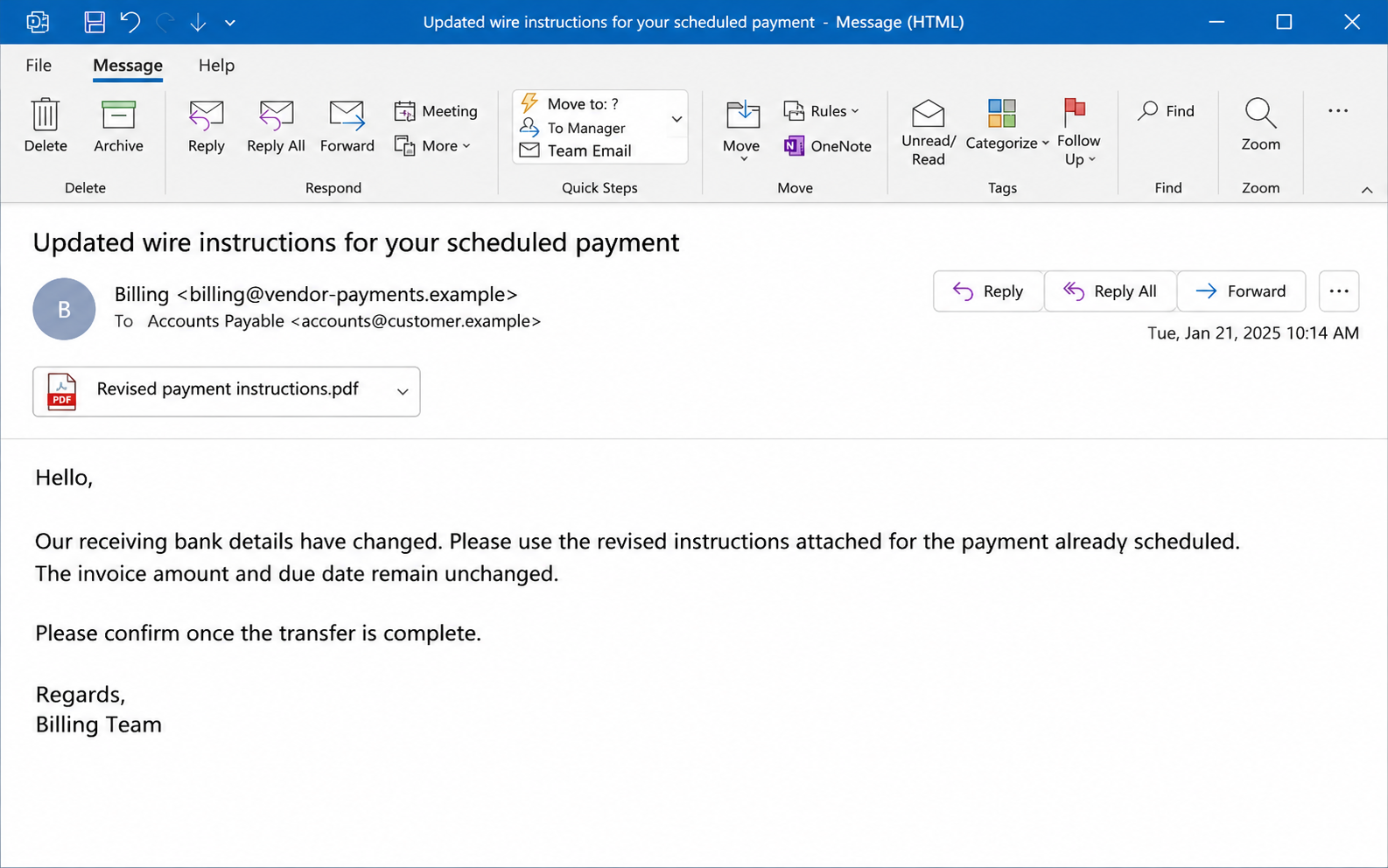
The email changes the receiving account while preserving the surrounding business context. A recognizable name or an attached document can help the alteration pass unnoticed.
The pictured email recreates this payment-switch request with fictional details. It is not a recovered message from the McPherson case.
A lookalike address may differ from the real one. With an actually compromised mailbox, the address can be correct while the instruction is fraudulent.
That is why spotting spelling mistakes helps but cannot settle the decision. An email address is only one part of verifying who authorized the destination.
Step 3: Normal payment procedures carry out the theft
The payer enters the substituted details and authorizes a wire. The transfer may work exactly as instructed, even though the instruction came from an impostor.
A bank confirmation then proves that money moved, not that the intended supplier received it. The receiving account must be checked against the legitimate agreement.
When finance staff focus on amount, invoice number, and approval, an account change can escape scrutiny. Give that change its own verification step before releasing funds.
Step 4: The recipient accounts help move the money onward
In this conspiracy, personal and illegitimate business accounts helped receive fraudulent payments. An account displaying a business name was therefore not reliable reassurance.
The person collecting the wire need not be the person writing the email. Organized payment diversion can involve several people performing different roles.
The October sentencing announcement for Shelton and Oxley makes that separation explicit. Prosecutors described both as facilitators of transfers rather than leaders of the operation.
They forwarded almost all the fraudulent proceeds to coconspirators overseas. The receiving account was therefore a stop along the route, rather than necessarily the final destination.
Oxley received one year and one day in prison, followed by supervised release. Shelton received community service and supervised release, with restitution ordered for both.
Those different sentences concern their individual roles. They do not make an instruction safe merely because its beneficiary appears to be an ordinary person or small business.
For a victim, the immediate task is identifying the actual destination and reporting it. You do not need to solve the entire organization before contacting your bank.
Step 5: The missing payment exposes the substitution
The problem may become obvious when the real payee says nothing arrived. At that point, compare the instructions used with the recipient’s independently confirmed details.
Do not send another wire simply because the conversation proposes a correction. First establish what happened to the original payment through both banks and the genuine recipient.
Why a Correct Invoice Can Still Lead You Astray
Think about the task you believe you are completing: paying an approved invoice on time. The scam succeeds by making a different task look like that one.
The amount can remain unchanged, so the request never triggers a discussion about additional spending. The loss comes from changing who receives the existing payment.
A familiar signature can also direct attention toward the wrong question. Recognizing the sender’s job title does not confirm that the sender authorized this particular instruction.
Attachments add another layer of apparent formality. A PDF can repeat an invoice number, address, and logo without proving ownership of the account printed inside it.
Do not treat a document’s polished appearance as a bank check. Compare the payment destination against a record obtained through a separate, trusted conversation.
There is also a difference between approving an invoice and approving new bank details. Those decisions deserve separate records, particularly when different employees handle purchasing and payments.
A second employee should verify the change rather than merely approve the first employee’s copied instructions. Otherwise, two approvals can repeat the same original mistake.
Urgency can make that distinction feel inconvenient. A looming deadline still does not give an unknown receiving account a legitimate connection to your supplier.
The Phone Call That Actually Checks the Instruction
The FBI’s business email compromise guidance recommends verifying changes to account numbers or payment procedures directly with the person making the request.
Use the telephone number already held in your supplier record, signed agreement, or earlier verified correspondence. A number newly supplied beside the replacement bank details cannot provide independence.
Explain precisely what needs checking: whether the payee requested a change, which payment it covers, and whether the receiving account belongs to that payee.
Do not ask only whether an invoice exists. The real company can confirm that you owe money while knowing nothing about the fraudulent account-change email.
Read back the relevant destination information through your approved business process. Record who confirmed it, when they confirmed it, and the contact route you used.
If the usual contact is unavailable, hold the transfer and escalate internally. Replacing an independent check with another message to the disputed mailbox restores the original risk.
For a personal transaction, the same principle applies without a finance department. Call the professional or business using the contact established when the relationship began.
Never let a stranger on the email thread define your verification procedure. An instruction to avoid calling should increase scrutiny rather than shorten it.
What Your Bank Receipt Does and Does Not Tell You
A transfer receipt is essential evidence, but it answers a limited question. It records the instruction your bank processed and the destination associated with it.
It does not independently establish that your contractor, vendor, or other intended recipient controls that destination. That connection is the missing link in payment diversion.
Keep both versions of the instructions when available. Investigators and banks can compare the legitimate destination with the substituted one instead of relying on a summary.
Record the amount, currency, sending time, bank reference, beneficiary details, and relevant correspondence. Do not change currency labels when describing an international transaction.
Also preserve the full email rather than only a cropped screenshot. Original message information may help investigators examine routing, account use, and the sequence of communication.
Keep a clear timeline linking the original invoice, the account-change request, the payment approval, and the transfer. That sequence separates the legitimate purchase from the substituted instruction.
If several staff handled the transaction, record each person’s action without rewriting the original messages. Your bank needs the actual instruction history rather than a reconstructed conversation.
Retain any telephone verification notes too, including the number used and who supplied it. That can reveal whether the attempted check returned to the same impersonator.
If a business mailbox might be compromised, involve its administrator. Ask them to preserve sign-in records and check rules that forward, hide, or delete messages.
A changed rule can help explain why an invoice conversation disappeared. Record its destination and creation time before removal through your organization’s incident process.
What to Do if You Have Fallen Victim to This Scam
-
Call the sending bank before doing anything else
Report a fraudulently induced wire and provide its reference, destination, amount, and time. Ask the bank to contact the receiving institution immediately.
Ask what recall, recovery, or beneficiary-account action is available. Keep the bank’s case number and follow its document-submission instructions without assuming recovery is guaranteed.
Describe the authorization accurately: you approved a transfer after receiving deceptive instructions. That account is more useful than claiming someone stole a card when no card was involved.
-
Contact the genuine payee through your established channel
Explain that the payment may have been redirected. Share the relevant transaction details securely and ask whether the company changed its instructions or received any funds.
Agree on how further communication will be verified. Pause another payment until your organization and the recipient understand the disputed transfer and their next steps.
-
Preserve evidence before deleting the conversation
Save original emails, attachments, invoices, bank receipts, and messages confirming the change. Include the original payment agreement and details of any verification attempts.
Keep copies outside a mailbox suspected of compromise. Finance and security teams should preserve relevant logs through their incident procedures rather than erase evidence during hurried cleanup.
-
Report the diversion and investigate exposed accounts
File a report through the FBI’s IC3 website and retain its confirmation. Provide the receiving account information and bank reference, not just the suspect display name.
Tell your email administrator if credentials were entered, unusual sign-ins appeared, or an account sent unauthorized messages. Match account-protection actions to what was actually exposed.
-
Reject another payment presented as a recovery requirement
Do not pay an unsolicited intermediary to release, insure, or recover the wire. Verify any claimed bank or investigator independently before sharing additional records.
A person quoting details of your loss may still be an impostor. Continue through the bank and reporting channels you contacted yourself.
Frequently Asked Questions
Is every email announcing new bank details a scam?
Businesses can genuinely change receiving accounts. The safe decision is to verify the particular change through an established independent contact before authorizing the transfer.
Can the email really come from my supplier’s mailbox?
A compromised account can send unauthorized instructions using a genuine address. The McPherson plea announcement describes compromised payee accounts as part of this conspiracy.
Does the correct invoice amount prove the instructions are genuine?
The amount can remain correct while the destination changes. Confirm who controls the receiving account instead of treating a familiar invoice total as authentication.
Does the prison sentence mean victims have been repaid?
A sentence, restitution order, and forfeiture obligation are separate from completed recovery. The announcements do not establish that every affected payer received their money back.
Should I reply to the email to verify its attachment?
A reply can reach the same impostor or compromised mailbox. Contact the real payee using a telephone number established before the questioned instruction arrived.
Should I wait for the recipient to investigate before calling my bank?
Contact your bank immediately while notifying the genuine recipient separately. Delaying the fraud report gives the destination account more time to move the money onward.
The Bottom Line
Do not wire money to changed bank details until the intended payee confirms them independently. The McPherson case shows how legitimate payments can fund a criminal conspiracy.
If you already sent the wire, call your bank now, preserve the original instructions, and notify the real recipient. Another reply to the disputed email is not verification.

Join the discussion
0 commentsShare your experience or ask a question about this article.
Community experiences
Did this happen to you?
Your experience could help someone recognize the same scam. Submit a private report for our team to review.
I experienced this tooReports are reviewed before publication. Sharing publicly is always your choice.
Discussion
Start the conversation
Have a question or something useful to share? Add the first comment.