


Coinexspro.com opens under the CoinEx name, with the exchange’s teal logo, a live Bitcoin price and an invitation to join a growing crypto exchange.
Before anyone sends this site money, we wanted to know who runs it, so we read its code, traced its domains and checked the real CoinEx.

Overview
What Coinexspro.com Shows Visitors
The home page carries the CoinEx name and a teal C logo, with menus for crypto, gold, stocks, ETFs and IEO/ICO offerings.
Log in and register buttons sit at the top, next to an online service link and a language menu that switches the whole interface.
The Bitcoin price on the page was within about $40 of the public market price when we checked, so the market data is not the problem.
What We Found Behind the Front Page
The site’s configuration file sends every account request to admin.coinexsmax.com, a domain registered in the same second as coinexspro.com itself.
Its code holds an interest-free loan feature, credit points and a request for a screenshot of your personal credit score.
The same code tells new users that their identity documents will be submitted to FINRA, the organization that oversees US brokerage firms.
Why This Matters Before You Deposit
The real CoinEx stopped accepting new users on September 15, 2026, is winding down, and names www.coinex.com as its only official website.
Here is what that means for anyone sent to Coinexspro.com by a new online friend, a trading mentor or a message from a stranger:
- Coinexspro.com is not CoinEx, because the real exchange names only www.coinex.com as its website and closed registrations in September.
- Deposits go to wallet addresses and are confirmed with an uploaded payment voucher, which leaves the operator in control of your balance.
- Built-in loans and credit scores give the platform a ready reason to ask for more money when you try to withdraw.
- Do not deposit, do not accept a platform loan, and do not pay any fee, tax or deposit to release a balance.
CoinEx Is a Real Exchange, and It Is Closing
CoinEx is a real cryptocurrency exchange with nine years of history, which is why its name lends a new site instant credibility.
On September 15, 2026, CoinEx published a notice of its orderly cessation of operations and stopped new registrations the same day.
Existing users can still withdraw their assets until December 22, 2026, the last date in the withdrawal schedule the notice sets out.
The notice also warns about fraud that impersonates CoinEx and names www.coinex.com as the only official CoinEx website, which rules out coinexspro.com.
When we opened coinex.com from a server in the United States, the exchange refused to serve our location and offered no way to sign up.
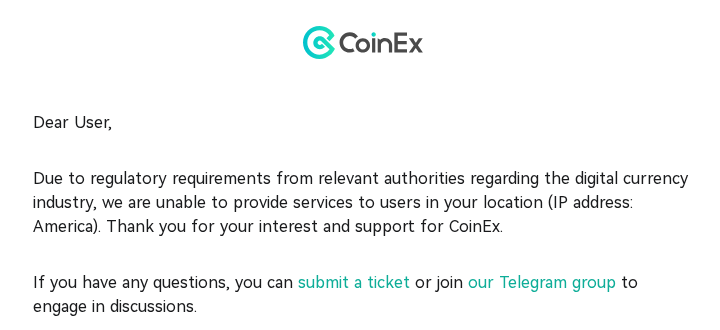
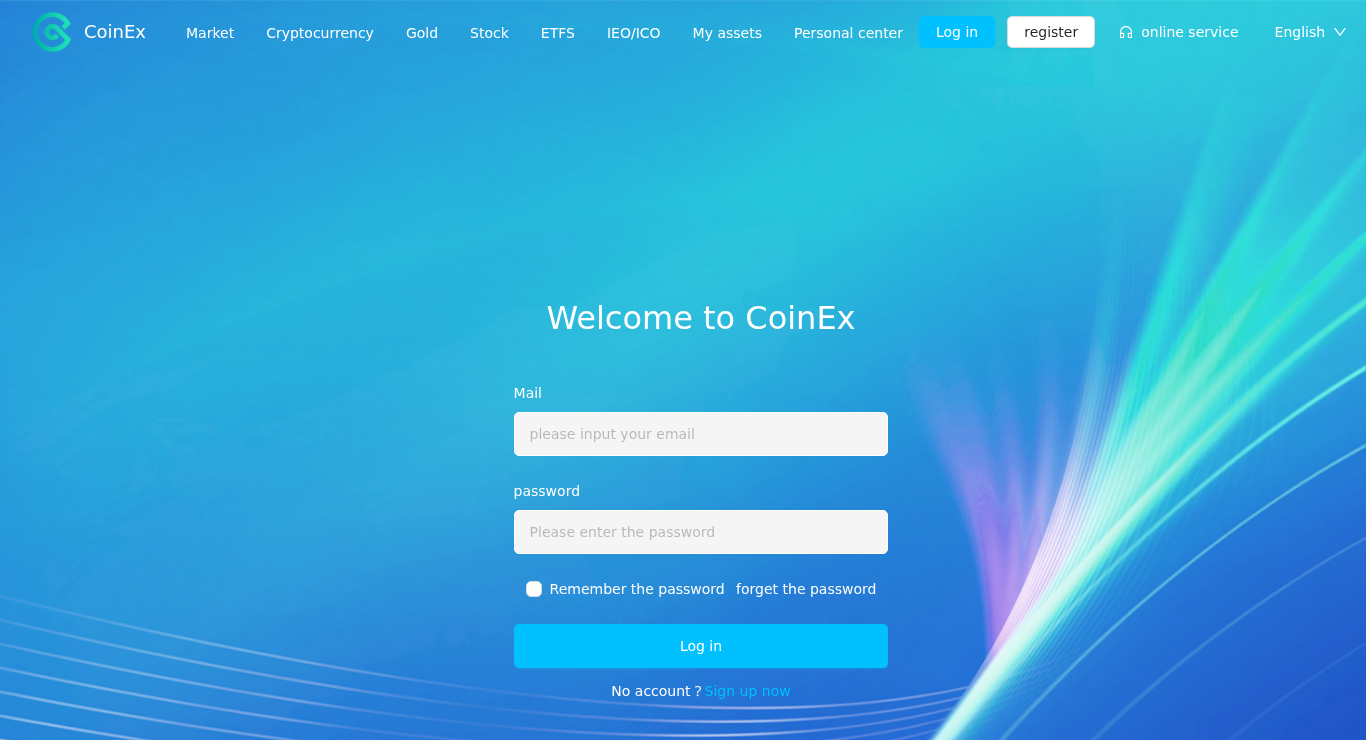
The copy, by contrast, welcomed us from the same location and placed a registration button in the top corner of every page.
This matters most for American readers, since the copy promises to send their documents to a US regulator while CoinEx itself turns US visitors away.
A genuine exchange that has closed its doors to new customers does not reopen them under a longer domain name with a different back end.
Anyone who holds a real CoinEx account should use only www.coinex.com and move their assets out before the December 22, 2026 deadline.
How the Coinexspro.com Scam Works
We did not create an account, so the steps below come from the site’s own code and screens, read alongside the FBI’s description of these schemes.
Step 1: A New Contact Points You to a Familiar Name
In the FBI’s warning about cryptocurrency investment fraud, criminals build trust with victims on dating apps, social media, professional networks and encrypted messaging.
Once the relationship feels safe, the conversation turns to crypto, and the victim is guided toward a trading website or app that the criminals control.
A site carrying the CoinEx name fits that script well, because a quick search turns up a real company that has run for years.
A domain that starts with coinex is easy to accept without checking who owns it, especially when a trusted contact sent the link.
Step 2: Sign-Up, Identity Documents and a Bank Card
The sign-in page greets visitors with “Welcome to CoinEx” and asks only for an email address and a password, so the first step feels familiar.
Inside, the code asks for an ID card, passport or driver’s license, and it adds an advanced verification step for users who go further.
It also invites users to bind a bank card, describing the link as a way to make payments and withdrawals more convenient.
The identity request promises that your documents will be authenticated and submitted to FINRA, a claim that does not match how FINRA works.
Handing a passport scan and bank details to an anonymous operator creates a risk that outlasts the money, since documents can be reused for new accounts.
Step 3: Deposits Through Wallet Addresses and Vouchers
Funding an account is called a recharge, and the deposit screens deal in wallet addresses and QR codes rather than card payments.
After sending crypto, the user is asked to upload a recharge voucher as proof of payment, which suggests each deposit is checked by hand.
The balance that appears afterward is whatever number the operator’s server chooses to display, and no blockchain record lets you check it.
An Experience mode in the same code runs on virtual wallets that cannot deposit or withdraw, which can show a newcomer easy profits before real money moves.
Step 4: Trading Screens That Look Like a Real Exchange
The platform lists spot trading, leverage, options, gold holdings, ETFs, IEO token sales and a product it calls carbon points.
It also offers stocks from the United States, Britain and Hong Kong, an unusually broad menu for a site that calls itself a crypto exchange.
Every price, trade and profit inside those screens is calculated by a back end the user cannot inspect, so a winning streak proves nothing.
Withdrawals start at 50 USD and are promised within minutes, while any special circumstances are routed to the online customer service instead.
Step 5: The Loan and the Credit Score
One page offers an interest-free loan, where users type the amount they want to borrow, and another keeps a record of every loan taken.
Alongside the loan sit a balance of credit points and a request for a screenshot of the user’s personal credit score.
We could not see the rules behind these screens without an account, but a platform that lends you its own money holds a lever over withdrawals.
An outstanding platform loan can be presented as a debt that must be repaid before any money leaves, which turns a withdrawal into a new payment.
That matches the outcome in the FBI’s warning, where victims who try to withdraw are told they must first pay a fee or taxes.
Step 6: Customer Service Decides What Happens Next
Every unusual situation in the code points to the online customer service, from slow withdrawals to security changes that trigger a manual account review.
The same chat pays cash rewards for inviting friends who register and verify their identity, which turns victims into recruiters for the platform.
Those invitations spread the losses to the people a victim trusts most, and a team page in the code tracks the friends each user brings in.
What the Code and Domains Reveal
Coinexspro.com is a small front end that loads its settings from one file, and that file shows where your data and messages really go.
The Site and Its Back End Were Registered Together
Registry records show coinexspro.com and coinexsmax.com created on October 22, 2025, at 06:21:50 UTC, through the same Singapore registrar, Gname.com.
Both records were updated 14 seconds apart on October 23, 2026, which points to one operator running them as a single setup.
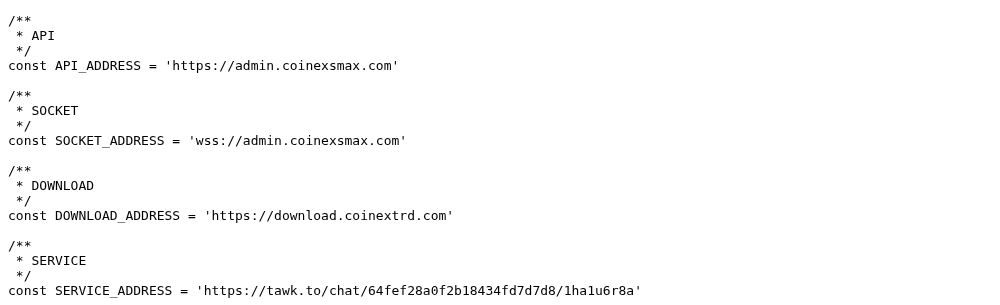
The configuration file sends the API and live socket traffic to admin.coinexsmax.com, so your account and balance live on a different domain.
App downloads point to a third domain, coinextrd.com, registered on November 2, 2026, through the same registrar, more than a year after the first two.
Splitting a site across fresh domains this way lets an operator swap the visible address while keeping every account and balance on the same server.
Support Runs Through Rented Chat Widgets
Customer service is a tawk.to chat window, a free widget anyone can embed, with no company phone line, office address or named support team.
A second chat service and a separate hostname are set aside for Vietnam, and comments written in Chinese label them in the configuration file.
The interface itself is translated into about a dozen languages, from Vietnamese, Indonesian and Thai to German, Italian and Portuguese.
A genuine exchange that serves that many countries names the legal entities and licenses behind each market, while this site names neither.
The FINRA Promise Does Not Hold Up
FINRA oversees brokerage firms in the United States, and each firm checks its own customers’ identity, so passports are not forwarded to FINRA.
FINRA’s guidance on regulator imposter scams is clear that it will never ask you for money, and that fraudsters borrow its name to request transfer fees.
You can look up any US broker on BrokerCheck, where a firm that invokes FINRA should appear under the same name.
The Same Kit Has Worn Other Names
The news section in the code still carries a story about “TGX Trade” sponsoring a 2021 esports major and Juventus, so this software has served other brands.
Names built on “coinex” are a long-running habit of fake platforms, and we have covered many, including Coinexon.com and Coinexsa.com.
The approach also resembles FentiCoin.com, where the site’s own code showed that the platform, not the market, decided what users saw.
Why the Loan Feature Is the Real Danger
A real exchange never asks you to borrow from it before you withdraw your own assets, and it does not need your credit score.
On a platform the operator controls, a loan can inflate your balance today and become the reason your withdrawal is frozen tomorrow.
Calling the loan interest-free makes it feel harmless, yet the borrowed amount is only a number on the operator’s server.
Any repayment you are asked to send, on the other hand, would be real money leaving your wallet for an address the operator chooses.
The IC3 warning is blunt about the result, saying victims cannot get their money back even when they pay the fees or taxes demanded.
How to Check a Crypto Exchange Before You Deposit
A few minutes of checking can separate a real exchange from a copy, and none of these steps require you to create an account.
Start with the brand’s own website, reached by typing its name into a search engine yourself, and compare the domain with the link you were sent.
CoinEx runs an official verification page where a website, email address or Telegram name can be checked before you trust it.
Look up the domain’s registration date with the ICANN lookup tool, since a site claiming years of history should not sit on a young address.
Treat any request to pay a fee, tax, deposit or loan repayment before a withdrawal as the end of the conversation, whoever makes it.
What to Do if You Have Money on Coinexspro.com
-
Stop sending money to the platform and refuse any fee, tax, loan repayment or deposit to release your balance, because paying only adds to the loss.
-
Turn down any loan the platform offers, since a platform loan creates a debt the operator can later use to block your withdrawal.
-
Save every piece of evidence you have, including the wallet addresses you paid, transaction IDs, uploaded vouchers, chat transcripts and screenshots of your balance.
-
Report the platform and the person who sent you at ic3.gov and reportfraud.ftc.gov, or to your national cybercrime unit outside the US.
-
Contact the exchange or bank you paid from with the transaction IDs and destination addresses, and ask whether the receiving accounts can be flagged or frozen.
-
Protect your identity if you uploaded a passport or license by considering a credit freeze and following the steps at IdentityTheft.gov.
-
Remove any app you installed from coinextrd.com and change every password you reused on Coinexspro.com, starting with your email account.
-
Ignore anyone who offers to recover your funds, because the FBI warns about fake law firms that charge victims upfront fees.
Frequently Asked Questions
Is Coinexspro.com the official CoinEx website?
No, CoinEx names www.coinex.com as its only official website, and the real exchange stopped accepting new users on September 15, 2026.
Can I withdraw my balance from Coinexspro.com?
The balance is a figure on the operator’s server, and the loans, credit points and manual reviews in its code give it many ways to refuse.
Why does the platform offer an interest-free loan?
A platform loan creates a debt the operator controls, which it can use to block withdrawals until you repay it with real money.
Does Coinexspro.com really send my documents to FINRA?
FINRA regulates US brokerage firms and is not where a trading site sends customers’ passports, so the claim only makes the upload feel official.
Is the real CoinEx still safe to use?
CoinEx is closing in an orderly way, so existing users should log in only at www.coinex.com and withdraw before December 22, 2026.
Someone offers to get my money back for a fee. Should I pay?
No, upfront recovery fees are a known follow-up scam aimed at people who already lost money, and law enforcement does not charge victims to investigate.
The Bottom Line
Coinexspro.com is not CoinEx but a copy that borrows its name and logo, sends accounts to another domain and makes a false FINRA promise.
Do not register, deposit or accept its loan, because a balance shown by this operator can be held back until you pay again.
If you already sent money, stop paying today, keep every transaction ID and chat, report the platform at ic3.gov and protect your identity.

Reviews & discussion
0 commentsShare a firsthand experience, or ask a question.
Community reviews
coinexspro.com
Moderated reader experiences, not an editorial verdict.
Start the conversation
Have a question or something useful to share? Add the first comment.