


The offer sounded like a way to profit from online advertising without building a website, finding customers or managing campaigns yourself. You simply bought a package and waited for returns.
For people who paid CryptoProgram, later called Amsys, the most revealing question is what happened between that advertising explanation and the destination of their money.
Overview
Advertising packages with a fixed monthly return
CryptoProgram offered packages that supposedly earned money from online advertising. Edward Zimbardi promoted the opportunity, describing it as separate from risky trading activity.
The packages promised a fixed 25% monthly return. That is an extraordinary financial commitment for something presented as a comparatively safe way to generate income.
The FBI identifies Amsys as the name adopted around June 2023. Investors should connect records under both names when reviewing payments and correspondence.
California identified deception before the federal charges
In its June 2023 desist-and-refrain order, California’s financial regulator found that most investor funds paid other investors in Ponzi fashion.
The order also found undisclosed transfers to an offshore forex broker, despite assurances that funds would go only toward advertising rather than trading.
These are regulatory findings about a deceptive mechanism. The separate federal indictment announced in 2026 contains allegations, and Zimbardi remains presumed innocent of those criminal charges.
What investors can do with the evidence they already have
The FBI has a case-specific victim-information form. Completing it is different from buying a recovery service or applying for an immediately available refund.
- Keep CryptoProgram and Amsys records together, including advertising-package receipts and instructions explaining where to send the payment.
- Record actual money received separately from the returns displayed or promised by the program.
- The FBI form asks about payment methods, wallet addresses and investment history, with additional instructions for transaction receipts.
- No promoter or private recovery company can turn submission of victim information into a guaranteed restitution payment.
Why Calling It Advertising Changed the Conversation
Online advertising is a real industry. Businesses pay to reach customers, and advertising companies can earn revenue by providing a useful service.
That familiar activity gave CryptoProgram’s pitch an understandable explanation. Instead of evaluating a trading strategy, prospective investors were asked to believe in advertising revenue.
The California order describes assurances that the program did not trade and that the absence of trading made its profits sustainable and comparatively low risk.
Those assurances addressed an investor’s concern about volatile markets. They also made the undisclosed transfer of funds to a forex broker particularly significant.
You cannot evaluate a financial risk honestly when the operator gives you the wrong explanation of what your money will be doing.
A purchase labeled an advertising package still needs customers, revenue and a credible explanation for its return. The label does not answer those questions.
Someone buying advertising for their own business would ordinarily care about the audience reached and resulting sales. Here, the investment promise centered on a fixed financial payout.
That difference should keep the analysis focused on money and representations, rather than whether online advertising itself is a legitimate business.
How the CryptoProgram Scam Works
Step 1: Present a package as a route to passive advertising income
The sales story invited people to purchase packages while others handled the underlying activity. The investor’s role was to provide funds and expect a return.
This arrangement reduced the apparent work involved. Buyers did not have to identify a campaign’s customers or understand the pricing of individual advertisements.
That convenience also meant they depended heavily on what the promoter said. An attractive package description could take the place of independently visible business activity.
Keep the presentation that explained your purchase. It may show whether your decision depended on advertising income, a fixed return or assurances about avoiding trading.
Step 2: Make the return predictable while keeping the business opaque
A fixed monthly percentage gives an investor a simple calculation. They can imagine future income without first proving how the operation will earn enough to provide it.
California’s order also described anonymous managers whose identities were withheld from prospective investors. Reassurance about experienced people could not substitute for knowing who controlled the money.
The combination matters: a precise payout promise can feel concrete even while the business behind it remains difficult to examine.
California’s order described packages offered for $550 each. At the advertised 25% monthly rate, that implied $137.50 per month before considering any other terms.
That calculation explains the appeal, rather than validating the promise. The operation still needed genuine earnings capable of funding that commitment to every package buyer.
For comparison, calculate what the promised rate would require from genuine activity. Calling a return sustainable does not provide evidence of customers, costs or earnings.
Step 3: Send funds using the payment instructions provided
The FBI’s investigation page describes cryptocurrency, cash and wire payments. Which method you used determines the records available to explain the transaction.
A cryptocurrency receipt should identify the asset, network, destination and transaction hash. A wire confirmation should identify the receiving account and transfer reference.
For cash, write down when and where the handover occurred, who received it and whether another person was present. Preserve any associated receipt or message.
Do not assume that a payment destination’s label explains who controlled it. Preserve the exact instruction alongside the transfer so investigators can compare them.
Step 4: Use participant money where advertising earnings were promised
The California regulator found that most incoming investor funds paid other investors. A successful payout therefore could reinforce the sales story while concealing its actual source.
That is the central Ponzi mechanism: incoming participants finance apparent returns that are presented as earnings from something else.
The same order described undisclosed offshore forex transfers. The problem was not simply that trading can lose money; it contradicted the explanation given to investors.
Someone deciding whether to reinvest needed to know both facts. An earlier payout could not supply informed consent to a different, undisclosed use of funds.
Step 5: Continue the story under a different program name
The FBI identifies a change from CryptoProgram to Amsys around June 2023, while describing the investment program as continuing in the same manner.
For an investor, that can split the evidence across names. Early receipts may mention one program while later messages or account records emphasize another.
Connect those records through dates, account identifiers and the people involved. A new name does not establish that an old balance became independently funded.
If a contact now proposes another conversion, request written terms and preserve them. Do not treat the existence of an old account as a reason to pay again.
CryptoProgram, Amsys and Edward Zimbardi
The package name and legal responsibility are different questions
CryptoProgram, Crypto Program and Amsys can appear in the same investor’s history. Keep the spelling on each original document when building your record.
The California order described CryptoProgram’s principal business details as unknown. Do not fill that gap by assigning a similarly named legitimate company to the operation.
The master-affiliate explanation did not resolve control of funds
California identified Zimbardi as CryptoProgram’s self-described master affiliate while finding that he controlled, induced or substantially assisted the conduct covered by its order.
For investors, a title is less useful than a documented role. Preserve who promoted the package, provided payment instructions and responded when you requested money.
The federal prosecution remains separate from the state findings
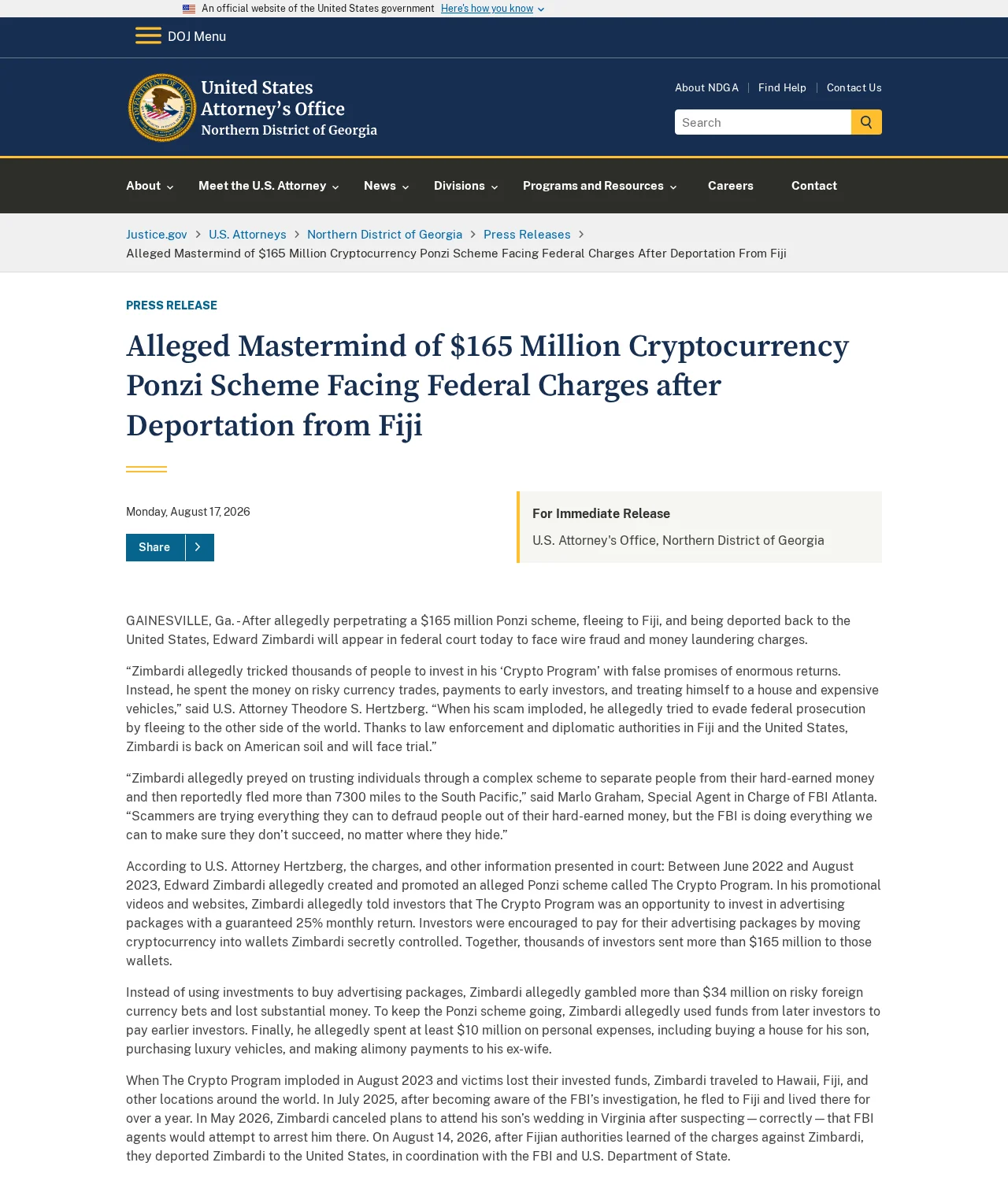
The Justice Department’s August 2026 announcement describes pending wire-fraud and money-laundering charges involving an alleged $165 million scheme.
An indictment is not a conviction. The financial allegations in that prosecution require proof in court, independently of the earlier California regulatory findings.
The FBI’s victim form identifies the actual investigation
The FBI’s Atlanta Division maintains a CryptoProgram/Amsys victim-information form. It explains the investigation and the information sought from people who invested.
That official route does not require hiring a private recovery agent. It also does not promise that every submission will produce a payment.
Do Not Confuse Promised Returns With Money Recovered
A package could display a balance that combines deposits and supposed earnings. Your financial history should distinguish those figures before you describe the loss.
List each amount you sent separately from each amount you actually received. Preserve the original currency and the payment method for both directions.
If money stayed inside the program and was marked reinvested, identify it as an internal entry. Do not count it again as a fresh external payment.
If cryptocurrency changed value after a transfer, keep the token amount and transaction date. A later converted estimate should not erase the original payment evidence.
A referral payment also belongs in the incoming column. Its source may be questionable, but leaving it out can distort the account investigators need to understand.
Ask a relative or trusted adviser to check the chronology if the records feel overwhelming. Share copies rather than giving anyone your account credentials.
The goal is a clear, supported history, rather than a perfect-looking spreadsheet. A missing receipt can be flagged without guessing what it would have said.
Keep promotional claims in a separate folder from payment evidence. Together, they explain both what you were told and the decision that followed.
What to Do if You Have Fallen Victim to This Scam
-
Stop funding any package or recovery proposal. Do not send more money because a contact says an old balance needs activation, conversion or verification.
Save the full message and payment destination. Verify any claimed role through the actual case team rather than through the person asking for payment.
-
Gather the information requested by the FBI. Prepare your investment dates, contact details, program names and the amounts sent and received.
For crypto, copy transaction hashes and addresses directly from reliable records. For wires or cash, gather confirmations, recipient information and dates before beginning the form.
-
Open the case-specific form on forms.fbi.gov. Confirm that its heading identifies the CryptoProgram/Amsys investigation and read the voluntary-information notice.
Answer the questions for your actual payment methods. The form separates wires, cash and cryptocurrency, so avoid placing unrelated details into the wrong section.
Review wallet addresses and amounts before submission, then keep a copy of what you provided. If a page instead requests a recovery fee, stop.
Submit the completed form after reviewing your entries and save any confirmation displayed. If submission fails, preserve your records and retry the official page later.
-
Send receipts only through the case page’s published instructions. The form lists thecryptoprogram@fbi.gov for purchase receipts and specifies a name-based subject format.
Use your name followed by “- Receipts” in the stated “Last, First – Receipts” format. Attach transaction receipts and retain your sent message.
The page says that address accepts receipts and is not monitored for questions. Do not expect an individual status reply from that mailbox.
It separately describes sending relevant communications with Zimbardi. Use the corresponding subject instructions if that question applies, keeping those materials separate from receipt-only submissions.
-
Ask your bank or exchange about the original transfer. Use its established support channel, identify the transaction and explain the investment-fraud concern.
Request any available tracing or reversal option and save the provider’s case number. Do not assume a completed cryptocurrency transfer can be canceled.
If the provider declines recovery, keep its explanation. That answer does not justify paying a stranger who promises access to a special reversal system.
-
Keep your records available after reporting. The FBI page says investigators may request more documentation later and may contact potential victims about the case.
Preserve the original files and note any later change in your contact information. Submission identifies potential victims; it does not establish an immediate restitution award.
What to Watch for in a Supposed Recovery Offer
Someone can repeat accurate details from a public case announcement without having any authority to recover money. Familiar information should not replace verification of their role.
Ask which court or agency appointed them and where that appointment appears. Check the answer through an independently located official source before sharing documents.
A demand for your wallet recovery phrase is especially significant. Investigators can examine transaction information without needing the secret that controls your remaining assets.
A claim that your report has already guaranteed repayment should also prompt scrutiny. The FBI’s form explains identification and possible future contact, rather than an automatic payout.
Keep recovery messages with your original evidence, including any requested fee. A second attempt to obtain money deserves its own clear record.
Frequently Asked Questions
Were CryptoProgram and Amsys connected?
Yes, the FBI describes Amsys as the name adopted by CryptoProgram around June 2023. Keep records under both names together when explaining your investment history.
What made the advertising-package pitch deceptive?
California found Ponzi payments and undisclosed forex transfers despite assurances that funds would buy advertising rather than support trading. The money’s use contradicted the pitch.
Does an early payout prove the advertising business worked?
No, a payment could come from another participant’s deposit. It does not establish that genuine advertising activity generated the return represented to investors.
Was Edward Zimbardi convicted in the federal case announced in 2026?
The cited announcement concerns an indictment and pending charges, rather than a conviction. It expressly preserves the presumption of innocence in that criminal case.
Does completing the FBI form guarantee restitution?
No, the form identifies potential victims and helps the investigation. Any eligibility or restitution process is separate from submitting your information.
Should I pay someone to recover a CryptoProgram balance?
Do not pay based on an unsolicited guarantee or an account screenshot. Use the official investigation route and independently verify anyone claiming authority to distribute money.
The Bottom Line
Do not buy another package or pay to release a CryptoProgram or Amsys balance. California’s findings exposed a money trail inconsistent with the advertising-income promise.
If you invested, preserve both program names in your records and use the FBI’s case-specific form. Report actual transactions while keeping pending criminal allegations accurately qualified.

Join the discussion
0 commentsShare your experience or ask a question about this article.
Community experiences
Did this happen to you?
Your experience could help someone recognize the same scam. Submit a private report for our team to review.
I experienced this tooReports are reviewed before publication. Sharing publicly is always your choice.
Discussion
Start the conversation
Have a question or something useful to share? Add the first comment.