

The Derma Muse Korean Color-Changing Foundation Stick has taken over Facebook and Instagram feeds with bold claims of adaptive pigment technology, hydrating skincare benefits, and flawless coverage for all skin tones. Advertised as a revolutionary Korean innovation, the product promises to eliminate shade-matching struggles, leaving users with smooth, radiant, and even skin.
But behind these appealing claims, many buyers are asking the same question: Is Derma Muse truly a next-generation K-Beauty foundation—or simply a clever example of modern dropshipping marketing?
In this in-depth analysis, we’ll examine Derma Muse from every angle: its claims, how it works, the ingredients it advertises, how the business operation behind it appears to function, and what to do if your experience doesn’t match the promises.
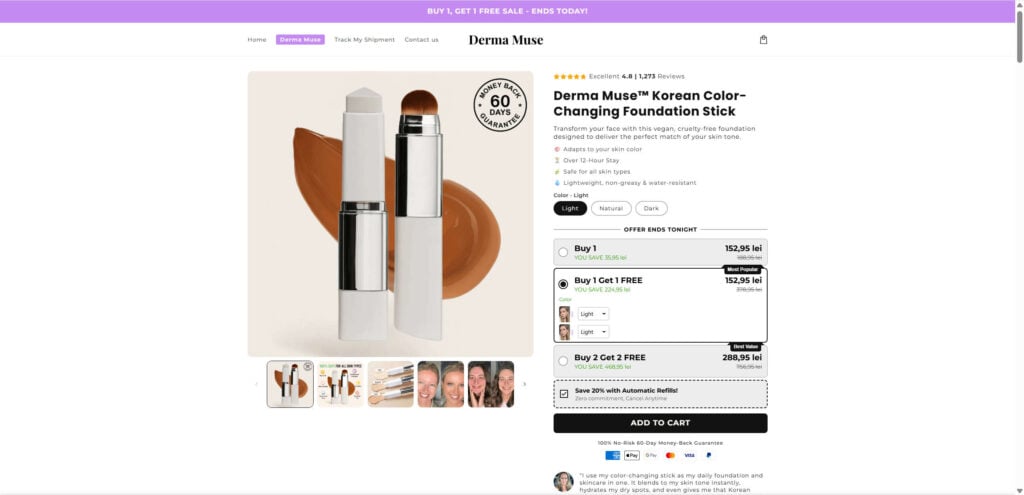
Overview: What Derma Muse Promises
Derma Muse markets itself as a “smart foundation stick” that adapts to each user’s unique skin tone. According to the official website, it’s designed to deliver:
- Flawless coverage with minimal effort
- A natural, glowy finish
- Deep hydration and skincare benefits
- A perfect shade match for all skin tones
The product has gained rapid visibility through aggressive social media advertising, particularly on Facebook, Instagram, and TikTok, using edited demonstration videos that show a white or neutral balm transforming into the perfect complexion shade upon application.
Heavy Reliance on Emotional Marketing
The messaging behind Derma Muse is crafted to speak directly to common beauty frustrations—like choosing the wrong foundation shade, dealing with heavy makeup, or finding products that work with sensitive skin.
The ads typically feature:
- Quick transformations where the balm appears to shift color instantly
- Before-and-after shots of flawless, radiant skin
- “Limited time” promotions such as:
- Buy 1 Get 1 Free
- Flash Sales with 70% off
- Free worldwide shipping countdown timers
These tactics are designed to create urgency and reduce hesitation before purchase—an approach commonly seen in viral beauty product campaigns.
K-Beauty Branding and Global Appeal
By associating itself with “K-Beauty,” Derma Muse taps into a massive global trend. Korean cosmetics are admired worldwide for their advanced formulations, gentle ingredients, and high performance.
However, there’s currently no publicly available evidence linking Derma Muse to a verified Korean cosmetics manufacturer or a registered K-Beauty brand. The official website does not provide:
- Ingredient concentration details
- Manufacturer name or address
- Third-party lab certifications
This lack of transparency doesn’t automatically discredit the product—but it raises fair questions about its true origin and formulation.
Ingredients Listed on the Official Site
According to Derma Muse’s own product page, these are the key advertised ingredients and technologies:
- Adaptive Pigment Technology – Smart color capsules that adjust to your skin tone for a perfect match.
- Hyaluronic Acid – Deep hydration to plump and smooth fine lines.
- Niacinamide (Vitamin B3) – Brightens, evens skin tone, and refines pores.
- Peptides – Supports elasticity and firmness for youthful radiance.
- Rosehip Oil – Rich in vitamins A & C to nourish and repair the skin barrier.
- Vitamin E – Provides antioxidant protection against environmental stressors.
On the surface, this reads like a luxury skincare-infused foundation. But marketing copy often does not reflect ingredient concentration, formulation quality, or actual performance. Without a complete ingredient list and third-party verification, it’s impossible to confirm whether these actives are present in meaningful amounts.
Pricing vs. Product Origin
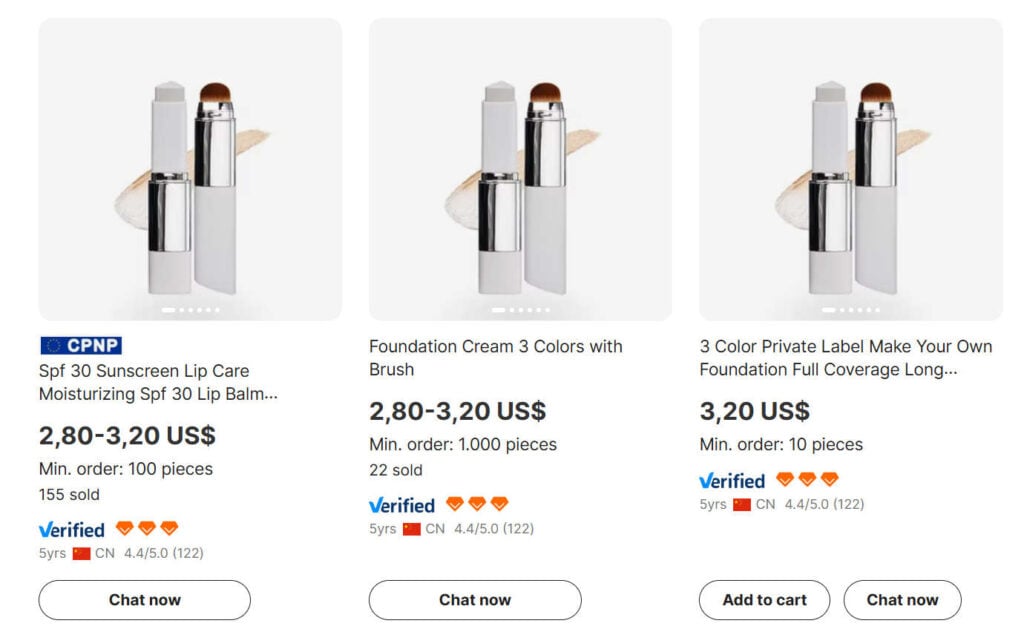
Derma Muse typically retails for $41.95 to $79.95 USD, depending on ongoing promotions. However, identical-looking products are available on wholesale platforms such as AliExpress, DHgate, and 1688.com for under $3.
This kind of markup is typical in dropshipping models, where low-cost products are branded, marketed, and sold at luxury prices—driven primarily by advertising and branding rather than formulation cost.
How the Operation Appears to Work
While the product’s marketing focuses on innovation, Derma Muse appears to operate using a dropshipping business structure—a model where the seller markets a product they don’t manufacture or stock directly.
This model itself isn’t inherently illegitimate, but it often prioritizes branding and ad spending over product development and quality control.
1. Sourcing Low-Cost Products
Foundationally, products resembling Derma Muse are purchased from wholesale suppliers on AliExpress or 1688.com at $0.99 to $3.00 each. They are generic tinted balm sticks with no verified proprietary pigment technology.
2. Rebranding and Premium Positioning
The product is then rebranded as a luxury K-Beauty innovation. This involves:
- A clean, elegant brand identity
- Emphasis on skincare actives and adaptive pigments
- Korean-inspired product positioning
- Price markup to $41.95 or higher
3. Launching a Professional-Looking Website
The dermamuse.co website uses a modern template with high-quality visuals, animated reviews, and professional copywriting.
A closer look reveals:
- Recently registered domain (September 2025)
- WHOIS privacy protection
- A virtual office address in Wyoming
- A customer service number linked to similar sites like Radiant Muse
This is consistent with many dropshipping brands that aim to look established while remaining lightweight behind the scenes.
4. Running High-Volume Social Media Ads
Most traffic comes from aggressive Meta Ads campaigns—particularly Facebook and Instagram. The ads use:
- Edited video clips showing dramatic transformations
- Emotional language focused on confidence and beauty
- Flash sale banners and countdown timers
These ads are designed to capture impulse buyers, especially those seeking quick, effortless beauty solutions.
5. Emphasizing “Advanced” Technology
Terms like “Adaptive Pigment Technology” and “Hyaluronic Acid infusion” sound scientific but lack supporting documentation. Without ingredient transparency or clinical studies, these claims serve marketing purposes rather than technical validation.
6. Creating Urgency with “Limited-Time” Offers
Derma Muse frequently uses:
- Buy 1 Get 1 Free bundles
- 70% Off “Today Only”
- Timer-based flash sales
This creates the feeling of a rare opportunity, encouraging immediate purchases and discouraging comparison with alternative products.
7. Presenting Reviews That Are Hard to Verify
The official website displays hundreds of 5-star reviews, but:
- They do not appear on independent review platforms
- Images often resemble stock or AI-generated content
- Identical layouts are found on sister brands
This is a common pattern in dropshipping beauty operations where on-site reviews are controlled and external verification is limited.
8. Simplifying Checkout While Limiting Buyer Protection
The checkout is optimized for speed and upfront payment, often using payment processors that offer limited recourse to customers.
Although the site advertises a “60-Day Money-Back Guarantee,” user feedback from similar brands often suggests:
- Complicated return processes
- Overseas shipping requirements
- Unresponsive customer service
9. Delivering Generic Products
Finally, customers receive a product that may:
- Not exhibit significant color-changing properties
- Have a waxy, uneven finish
- Arrive with minimal packaging or branding
This disconnect between expectation and reality is what typically frustrates buyers of dropshipped beauty products.
What to Do If You’ve Already Purchased It
If your experience with Derma Muse doesn’t match its promises—or if you haven’t received your order—there are practical steps you can take to protect yourself:
- Contact Your Payment Provider
Request a chargeback for “item not as described” if the product did not match the advertised claims. Provide screenshots, ads, and order confirmations. - Document Everything
Save all receipts, product photos, email exchanges, and ad screenshots. This strengthens your case with your bank or payment processor. - Report the Website if Necessary
- U.S. residents: file a report with the FTC at reportfraud.ftc.gov.
- International customers: contact your local consumer protection authority.
- You can also report misleading ads directly on Facebook and Instagram.
- Check Scam and Review Databases
Search the domain on platforms like Trustpilot, Scamwatch, or the MalwareTips Scam Center to see other user experiences. - Be Wary of Complicated Returns
Dropshipping beauty brands often require expensive overseas returns. If the value is low, a chargeback may be more practical than attempting a return. - Install Protection Tools
Extensions like Malwarebytes Browser Guard or AdGuard can help block misleading ads and shopping sites in the future. - Share Your Experience Publicly
Honest reviews on Reddit, Trustpilot, or beauty forums help other consumers make informed decisions.
The Bottom Line
Derma Muse Korean Color-Changing Foundation Stick is marketed as an innovative K-Beauty product featuring advanced Adaptive Pigment Technology and skincare ingredients like hyaluronic acid and peptides.
But after examining its marketing tactics, business structure, and lack of ingredient transparency, it closely resembles many dropshipping beauty products—where inexpensive wholesale items are rebranded, heavily advertised, and sold at premium prices.
This doesn’t automatically make the product dangerous or fraudulent—but it does mean:
- The marketing may overstate performance
- Ingredient claims may not reflect effective concentrations
- The buying experience may not match expectations
Consumers interested in adaptive foundation technology may find more reliable results from established brands with transparent ingredient lists and clinical backing—such as L’Oréal, IT Cosmetics, or Clinique.
FAQ
Is Derma Muse a real Korean brand?
No verifiable evidence confirms that Derma Muse is made or distributed by an official Korean cosmetics company. Its branding aligns with K-Beauty trends, but its domain and shipping information suggest a different origin.
Does the foundation actually change color?
Most similar formulas only oxidize slightly, resulting in a fixed medium-beige shade. Real adaptive pigment technology is typically limited, not universal.
Are the skincare ingredients effective?
The listed ingredients (hyaluronic acid, niacinamide, peptides, rosehip oil, vitamin E) are popular, but without concentration data, it’s impossible to know if they’re present in meaningful amounts.
Why is it so expensive if similar products cost $3?
This pricing aligns with dropshipping markup strategies: low-cost items are rebranded, marketed heavily, and sold at luxury prices.
Are the before-and-after photos real?
Many appear to be stock or AI-generated images, not verified user submissions.
Can I return the product?
Although the site offers a “money-back guarantee,” customer experiences with similar brands suggest refunds can be challenging due to shipping and support issues.
Are there safer alternatives?
Yes. Established brands like IT Cosmetics, L’Oréal, and Clinique offer adaptive foundations with transparent ingredient disclosures and consumer reviews.
What should I do if I’m not satisfied?
Document everything, file a chargeback with your bank if necessary, and share your experience to help others avoid the same situation.
Final Verdict:
Derma Muse positions itself as an innovative K-Beauty foundation, but it follows a familiar dropshipping playbook: low-cost sourcing, high-end branding, bold claims, and urgency-driven marketing.
Consumers should approach with measured expectations and do their research before buying. If the promise sounds too good to be true, it often is.
Recommendation: Consider verified brands with transparent ingredient lists, real adaptive pigment technology, and proven performance before investing in Derma Muse.

Join the discussion
0 commentsShare your experience or ask a question about this article.
Discussion
Start the conversation
Have a question or something useful to share? Add the first comment.