

A returned-payment message lands in the finance inbox. It sounds like a small administrative problem that needs attention.
An attached bank report apparently explains what went wrong. Before continuing, look at the route its instructions ask you to follow.
Overview
A returned-transfer story targets a familiar office task
The diocesan account wire transfer email scam pretends to concern a payment that failed because the recipient supplied incorrect banking details.
It impersonates the Missionary Sisters of St Peter Claver in Rome and references a church project. That organization is being impersonated, not accused of distributing the message.
The request sounds limited: inspect the attached bank report and confirm the account information. Its apparent routine nature makes it easy to handle without stopping to verify.
The PDF is an intermediate step, not the final report
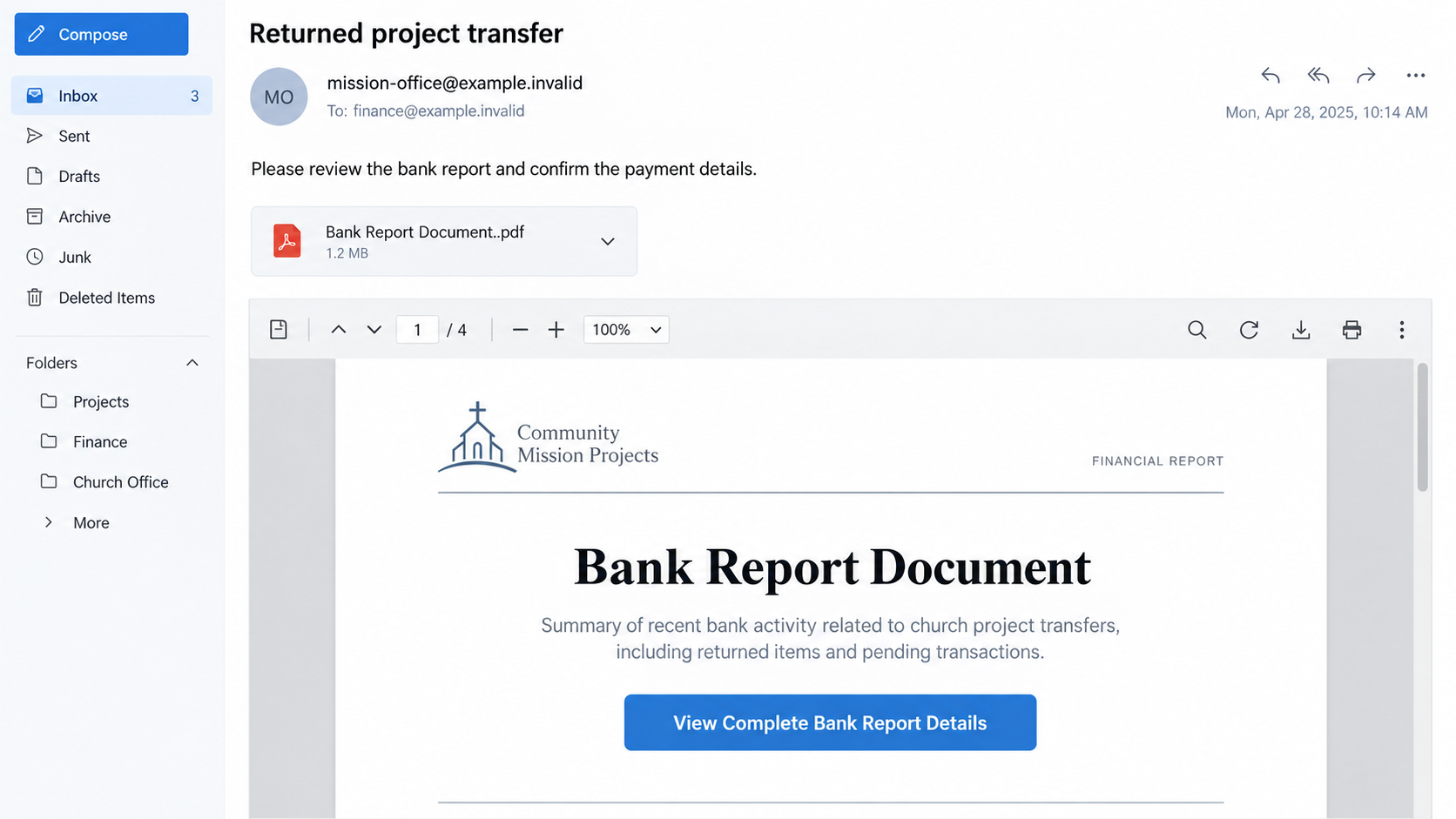
The reported attachment is named Bank Report Document..pdf. Instead of providing the promised transaction details, it directs the reader to another location through a report-view link.
That route was reported to deliver a malicious executable. The payload family was not identified because the download endpoint was inactive during analysis.
Do not label it a particular trojan, stealer, or ransomware without additional evidence. The established warning concerns the deceptive executable-download route.
Your response depends on how far you went
Reading the email, opening a PDF, following its link, downloading a program, and running that program are different exposures. They should not receive the same diagnosis.
- No interaction: preserve or report the message, then keep it out of normal processing.
- Link or download only: stop and establish whether anything executed or permissions changed.
- Program execution: isolate the affected device and seek trusted cleanup assistance.
- Shared banking information: involve the genuine finance contact and your financial institution as appropriate.
The image illustrates the email-to-document arrangement with fictional details. It is not an original message, genuine bank report, or record of an infection we executed.
How the Diocesan Account Wire Transfer Email Scam Works
Step 1: A project reference makes the message feel like existing business
The sender claims a transfer was returned and needs correction. A project number and a payment date make that explanation sound anchored to a real administrative history.
The reported message references project A 288/2026. A reference like that can be persuasive even when the recipient has no matching entry in their records.
Someone in a church office may assume a colleague arranged the grant. Someone outside that setting may still open it to discover whether it concerns their organization.
Neither reaction verifies the sender. Before reviewing an unexpected payment attachment, ask whether the payment and the relationship can be confirmed through an established contact.
Do not use a new reply address in the disputed message as your independent check. A conversation with the same sender simply continues the original claim.
If a familiar person’s signature appears, contact that person using details already held. A real name is useful to an impersonator precisely because it sounds recognizable.
Step 2: The bank-report attachment supplies a reason to continue
A PDF feels like supporting paperwork. For a finance worker, reviewing one may seem safer and more routine than following an unexplained email link.
But a PDF can contain clickable links. The container does not guarantee the destination, and a document-looking button can still start a separate download.
In this case, the supposed report does not satisfy the original request for meaningful transaction information. It asks the reader to leave the attachment for more details.
That change deserves attention. A document claiming to explain a returned transfer should not require an unfamiliar executable just to reveal the explanation.
Adobe-related wording in a document footer does not establish Adobe’s involvement. A creator can type familiar software names into ordinary page content.
Likewise, a PDF icon is not an endorsement by a bank. The relevant questions remain who supplied the document and what its next instruction does.
Step 3: A viewing instruction becomes a program download
The reported embedded link leads toward a malicious executable. That is the critical change from reading financial paperwork to potentially running software on the computer.
A filename can encourage the transition by sounding like a viewer, report, or update. Check the actual file type rather than relying on the beginning of its name.
If a browser warns about a download, do not disable its protections to finish this task. An email’s payment story does not justify bypassing a security warning.
Do not install a special bank-report application offered by the sender. If legitimate software is genuinely needed, obtain it through your organization’s approved process.
The inactive endpoint limits what can be concluded about this campaign. We cannot responsibly supply an exact malware name, encryption behavior, or list of stolen records.
Those unknowns are not reasons to execute the file experimentally. A reader does not need a precise family label to reject an unverified program delivered through fake paperwork.
Step 4: Running the download can create a separate security incident
If a malicious program executes, the problem extends beyond a misleading payment request. What happens next depends on the file and the access it obtains.
That may require device investigation and account protection, but it should be based on actual findings. Do not assume every listed malware capability occurred.
For a workplace computer, responders may need the original email, the PDF, the download location, and the approximate execution time to reconstruct events.
Even if the program appears to do nothing, tell the team it ran. Silence on screen is not a useful test of whether software made changes.
Conversely, opening the message without following its instructions does not prove compromise. Avoid turning an untrusted email’s story into a diagnosis of your own computer.
The safe decision is to stop the chain and report the actual action taken. That gives trusted support a much better starting point than guessing the payload.
Verify the Payment Before Correcting Any Account Details
Match the project to your own records
Look for an existing project agreement, expected transfer, and established finance contact. Do not create a matching explanation simply because the message includes a reference number.
A genuine relationship should have records independent of this email. If none exist, there is no reason to supply banking details to complete the sender’s story.
If the project is real, confirm the specific returned-payment claim anyway. Impersonators can borrow public project information or details taken from earlier correspondence.
Ask your bank about the actual transaction
A payment institution can explain information available about your own account. The stranger’s PDF is not the authority on whether funds arrived, failed, or were returned.
Use your usual banking channel. Do not contact a supposed bank officer introduced inside the disputed document to validate the same document.
For organizational accounts, follow established approval procedures. A request to correct a beneficiary can become a payment-redirection risk even when no malicious software is involved.
Keep the real organization separate from its impersonator
The campaign borrows a missionary organization’s identity to make the request plausible. It does not establish wrongdoing by that institution or the person named in the signature.
Report the misuse through a genuine contact if you have one. Avoid publicly publishing staff details or private banking records as evidence of the impersonation.
The useful warning is about the fraudulent email and download path. Blaming the copied institution can misdirect readers away from the actual risk.
What to Do If You Opened the Email or Bank Report
Stop following the document’s instructions. Do not reopen its link, download another viewer, or run the file again to check what it does.
Keep the original message available for your reporting team. If you only read it, avoid escalating the situation into unnecessary computer changes.
Reconstruct the sequence honestly. Note whether you opened the PDF, followed a link, saved a download, launched it, or approved an installation prompt.
If you are unsure, say so. Browser download history and security records may help an administrator establish what happened without repeating the risky action.
If the program ran or remote access was granted, disconnect the affected device from networks and contact trusted support. Managed workplace devices should go through their incident-response process.
Do not use that device to administer banking or other systems while its condition is uncertain. Use an unaffected device for urgent account-protection work.
Arrange a malware assessment appropriate to the system. Malwarebytes can help detect unwanted software; a serious compromise may require additional investigation or rebuilding.
AdGuard can reduce some malicious advertising and site exposure during later browsing. It does not remove every malicious program or guarantee that a downloaded file is safe.
Secure any credentials entered or exposed. Review sessions and account changes through the real provider, especially for email, banking, and administrative accounts used during the incident.
For Google account recovery, use the provider’s genuine guidance. A password reset and a device scan address different parts of a compromise.
Contact your financial institution if you sent money or supplied information that could affect an account. Explain the exact disclosure rather than assuming every account is already drained.
If beneficiary details changed, involve the organization’s finance lead immediately. Preserve transfer references and ask what recall or dispute options remain available.
Report the impersonation with the original email and attachment through a safe channel. Provide the project reference and timing, but keep sensitive documents out of public discussions.
Do not pay someone who promises to recover the payment or clean the computer after contacting you unexpectedly. Use support you reached independently.
Is Your Device Infected? Run a Free Malware Scan
Slow performance, constant pop-ups, or strange behavior? These are classic signs of a malware infection. The fastest way to find out is to scan your device with Malwarebytes Free — one of the most trusted malware removal tools available.
The free version detects and removes the most common threats, including:
- Adware — the cause of those annoying pop-ups
- Browser hijackers — unwanted redirects and changed homepages
- Trojans and spyware — hidden programs stealing your data
- Potentially unwanted programs (PUPs) — software you never asked for
👉 Select your device below — Windows, Mac, or Android — then follow the simple steps to download Malwarebytes, scan your system, and remove any threats it finds. The scan usually takes 5 to 20 minutes.
Run a Malware Scan with Malwarebytes for Windows
Malwarebytes is one of the most popular and trusted anti-malware tools for Windows — and it’s completely free for removing infections. It catches threats that many antivirus programs miss, including adware, browser hijackers, and trojans. Follow the steps below to scan and clean your PC in just a few minutes.
Download Malwarebytes
Click the button below to download the latest version of Malwarebytes for Windows from the official source. The free version is all you need — it will scan your computer and remove adware, browser hijackers, and other malicious software at no cost.
Download MalwarebytesOfficial installer for Windows 11 and 10. Your download starts right away.Want real-time protection? See Malwarebytes Premium Malwarebytes Free for WindowsScans and removes malware at no cost
-
Install Malwarebytes
When the download finishes, open your Downloads folder and double-click the MBSetup file. If Windows shows a User Account Control pop-up, click “Yes” to allow the installation.

Follow the On-Screen Prompts to Install Malwarebytes
The setup wizard will walk you through a few quick screens:
-
Choose where you’re installing the program — “Personal Computer” or “Work Computer” — then click Next.

-
Malwarebytes will now install on your device. This usually takes under a minute.

-
When installation is complete, the “Welcome to Malwarebytes” screen will open automatically.

-
On the final screen, click Open Malwarebytes to launch the program.

-
Enable “Scan for Rootkits”
Before scanning, turn on rootkit detection so Malwarebytes can find even the most hidden threats. Click the Settings gear icon on the left side of the screen.

In the settings menu, find “Scan for rootkits” and click the toggle so it turns blue.

Done? Click “Dashboard” in the left pane to return to the main screen.
Start the Scan
Click the blue Scan button. Malwarebytes will automatically update its virus database and start checking your computer for malware.

-
Wait for the Scan to Finish
The scan checks your entire system for browser hijackers and other malicious programs, so it can take 5 to 20 minutes depending on your computer. Feel free to do something else — just check back occasionally to see the progress.

-
Quarantine the Detected Threats
When the scan is done, you’ll see a list of everything Malwarebytes found — malware, adware, and potentially unwanted programs. Click the “Quarantine” button to remove all of them at once.

Malwarebytes will now remove the malicious files and registry entries and move them safely into quarantine.

-
Restart Your Computer
Some threats can only be fully removed after a reboot. If Malwarebytes asks you to restart, click Yes. Once you’re logged back in, Malwarebytes has finished removing the threats it found.

That’s it — your Windows PC is now clean of trojans, adware, and other malware, and should be back to running smoothly.
If you are still having problems with your computer after completing these instructions, then please follow one of the steps:
- Run a computer scan with ESET Online Scanner
- Ask for help in our Windows Malware Removal Help & Support forum.
Run a Malware Scan with Malwarebytes for Mac
Malwarebytes for Mac is a free on-demand scanner that removes the malware other security software tends to miss — adware, browser hijackers, and unwanted programs included. Cleaning an infected Mac with Malwarebytes has always been completely free, and it’s our go-to recommendation. Follow the steps below to scan and clean your Mac in just a few minutes.
-
Download Malwarebytes for Mac
Click the button below to download the latest version of Malwarebytes for Mac.
Download MalwarebytesOfficial installer for macOS. Your download starts right away.Want real-time protection? See Malwarebytes PremiumMalwarebytes Free for MacScans and removes malware at no cost -
Open the Malwarebytes setup file
When the download finishes, open your Downloads folder and double-click the setup file to begin the installation.

-
Follow the On-Screen Prompts to Install Malwarebytes
The Malwarebytes for Mac Installer will guide you through a few quick screens. Click “Continue” and keep following the prompts until the installation completes.



When the installation is complete, Malwarebytes opens to the Welcome to Malwarebytes screen. Click “Get started“.
-
Select “Personal Computer” or “Work Computer”
Malwarebytes will ask what type of computer you’re installing it on. Click either Personal Computer or Work Computer, whichever applies.

-
Start the Scan
Click the “Scan” button. Malwarebytes will automatically update its detection database and begin checking your Mac for malware.

-
Wait for the Scan to Finish
Malwarebytes will scan your Mac for adware, browser hijackers, and other malicious programs. This can take a few minutes, so feel free to do something else — just check back occasionally to see the progress.

-
Quarantine the Detected Threats
When the scan is done, you’ll see a list of everything Malwarebytes found. Click the “Quarantine” button to remove all the threats at once.

-
Restart Your Mac
Malwarebytes will now remove all the malicious files it found. Some threats can only be fully removed after a reboot — if Malwarebytes asks you to restart, allow it. Once you’re logged back in, your Mac is clean.

That’s it — your Mac is now free of adware, rogue browser extensions, and other potentially harmful software.
If you are still experiencing problems while trying to remove a malicious program from your computer, please ask for help in our Mac Malware Removal Help & Support forum.
Run a Malware Scan with Malwarebytes for Android
Malwarebytes for Android automatically detects and removes dangerous threats like malware and ransomware so you don’t have to worry about your most-used device being compromised. Aggressive detection of adware and potentially unwanted programs keeps your Android phone or tablet running smooth.
-
Download Malwarebytes for Android.
You can download Malwarebytes for Android by clicking the link below.
Get Malwarebytes for AndroidOpens Google Play in a new tab.Want real-time protection? See Malwarebytes Premium for AndroidMalwarebytes for AndroidScans your phone and removes malware at no cost -
Install Malwarebytes for Android on your phone.
In the Google Play Store, tap “Install” to install Malwarebytes for Android on your device.

When the installation process has finished, tap “Open” to begin using Malwarebytes for Android. You can also open Malwarebytes by tapping on its icon in your phone menu or home screen.

-
Follow the on-screen prompts to complete the setup process
When Malwarebytes will open, you will see the Malwarebytes Setup Wizard which will guide you through a series of permissions and other setup options.
This is the first of two screens that explain the difference between the Premium and Free versions. Swipe this screen to continue.
Tap on “Got it” to proceed to the next step.
Malwarebytes for Android will now ask for a set of permissions that are required to scan your device and protect it from malware. Tap on “Give permission” to continue.
Tap on “Allow” to permit Malwarebytes to access the files on your phone.
-
Update database and run a scan with Malwarebytes for Android
You will now be prompted to update the Malwarebytes database and run a full system scan.

Click on “Update database” to update the Malwarebytes for Android definitions to the latest version, then click on “Run full scan” to perform a system scan.

-
Wait for the Malwarebytes scan to complete.
Malwarebytes will now start scanning your phone for adware and other malicious apps. This process can take a few minutes, so we suggest you do something else and periodically check on the status of the scan to see when it is finished.

-
Click on “Remove Selected”.
When the scan has been completed, you will be presented with a screen showing the malware infections that Malwarebytes for Android has detected. To remove the malicious apps that Malwarebytes has found, tap on the “Remove Selected” button.

-
Restart your phone.
Malwarebytes for Android will now remove all the malicious apps that it has found. To complete the malware removal process, Malwarebytes may ask you to restart your device.
That’s it — your Android phone is now clean — no more malicious apps, adware, or browser redirects.
If you are still having problems with your phone after completing these instructions, then please follow one of the steps:
- Restore your phone to factory settings by going to Settings > General management > Reset > Factory data reset.
- Ask for help in our Mobile Malware Removal Help & Support forum.
Stay Protected: Block Ads and Malicious Sites
Now that your device is clean, keep it that way. Most infections start with a malicious ad or a fake download button — so blocking them at the source is your best defense.
We recommend AdGuard, which blocks malicious ads, phishing pages, and dangerous redirects before they can reach you.
👉 Download AdGuard and browse safely
What a Clean-Looking PDF Can and Cannot Tell You
A readable first page only shows that the document can display content. It does not validate the sender, the bank story, or an embedded website.
A scan of the attachment may also answer a narrower question than expected. A link destination can change after a document is delivered or become unavailable later.
That does not make every linked PDF malicious. It means an attachment’s appearance should not replace independent verification of a sensitive request.
Modern document readers and updated systems reduce some technical risks. They cannot decide whether a stranger’s request to install a report viewer is legitimate.
Keep document viewing and software installation as separate decisions. An ordinary bookkeeping task should not quietly become permission to run a new program.
CISA’s phishing guidance explains why unexpected messages and attachments deserve independent checks. The principle applies even when the message uses a charitable or religious context.
A Practical Rule for Church and Nonprofit Finance Teams
Give staff a simple escalation route for unexpected banking attachments. They should not need to identify malware before asking whether a transfer story is genuine.
Separate the person reviewing an account change from the person approving a payment. Existing controls still matter when the request arrives with a reassuring signature.
Use previously verified telephone or portal details for important corrections. Replacing those contacts with details from the disputed message defeats the point of checking separately.
Record whether any downloaded file ran when reporting internally. That single fact can determine whether the response is email handling, account protection, or a broader device incident.
If a colleague received the same attachment, warn them through an internal channel without forwarding the active file. A text description can prevent another accidental execution.
Agree who will contact the real project office and the bank. Coordinating those checks reduces conflicting requests while keeping sensitive payment information within the proper team.
Frequently Asked Questions
Is the real missionary organization sending malware?
The organization’s identity is being borrowed. A familiar mission name and staff-style signature are reasons to check the sender, not evidence that the attachment is genuine.
Verify any real project communication through contacts you already trust.
What is suspicious about Bank Report Document..pdf?
The reported attachment redirects the reader toward an executable instead of supplying the promised banking details. That behavior matters more than punctuation in its filename.
A convincing icon or document footer does not justify installing software.
Does opening the PDF automatically infect my computer?
Do not assume that from this report. The described route involves the document’s embedded link and a downloaded executable.
Tell trusted support which steps you actually took. Software execution, not merely seeing a filename, changes the response.
Which malware does the campaign install?
The payload family was not identified because the download endpoint was inactive during analysis. Calling it a specific ransomware or trojan would overstate the evidence.
Reject the download route regardless, and investigate any file that already ran.
Should I reply with corrected bank details?
No. Confirm the payment and sender separately before supplying financial information. A reply to the disputed email is not independent verification.
Use your organization’s finance procedures and its established banking contacts.
Can antivirus recover money from this email scam?
No. Antimalware helps address malicious software; it cannot recall a bank transfer. Contact the financial institution promptly about payment options.
If both software and money were involved, pursue device response and financial reporting separately.
The Bottom Line
Do not download or run a supposed bank-report viewer from this diocesan transfer email. Its returned-payment story leads away from genuine financial verification.
If you already interacted, establish whether anything executed and involve trusted support. Confirm any real payment with the actual institution, not the sender of the attachment.

Join the discussion
0 commentsShare your experience or ask a question about this article.
Community experiences
Did this happen to you?
Your experience could help someone recognize the same scam. Submit a private report for our team to review.
I experienced this tooReports are reviewed before publication. Sharing publicly is always your choice.
Discussion
Start the conversation
Have a question or something useful to share? Add the first comment.