

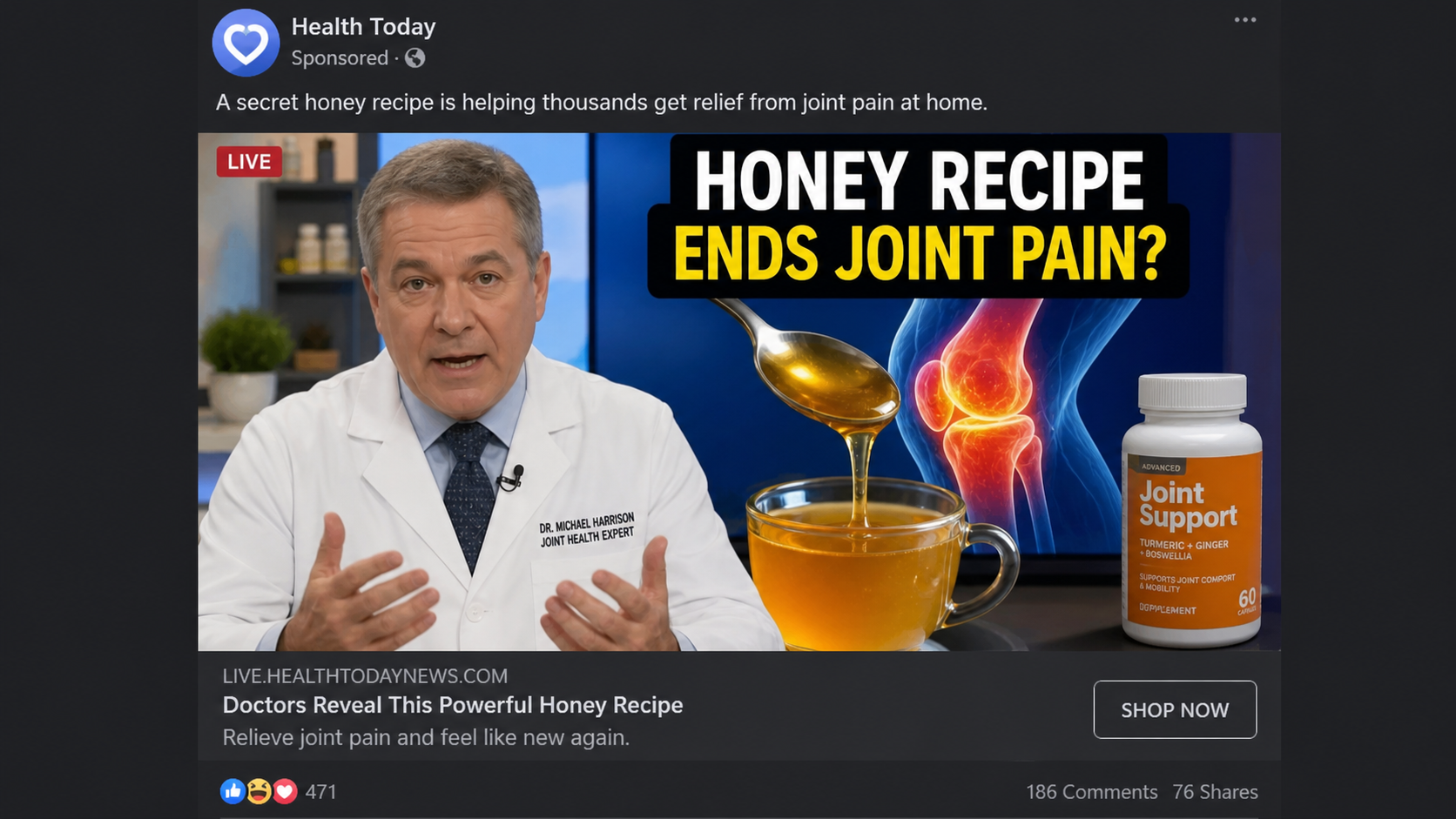
A doctor on a familiar television set leans toward the camera and says one spoonful of honey can end years of joint pain. The voice sounds like Dr. Sanjay Gupta, the page looks like health news, and the promised recipe appears harmless enough to try.
That carefully engineered moment is the entrance to a supplement sales funnel. The Dr. Sanjay Gupta honey recipe joint pain scam uses fake AI endorsements, invented medical explanations, and a disappearing “home remedy” to turn concern into a rushed order.
Overview
The campaign impersonates a trusted medical journalist
Dr. Sanjay Gupta is a real neurosurgeon and medical correspondent. That combination of medical credentials and television familiarity makes his identity valuable to scammers. People recognize the face before they have time to question the claim.
The ads may use a cloned voice, manipulated video, old interview footage, or a lookalike presenter. A caption then claims that Gupta revealed a honey recipe doctors do not want patients to know. In some versions, other real or invented experts appear beside him to make the story feel independently confirmed.
Gupta has publicly warned about AI-generated versions of him promoting health cures. That general warning is important, but every individual ad still deserves precise verification. If the statement cannot be found through his official work or a real publisher’s archive, do not treat the clip as authentic.
The harmless recipe is a curiosity hook
Honey is familiar, inexpensive, and emotionally comforting. It sounds less threatening than an unfamiliar pill, so a viewer may continue watching even if they would normally ignore a supplement advertisement. The ad may add cinnamon, turmeric, an “Indian root,” or another kitchen ingredient.
The script promises that this combination flushes a hidden joint toxin, rebuilds cartilage, or stops inflammation at its source. Some campaigns invent scientific-sounding substances to explain why ordinary treatment supposedly fails. The terminology is offered quickly, without a credible paper or a qualified specialist who can be contacted.
Honey can be food without being a cure for arthritis or damaged joints. A household ingredient does not become a proven treatment because an AI voice places it beside medical vocabulary.
The story is built to sell a rotating supplement
Viewers expect instructions for a recipe, but the presentation slowly makes the recipe inconvenient or incomplete. The narrator says the ingredients must be combined at a precise concentration, harvested from a rare source, or activated through a proprietary process.
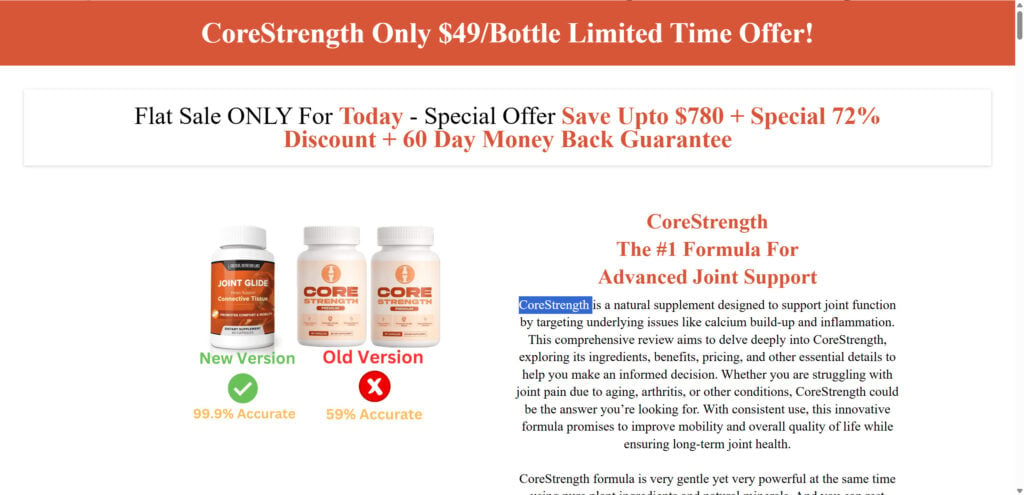
In a campaign we reviewed, that pivot leads to Core Strength Premium. The product page advertises a per-bottle price, a large percentage discount, and a guarantee. Another operator can replace Core Strength with a new bottle while keeping the Dr. Gupta honey story nearly word for word.
The lasting subject is therefore the fake endorsement and funnel, not one supplement name. Once an ad account or product page attracts complaints, the seller can rotate the branding and continue targeting the same audience.
Why the Honey Joint Pain Story Does Not Hold Up
A television-style setting is not proof of a real broadcast
AI video tools can place a fictional presenter behind a desk, clone a voice, and add convincing lower-third graphics. Scam pages also borrow the visual language of CNN, Fox News, CBS, or another familiar outlet without being hosted or approved by that organization.
Open a new browser tab and search the real outlet’s website for the exact interview. Check the URL letter by letter. A long marketing domain with a news logo in the page header is still a marketing domain.
The medical explanation changes to fit the product
One version blames toxins, another blames parasites, and another claims that aging joints are starved of a particular nutrient. These stories can contradict each other because their purpose is not diagnosis. Their purpose is to create one solvable villain.
Joint pain can come from osteoarthritis, inflammatory arthritis, injury, infection, gout, nerve problems, or other conditions. A generic video cannot identify the cause. Promising the same rapid fix to every viewer is a basic medical red flag.
The ad replaces evidence with urgency and emotion
Testimonials often describe a person walking normally, sleeping through the night, or canceling surgery after days of use. The stories may be paired with family photos and comments claiming the recipe changed lives.
None of this proves the exact product is effective. Ask for randomized human studies on the finished formula, its actual ingredient quantities, possible interactions, and adverse effects. A study about an ingredient is not automatically a study about the bottle being sold.
The checkout reveals what the story was designed to do
A genuine public-health explanation would be useful without requiring an immediate purchase. In this funnel, every element points toward a bundle selector. The hidden secret, dramatic interview, patient story, scarcity warning, and large discount all converge on the card form.
That does not prove every bottle is counterfeit or every purchaser will face an unauthorized charge. It does show that the apparent news story is commercial advertising and should be judged as such.
How the Scam Works
Step 1: A short AI video promises a kitchen cure
The campaign begins on Facebook, Instagram, YouTube, TikTok, or a low-quality ad network. A brief video asks whether joint pain is caused by something doctors missed and promises a honey trick that works faster than conventional care.
The ad avoids a complete explanation. Curiosity is the conversion tool, and the viewer must click to learn the ratio, ingredient, or “seven-second” step.
Step 2: Dr. Gupta’s identity supplies instant authority
A familiar face and voice lower skepticism. The clip may appear to show Gupta speaking naturally, but words can be generated or assembled from unrelated footage. Subtitles reinforce the claim even if the audio is vague.
Scammers count on viewers sharing the video before checking it. The endorsement should be verified at its original source, not inside a copy uploaded by the advertiser.
Step 3: The visitor enters a fake news advertorial
The destination imitates a trusted news site or televised interview. It may include a headline about a “heated confrontation,” a story supposedly removed from television, or a warning that the video will soon be taken down.
Navigation links may be decorative, the publication date may automatically update, and comments may always display the same recent times. These are clues that the page is a conversion template rather than an independent article.
Step 4: The presentation invents a single cause of joint pain
The narrator introduces a toxin, deficiency, or damaged pathway that supposedly explains every aching knee, hip, hand, and back. Real medical terms are mixed with unsupported statements until the promised solution feels inevitable.
A responsible explanation would acknowledge different diagnoses and evidence limits. The scam cannot do that because uncertainty would weaken the sale.
Step 5: The honey recipe becomes a supplement pitch
After holding attention for several minutes, the presentation says supermarket ingredients are too weak or inconsistent. The “exact formula” is already prepared in capsules or drops. Core Strength Premium is one product that has appeared at this stage.
Our separate Core Strength Premium investigation examines that offer. The important lesson is that the bottle can change while the false Dr. Gupta honey endorsement stays intact.
Step 6: A large discount makes a bundle feel temporary
The sales page may show a crossed-out retail price, claim savings above 70%, and reserve the lowest figure for the largest package. A timer or inventory counter suggests that leaving the page means losing the opportunity.
Read the label beneath the price. $49 may mean $49 for each bottle in a six-bottle order, not a $49 total. Calculate the full charge before selecting anything.
Step 7: The buyer passes through upsells and possible continuity terms
Some supplement funnels add extra bottles, expedited shipping, digital guides, or related products after the first order button. The pages may present “no thanks” links in faint text, especially on mobile devices.
A subscription is not proven merely because a funnel is aggressive. However, buyers should search all checkout and policy text for recurring billing, autoship, membership, and future-shipment language before submitting a card.
Step 8: Refund friction appears after the advertising disappears
The social ad can vanish while the charge remains. A buyer may discover that the brand is not the merchant descriptor, the return address is a warehouse, or support requires an authorization number before accepting a package.
Deadlines matter. Waiting weeks for a seller that does not answer can weaken a refund or dispute. Document contact attempts and involve the card issuer promptly when the transaction differs from what was authorized.
Company, Address, and Fulfillment Checks
Make the seller show its real legal identity
Ignore the bottle logo for a moment. Identify the company accepting the order and compare it with the names in the terms, privacy policy, receipt, and statement. Missing or conflicting entities make accountability difficult.
A legitimate seller should not require detective work to learn who takes the money, who provides support, and who stands behind the health claims.
Do not mistake a fulfillment center for headquarters
A return location may be a third-party warehouse that handles packages for unrelated brands. It can also be a virtual mailbox, residence, or address copied from another business. None of those possibilities proves where the product was formulated or manufactured.
Search the address independently and ask whether returns require authorization. Send tracked parcels only after confirming the exact instructions.
Test the phone and email before giving them a card
Call support and ask for the legal company name, exact total, subscription status, cancellation method, and return destination. A number that never answers, routes every brand to the same vague agent, or cannot identify the product is a sharp warning.
Email a simple question and save the reply. Silent or disposable support channels are especially concerning when the guarantee is the main reason a buyer feels safe.
Demand traceable manufacturing and a complete label
Generic supplements can be mass-produced by contract factories in the United States, China, or elsewhere. We could not confirm an overseas origin from the advertisement alone, and buyers should not assume one. They should demand facts: manufacturer, country of origin, lot number, batch testing, and a complete Supplement Facts panel.
“Natural,” “doctor formulated,” and “FDA registered” do not establish safety, effectiveness, or FDA approval. Concentrated ingredients can interact with blood thinners, diabetes drugs, and other medicines.
What to Do If You Fell Victim
- Preserve the evidence. Screenshot the AI ad, fake news page, product offer, selected bundle, checkout total, receipt, and policies. Save the URL and date because rotating campaigns can disappear quickly.
- Review the order line by line. Check bottle quantity, per-bottle versus total price, shipping, upsells, and any autoship or membership wording. Compare the receipt with the amount posted to the card.
- Cancel clearly in writing. Tell the seller to cancel the order and every recurring plan, reject future charges, and confirm the cancellation in writing. Keep emails and call logs.
- Speak with the card issuer. Report any unauthorized amount, repeat charge, or materially misleading transaction. Ask about dispute deadlines and blocking the merchant. Do not wait indefinitely for a silent seller.
- Handle returns carefully. Obtain any required return authorization, photograph the products, and use tracked shipping. Keep proof of delivery and do not send the package to an address found only in a social media comment.
- Check your device if the funnel requested more than payment. Run Malwarebytes if you installed a file, extension, or app, or if the page produced suspicious redirects. AdGuard can help block deceptive ads and redirect chains in the future.
- Get appropriate medical advice. Joint pain with swelling, redness, fever, injury, weakness, or sudden severity may need prompt evaluation. Show a pharmacist the exact supplement label before taking it with medication.
- Report the campaign. Use the social platform’s impersonation and scam tools. Report deceptive commerce to the FTC at ReportFraud.ftc.gov and health-product concerns to the FDA when appropriate.
Frequently Asked Questions
Did Dr. Sanjay Gupta endorse a honey recipe for joint pain?
We found no reliable evidence that he endorsed the campaign reviewed. Gupta has publicly warned about AI-generated versions of him selling health cures. Confirm any claim through his verified work, not a video embedded in a sales page.
Can honey rebuild cartilage or cure arthritis?
No reliable evidence shows that a honey ritual rebuilds cartilage or cures the different diseases grouped under arthritis. Joint symptoms have many causes, and effective treatment depends on a proper diagnosis.
Is Core Strength Premium the real subject of the scam?
It is one product connected to a version of the funnel. The fake celebrity story is broader and can redirect to other supplements. That is why the ad’s narrative, endorsement, and checkout deserve separate verification.
How do I verify a television health interview?
Search the official network site and the speaker’s verified channels in a new tab. Match the date, complete clip, and exact words. A familiar logo or studio background on an unrelated domain is not confirmation.
Does a 60-day guarantee eliminate the risk?
No. Read who honors it, when the period begins, whether opened bottles qualify, what must be returned, and whether authorization is required. The cost and difficulty of tracked returns can also matter.
What if I already used the supplement?
Stop and seek medical advice if you feel unwell. Otherwise, show the label to a pharmacist or clinician, especially if you take prescriptions, have chronic conditions, or are scheduled for a medical procedure.
The Bottom Line
The Dr. Sanjay Gupta honey recipe joint pain scam manufactures trust with an AI endorsement, disguises advertising as health news, and turns a simple home-remedy promise into a supplement checkout. Core Strength Premium is one product in the pattern, not proof of the cure story.
Verify the original video, medical evidence, legal seller, total charge, and recurring terms before buying. A persuasive face and a spoonful of honey cannot replace an accountable company or a proper diagnosis.

Join the discussion
0 commentsShare your experience or ask a question about this article.
Discussion
Start the conversation
Have a question or something useful to share? Add the first comment.