

A respected television doctor seems to interrupt a health segment with a startling confession. A simple gelatin mixture, he says, changes the reason people gain weight and makes dieting almost unnecessary.
The setting looks like news, the explanation sounds medical, and the comments are full of gratitude. Yet the closer the Dr. Sanjay Gupta gelatin recipe scam gets to the checkout, the less it resembles medicine or journalism.

Overview
What Viewers Are Shown
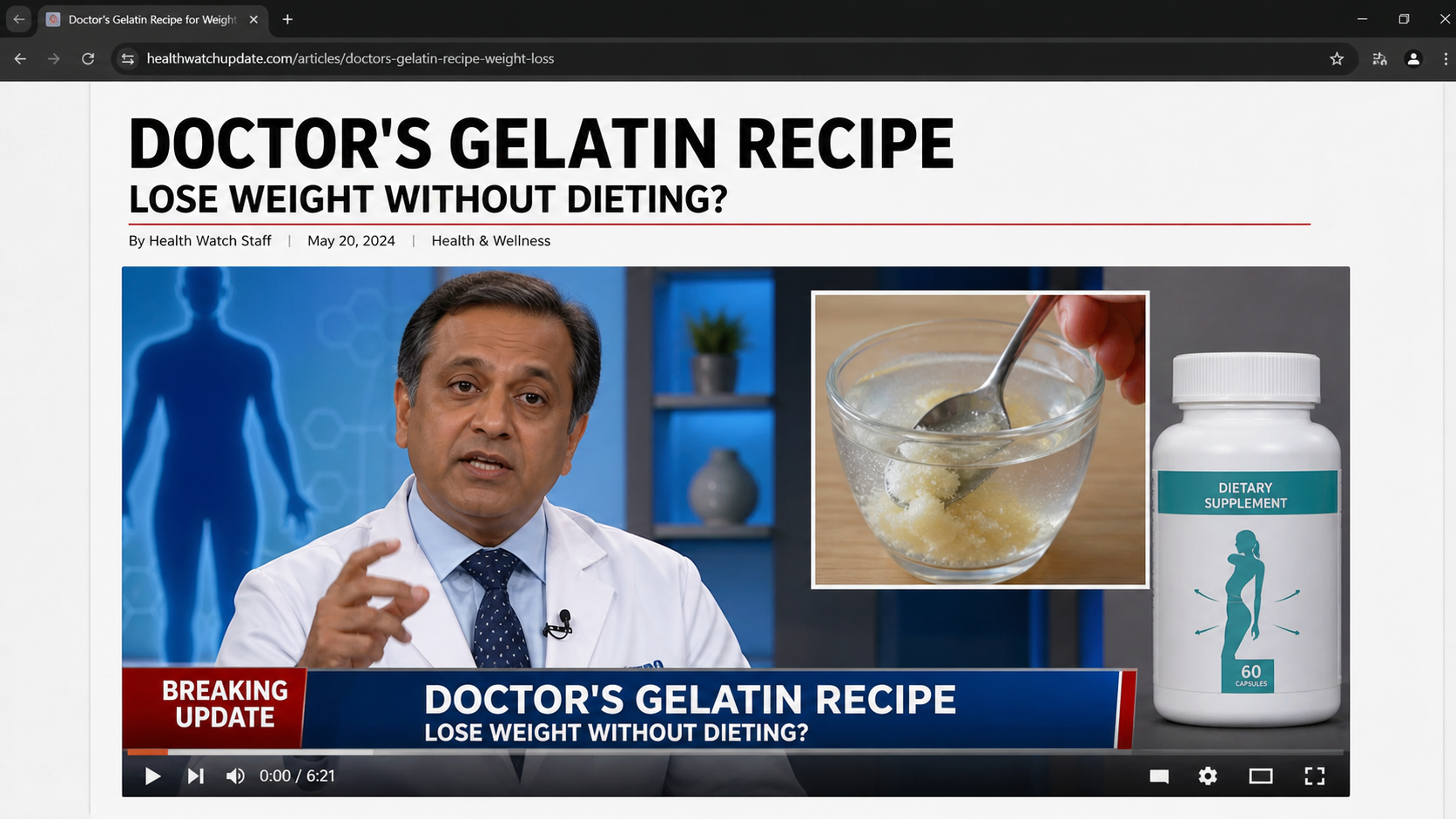
The ad portrays Dr. Sanjay Gupta revealing a gelatin recipe that supposedly restarts metabolism, dissolves abdominal fat, or works like an expensive prescription injection. A fake presenter may claim that the interview was censored because it threatens the weight-loss industry.
Several celebrity stories can be layered into the same page. Valerie Bertinelli, Adele, Michelle Obama, or a fictional patient may appear in testimonials, even though none of those additions proves the product works.
What Can Be Verified
Dr. Gupta is a real neurosurgeon and medical correspondent, which makes his identity valuable to health scammers. A Coconut Creek Police Department alert describes an AI-generated scam using his name, voice, and likeness to sell phony health cures.
We found no verified evidence that he endorsed the advertised gelatin recipe or the rotating supplement offered at the end. A counterfeit page can copy the appearance of CNN, but it cannot create a genuine CNN report.
- The doctor footage may be real while the speech is cloned.
- The apparent CNN page may sit on an unrelated domain.
- The recipe is delayed until a commercial product appears.
- Celebrity testimonials can be fabricated or recycled.
- Scientific phrases are used without product-specific proof.
- The final supplement and seller can change rapidly.
Why This Is Not Just One More Gummy Review
The defining feature is the stolen medical authority, not one gummy label. A campaign can move from capsules to gummies, drops, or powders while retaining the fake Dr. Gupta segment and gelatin promise.
MalwareTips has also investigated the broader Dr. Gupta weight-loss pill scam. This report isolates the gelatin-recipe version so readers can recognize its specific bait even when the bottle is unfamiliar.
How a Counterfeit CNN Page Creates False Credibility
A real news website has a consistent domain, working navigation, archives, author information, corrections process, and links that lead to different reporting. A counterfeit advertorial copies only the pieces needed to make a visitor hesitate before leaving.
The fake page may display a CNN-style red header, breaking-news strip, health category, byline, and embedded video. Comments underneath claim the recipe worked for friends and relatives. Those elements can all be created by the advertiser.
Hover over the menu and inspect the address bar. Scam advertorials often use generic domains containing words such as health, daily, wellness, report, or news. Buttons may reload the same sales video instead of opening genuine sections.
The safest verification is independent. Open CNN directly, search its archive, and check Dr. Gupta’s verified pages without using links inside the ad. If the supposed broadcast exists nowhere outside the marketing funnel, it is not reliable evidence.
Why a Doctor Deepfake Is More Persuasive Than a Celebrity Ad
A familiar actor can attract attention, but a physician appears able to validate a mechanism. The white coat, brain graphics, and clinical vocabulary encourage viewers to treat the pitch as education before realizing a product is being sold.
Voice cloning is particularly dangerous here. It can reproduce cadence and emphasis well enough for a short mobile clip. Captions tell the viewer what they expect to hear, reducing the chance that subtle audio errors will be noticed.
Deepfake detection clues include mismatched lip movement, unnatural pauses, shifting facial texture, and a voice that remains emotionally flat. None is guaranteed. High-quality manipulation may not offer an obvious visual mistake.
Provenance is therefore stronger than appearance. Ask where the original video was published, who owns the domain, and whether the named doctor acknowledges the product. A perfect-looking clip with no authentic source remains unverified.
The Gelatin Explanation Does Not Prove the Product
Gelatin contains protein and has ordinary culinary uses. That does not establish that a ten-second recipe triggers dramatic fat loss, mimics a prescription medication, or corrects a universal hidden cause of weight gain.
The sales video may cite studies about an individual nutrient, satiety, collagen, or blood sugar. Research on one ingredient does not automatically validate a finished gummy containing different amounts and additional ingredients.
Look for a study that identifies the exact formula, dose, duration, comparison group, participant count, and measured outcome. If the seller provides only animated diagrams and testimonials, the claim has not been meaningfully substantiated.
Weight changes can also reflect medical conditions and medication effects. An online video cannot determine why one person is struggling, which is why a universal recipe is an especially weak foundation for a health decision.
How the Dr. Sanjay Gupta Gelatin Recipe Scam Works
Step 1: A Social Ad Uses an AI Doctor
The viewer sees Dr. Gupta apparently discuss a newly discovered gelatin recipe in a CNN interview, podcast, or emergency health update. The opening claims that one simple step worked when standard weight-loss advice failed.
The cloned script may include a personal confession or claim that a colleague was threatened for revealing the discovery. Urgency replaces the cautious language a real medical correspondent would normally use.
Step 2: A Fake CNN-Style Article Continues the Illusion
The click opens a page designed to resemble a trusted publisher. Logos, colors, presenter images, and a fake transcript make the ad feel like independent reporting.
The domain is not CNN’s. Comments, shares, and reader counts may be hard-coded graphics. Every useful link drives the visitor deeper into the sales funnel.
Step 3: A Long Video Invents One Hidden Cause
The presentation says a toxin, hormone, enzyme, or metabolic switch explains stubborn fat for nearly everyone. Real health conditions are simplified into one problem that the advertiser’s formula supposedly solves.
Doctors, dietitians, and drug companies are portrayed as unaware or dishonest. This discourages outside advice precisely when the viewer should be asking for it.
Step 4: Gelatin Becomes the Bait for a Supplement
The recipe is promised repeatedly but never presented as a clear, complete set of free instructions. At the reveal, ordinary gelatin is said to need a proprietary activator, exact blend, or concentrated delivery method.
A bottle then appears as the convenient solution. The educational tone has completed its job and the page becomes a direct sales pitch.
Step 5: Fake Proof Removes Remaining Doubts
Testimonials show large weight changes, improved laboratory results, and doctors who were supposedly amazed. Stock portraits, stolen photos, fabricated names, and edited transformations can produce the entire section.
Badges may suggest clinical approval, secure ordering, or media recognition. A graphic printed by the seller is not independent certification.
Step 6: The Order Page Pushes Multiple Bottles
A low per-bottle or per-day figure attracts attention, while the full bundle charge appears later. Six-bottle packages are framed as necessary because the formula allegedly needs months to work.
Buyers should examine the quantity, total, shipping, tax, add-ons, and selected options. A discount is not valuable if it produces an order the customer never intended.
Step 7: Refills and Returns Create the Last Trap
Terms may authorize recurring shipments or require customers to contact support before returning unopened products. The seller can delay responses until the refund period expires.
When complaints become visible, the campaign can switch domains and products. The fake doctor story then begins sending traffic to a fresh checkout.
Fast Checks That Break the Illusion
- Type the supposed news outlet’s address yourself and search its archive.
- Compare the visible logo with the actual domain in the address bar.
- Search a distinctive sentence from the video in quotation marks.
- Look for the endorsement on the doctor’s verified channels.
- Pause when the free recipe becomes a paid bottle.
- Ignore countdowns until the total and terms are understood.
- Search the merchant name, phone number, and return address separately.
- Assume testimonials are marketing until independently verified.
A fake CNN page succeeds when visitors evaluate its appearance. It fails when they verify the domain, source, seller, and product evidence separately.
Company, Address, and Fulfillment Checks
Find the Seller Behind the Bottle
The product name is not enough. Identify the legal entity accepting payment and compare it with the company in the terms, privacy policy, receipt, shipping label, and bank statement.
Scam operations use disposable brands because a new label is easier than repairing a damaged reputation. Conflicting company names make refunds and accountability harder by design.
Search the Address, Do Not Admire It
A professional-looking street address may be a virtual mailbox, residential unit, shared office, unrelated company, or fulfillment warehouse. Returns centers move boxes. They do not prove that scientists, executives, or manufacturers work at that location.
Check mapping services, business records, and other sites using the same suite. A crowded mailbox address is not the transparent headquarters implied by the sales video.
Test Support Before It Controls Your Refund
Call and ask whether the number serves the exact product, whether billing repeats, what the full order costs, and where returns go. Unanswered phones and evasive agents are strong reasons to walk away.
Do not rely on contact details displayed inside the fake CNN page. Find support through the seller’s formal terms, then see whether those details agree everywhere.
Untraceable Supplements Can Be Risky
Look for ingredient amounts, warnings, lot information, an identifiable responsible company, and a real manufacturing trail. “Natural,” “doctor formulated,” and “FDA registered” do not mean the product is approved to treat obesity.
Generic supplements can be mass produced overseas, including in China, then relabeled for unrelated sellers. That fact alone does not establish danger, but missing traceability means buyers cannot verify formula accuracy, contamination controls, or who will investigate an adverse event.
What to Do if You Have Fallen Victim to This Scam
- Send a clear cancellation. Cancel the purchase and every recurring plan in writing. Ask for a confirmation number, refund amount, return authorization, and the final billing date.
- Speak with the card issuer. Describe misleading quantities, unauthorized renewals, or a price that differed from the order screen. Ask about disputes and stopping future merchant attempts.
- Build an evidence folder. Save the AI ad, fake news page, video URL, checkout, terms, receipt, support messages, package, bottle, and statement descriptor. Include dates and screenshots.
- Get medical advice before taking it. Show the ingredient panel to a pharmacist or physician, particularly if you use medication or manage a chronic condition. Report serious symptoms promptly.
- Protect any reused credentials. Change passwords reused on the checkout, begin with email, and enable multi-factor authentication wherever possible.
- Scan after suspicious prompts. If the page delivered a file, browser extension, or alarming notification, run a full Malwarebytes scan.
- Reduce malicious advertising. AdGuard can block many scam domains, trackers, and intrusive ads. Continue verifying endorsements because no blocker catches every new domain.
- Report the impersonation. Report the ad to the social platform and file a complaint at ReportFraud.ftc.gov. Include the domain, seller identity, phone number, and payment descriptor.
- Use a qualified source for weight concerns. A clinician can evaluate symptoms, medication effects, nutrition, and evidence-based options without relying on a fabricated television segment.
Frequently Asked Questions
Did Dr. Sanjay Gupta Endorse a Gelatin Weight-Loss Recipe?
We found no verified evidence of that endorsement. Public scam warnings have specifically addressed AI advertising that misuses his name, voice, and likeness to sell phony health cures.
Is the CNN Page in the Ad Real?
Not if its domain is unrelated to CNN and the report cannot be found in CNN’s own archive. A copied logo and layout do not make an advertorial genuine journalism.
Can a Gelatin Recipe Work Like a Prescription Injection?
No evidence presented by these ads supports that comparison. Prescription treatments have specific indications, doses, risks, and clinical evidence that a mystery gummy cannot borrow through marketing language.
Why Are Other Celebrities Added to the Story?
More familiar names increase the chance that a viewer trusts at least one part of the page. Their images may be unrelated, fabricated, or used without permission.
Does a News-Style Video Prove a Supplement Was Tested?
No. Production quality proves only that someone created a convincing video. Product evidence must identify the exact formula, dose, study, and outcome.
Can My Bank Stop Future Refill Charges?
Often it can help, but options vary. Contact the issuer quickly, provide the cancellation evidence, and ask specifically about recurring merchant attempts and dispute deadlines.
The Bottom Line
The Dr. Sanjay Gupta gelatin recipe scam combines a cloned medical authority, counterfeit CNN design, and a familiar kitchen ingredient to sell rotating weight-loss supplements.
Do not judge the story by how natural the voice sounds. Verify the original broadcast, inspect the domain and seller, and demand evidence for the exact product before trusting any health claim.

Join the discussion
0 commentsShare your experience or ask a question about this article.
Discussion
Start the conversation
Have a question or something useful to share? Add the first comment.