


A stranger says you have made the list for a private investment round. There is a famous name at the top and someone ready to walk you through it.
Before you answer, look at what the invitation actually offers.
Overview
The invitation is not an endorsement
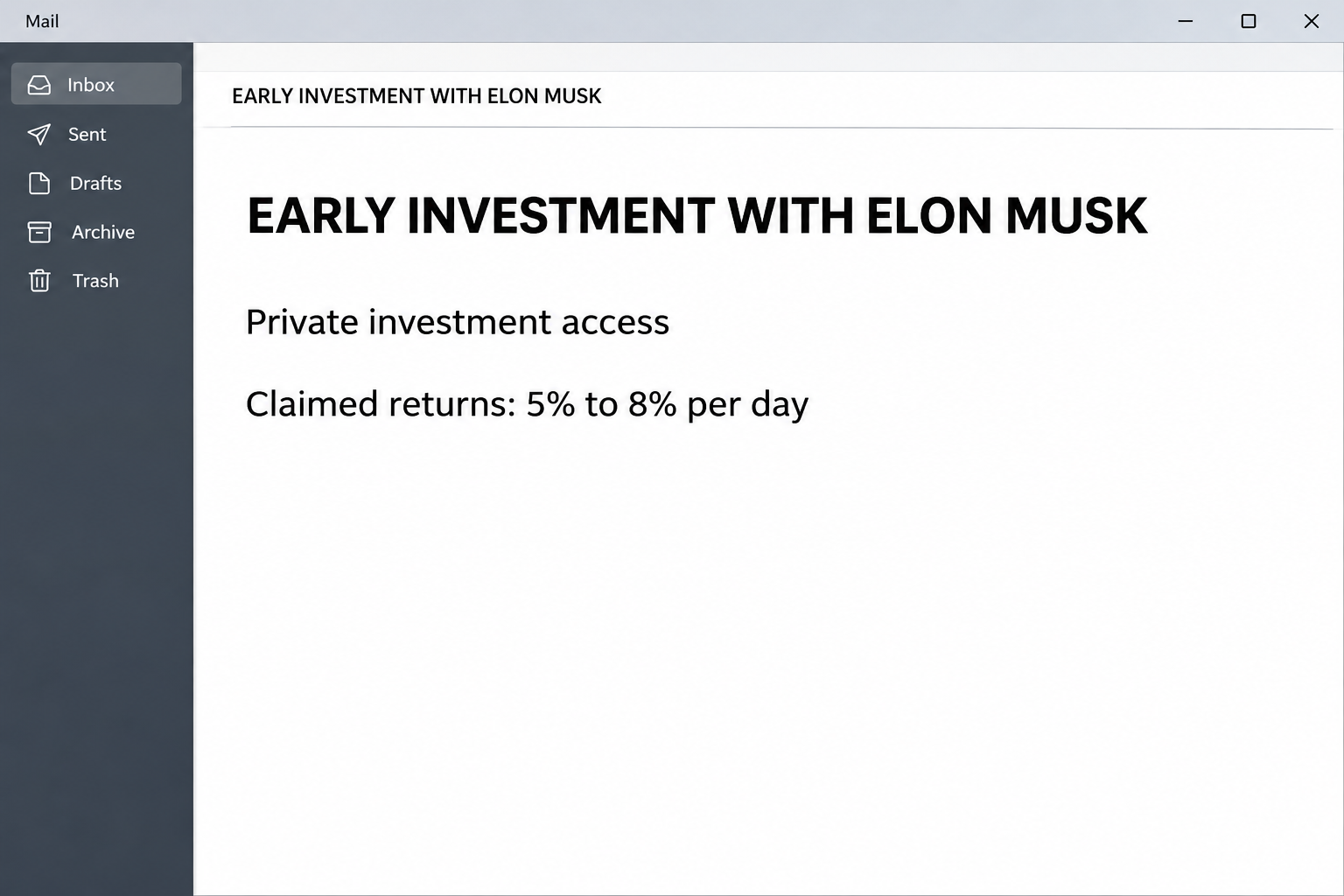
The Elon Musk Investment Team email scam uses a cold pitch headed “EARLY INVESTMENT WITH ELON MUSK.” It presents the sender as part of an exclusive trading operation.
The sender claims to offer private automated trading, with 5% to 8% daily returns and a person to help manage the account.
It even advertises a Zoom conversation with Musk during onboarding. That was a claim in the pitch. The case does not establish that such a call happened.
Nothing in the message demonstrates authorization from Musk, Tesla or any legitimate business affiliated with him. Do not mistake a celebrity’s name in a subject for that person’s involvement.
The image recreates the key claims and leaves out any contact information. It is not a record of a genuine investment offer.
Read the return in the units the email uses
The claim is 5% to 8% a day, not 5% to 8% a year. That difference changes how extraordinary the claim is.
At 5% compounded daily, $1,000 would become more than $4,300 in 30 days, assuming no losses. That is arithmetic, not a forecast.
The email’s references to automation and risk control do not explain who holds the money or why the results would repeat. A trading program does not eliminate market risk.
Profit tracking is not independent evidence either. A chart does not say whether the operator actually traded, whether the accounts are segregated or whether the money is available.
The offer skips the checks that matter
The invitation’s personal tone may make it feel rude to ask administrative questions. Asking who can handle your money is the central question, not an interruption.
- What exact legal business is offering the investment?
- Where can you check the business and the person through an independent register?
- Which institution would hold your money, and how could you contact it without the promoter?
- What independent records support the alleged performance?
- Can the person claiming an endorsement point to something you can verify outside the pitch?
If the only available answers come from the email’s sender, they are still representations by the same party. The SEC’s investment fraud alert explains why independent verification matters.
How the Scam Works
Step 1: The message gives a cold contact the feel of an invitation
An offer sent by a stranger is usually easy to set aside. This one asks the recipient to think of themselves as selected, not marketed to.
The all-caps heading puts the famous name first. It encourages you to wonder why you got picked before asking who actually wrote to you.
An invitation described as private leaves the reader with less public material to check. The lack of an independent record should count against the offer, not in its favor.
If you have recently read about Tesla, AI or trading, the pitch can feel timely. That coincidence does not mean the email originated from one of those businesses.
Step 2: The automated system promises earnings without clear accountability
Daily returns are the center of the pitch. The management and monitoring details give the claim a businesslike frame without explaining how a result would be generated or verified.
Notice the imbalance. The message makes the possible upside exact, yet it leaves an ordinary reader without an independently checked custodian, legal relationship or meaningful measure of loss.
Someone could show you a trading chart and even include occasional down days. The better question is whether a party outside the offer can verify actual deposits and positions.
A promise may be worded as a target rather than a guarantee. That does not fix the problem when the promoter continues to market a steady daily range without support.
Step 3: A dedicated contact makes it feel safe to move forward
The offer says help is available through a dedicated account manager. It also suggests access to the public figure himself through Zoom.
The promised call may be enough to get someone to respond, even if it never takes place. Do not report a deepfake or a real celebrity appearance without evidence.
In related frauds, conversations can continue by phone or chat. If you get a follow-up, a name, professional title or video image is not an independent check of the operator.
Skip the call and check the invitation independently. Use the regulator or the business’s public record instead of the contact details supplied in the pitch.
Step 4: The financial risk changes as soon as money is requested
The email documents the solicitation. It does not let us verify the payee, whether particular trades took place or whether any individual transferred funds.
In investment schemes that use a similar invitation, a promoter may ask for a starter deposit into an account the recipient does not control.
The payment can be disguised as funding a personal trading profile. Inspect the recipient on the actual transfer record, not the label on the promoter’s website.
A beneficiary name that differs from the claimed firm is a reason to stop. A matching name can also be copied, so use a separate verified contact.
If a person asks for cryptocurrency, move slowly enough to distinguish depositing at your own exchange from sending assets out of it. That second action can be hard to reverse.
Step 5: A number on a screen can stand in for a real investment
A false dashboard may show that your first payment is earning something. Seeing a balance can make people protect the supposed profit rather than reconsider the original transfer.
A balance displayed only by the person soliciting money is not a statement from an independent financial institution. Do not let screenshots stand in for a withdrawal or custody record.
If a promoter offers a small successful withdrawal, that is not proof that a larger balance exists. Check what movement actually reached your bank or wallet and who sent it.
This progression is a common investment fraud pattern, not a verified series of events for everyone who saw this particular email. Keep your own evidence rather than assuming.
Step 6: The exit can become another sales pitch
When people ask for withdrawals in similar schemes, they may be told to pay extra for taxes, verification or a release. A new explanation can appear after each payment.
The pressure changes direction. The person offering to grow your money now offers to let you have it back, on one more condition.
Read a demand for a separate advance payment as a new transaction with its own risks. It does not become legitimate because the person ties it to an earlier deposit.
Do not rely on that person’s account of obligations to an authority. If a real bank, exchange or tax body is cited, speak to it independently.
What To Do If You Fell Victim
-
Pause every new transfer.
Do not send a top-up, tax payment or unlocking fee. If the contact is on the phone, end the conversation before checking any financial account.
Open your own bank or exchange through your usual route. Check what actually cleared and whether any transfer remains pending or scheduled.
Do not sign a new agreement under a deadline imposed by the person already asking for money. Forward it to your own adviser or financial institution instead.
-
Get in touch with the institution that moved the money.
Give the bank or exchange the transfer times, actual recipient and payment method. Say clearly that the payment followed an impersonation investment pitch.
Ask about available recall, freezing or dispute options. The institution can explain the procedure, but it cannot promise that funds will still be recoverable.
If someone saw your banking login or guided a transaction on screen, report that too. A suspected transfer fraud and possible account access need separate checks.
-
Keep original records and reconcile the payments.
Save the initial notice, chat history, invoices, payment confirmations and links as private evidence. Do not put account information in a public comment.
Build a simple list of what left your control. Include dates, amounts, receiving names and transaction references from your bank, rather than the values advertised by the platform.
For cryptocurrency, preserve the network and transaction hash from the sending service. Report them to the exchange or investigator directly, not to a stranger offering to trace the funds.
-
Think about what else you shared.
If you sent identification, tell your financial institution which document was sent and ask what follow-up monitoring or reporting is appropriate.
If your email password or verification codes were exposed, secure the account from a trusted device. A working mailbox can let another person hide financial notices or reset access elsewhere.
If you merely answered with your name but gave no money, documents or credentials, the immediate concern is further targeting. Block the contact and screen follow-ups.
-
File a report without turning it into a payment.
US readers can send details to the FBI Internet Crime Complaint Center. Outside the US, report through your local fraud or police service.
An official report helps document the case. It is separate from urgent contact with the bank and does not create an obligation to send money to a recovery service.
Report the email to your mailbox provider as well. Do not direct other potential targets to the pitch so they can investigate it themselves.
-
Make a plan for the next call.
Someone claiming to be an investigator or former account manager may know the name of the investment and what you paid. That alone is not proof of authority.
Write down the name and organization, hang up and call a verified number. If they object to a callback, do not treat the objection as confidentiality.
Share the situation with someone you trust. An outside person can help separate bank records from the story that built up around them.
When Someone Sends a Registration Certificate
A promoter may show a registration number once you ask for proof. Take the document as a claim to check, not as a decision the regulator already made for you.
Look up the legal name independently and compare the contact information in the official record. A real registration does not connect the person emailing you to that firm.
If the contact says a recognizable company is just handling payments, ask the company itself through public support. Do not transfer money while the roles are unclear.
Even when a firm is real, registration is not an endorsement of returns. You still need separate evidence about the offer, its risks and where funds would sit.
Frequently Asked Questions
Is the Elon Musk Investment Team email genuine?
The reported cold email is an impersonation pitch, not a verified invitation. The message itself does not show any relationship to Musk or his businesses.
Do not use a reply to the promoter as a way to confirm the claim. Seek a separate, official source if you need to check an alleged announcement.
Did anyone actually speak to Elon Musk on Zoom?
The invitation promises access in a call. There is no reliable evidence in this case that a recipient spoke to him.
A meeting link, a profile photo and a promising title are not independent verification. An investment decision needs more than an impression of who attended a call.
Is this the same as a fake advertisement about X Money?
This article covers a particular email that promises an automated trading system with advertised daily returns. The fact that multiple pitches name Musk does not make them the same operation.
Treat the wording, money flow and person requesting payment as separate questions. A real service’s name can be borrowed even when the proposed investment has nothing to do with it.
What if I only replied to the initial pitch?
Expect possible follow-ups, but a reply by itself does not put your bank balance under a sender’s control. Block the contact and assess anything you actually handed over.
If you disclosed personal details, note which ones. If you made a deposit, move beyond email reporting and call the service through which you paid.
Can I recover a cryptocurrency payment?
Recovery depends on the facts, including the receiving service and how quickly the case is reported. Saving the transaction record helps, but it does not reverse the transfer.
Use your exchange’s fraud channel and the appropriate authorities. A recovery guarantee from an unsolicited contact is not credible evidence of access to the funds.
Should I pay a fee to release my own money?
Do not pay the promoter another fee. A withdrawal demand must be verified outside the platform, especially if the person insists on a separate transfer.
Ask a financial institution or qualified adviser you chose independently. Be especially cautious if the promoter claims to speak for the tax authority without an official record.
The Bottom Line
An offer of 5% to 8% per day deserves scrutiny, celebrity name or not. This email never establishes who can responsibly handle your money.
If you responded, stop the conversation at the point it reached. If money moved, secure the accounts involved and give the real transaction details to the appropriate institution.

Join the discussion
0 commentsShare your experience or ask a question about this article.
Community experiences
Did this happen to you?
Your experience could help someone recognize the same scam. Submit a private report for our team to review.
I experienced this tooReports are reviewed before publication. Sharing publicly is always your choice.
Discussion
Start the conversation
Have a question or something useful to share? Add the first comment.