

A Manchester name, elegant branding, and a large closing-style discount can make an unfamiliar fashion store feel local and established.
Emily Carter Manchester now presents itself as By Emily. We examined the business details, domain history, sale pricing, return rules, and recurring customer complaints.
Overview
The website has changed its customer-facing identity
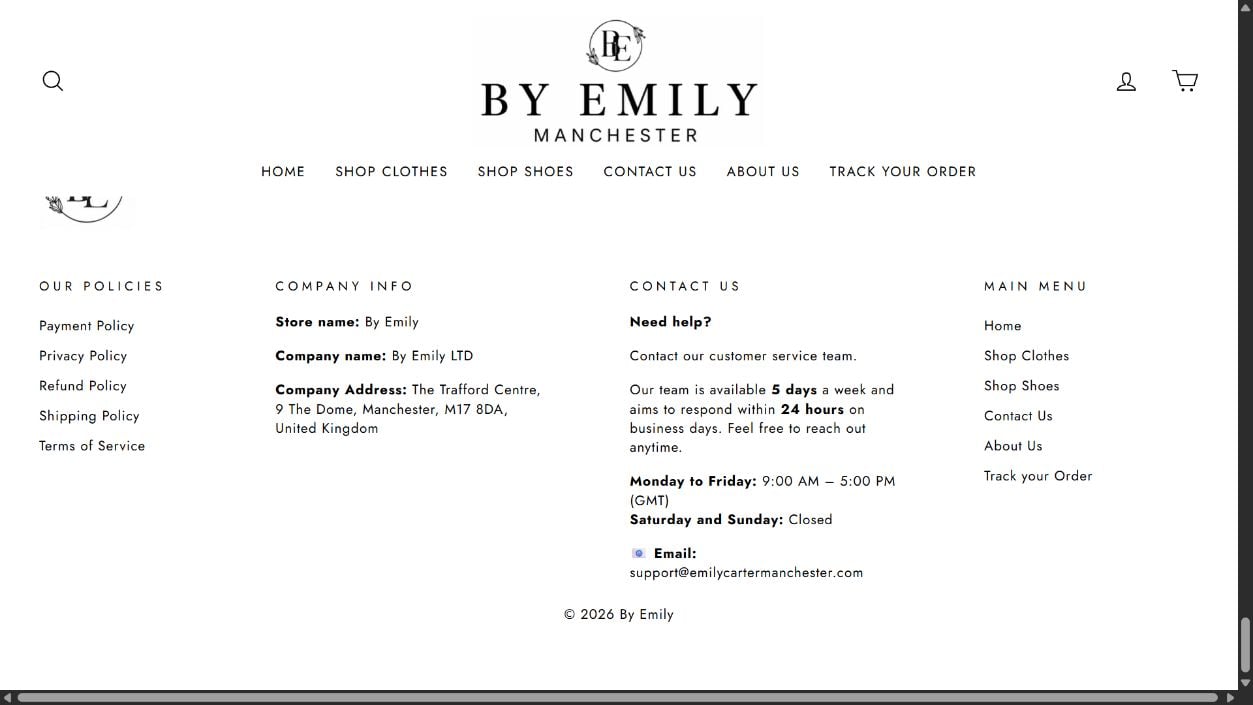
The domain remains emilycartermanchester.com, while the storefront currently displays “By Emily” and “By Emily Manchester” across its header and footer.
The footer names “By Emily LTD” and lists The Trafford Centre, 9 The Dome, Manchester, M17 8DA as its company address.
A rebrand is not proof of wrongdoing. It becomes relevant when reviews, receipts, policies, and corporate records use different names.
The local presentation conflicts with the return process
The homepage emphasizes United Kingdom delivery, a Manchester identity, and a “30-day hassle-free return policy.”
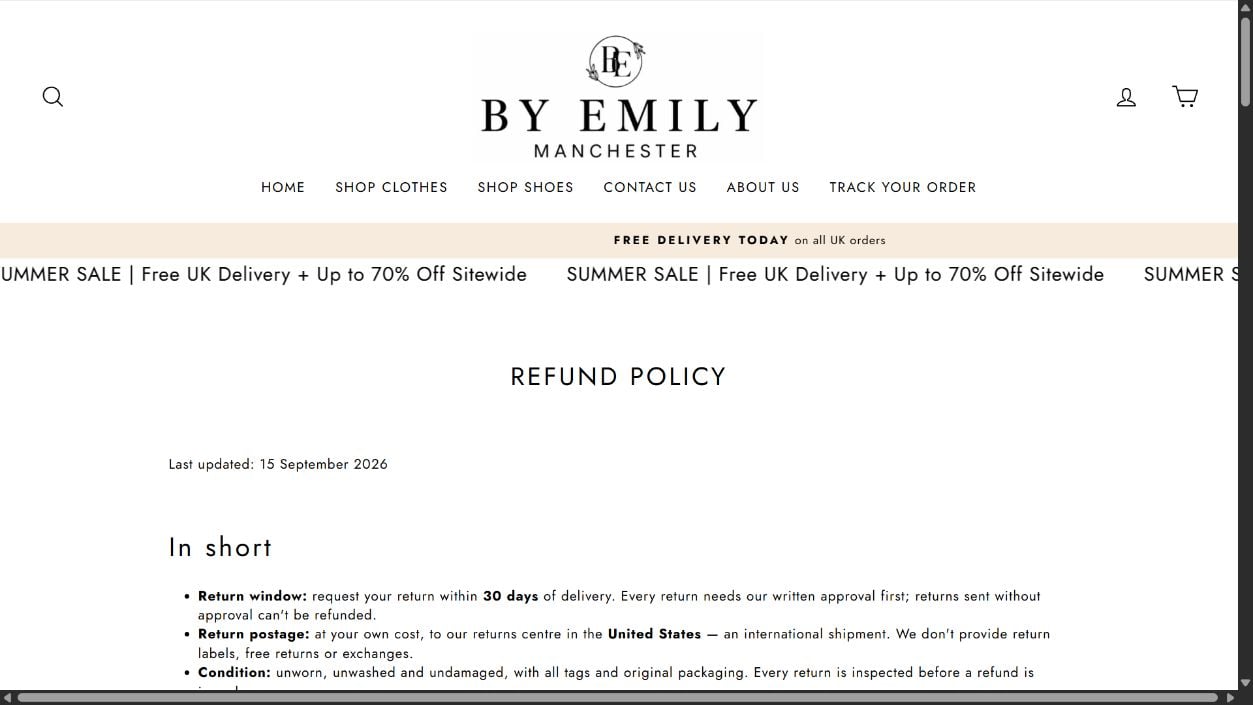
The refund policy says the business has no United Kingdom returns address. Customers must pay tracked international postage to a center in the United States.
That is a substantial practical difference. A return that sounds local and simple can become expensive, slow, and difficult to track.
Customer reports describe familiar fashion-store problems
Public reviews include allegations of items differing from photographs, disappointing material, sizing issues, overseas returns, delayed replies, and refund resistance.
Those statements are customer reports, not facts we independently proved for every order. Repeated themes still help shoppers identify likely friction.
The written return policy independently confirms several disputed points, including international postage, a five-minute cancellation limit, and narrow fault reporting.
- The domain was registered on July 1, 2026.
- The store now uses By Emily branding on the Emily Carter Manchester domain.
- The footer displays a Manchester shopping-center address.
- The policy says returns go to the United States at the customer’s cost.
- Order cancellation is limited to five minutes after purchase.
- Fault claims generally must be reported within three business days.
Is Emily Carter Manchester a Scam?
The website is a functioning Shopify store with products, payment options, policy pages, tracking, support email, and a stated company identity.
We cannot conclude from those facts alone that every order is fraudulent or that no customer receives clothing.
The concern is a mismatch between the storefront’s local, reassuring presentation and the much more burdensome terms governing returns and cancellations.
The domain is recent, yet the store looks like an established Manchester boutique. Its current By Emily branding further complicates the history shoppers are trying to verify.
Official company-search results did not allow us to confidently match the exact displayed name and Trafford Centre address to a specific registered entity.
That does not prove the company statement is false. It means the site should provide a company number and complete legal details so buyers can verify them.
The store’s policies are unusually protective of the merchant. Orders enter processing within minutes, returns require approval, and several common complaints are excluded as faults.
Our conclusion is not that the store is a proven phantom. It is a high-risk fashion purchase with material policy details that the homepage does not communicate clearly.
The Storefront Creates a Local Boutique Impression
The header uses “By Emily Manchester,” while the page features polished collections, seasonal copy, British pricing, and United Kingdom delivery language.
Product cards commonly show 70% discounts. Coats listed around £134.95 appear at £39.95, while other garments follow similarly steep pricing patterns.
Large, repeated discounts create the impression of a temporary clearance. A shopper may act quickly to avoid losing a size or color.
The homepage also promises free delivery and a 30-day money-back guarantee, with language describing returns as hassle-free.
These signals combine familiarity, location, savings, and reassurance. Together they reduce the perceived risk of buying from an unknown retailer.
The footer then displays a prestigious shopping-center address. Many buyers will reasonably infer that the store operates locally or maintains a physical business presence there.
The refund policy tells a different operational story. It says there is no United Kingdom return address and approved goods must travel internationally.
A physical-looking address can be a correspondence location, virtual office, retail complex, or unrelated reference. Buyers should verify the exact unit and company registration.
How the Sales Funnel Works
Step 1: Social ads present a stylish local retailer
The advertisement usually features attractive garments, large discounts, and an emotional reason for the sale, such as season changes or limited availability.
Manchester branding helps the store feel closer to United Kingdom shoppers. Locality can imply easier delivery, support, and returns.
The ad sends viewers directly to product pages before they have searched the company name or checked external feedback.
Step 2: Repeated 70% discounts create urgency
Many products show a high reference price crossed out beside a much lower sale price.
When almost everything is discounted by a similar amount, the sale can function as a permanent conversion tool rather than a rare event.
Buyers should compare similar garments elsewhere and ask whether the reference price reflects genuine prior sales.
Step 3: The homepage reassures buyers with simple promises
Free delivery, responsive service, a money-back guarantee, and hassle-free returns answer the most common objections near the bottom of the page.
Those short statements are easier to absorb than the detailed policy. Many shoppers never open the longer document.
The sale therefore feels reversible, even though the practical return path is considerably more demanding.
Step 4: Orders become difficult to stop almost immediately
The refund policy says confirmed orders are sent automatically to the supplier’s warehouse and can be canceled only within five minutes.
After that, the store says it cannot change, stop, or cancel the order, even when the customer notices an error.
The buyer must wait for delivery, request approval, and potentially fund an international return.
Step 5: The detailed return conditions narrow the guarantee
Returns require written approval, original condition, tags, packaging, tracked shipping, and delivery to the address provided after approval.
The customer pays international postage to the United States. The policy says parcels with customs fees due may be refused.
Returns sent elsewhere, without approval, or after the allowed period can be rejected and left without a refund.
Step 6: Common quality complaints may not qualify as faults
The policy excludes loose threads, small open seams up to about 2 cm, minor stitching irregularities, slight asymmetry, and some measurement differences.
It also says fabric feel, weight, thickness, softness, sheen, and differences in how an item looks on the customer are not faults.
These exclusions address precisely the issues often raised when inexpensive online clothing differs from expectations.
Step 7: A replacement may take priority over a refund
Customers must report damage, faults, or incorrect items within three business days and provide photographs.
When the store confirms a fault, the policy says it sends a replacement rather than a refund.
If the exact item is unavailable, the seller may propose another color or comparable product in consultation with the customer.
The Return Policy Deserves to Be Read Before Ordering
The homepage’s “30-day hassle-free” message gives only the headline. The detailed policy adds approval, condition, location, cost, timing, and evidence requirements.
The 30-day period begins from the delivery date recorded by the carrier. Customers must request approval within that window.
Once approved, the parcel must be sent within the stated period using tracked international shipping.
The customer remains responsible until the return reaches the United States center. Lost, damaged, or untraceable returns cannot be refunded.
The policy says items are inspected after arrival. A refund may be reduced or refused when the store decides the condition does not meet requirements.
Shipping protection fees and return postage are not refunded. These costs can consume a meaningful share of a low-priced garment refund.
Refusing delivery does not count as cancellation or return under the policy.
A shopper should request an estimated international return cost before purchasing. The cheapest tracked option may still make a small refund uneconomical.
What Customer Complaints Suggest
External reviews include allegations that clothing looked cheaper than expected, differed from images, fit poorly, or arrived after long waits.
Several reviewers say they expected a United Kingdom return but were directed overseas. Others describe automated responses or offers that did not resolve the complaint.
These accounts should be treated as individual experiences. Review platforms can contain incomplete, emotional, duplicated, or unverifiable statements.
Still, the overseas-return theme is consistent with the store’s own published policy. It is not merely a rumor from dissatisfied customers.
Likewise, complaints about seams, fabric feel, sizing, and appearance correspond with categories the policy says may not count as manufacturing faults.
The most useful approach is to compare complaint patterns with the written rules. When they align, the operational risk becomes easier to understand.
Company, Address, and Fulfillment Red Flags
The displayed company name needs a registration number
The footer says “By Emily LTD,” but it does not prominently provide a company number beside that name.
Exact-name searches can return unrelated businesses. A registration number would let shoppers connect the store to the correct official filing without guessing.
The Trafford Centre address does not explain operations
The site lists The Trafford Centre, 9 The Dome, Manchester. We could not verify from the page whether this is a shop, office, correspondence point, or another arrangement.
The policy’s statement that no United Kingdom returns address exists makes the displayed location especially important to clarify.
The support trail relies heavily on one email
The visible contact address is support@emilycartermanchester.com. The footer provides service hours but no public customer-service telephone number.
Email creates a useful record, yet buyers remain dependent on the store’s response when a five-minute cancellation window is running.
The supplier and returns center are separate from the brand
The policy says orders pass to a supplier’s warehouse and returns go to a United States center disclosed after approval.
Neither statement identifies the garment manufacturer. We found no reliable evidence proving a particular country of manufacture, so that detail should not be invented.
What to Do if You Have Fallen Victim to This Scam
- Act immediately after ordering. If cancellation is needed, email within five minutes, include the order number, and put “CANCEL” in the subject line.
- Preserve the original listing. Save product photographs, material claims, size chart, price, discount, delivery promise, homepage guarantee, and complete return policy.
- Film the unopened parcel and unboxing. Record the shipping label, item, tags, measurements, seams, color, and any damage before wearing or washing it.
- Report faults within three business days. Send clear photographs and a precise explanation. Ask whether the proposed remedy is replacement, refund, or another item.
- Obtain written return approval. Do not use the shipping-label address. Request the official United States return address, deadline, customs instructions, and tracking requirements.
- Compare postage with the expected refund. Include tracked international shipping, nonrefundable fees, and possible customs complications before mailing the parcel.
- Use payment protections when terms are not honored. Contact the card issuer within its deadline and provide the local-return impression, policy, correspondence, and product evidence.
- Secure the device used for checkout. Run Malwarebytes after suspicious downloads or redirects. AdGuard can reduce deceptive advertising and repeated tracking, but it cannot recover a payment.
- Report materially misleading promotion. Notify the advertising platform and relevant United Kingdom consumer-protection channels with saved evidence.
How to Shop More Safely From Online Fashion Stores
Verify the legal entity and company number before ordering. Match the name across the footer, terms, receipt, payment descriptor, and official register.
Search the exact address. Determine whether it is a retail unit, virtual office, mailbox, residential property, or unrelated business.
Read the return location before focusing on the return period. Thirty days offers little comfort when postage exceeds the item’s value.
Reverse-search product images and compare identical garments on other marketplaces. Reused photographs can reveal generic inventory and more realistic pricing.
Start with one low-value item and pay by credit card. Avoid large bundles until quality, sizing, delivery, and support have been personally tested.
Measure a garment you already own and compare actual dimensions. Do not rely only on familiar size labels.
Frequently Asked Questions
Is Emily Carter Manchester now called By Emily?
Yes. The current website uses By Emily branding while continuing to operate on the emilycartermanchester.com domain.
Is the store definitely fraudulent?
We cannot prove every transaction is fraudulent. The store presents significant transparency and return risks that justify strong caution.
Can buyers return items in the United Kingdom?
The published refund policy says the business does not operate a United Kingdom returns address. Approved returns go to a United States center.
How long do customers have to cancel an order?
The policy says cancellation or modification is possible only within five minutes after ordering because orders enter supplier processing automatically.
Does the 30-day guarantee mean free returns?
No. Customers pay international tracked postage, and prior written approval is required. Return shipping and certain fees are not refunded.
What is the strongest warning sign?
The clearest issue is the gap between local Manchester presentation and a return process requiring customer-funded shipment to the United States.
The Bottom Line
Emily Carter Manchester, now By Emily, presents itself like an approachable United Kingdom boutique while operating a much stricter international return process.
The store may deliver clothing, but its new domain, unclear company match, rapid cancellation cutoff, and overseas returns make the purchase far less simple than advertised.

Join the discussion
0 commentsShare your experience or ask a question about this article.
Discussion
Start the conversation
Have a question or something useful to share? Add the first comment.