


The loafers look like the comfortable slip-ons you’d buy for a parent with sore feet: hands-free, orthopedic, genuine leather, and more than half off.
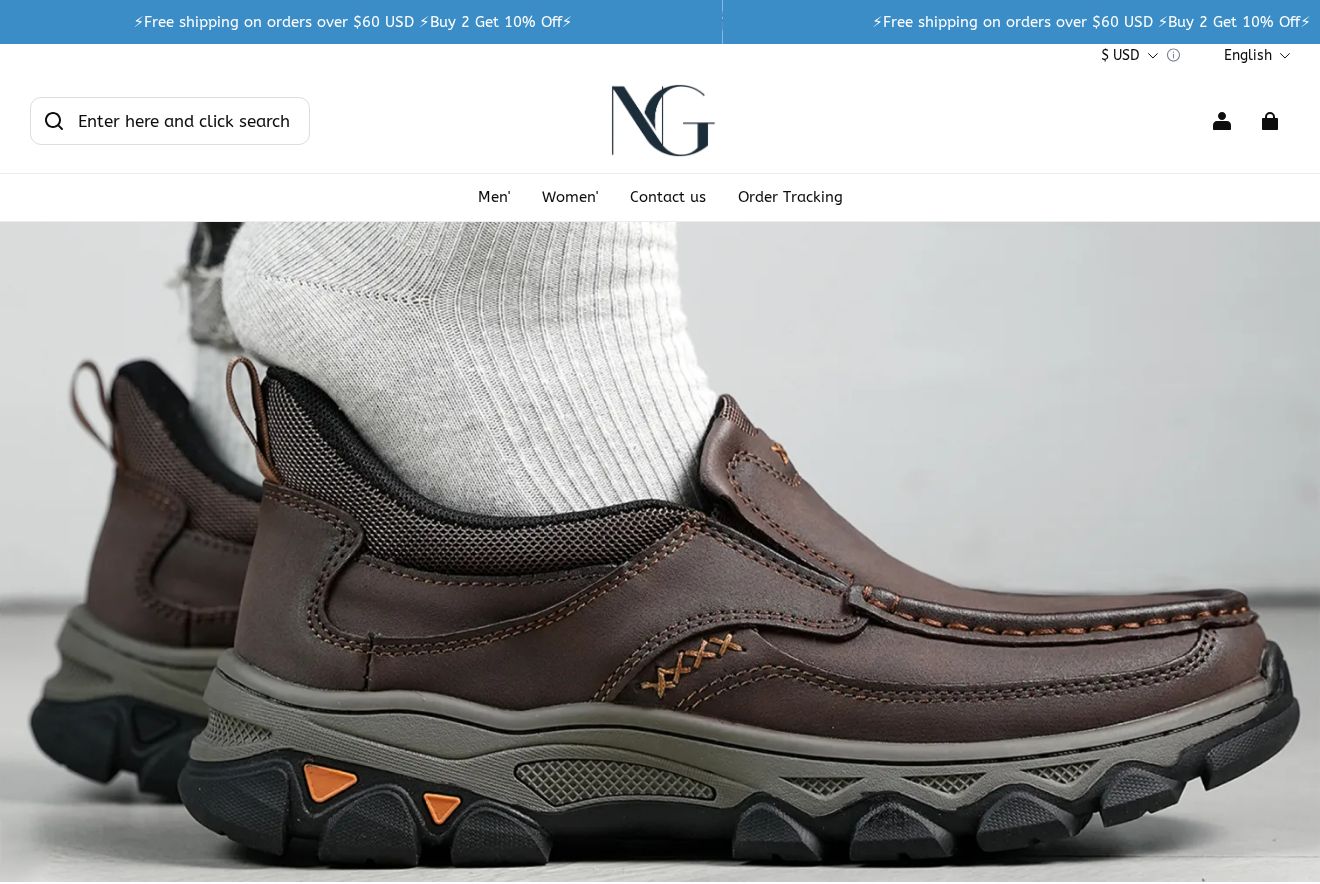
If you’re reading Enjerr reviews before ordering, or after a pair arrived, the first surprise is the name now printed at the top of the website.
Overview
Enjerr is online, now branded Novagrac
Enjerr.com and novagrac.com display the same Novagrac storefront. Archived homepages show the Enjerr name through March 2026 and Novagrac by late July.
A changed shop name does not change an existing order. Keep the original confirmation, payment descriptor and support correspondence together rather than relying on today’s logo.
The comfort pitch comes with a costly exit
The main loafer is $85.99 against $179.99. Its central promise is “Free returns >>Fast refund, 100% Money-Back Guarantee.”
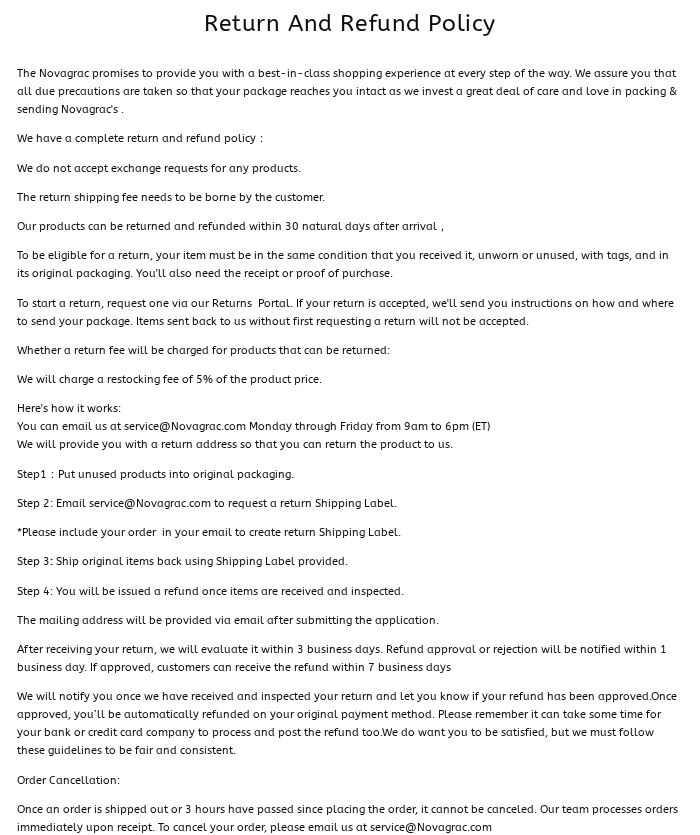
The return policy instead requires customer-paid postage, a 5% restocking fee and unworn goods with tags and packaging. It refuses exchanges.
For shoes, the ability to reverse a poor fit matters as much as the buying price. A guarantee needs workable instructions, not just reassuring words.
Should you order? No
Do not buy from Enjerr or Novagrac. The documented sales-versus-policy mismatch makes this an offer to avoid, especially when choosing footwear for someone already in pain.
- Identify the contracting seller, not just the name above the shoe photograph.
- Compare the advertised remedy with the actual cost of returning an unsuitable pair.
- Judge orthopedic language by evidence about the exact model.
- If you already paid, preserve the order and choose a remedy suited to what actually went wrong.
Enjerr Reviews: What the Complaints Actually Describe
The Trustpilot profile shows 1.2 from 231 reviews, 97% one-star, an unclaimed profile and no recorded review invitations.
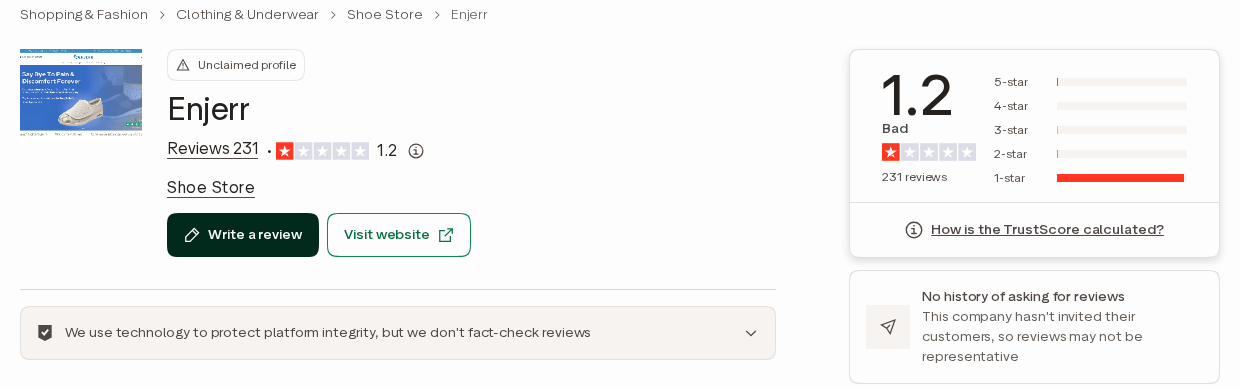
Reports describe wrong colors, sizing problems and flimsy footwear. One reviewer liked a clog’s fit but found little contoured support.
A shoe buyer reported a 15% future-purchase coupon and repeated unanswered return-address requests. A separate jacket complaint described 15%, then 40% refund offers.
Another customer reported recovering the full payment through her card company after roughly six or seven weeks. That is a completed recovery, rather than another support offer.
Read past the rating and look for details that match your situation. A sizing complaint requires different evidence from a parcel that never arrived.
Look for the sequence: what was ordered, what arrived, when support replied and whether money actually appeared back in the account. Those details beat an angry headline.
An offer, an approved refund and a completed credit are different stages. Keep that distinction when reading a complaint or describing your own experience to a bank.
What about Enjerr shoes on Walmart?
Walmart Marketplace also lists Willtoo Enjerr Orthopedic Shoes, with Willtoo identified as the seller. Check that marketplace order under its own seller and return terms.
Check the seller shown beside the actual purchase button, its applicable return terms and the order receipt. A shared product title does not identify your contracting merchant.
How the Enjerr Sales Funnel Works
Step 1: Familiar logos make the shop feel established
The homepage places eight news logos beneath an As Seen On Sponsored Content label. The logos do not link to supporting articles.

A news logo cannot tell you who inspected materials, tried on a pair, or handled a return. Look for an actual review with those details.
The homepage also connects purchases with ocean protection without naming a charity, program or contribution amount.
Ask what the purchase funds and where that commitment can be checked. A charitable-sounding story should not decide whether the shoe fits or the return is affordable.
Our Zelleria orthopedic shoes and Orthora Footwear reports explain other comfort-shoe offers where medical language and purchase protection need separate scrutiny.
Step 2: A comfort purchase becomes a health decision
The loafer listing targets plantar fasciitis, heel pain and flat feet; the FAQ adds heel-spur relief.
That matters because someone shopping for pain relief may tolerate a higher price or overlook a difficult return, hoping the next pair will finally solve the problem.
Separate the job you need a shoe to do from the story used to sell it. Easy entry, cushioning and room for toes are different requirements.
Before choosing, explain the discomfort and daily activity to a qualified clinician. Ask which construction and fit features matter for your feet, rather than seeking one universal remedy.
Step 3: Urgency competes with a careful first purchase
The Sold display showed 2,867, 3,712, 3,142, then 4,272. A countdown and bundle offers added pressure.
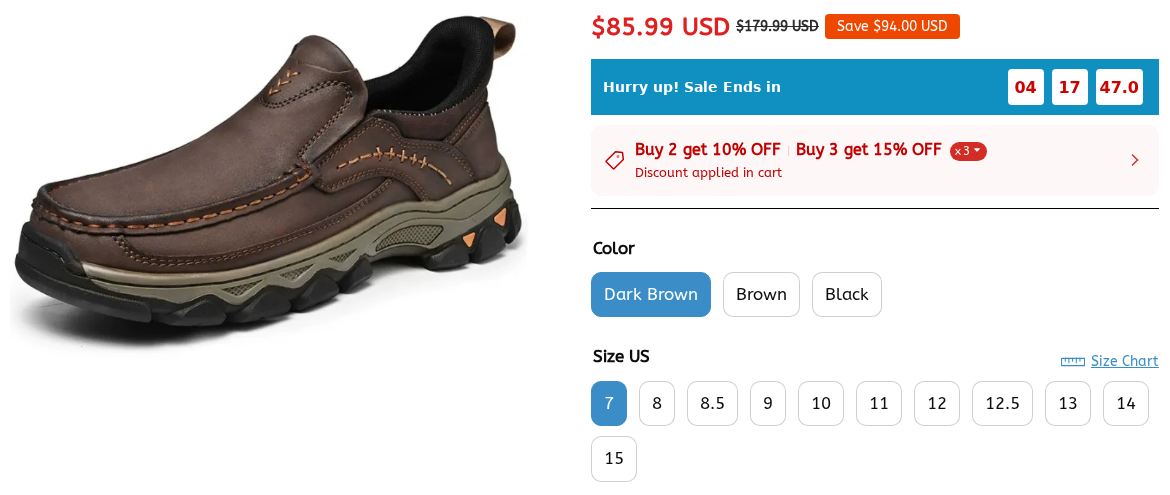
Those displays are not authenticated sales records. A falling total undermines the social proof; it does not make a bundle worth buying.
Ignore how many strangers supposedly bought. Work out whether you would still want one pair at the final delivered price without the timer or comparison price.
Do not solve uncertain sizing by ordering several colors immediately. Extra pairs multiply the cost of a mistake before you know whether the first pair suits you.
A checkout screenshot should show your selected size, width, color, quantity, currency and total. Compare it with the confirmation before closing the page.
Step 4: The detailed policy changes the buying calculation
Cancellation ends once the order ships or three hours after purchase. Return instructions and the mailing destination are supplied after authorization.
The shipping policy combines 3–7 business days of processing with 11–25 days after dispatch, while also describing 11–25 days as the total.
The listing separately promises worldwide express delivery in 5–10 days; the shipping policy limits destinations to the US. Those are materially different expectations.
A customer cannot plan an occasion-specific purchase around incompatible timetables. Choose a deadline based on when the shoes become useless to you, not the earliest advertised arrival.
Likewise, ask whether return tracking must show dispatch or warehouse receipt by the relevant deadline. Do not let an unanswered email consume the entire window.
Step 5: Negotiation can replace a straightforward return
Decide what outcome you actually want before replying: keep a usable pair with an agreed partial cash refund, or return the goods and request the full remedy.
A discount on a future order requires another purchase. Cash returned to your original payment method is different, even when it is less than you requested.
Compare any settlement with the realistic net recovery from mailing the goods back. Consider postage, deductions, tracking and whether accepting the offer closes your claim.
You may decline an inadequate offer. You may also choose a documented settlement that suits you. Neither choice should rest on a promise that a bank must refund everything.
Who Runs Enjerr Now: Company, Address and Brand Names
The seller declares KEJU TRADE INC
The contact page names KEJU TRADE INC, EIN 99-4913528, service@Novagrac.com and 110 16th Street, Denver, Colorado.
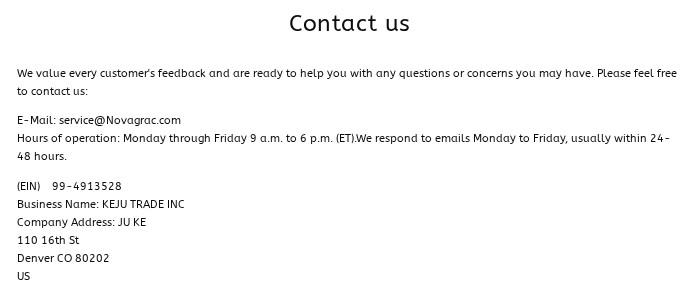
Our Veloraer report records the same company name, EIN and street address on another differently branded store. Shared declarations do not establish ultimate ownership.
Match the receipt and card descriptor to these declared details. If a different name appears, ask the merchant and payment provider how it relates to your particular transaction.
An office address is not a return authorization
Alliance Virtual Offices advertises mail and business-address services at 110 16th Street. The shop lists no suite; its use of that provider is unconfirmed.
An address in a business district can serve administration rather than parcel returns. Sending goods there without instructions can leave you paying postage without obtaining the intended remedy.
Use the destination supplied for your authorized return, and check the recipient, reference and country before buying a label. Keep the approval alongside the tracked-postage receipt.
Several names appear in the same sales material
The storefront mixes Novagrac, Enjerr and an About-Totria link. The loafer description also uses Comfymore and CAIPCMALL.
Hands Free Slip-ins is also a Skechers product-line name. Similar wording does not establish that Skechers manufactured or endorsed this offer.
January 2026 Meta ads from Maigali linked to an Enjerr-named loafer listing. Maigali still operates a store, but that listing now displays a 404 error.
Keep the campaign name separate from the order merchant. When seeking help, the receipt and payment destination are more useful identifiers than a changing label on an advertisement.
The legal pages contain inconsistent boilerplate
The terms mention UK restrictions but specify Colorado governing law. The privacy policy associates French law with the Patriot Act; the payment page uses China-registration reassurance.
Policy pages should clarify the agreement before payment. A shopper should not need to untangle mismatched legal references while trying to solve a simple footwear return.
Check the Shoe, Not Just the Orthopedic Label
The American Podiatric Medical Association has a Seal of Acceptance database for submitted products reviewed by its podiatrist panel. It does not test every shoe sold.
An absent listing is not proof that a pair is unsafe. A reassuring category name is not proof that the exact shoe meets your medical needs either.
Ask for finished measurements, width information, fastening details and the intended fit. Compare the size chart with your foot measurements, not just your usual shoe number.
Check whether the insole can be removed if you use an orthotic. Ask your clinician what room and support the prescribed device needs before ordering unfamiliar footwear.
Request close photographs of the lining, seams, sole and heel area. An attractive side profile cannot answer how the shoe is assembled or whether a particular pressure point fits.
If a seller cannot answer an ordinary construction question, do not fill the gap with an assumption that a medical-sounding title guarantees premium workmanship.
What to Do If You Ordered From Enjerr or Novagrac
- Create one clear order record.
Put the confirmation, receipt, payment descriptor, delivery estimate and support messages together. Keep originals; send copies when asking another organization for help.
Write a brief timeline with order, dispatch, arrival and complaint dates. It makes the issue easier to explain without forwarding an unstructured pile of emails.
- Preserve the exact promise.
Save the listing and applicable policy as images or PDFs, including the full address and date. Keep the version shown when you bought, not just today’s wording.
Identify the specific mismatch you relied on. A concise explanation tied to your order is stronger than accusing every product on the store of being fake.
- Inspect before wearing outdoors.
Photograph both shoes, labels, soles, packaging and shipping label. Compare the selected size, width and color against the confirmation before discarding any wrapping.
The shipping policy requests proof of damage or missing items within 24 hours. Report an issue promptly while preserving any other rights that apply.
- Explain the problem to support.
Give the order number, delivery date, clear photographs and requested outcome. Explain an objective difference, such as the received color or marked size, where one exists.
Do not simply write that the shoes feel cheap. Describe the actual construction issue or visible defect and how it differs from the listing.
- Get return instructions before posting.
Confirm the full authorized address, deadline, tracking requirement and expected repayment. Ask whether an emailed label is prepaid or later deducted.
Keep the goods in their documented condition while waiting. If support sends conflicting destinations, request one confirmed instruction rather than guessing which warehouse to use.
- Evaluate a settlement without pressure.
Ask whether the proposed percentage is cash, store credit or a coupon. Confirm the amount, payment method, timetable and effect on any remaining claim.
Never describe an accepted cash settlement as an unauthorized charge. Give the payment provider the actual transaction history if the agreed money does not arrive.
- Track any authorized return.
Photograph the packed parcel and label, retain the carrier receipt and save delivery tracking. An approval email alone does not show the warehouse received the shoes.
If a label or customs declaration seems incorrect, ask the carrier and merchant for clarification before sending. Do not invent the contents or value to satisfy support.
- Keep foot pain separate from the payment dispute.
Stop using footwear that causes pain or injury. Get professional advice for ongoing symptoms instead of waiting for the refund discussion to decide what your feet need.
Document the condition without claiming a medical diagnosis you have not received. A clinician can assess symptoms; the payment provider handles the purchase dispute.
How to Spot Fake Shoe Stores
Fraudulent shopping websites often share common patterns that make them easier to detect once you know what to look for. Before entering personal information or making a payment, take a few minutes to check for these warning signs:
- Unrealistic prices and discounts
If a website offers products at prices far below trusted retailers, it’s often a red flag. Many of these sites advertise luxury or high-demand products at massive discounts to create a sense of urgency. A $300 product listed for $49.99 should immediately raise suspicion. - Recently registered or suspicious domain names
Many fraudulent websites operate on newly created domains that disappear after a few weeks. Look for signs like random characters in the URL, misspellings of well-known brands, or hyphenated domains.
You can check a site’s age with a WHOIS lookup, or run it through our free Scam URL Scanner. - Missing or vague company details
Legitimate businesses clearly display their company name, tax information, phone numbers, physical address, and return policies. Fraudulent sites often provide incomplete, fake, or no company details at all. A lack of verifiable contact information is a major warning sign. - No reliable customer service
Real businesses provide clear ways to contact support—email, phone, live chat, or physical return addresses. Fake stores often list nonfunctional contact forms, invalid phone numbers, or reply with generic automated messages. - Poor website quality and structure
Many fake stores are set up quickly with low-effort templates. Look for poor grammar, spelling errors, low-resolution product images, broken links, or missing legal pages (Terms of Service, Privacy Policy, Return Policy). A sloppy website often signals something isn’t right. - Copied product descriptions and images
Fraudulent sites often lift product listings directly from real retailers or marketplaces. If you reverse image search a product photo and find it on multiple unrelated websites, the listing is likely not original. - Lack of credible reviews or suspicious review patterns
A real store will usually have a mix of customer reviews across different platforms. Warning signs include no reviews at all, obviously fake five-star reviews, or multiple identical reviews posted on the same day. Searching “[website name] reviews” or “[website name] scam” on Google often reveals warnings from other consumers. - Unclear or unfair return and refund policies
Fake stores often use vague language around returns and refunds—or avoid the topic entirely. If you can’t easily find clear instructions for how to return an item or get a refund, proceed with caution. - Aggressive urgency and pressure tactics
Fraudulent websites commonly use fake scarcity (e.g., “Only 2 left in stock!”) or countdown timers (“Sale ends in 10 minutes!”) to push you to buy before you think it through. Legitimate stores don’t rely on fabricated urgency to make sales.
Quick Steps to Verify a Website’s Legitimacy
Before entering payment or personal details on a new shopping website, take a few simple precautions:
- Search for the store’s name along with words like “reviews” or “complaints” on Google and Trustpilot.
- Check the website’s domain registration using Whois.com.
- Use trusted tools to scan for malicious or fraudulent links:
- Malwarebytes ScamGuard – detect scams and unsafe links before they reach you on Android and iOS phone.
- Malwarebytes Browser Guard – block dangerous or fake websites on Windows and macOS browsers.
- Verify the business address on Google Maps to ensure it’s a legitimate location.
- Review the store’s accepted payment methods – credit cards and PayPal are traceable and safer than cryptocurrency or bank transfers.
- Trust your instincts; if something feels off, it’s better not to proceed.
How to Spot Similar Scams on Social Media
Many fraudulent shopping websites rely heavily on sponsored social media ads to draw in large numbers of potential buyers. These ads often promise extraordinary discounts—sometimes up to 90% off—and use emotionally charged language to push users into buying immediately.
They frequently appear on Facebook, Instagram, and TikTok, blending in with legitimate content. However, these ads follow predictable patterns that make them easier to identify once you know what to look for.
Spotting Fraudulent Facebook Ads
Facebook’s advertising platform is a favorite tool for fake online stores because of its massive reach. These ads often feature “unbelievable” offers designed to create urgency and bypass critical thinking. Warning signs include:
- Extreme, unrealistic discounts such as “90% OFF,” “Store Closing Sale,” or “Final Liquidation.” Real retailers rarely discount new products this aggressively.
- Poor grammar, awkward phrasing, or inconsistent language throughout the ad or website, indicating low-effort, mass-produced content.
- Generic stock photos or images with watermarks, suggesting the images were taken from legitimate brands or stolen from other sources.
- Recently created Facebook Pages, which is common for temporary fraudulent campaigns. Check the “Page Transparency” section to see when the page was created.
- Limited or no engagement from real customers. Authentic brands usually have reviews, comments, and visible user interaction.
If an ad raises doubts, search for reviews of the website or reverse image search the product photos to see if they’re copied from elsewhere. Never provide payment information until the site is verified.
Spotting Fraudulent Instagram Ads
Instagram is another major platform used to promote fake shopping sites through eye-catching visuals and short-lived “flash sale” captions. Warning signs to look for:
- New or disposable accounts with few posts and followers, often created just weeks or days before launching ads.
- Lack of tagged users in product posts. Legitimate stores often feature real customers, influencers, or product usage.
- Unsecured checkout pages. If the website linked in the bio does not use HTTPS, do not enter payment information.
- Fake or missing customer reviews. Fraudulent stores rarely have authentic purchase feedback.
- Unclear or restrictive return policies, often hidden or written vaguely to make refunds difficult.
When in doubt, search for independent reviews before buying, and only enter payment details on verified, secure websites.
Catching Fake TikTok Ads
TikTok is increasingly used to promote questionable shopping deals through short, persuasive videos. While many ads look polished, the same red flags apply:
- Links to unknown stores that don’t appear in search results or have no external reputation. Many of these sites are temporary and disappear after a short time.
- No verification badge on the TikTok account. While not every legitimate store is verified, the lack of a badge is one more indicator to check further.
- Aggressive countdown timers or “one-day only” promotions designed to rush decision-making.
- Lack of genuine customer reviews or real user content demonstrating the product in actual use.
- Comment sections filled with complaints or warnings from other users. This is often the first place victims speak up.
TikTok scams often rely on impulse buying. Take a moment to verify the website, read independent reviews, and use trusted browser protection before visiting external links.
When an Ordinary Return Does Not Resolve Your Order
Contact your card issuer or payment service when the merchant does not resolve a documented problem. Ask which dispute route fits non-delivery, a material mismatch or an unpaid agreement.
For US credit-card billing errors, written notice must reach the issuer within 60 days after the first bill containing the error was sent.
The FTC distinguishes billing errors from quality complaints. Quality cases have additional conditions; explain what happened and follow the issuer’s instructions.
An order you approved is not automatically an unauthorized payment. Report separate unfamiliar charges accurately, and ask the issuer what account protection is warranted by those facts.
Do not close a dispute merely because support promises payment. Ask the provider about closure consequences, then check that any agreed credit actually posts.
US consumers can report documented misleading sales practices at ReportFraud.ftc.gov. Reporting does not itself produce a refund or replace the payment claim.
Frequently Asked Questions
Is Enjerr legit?
A functioning shop is not enough. Avoid this offer; choose a seller whose product evidence and practical remedies justify trusting it with your first order.
What do Enjerr reviews say?
Reports describe fit, color, construction and refund difficulties, alongside a successful card recovery. Preserve evidence of your own order rather than relying on someone else’s complaint.
Are Enjerr shoes really orthopedic?
The label alone is not enough. Ask a podiatrist which features suit your feet, then compare those requirements with a clearly identified model.
Why does enjerr.com now say Novagrac?
Novagrac is the current storefront name on the Enjerr address. Save both names with your receipt so support and your payment provider can identify the order.
Does Enjerr offer free returns?
The advertised promise conflicts with the postage and deduction requirements described above. Obtain the exact cost in writing before agreeing to ship.
How do I get my money back from Enjerr?
Request the remedy you want, retain the reply and contact your payment provider if unresolved. Eligibility, evidence and deadlines depend on the transaction and provider.
The Bottom Line
Do not buy from Enjerr or Novagrac. Comfort footwear should come with clear product information and a usable remedy, not a purchase decision built around reassuring badges.
If you already ordered, keep the shoes and records in a condition that preserves your options. Seek a documented resolution, compare any settlement carefully and escalate promptly when necessary.
This article is for informational purposes only and should not be relied upon for financial or business decisions. We identify potential scams using research, user experiences, and expert analysis. However, all claims should be independently verified. Mistakes may occur, and legitimate products could be flagged. We strive for accuracy but make no warranties regarding the completeness or reliability of the information.

If you are the owner of the website or product in question and wish to offer clarifications regarding your business or website, please reach out to us via our Contact form.

Join the discussion
2 commentsShare your experience or ask a question about this article.
Discussion
This article is excellent; I, too, am a victim of Enjerr.
In reply to Luna
Thank you, Luna. I’m sorry you were affected too.
Comments like yours help confirm that the problems are not isolated and give other readers a reason to pause before ordering.