

EpiCooler AC is being promoted online as a compact cooling and heating device that can make rooms more comfortable without installation, window hoses, or expensive energy bills.
The ads make it look like a simple alternative to a real air conditioner. But when you look closer at the claims, the product design, the customer complaints, and how these campaigns are being promoted, the picture becomes much less convincing.
This review breaks down what EpiCooler appears to be, what the marketing claims, why many buyers are disappointed, and whether it is worth your money.
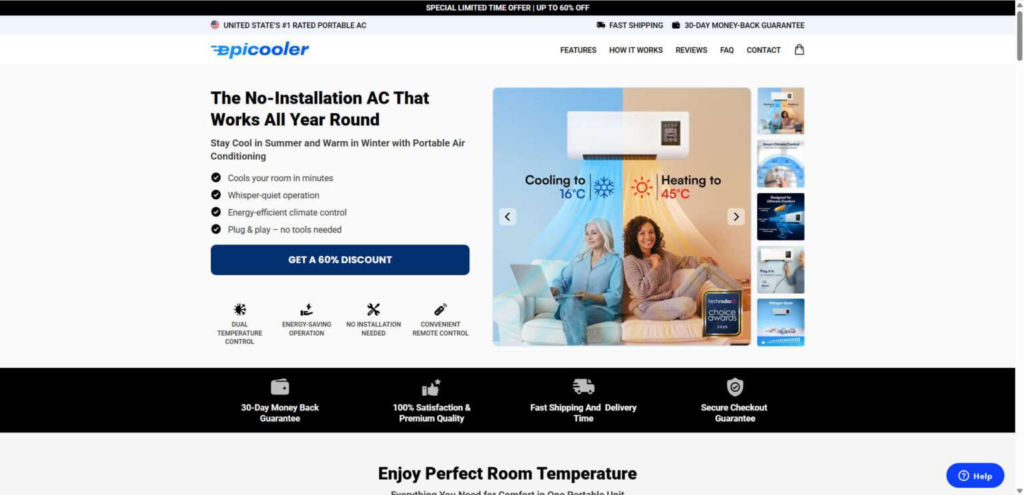
EpiCooler AC Overview
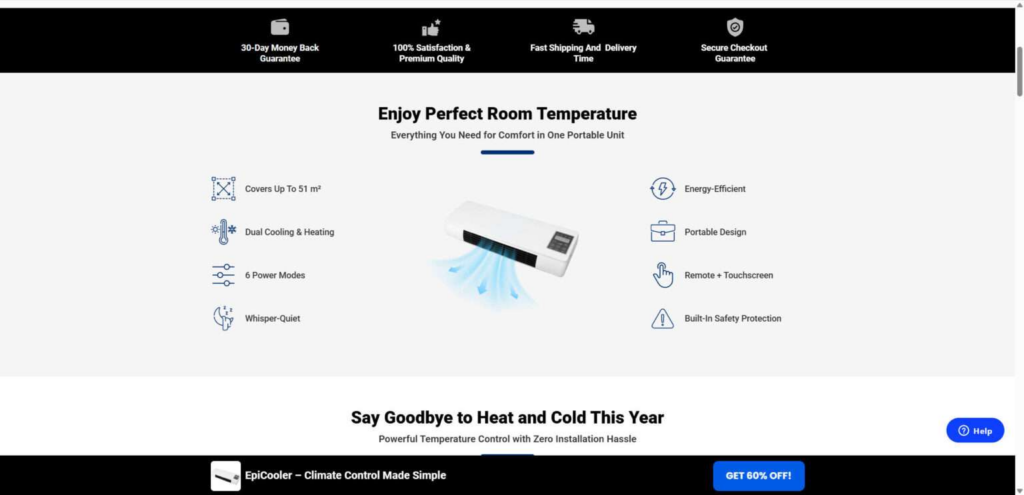
EpiCooler AC is marketed as a portable climate device that can both cool and heat indoor spaces. Some 2026 promotional pages describe it as a plug-and-play solution with no installation, no window kit, no external unit, and no complicated setup. Promotional material also claims features such as six operating modes, a remote control, touchscreen controls, quiet operation, overheating protection, and room coverage of up to 549 sq ft.
That sounds attractive, especially for people who live in apartments, rent their homes, or do not want to install a window AC unit. The problem is that the marketing language makes EpiCooler sound much closer to a real air conditioner than the product appears to be.
A real air conditioner does not simply blow air. It removes heat from the room and transfers that heat elsewhere. Standard room air conditioners use cooling systems built around refrigerant, coils, compressors, and heat exchange. The U.S. Department of Energy notes that room air conditioners are typically rated by cooling capacity, with common models ranging from 5,500 to 14,000 BTU per hour.
That matters because cooling is not magic. If a device has no compressor, no refrigerant cycle, no exhaust hose, and no way to move heat outside the room, it cannot cool a room like an actual air conditioner. At best, it can move air around. If it uses water evaporation, it may create a small localized cooling effect in dry conditions. If it uses a heating element, it may function as a small heater. But that is not the same as replacing an AC system.
This is the central issue with EpiCooler AC. The product is promoted with language that suggests powerful room cooling, but the available evidence points to a basic low-power device with limited airflow and questionable performance.
Is EpiCooler AC a Real Air Conditioner?
Based on the available information, EpiCooler should not be treated as a real air conditioner.
A true air conditioner removes heat from indoor air and transfers it away from the room. Portable air conditioners normally need an exhaust hose because the heat has to go somewhere. Window units push heat outdoors through the back of the unit. Split systems move heat through an outdoor condenser. The basic principle is the same: heat is extracted from the indoor space and released elsewhere.
EpiCooler-style marketing often tries to avoid this technical reality by using softer terms such as:
- Portable AC
- Personal cooling
- Cooling and heating solution
- Energy-efficient climate control
- No hose required
- No installation required
- Cools your room in minutes
Those phrases can mislead buyers. A device can be “portable” and blow air, but that does not make it an air conditioner. A fan can feel refreshing when pointed at you, but it does not lower the actual room temperature. An evaporative cooler can help in dry climates, but it becomes much less effective in humid conditions and adds moisture to the room. A small fan heater can warm the area near it, but that does not mean it is a serious room climate system.
The strongest red flag is the “no hose, no installation, cools a room” combination. If there is no exhaust path and no refrigerant-based system, the device cannot remove significant heat from a room. Any ad suggesting otherwise should be treated with caution.
Why the EpiCooler Marketing Looks Misleading
The EpiCooler campaign uses a familiar formula seen across many viral gadget promotions. The product is presented as a breakthrough device that solves a common household problem for a fraction of the normal cost.
The formula is simple:
- Take a generic product with a sleek appearance.
- Give it a fresh brand name.
- Build a polished website around it.
- Add dramatic claims about performance and savings.
- Use countdown timers, discounts, and social proof.
- Run aggressive ads on Facebook, Instagram, TikTok, and display networks.
- Make the product seem rare, urgent, and heavily discounted.
This style of campaign is especially common with gadgets such as mini air conditioners, portable heaters, posture devices, pressure washers, mini projectors, retro game sticks, and “miracle” household tools.
The product itself is usually not new. What is new is the branding, the landing page, and the story built around it.
EpiCooler appears to follow this same pattern. The marketing does not simply present it as a small fan or personal comfort device. It creates the impression that this is a serious alternative to an air conditioner, while avoiding the technical details that would allow buyers to compare it fairly with real AC products.
Customer Complaints and Trust Signals
Customer feedback is another major concern.
As of the available 2026 Trustpilot data, epicooler.com has a “Poor” TrustScore of 2.1 out of 5 based on 282 reviews, with 73% of reviews rated 1 star. Trustpilot’s review summary shows repeated complaints involving product performance, pricing, quality, and customer service.
Several visible complaints describe the product as weak, not cooling properly, delayed in delivery, or not matching the advertising. Some buyers say the heating function works better than the cooling side, which would be consistent with a simple fan heater rather than a true air conditioner.
This does not automatically prove that every order is fraudulent. Some buyers may receive a device. Some may find it useful as a fan or small heater. But the complaint pattern strongly suggests a mismatch between marketing expectations and real-world performance.
For a product advertised as a powerful cooling solution, that gap is important. A buyer who expects a desk fan may not be shocked. A buyer who expects an air conditioner replacement will likely be disappointed.
The Biggest Red Flags
1. “No Hose” Cooling Claims
Any device that claims to cool a room like an air conditioner without a hose, outdoor unit, compressor, or refrigerant system deserves scrutiny.
Heat cannot simply disappear. If the device does not move heat outside the room, it is not performing real AC-style cooling.
2. Overstated Room Coverage
Promotional claims around large room coverage, such as up to 549 sq ft, are highly questionable for a compact plug-in gadget. A real room AC is sized by BTU capacity, and proper sizing is important for comfort, humidity control, and efficiency.
A small fan-based device cannot realistically control a large room the way a properly rated air conditioner can.
3. Vague Technology Claims
Terms like “TurboCool,” “advanced cooling,” “energy-efficient climate control,” and “personal climate technology” sound impressive, but they are not a substitute for real specifications.
A legitimate cooling product should clearly disclose:
- BTU rating
- Power consumption
- Cooling method
- Refrigerant type, if applicable
- Exhaust requirements
- Room size guidance
- Safety certifications
- Warranty details
- Manufacturer information
If these details are missing, vague, or buried behind marketing language, that is a warning sign.
4. Heavy Discount Psychology
Many viral gadget sites use inflated “regular prices” followed by huge discounts. This makes buyers feel they are getting a premium product for a limited-time bargain.
The issue is that the original price is often artificial. A product listed at $199 or $299 with a 50% discount may not have ever been worth that amount.
5. Generic Product Pattern
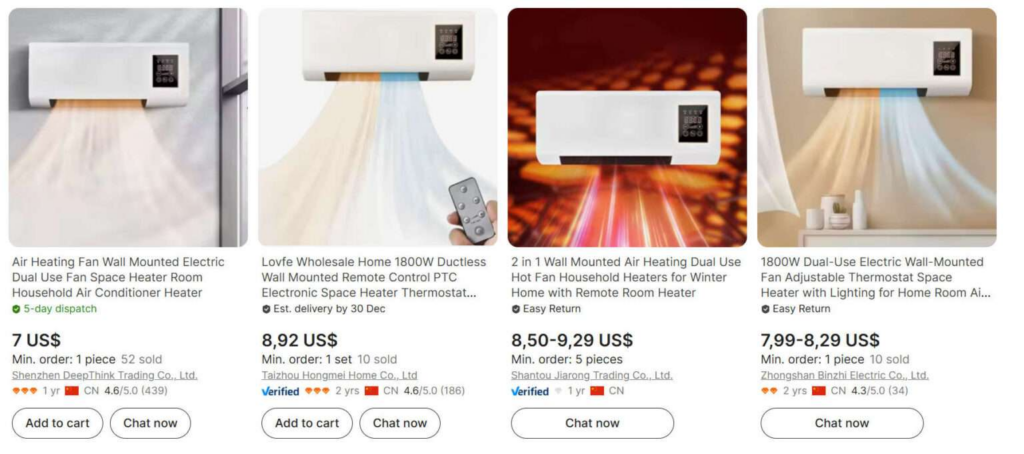
Many products in this category are generic devices rebranded under different names. The same core product can appear across multiple stores with different logos, different claims, and different “official” websites.
That makes accountability difficult. If one brand receives too many complaints, the same product can be relaunched under another name.
6. Poor Review Profile
The current Trustpilot profile for epicooler.com shows a large percentage of 1-star reviews and repeated dissatisfaction around product performance and quality.
That does not support the polished marketing image of a highly rated, breakthrough climate device.
How the EpiCooler Sales Funnel Works
Step 1: The Buyer Sees a Viral Ad
Most buyers first encounter EpiCooler through an online ad. The ad usually targets a common frustration: high energy bills, hot rooms, expensive AC installation, or the discomfort of summer heat.
The promise is simple: stay cool without buying a real air conditioner.
That promise is powerful because it speaks to a real problem. Many people want cheaper cooling. Many renters cannot install window units. Many households want to reduce electricity usage. The ad enters that pain point and offers a convenient shortcut.
Step 2: The Product Is Framed as a Breakthrough
The landing page often presents EpiCooler as if it is a new innovation rather than a basic consumer gadget.
The wording may suggest that it was developed by engineers, designed for modern homes, or created as a smarter alternative to traditional AC. Some promotional pages describe it as a dual cooling and heating device for year-round comfort.
This framing is important. Buyers are not just purchasing a fan. They are being sold the idea of a clever solution that big AC companies supposedly do not want them to know about.
Step 3: Technical Details Are Replaced With Marketing Claims
Instead of clearly explaining the cooling mechanism, the page leans on emotional benefits:
- No more sweating
- No expensive installation
- No high electricity bills
- No bulky AC unit
- No complicated maintenance
- Comfortable rooms in minutes
But the more important question is not whether the product sounds convenient. The question is whether it can actually remove heat from a room.
That is where the marketing becomes weak.
Step 4: Urgency Pushes the Buyer to Order Quickly
Many viral gadget stores use pressure tactics such as:
- Limited-time discounts
- Countdown timers
- “Only a few left” warnings
- Bundle offers
- “Today only” pricing
- Free shipping thresholds
These tactics are designed to reduce research time. The buyer feels they must decide now or lose the deal.
That is exactly when bad purchases happen.
Step 5: The Product Arrives and Fails to Match Expectations
Some buyers report receiving a product that does not cool the room as advertised. Others complain about weak airflow, poor build quality, delays, and refund problems.
This is where the gap between “portable AC” marketing and actual performance becomes obvious.
If the buyer expected a small fan, the device may seem acceptable. If the buyer expected real air conditioning, it will likely feel like a major disappointment.
Step 6: Refunds Become Difficult
Many dropshipping-style stores make refunds harder than expected. Common problems include:
- Slow support replies
- Return shipping costs
- Requests to send the item overseas
- Restocking fees
- Partial refund offers
- Claims that the product was already shipped
- Long delays before resolution
Should You Buy EpiCooler AC?
Our recommendation: no, not if you are expecting a real air conditioner.
EpiCooler may function as a small fan, personal air mover, or heater depending on the model received. But the marketing creates expectations that the product does not appear able to meet.
You should avoid EpiCooler if you want:
- Real room cooling
- Reliable temperature reduction
- Verified BTU performance
- A true portable AC
- A product from a transparent HVAC manufacturer
- Clear warranty and refund support
- A device that can cool a bedroom, living room, or apartment
You may only consider it if you understand that it is not a true air conditioner and are willing to risk buying a small personal comfort gadget with mixed customer feedback.
For most people, that is not a good trade-off.
Better Alternatives to EpiCooler
If you need actual cooling, consider one of these options instead.
Window Air Conditioner
A window AC is usually the best value for real room cooling. It vents heat outdoors and provides a clear BTU rating so you can match the unit to your room size.
Portable Air Conditioner With Exhaust Hose
A real portable AC will include an exhaust hose and usually a window adapter. It is less efficient than many window units, but it can still remove heat from a room.
Evaporative Cooler
An evaporative cooler can help in dry climates, but it is not ideal for humid areas. It adds moisture to the air and does not work like a compressor-based AC.
Tower Fan or Circulator Fan
If you only need airflow, buy a reputable fan from a known brand. It will not cool the room, but it may help you feel more comfortable for less money.
Small Space Heater
If heating is your main goal, buy a certified space heater from a known retailer with clear safety documentation and an easy return policy.
What To Do If You Already Bought EpiCooler
1. Save Screenshots of the Advertising
Take screenshots of the product page, checkout page, ads, discount claims, refund policy, shipping policy, and any cooling claims.
This evidence matters if you need to dispute the purchase.
2. Contact the Seller in Writing
Email customer support and clearly request a cancellation or refund. Keep the message short and specific.
Example:
“I am requesting a full refund because the product was advertised as a room cooling device, but it does not perform as described. Please confirm the refund process in writing.”
Do not rely on phone calls only. You need a written record.
3. Do Not Accept Endless Delays
If the seller keeps delaying, document every response. If shipping was promised by a specific date and the seller cannot meet it, they may be required to notify you and give you the option to cancel or accept the delay under FTC mail, internet, and telephone order rules.
4. Open a PayPal Dispute or Card Chargeback
If you paid by PayPal, open a dispute for “item not as described” or the closest available category.
If you paid by credit card or debit card, contact your bank and ask about a chargeback. Explain that the product was misrepresented and provide screenshots.
5. Be Careful With Return Shipping Demands
Some sellers may demand that you pay expensive return shipping, sometimes to another country. Before paying for return shipping, ask your payment provider whether that is required for your dispute.
If the product was materially misrepresented, make that clear in your claim.
6. Report the Store
If you believe the advertising was deceptive, report it to the FTC, your payment provider, and the platform where you saw the ad.
7. Watch for Recovery Scams
If you leave a negative review or post about the issue, scammers may contact you claiming they can recover your money for a fee. Do not pay them.
FAQ About EpiCooler AC
Is EpiCooler AC a scam?
EpiCooler appears to be a heavily marketed gadget with serious red flags, especially around cooling claims, customer complaints, and performance expectations. Whether you call it a scam or a misleading product, the safest conclusion is that it is not recommended as a real air conditioner.
Does EpiCooler really cool a room?
There is no convincing evidence that EpiCooler can cool a room like a real AC unit. A true air conditioner needs a way to remove heat from the room. Compact fan-style devices without compressors, refrigerant systems, or exhaust hoses cannot provide serious room cooling.
Why do EpiCooler ads say it works like an AC?
The ads use broad marketing language that makes the product sound more powerful than it likely is. Phrases like “portable AC,” “cooling technology,” and “climate control” can make a basic airflow device seem like a real cooling system.
Can EpiCooler work as a fan?
It may work as a small fan or personal air mover, depending on the exact unit delivered. But that is very different from functioning as an air conditioner.
Can EpiCooler heat a room?
Some versions appear to include a heating function, likely using a PTC ceramic heating element. That may provide local warmth, but buyers should still be cautious about safety, certifications, build quality, and warranty support.
Is EpiCooler good for bedrooms?
Not if you need real cooling. If your bedroom is hot and you need temperature reduction, choose a properly rated window AC or portable AC with an exhaust hose.
Why are there so many positive EpiCooler reviews online?
Many positive “reviews” for viral gadgets are promotional articles, advertorials, affiliate pages, or AI-generated content designed to rank in search engines. Look for independent customer reviews, refund complaints, and technical evidence instead of relying only on glowing review pages.
What should I buy instead of EpiCooler?
For real cooling, buy a window AC or a portable AC with an exhaust hose from a reputable brand. For airflow only, buy a normal fan. For dry climates, an evaporative cooler may help, but it is not a substitute for AC in humid conditions.
Can I get a refund from EpiCooler?
You can try contacting the seller first. If they refuse, delay, or make the process unreasonable, open a PayPal dispute or card chargeback. Provide screenshots showing the advertising claims and explain why the product was not as described.
Should I trust EpiCooler in 2026?
Based on the current marketing claims, customer complaints, and lack of clear evidence that it performs like a real AC, EpiCooler is not a product we recommend buying in 2026.
The Bottom Line
EpiCooler AC is marketed as a simple, affordable way to cool and heat your space without installation. But the core promise does not hold up well.
A real air conditioner needs a proper cooling system that removes heat from the room. EpiCooler-style devices appear to rely on basic airflow, possible evaporative cooling, and heating elements rather than true AC performance. The current review profile also shows a large number of unhappy buyers, with complaints about weak cooling, poor quality, slow shipping, and refund problem.
If you want a fan, buy a fan. If you want a heater, buy a certified heater. If you want actual cooling, buy a real AC unit with a clear BTU rating and a proper heat exhaust system.
EpiCooler AC is not recommended for buyers expecting genuine air conditioning performance.

Join the discussion
17 commentsShare your experience or ask a question about this article.
Discussion
I ordered and paid 149.97US for the EpiCooler device that was promising some cool air in my apartment without any tubing nor any complicated installation. I received this device 3 weeks after ordering. A few days of trying it at home proved it did not provide a single degree of cooling. Assuming the unit was defective, I asked for a replacement. Again, many weeks of delaying and reaching out to the seller. Finally, the replacement unit could not cool just the same.
I then asked for a complete refund. Many successive EpiCooler representatives sent me messages asking for details, pictures of the device. They proposed 25% refund if I returned the units at my expenses, which I refused of course. They proposed I keep the units and a refund of 49%. Again, I refused that offer, promising a negative review on the BBB website. Finally, they offered me a 70% refund which I accepted, having wasted enough time with this seller. I received my refund the next day but I still feel EpiCooler is a scam and that customers should stay away from this company. The many other negative reviews about EpiCooler back me up plenty.
In reply to Moose
Thank you for documenting the full experience, Moose. Two units failing to cool, weeks of delays, and repeated partial-refund offers are important details for other readers. I am glad you recovered 70% of the payment, although that does not make up for the time and frustration. Keep the order records and refund confirmation until the credit is fully settled.
In reply to Stelian
i had the same problem as moose but they only offered 45 % witch i denied they pushed me off when i replied again they told me it was past there 30 day window for a refund and there was nothing they can do epi cooler is in business to rip people off stay away
I made the mistake of ordering this and received a wall heater instead. It took over a month to recive anything.They are now offering only 47% refund.
In reply to JBog
That combination is telling, JBog: a month-long wait, the wrong item entirely, and then a partial refund offer. Receiving a different product than the one advertised is one of the strongest dispute cases there is, so decline the 47 percent and take it to your card issuer as goods not as described. Photograph the item and the shipping label, keep the listing and any messages, and don’t ship anything back at your own expense unless they send a prepaid label.
Real scam . Ordered four units . none arrived . The neck coolers are working but a very limited timespan. Poor customer service and dfinding it impossible getting a refund . take my advice avoid
In reply to victor glendinning
Four units paid for and none delivered is the clearest possible case, and it doesn’t need their cooperation: go to your card issuer and dispute the whole amount as goods not received. Chasing the refund through their support only burns the time you need for the dispute window. Your point about the neck coolers is worth noting too – the cooling lasts only as long as the water is evaporating, which is a few minutes in humid air, and no amount of marketing changes that.
I purchased a unit, quickly discovered it could not possibly deliver as promised. Have dickered with them for several days, specially for full refund. Just today, received email saying credit was approved, but may take 14 days to show on my credit card. I will contact Amex if I don’t see said credit. Don’t walk: RUN away from this scam!
In reply to Brent Murray
Good instinct to keep Amex in reserve. A refund “approved” by email but not yet issued is a common way to buy another two weeks, so mark the date and open the dispute the moment 14 days pass without the credit appearing – Amex is one of the better issuers for this. Keep the approval email, since it’s an admission that a refund is owed and makes the dispute almost automatic.
This is definitely a scam. I purchased a unit, quickly discovered it could not possibly deliver as promised. Have dickered with them for several days, specially for full refund. Just today, received email saying credit was approved, but may take 14 days to show on my credit card. I will contact Amex if I don’t see said credit. Don’t walk: RUN away from this scam!
In reply to Brent Murray
Noted, and thanks for the detail – it looks like this came through twice, so there’s a fuller reply on your other comment. Short version: keep the email approving the credit, and if it hasn’t appeared on your card within the 14 days they quoted, take it straight to Amex as a dispute with that email attached.
Although EpiCooler is said to be invented by Luke Wallace a British engineer who took over his fathers firm a simple trace on returns and companies house the person/entity with significant control is in fact 4PX EXPRESS UK which is owned by Alibaba Group Holding Limited (ring any bells) lol
In reply to Neil
Ive read 10 reviews all but your was positive. Maybe ask the people dissing it how they use it.
In reply to Liquid
That is a reasonable instinct – if nine sources say one thing and one says another, the odd one out deserves scrutiny. But the count is misleading here, because those ten reviews are not ten independent opinions.
Search results for a product name are dominated by affiliate pages: whoever writes a positive review earns a commission on every sale through their link, and there is no commission in writing that something does not work. Many are generated in bulk from the seller’s own marketing copy, which is why they share the same phrases and the same fake before-and-after photographs. We earn nothing whichever way our conclusion goes, which is precisely why we are the outlier.
As for asking the unhappy buyers how they used it – a fair question, and many of them answer it in the comments here. Read a few. The recurring complaints are not about technique: charged three times for one order, no reply from support, a different item in the box, a Florida-only warning on the label. Technique does not cause that.
In reply to Neil
That is a genuinely good piece of research, and the finding fits the pattern precisely. A named British inventor with a family firm behind him is the cheapest element of the whole product – the story is written, a stock photograph or an AI portrait is attached, and the name never appears anywhere else. What the filings show is the actual arrangement: the trading entity is a shell, and control sits with a logistics operation that fulfils orders for anyone paying for the service.
Worth adding one caution for other readers, because it is a distinction the sellers rely on being blurred. A freight forwarder appearing as the person with significant control usually means the company was incorporated as part of a fulfilment package, and the forwarder’s ownership does not imply that its parent group has any knowledge of, or involvement in, the product being sold – these services are bought off the shelf by thousands of unrelated sellers. The meaningful conclusion is narrower but still damning: there is no British engineering firm, no inventor, and nobody in the UK actually responsible for the product.
Anyone can check this for free at find-and-update.company-information.service.gov.uk before buying – filing history and the officers’ other appointments tell you most of what you need to know in about two minutes.
Maybe it runs air over ice cubes from the refrigerator? Then heat would be removed whenever you throw out the meltwater. Major bother, though, and no energy saving since you have to make the ice.
As for complaining to PayPal–I tried that once. They wrote saying they’d investigate–never heard from them again. Am happy not trying them again.
In reply to D Crafts
Hi, good point. Devices that rely on ice are not true air conditioners in the normal sense, and the cooling depends on ice that already took energy to make. Your PayPal experience is also a useful reminder to document everything and follow up quickly.