

EvoSlim arrives at the end of a story that feels almost too convenient. A familiar television personality appears to discuss a simple baking soda weight loss discovery, a medical expert seems to explain the science, and a capsule promises to turn the viral trick into an effortless daily routine.
This EvoSlim review follows that story through the actual website, order button, ingredient claims, refund language, and company trail. The closer the pages are compared, the less the offer looks like a self-contained health brand and the more it resembles a reusable marketing funnel.
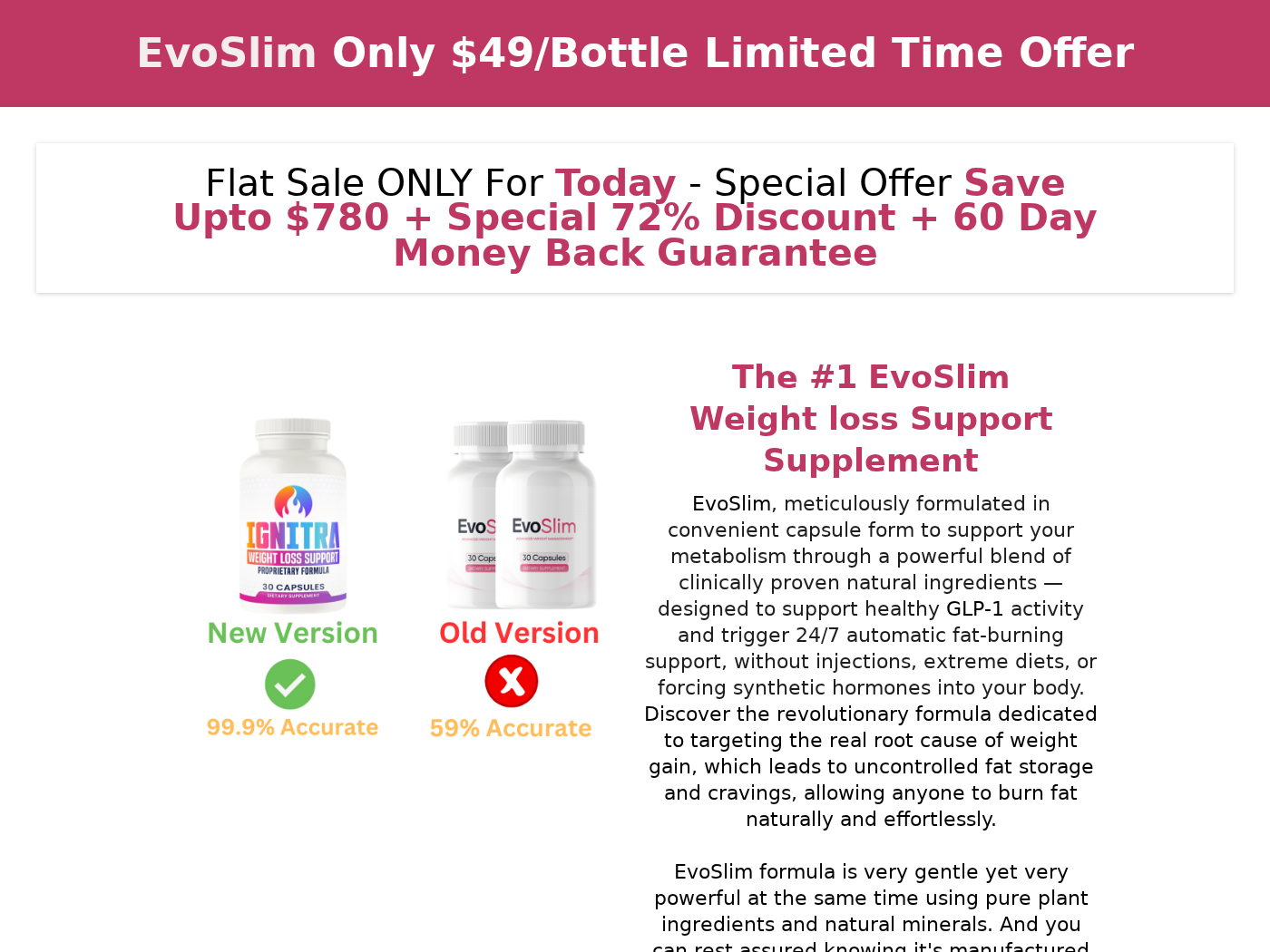
The EvoSlim page opens with a $49 bottle price, a claimed $780 saving, a 72% discount, and a 60-day guarantee. It also shows an EvoSlim bottle beside an Ignitra bottle, labeling Ignitra the new version and EvoSlim the old version.
That is an unusual first impression. A shopper who clicked an advertisement for EvoSlim is immediately told that another formula is more accurate, yet the rest of the page continues to describe EvoSlim using several incompatible ingredient stories.
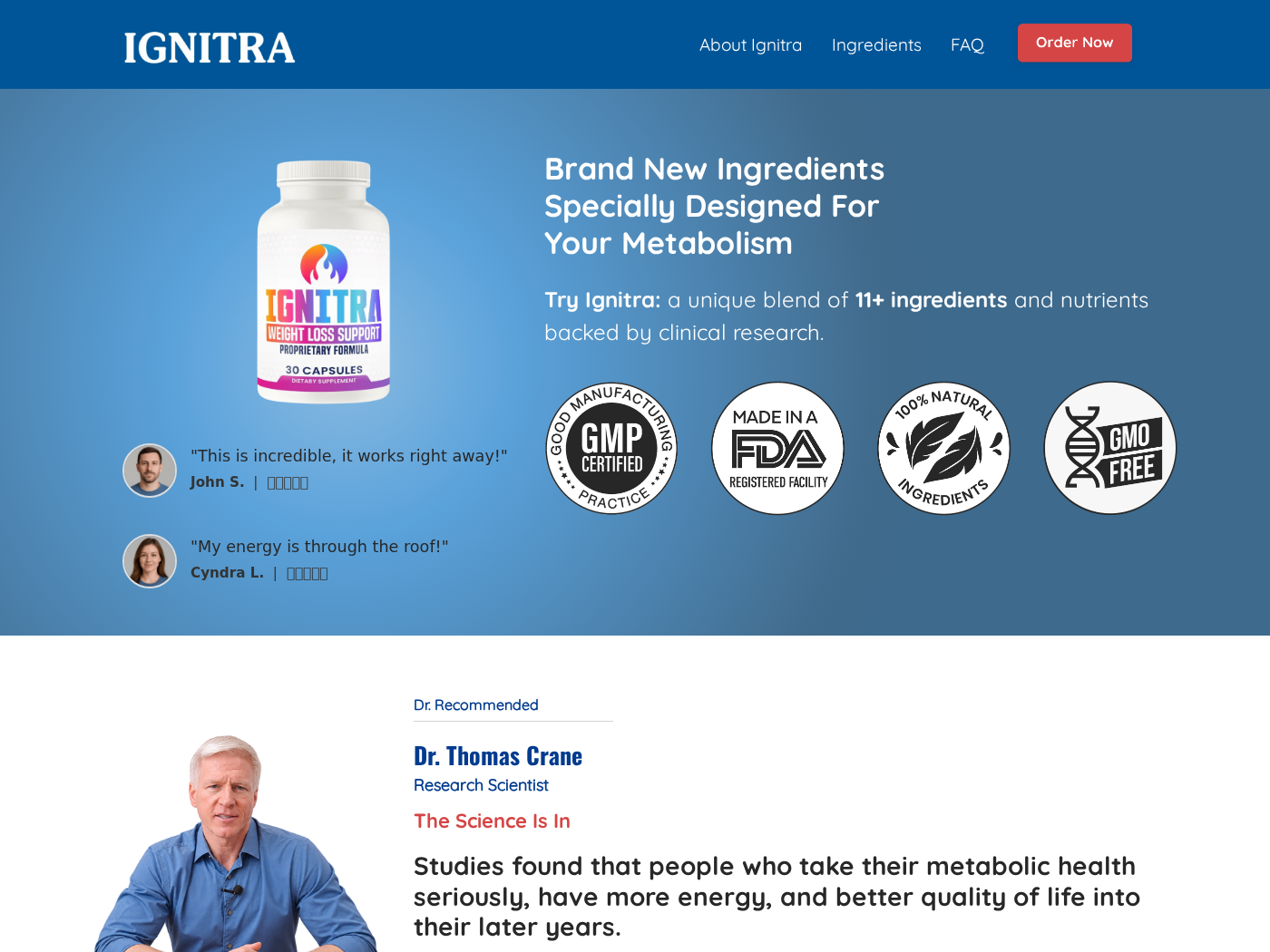
The disconnect becomes clearer after the order button is clicked. The visitor leaves the EvoSlim-branded page and reaches a full Ignitra presentation, the same destination reached from a separate SlimSoda offer reviewed at the same time.
Overview
EvoSlim is a real sales page attached to a recycled weight loss story
The website is real in the basic sense that it displays a bottle, price claims, ingredient descriptions, testimonials, a guarantee, and order links. That does not establish that every video, expert appearance, scientific statement, or customer result used to attract buyers is authentic.
The advertising story uses the same pattern described in the MalwareTips investigations of the fake Oprah baking soda shot and Dr. Ania Jastreboff baking soda shot campaigns. Manipulated clips create trust before the supplement name appears.
The order button does not lead to an EvoSlim checkout
During this investigation, EvoSlim order links routed through a tracking domain and opened an Ignitra sales page. The destination promoted a different bottle, different branding, a supposed research scientist, and a separate formula rather than a clear EvoSlim cart.
A product page that changes the brand at the moment of purchase creates basic questions. Buyers cannot easily know which item will arrive, which ingredient panel governs the order, which guarantee applies, or which name will appear on the card statement.
The visible page says one-time payment, not confirmed automatic refills
EvoSlim’s FAQ says the order is a one-time transaction with no hidden autoshipments or additional charges. That statement matters, and the visible offer should not be labeled a confirmed subscription trap without checkout terms or card statements proving recurring billing.
Still, a shopper should save the final payment screen because the brand and destination already change inside the funnel. If a later checkout introduces continuity terms, a trial, or future shipments, leave without completing the purchase. The final authorization controls what the customer actually agrees to.
- Fake or manipulated celebrity-style videos provide the emotional hook.
- The page advertises EvoSlim at $49 per bottle and pushes a six-bottle package.
- The same page presents Ignitra as a new and supposedly more accurate version.
- The order button redirects to an Ignitra sales page rather than a clear EvoSlim cart.
- Several sections give conflicting accounts of the EvoSlim formula.
- The refund instructions omit the contact address needed to request an RMA.
- The page says one-time payment, so recurring billing is not confirmed by the visible offer.
What the EvoSlim Advertising Story Is Really Selling
The campaign rarely begins with the bottle. It begins with a familiar face, a supposedly suppressed discovery, and a kitchen ingredient almost everyone recognizes. Baking soda makes the pitch feel inexpensive, safe, and easy to test at home.
The viewer is then told that ordinary baking soda needs a precise addition, ratio, or biological activator. This turns a free household tip into a suspense device. The missing piece is revealed only after the viewer has invested several minutes in the story.
AI-generated speech and edited video can make it appear that Oprah Winfrey or a respected obesity specialist discussed the discovery. There is no authentic endorsement connecting those public figures to EvoSlim. Their recognizable authority is being used to lower the viewer’s skepticism.
The story also borrows language associated with GLP-1 medicines. EvoSlim is a dietary supplement, not a prescription GLP-1 drug. Saying a formula supports natural GLP-1 activity is not the same as demonstrating the clinical effects, dosing, safety review, or regulatory approval of an injectable medicine.
By the time the sales page appears, the customer is not evaluating an unknown bottle from a neutral starting point. The customer has already been primed to believe that the product represents a medical breakthrough and that acting quickly could solve a frustrating problem.
What Our EvoSlim Investigation Found
The most striking finding is the brand switch. The EvoSlim page calls Ignitra the new version and EvoSlim the old version. Clicking the order link opened Ignitra, not an EvoSlim checkout. A separate SlimSoda page sent buyers to the same Ignitra destination.
The ingredient information is also unstable. One part of the page discusses gymnema, bitter melon, banaba, chromium, apple cider vinegar, garcinia cambogia, and raspberry ketones. Another lists chicory inulin, resistant potato starch, three probiotic strains, maqui berry, rhodiola, haematococcus, amla, cacao, and schisandra.
The FAQ narrows the formula again to chicory inulin, resistant potato starch, and a probiotic blend. These are not minor wording differences. They are materially different formulas, and the customer cannot make an informed safety or interaction check without knowing which label is accurate.
The testimonials use the names Miah H., Melissa T., and Jhon K. The SlimSoda page displays the same names and substantially the same stories with only the product name changed. That cloning weakens their value as evidence of independent customer experiences.
The refund section promises 60 days but tells buyers to contact the company at a blank space to receive an RMA. It then requires customer-paid return shipping within 14 days after the RMA is issued. A guarantee is only useful when the customer can identify the responsible seller and follow complete instructions.
The page uses phrases such as FDA registered facility and FDA approved facility. The FDA does not approve dietary supplements before sale, and facility registration is not product approval. A badge cannot replace a complete Supplement Facts panel, traceable manufacturer, batch testing, and reliable finished-product evidence.
How the EvoSlim Scam Funnel Works
Step 1: An AI video borrows a trusted face
The campaign starts inside a social feed, where a short video appears to feature a celebrity or recognizable health expert. Edited footage, synthetic audio, and inaccurate subtitles make the endorsement feel current and personal.
Viewers are encouraged to focus on the apparent speaker rather than the account that paid for the ad. The advertiser may use a newly created page, a generic wellness name, or an unrelated profile that disappears after reports accumulate.
Step 2: A baking soda secret creates curiosity
The video promises a small shot, recipe, or morning ritual that supposedly activates weight loss. The exact instructions are delayed. This open loop keeps the viewer watching because the answer always seems one sentence away.
The method sounds scientific enough to be intriguing but simple enough to feel safe. No personal medical history, medication list, or diagnosis is considered, even though the message implies that the same trick works for almost everyone.
Step 3: A fake editorial page imitates trusted reporting
The click may open an advertorial styled like a news report, television transcript, or health investigation. Familiar visual cues create the impression that an independent publication verified the discovery.
The page is actually part of the sales route. Its buttons point in one direction, skeptical evidence is absent, and the dramatic claims are carefully separated from the softer disclaimers displayed near the supplement checkout.
Step 4: EvoSlim becomes the convenient answer
Once the story has built desire, EvoSlim appears as the packaged version of the secret. The buyer is no longer asked whether the underlying claim is credible. The decision is reframed as how many bottles to order.
The page connects the capsule to natural GLP-1 activity, metabolism, appetite, mitochondria, gut bacteria, and effortless fat burning. Combining many popular concepts makes the formula sound comprehensive even when the ingredient descriptions do not agree.
Step 5: Urgency and bundle math push a larger order
The sales page says the special price applies today, stock is limited, 93% of customers choose six bottles, and the largest package saves $780. These statements make hesitation feel like losing money.
The reference prices and popularity claim are controlled by the seller. A lower unit price does not make a six-bottle purchase safer, especially when the buyer has not confirmed tolerance, formula accuracy, support quality, or the identity of the legal seller.
Step 6: The order link changes the product
Instead of presenting a clean EvoSlim cart, the link routes through tracking and opens Ignitra. The customer may continue because the new page describes Ignitra as an improved formula and repeats familiar manufacturing badges.
This is where careful buyers should stop. A changed brand can mean changed ingredients, price, guarantee, merchant, and return conditions. Never assume that promises on the first page automatically apply to the item on the final payment screen.
Step 7: Refund friction appears after the sale
If the product disappoints, the customer must identify the merchant descriptor, locate support, obtain an RMA, pay return postage, meet a 14-day shipping deadline, and prove which guarantee was shown during the funnel.
Incomplete contact details make that process harder. The campaign can also rotate from EvoSlim to SlimSoda or Ignitra while the customer is still trying to explain an order associated with an earlier name.
Company, Address, and Fulfillment Checks
The brand switch destroys basic accountability
EvoSlim is printed on one bottle, Ignitra is called the new version, and the order button opens Ignitra. A trustworthy seller should disclose the legal company that owns both names, explain the formula change, and state exactly which product the customer is buying.
No shopper should have to reconstruct that relationship from redirects. If the receipt, package, support email, and card statement use different names, a refund or dispute becomes unnecessarily confusing.
The refund contact is literally missing
The page says buyers must contact the seller to request an RMA, but the contact detail after the word at is blank. That is not a cosmetic flaw. It removes the instruction needed to start a time-limited return.
Call or email before ordering and ask for the legal seller name, working support address, RMA procedure, and physical return location. If the seller cannot answer before taking payment, do not expect the process to become clearer afterward.
A fulfillment address would not prove who made the capsules
Supplement campaigns often use warehouses, mailboxes, call centers, and payment processors operated by third parties. A parcel can be shipped from a real facility without that facility owning the brand or accepting responsibility for the advertising.
Match the entity in the terms with the receipt and card statement. Then verify whether the listed address is a headquarters, return warehouse, virtual mailbox, residential property, or unrelated business. A shipping location is not a manufacturer certificate.
Unknown formula and unknown origin are a health risk
The EvoSlim page does not present one stable ingredient story. That alone should stop anyone who takes prescriptions, has diabetes, is pregnant, has kidney or liver disease, or needs to avoid specific herbs and stimulants.
Do not claim the capsules came from China without evidence, but do not accept a Made in USA badge as proof either. Demand a complete label, lot number, manufacturer, expiration date, allergen information, and credible testing. Mass-produced supplements from any country can be risky when the supply chain is hidden.
EvoSlim Pricing, Refund Terms, and Subscription Risk
The headline price is $49 per bottle, but the page is built to move the visitor toward six bottles. The claimed $780 saving is meaningful only if the crossed-out reference price reflects a genuine price at which the same product was ordinarily sold.
The 60-day guarantee sounds broad, yet the operational language is narrower. Buyers must obtain approval, include an RMA, pay return shipping, return the product in good physical condition with accessories, and ship it within 14 days after receiving the authorization.
The page also says no questions asked while imposing conditions. These phrases should be reconciled before payment. Ask whether opened bottles qualify, whether all bottles in a bundle must be returned, whether shipping is deducted, and when the 60-day clock begins.
There is no confirmed subscription on the version reviewed. The FAQ explicitly describes a one-time purchase. However, every customer should inspect the final Ignitra checkout because it is a different page and may contain terms that were not visible on the EvoSlim landing page.
If the payment screen shows a different product, quantity, price, seller, or continuity term, take a screenshot and leave. Do not rely on an affiliate page to summarize the contract that appears at the final checkout.
Warning Signs to Watch For
- An AI-generated celebrity or doctor appears to endorse a baking soda weight loss secret.
- The product name is hidden until the viewer has watched a long emotional story.
- EvoSlim is presented beside Ignitra as an old version with lower claimed accuracy.
- The order button opens a different brand instead of a clear EvoSlim cart.
- Multiple sections describe materially different ingredient formulas.
- The same testimonials and names appear on the SlimSoda page with the brand swapped.
- The refund instructions omit the support contact required to obtain an RMA.
- FDA badges blur the difference between facility registration and product approval.
- The page says the offer expires today and 93% of customers choose six bottles.
- The legal entity responsible for the advertising and formula is not clearly identified.
The problem is not a single typo. It is the combined sequence of borrowed authority, unstable formulas, cloned testimonials, a changed product at checkout, aggressive bundle pressure, and incomplete accountability when the buyer needs a refund.
What to Do if You Have Fallen Victim to This Scam
- Preserve the complete funnel. Save the social ad, video, advertorial, EvoSlim page, Ignitra destination, final checkout, receipt, confirmation email, package, and refund wording. Include dates and page addresses because these campaigns can change names quickly.
- Identify what you actually bought. Compare the product and quantity on the final checkout with the confirmation and parcel. Write down the merchant descriptor exactly as it appears on your card statement, even if it does not mention EvoSlim.
- Check for any future billing authorization. Read the receipt and checkout terms for words such as subscription, continuity, autoship, membership, trial, or refill. The landing page says one-time payment, so save that statement if later charges contradict it.
- Request a refund in writing. Contact the support address on the receipt or payment record, state the order number and amount, quote the 60-day promise, and request an RMA. Ask for a case number and a written deadline for returning the product.
- Do not mail bottles to an unverified address. Obtain the authorized return location in writing. Photograph the bottles and parcel, use tracked shipping, and keep the receipt and delivery proof. A random address found in an advertisement may belong to a fulfillment provider or unrelated business.
- Contact the card issuer when the charge is wrong. Explain whether the problem is an unauthorized amount, a different product, missing merchandise, recurring billing you did not accept, or a promised refund that was denied. Ask about the dispute deadline and required evidence.
- Protect the device used for payment. Run a full Malwarebytes scan if the ad sent you through suspicious downloads, browser notifications, or unfamiliar extensions. Use AdGuard to block malicious advertising and deceptive redirect pages while you clean up the browser.
- Report the deceptive advertisement. Report the ad and account to the social platform. In the US, complaints involving misleading health claims or billing can also be submitted to the FTC and your state attorney general. Give each report the saved URLs and screenshots.
Frequently Asked Questions
Is EvoSlim fake or real?
EvoSlim has a real promotional page, but the page contains conflicting formulas, cloned testimonial content, and an order button that changes the offer to Ignitra. A physical page or bottle image does not validate the advertising claims.
Did Oprah Winfrey or Dr. Ania Jastreboff endorse EvoSlim?
No authentic endorsement connecting either person to EvoSlim was found. Videos that appear to show them promoting a baking soda shot or this supplement should be treated as manipulated or falsely contextualized advertising.
Does EvoSlim contain a prescription GLP-1 medicine?
The page markets EvoSlim as a dietary supplement. It does not establish that the capsule contains an approved prescription GLP-1 drug. General language about supporting natural GLP-1 activity is not equivalent to prescription treatment.
Is EvoSlim a subscription trap?
The visible FAQ says the order is a one-time transaction with no autoship. That means recurring billing is not confirmed from the page reviewed. Buyers should still inspect and save the final Ignitra checkout before authorizing payment.
Why does the EvoSlim button open Ignitra?
The redirect shows that EvoSlim is functioning as a bridge page for a different offer. The page calls Ignitra the new version, but it does not clearly explain the legal relationship, formula change, or which guarantee governs the purchase.
Can I get an EvoSlim refund?
The page promises 60 days but requires an approved RMA and customer-paid return shipping. Because the displayed contact instruction is incomplete, use the support information on the receipt and payment record, act quickly, and keep written proof.
The Bottom Line
EvoSlim is not a straightforward supplement offer. The fake celebrity-style story leads to a page with conflicting ingredients, recycled testimonials, aggressive bundle claims, and an order button that replaces EvoSlim with Ignitra. Those are substantial reasons to stop before payment.
The responsible conclusion is not that every bottle or charge is imaginary, nor that automatic refills are proven. It is that the EvoSlim funnel does not provide the stable product identity, formula transparency, company accountability, and checkout consistency a careful buyer should require.








