


A text claiming to come from your employer’s helpdesk arrives between meetings, when signing in feels routine and the familiar company name makes the request reassuring.
Before following that instruction, consider where the request leads. A newly concluded criminal case connects employee text messages with losses far beyond the first workplace account.
Overview
A workplace login is the first target
The campaign sent employees texts impersonating their companies or contracted technology providers. Links led to lookalike login pages designed to collect confidential information.
The initial request appeared connected to work, but stolen access could expose information about other people. That made the harm larger than one employee’s password.
The case ended with guilty pleas and prison sentences
On November 17, 2026, Tyler Robert Buchanan received a six-year federal prison sentence. Prosecutors described intrusions at at least a dozen companies and $11.6 million in cryptocurrency theft.
Buchanan and four codefendants pleaded guilty in the case. The documented scheme combined phishing, account intrusion, stolen personal information, and unauthorized telephone-number transfers.
Protect the workplace account and the telephone number separately
Do not sign in through an unexpected helpdesk text. Verify the request through your company’s established support channel, and report any credentials you already entered.
- Use your saved workplace portal instead of the message link.
- Tell security staff whether any code was also disclosed.
- Contact your carrier if your number unexpectedly stops working.
- Review financial accounts separately from the workplace incident.
What the Buchanan Prosecution Established
The Justice Department’s sentencing announcement describes conduct from September 2021 through April 2023. The recent sentence closes a historical prosecution, not a newly discovered November texting campaign.
Employees received hundreds of phishing texts. The operation’s phishing kit transmitted captured login information to a Telegram channel administered by Buchanan and another conspirator.
The conspirators used stolen company information to identify and access individual cryptocurrency accounts. Unauthorized SIM swaps helped intercept authentication codes sent to victims’ telephone numbers.
Investigators also found a file containing a victim’s cryptocurrency seed phrases and login information. The theft therefore involved more than one possible route into financial assets.
These findings establish a coordinated fraud operation. They do not establish that every company-login text today belongs to this group or that every recipient lost cryptocurrency.
The practical point is the connection between stages. Information stolen through a work account can help an attacker target a person somewhere else.
The affected sectors included technology, telecommunications, cloud communications, virtual currency, and business-process suppliers. That variety matters because one company’s systems can contain information about people outside its own workforce.
An employee handling support or customer records may therefore hold access useful for another intrusion. The value of an account is not limited to its owner’s personal balance.
For an administrator, investigate which records the compromised identity could reach and what activity occurred. Do not conclude that the incident ended when the first password changed.
How the Employee Helpdesk Text Scam Works
Step 1: The message borrows a workplace identity
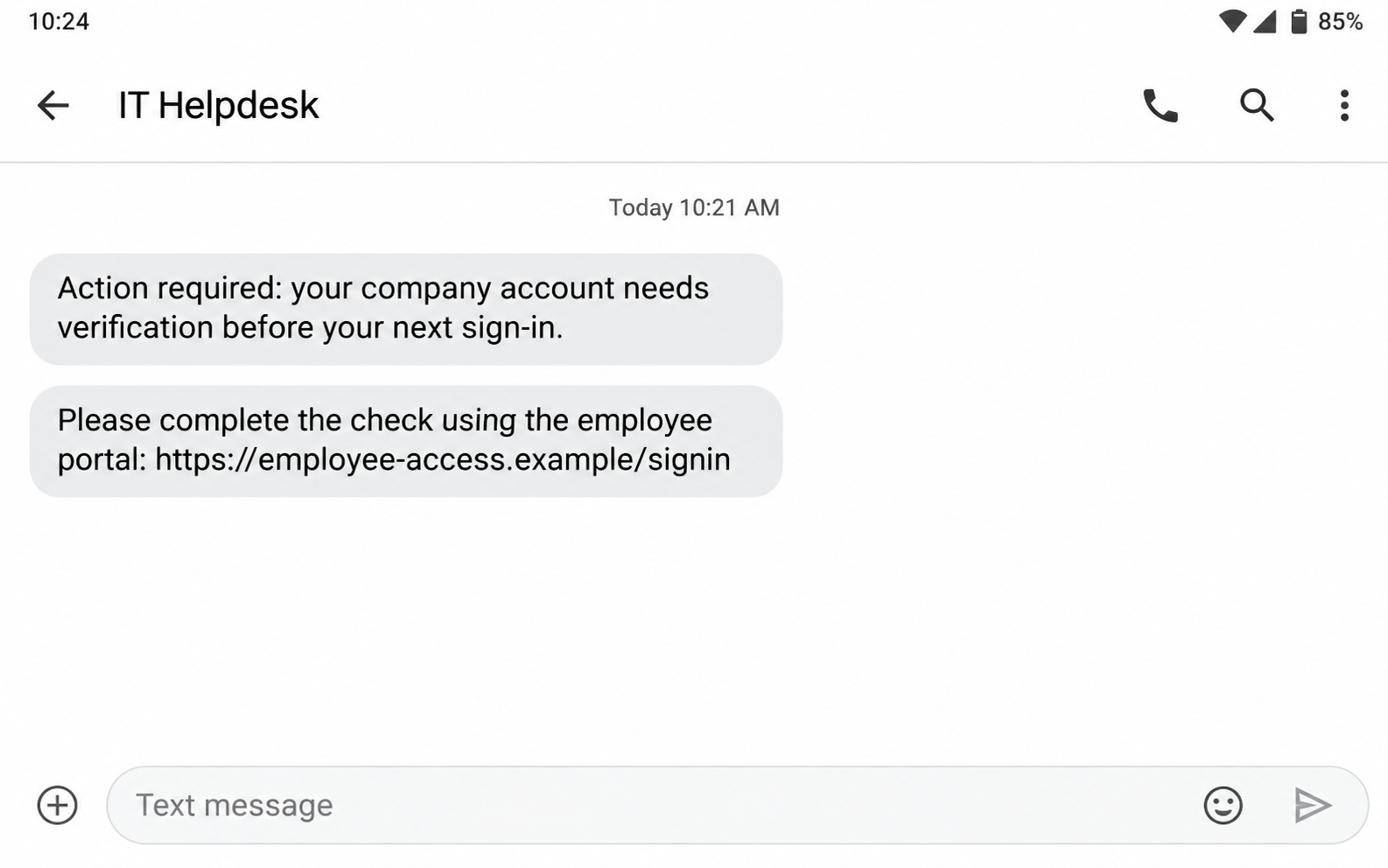
The text appears to concern the employer or a contractor employees recognize. That makes an unexpected sign-in request feel connected to an existing responsibility.
The pictured helpdesk text recreates that kind of request using a nonfunctional address. It is not a recovered message from the Buchanan prosecution.
Attackers can exploit the assumption that a work-related message reaching a personal number must come from someone inside the company. Possessing the number does not establish that connection.
Pause before responding to any account-verification request you did not initiate. A real technology problem can be checked through the helpdesk contact you already use.
Step 2: A copied sign-in page collects credentials
The linked page resembles a legitimate service and asks for information normally entered during sign-in. Its appearance encourages the employee to continue a familiar routine.
A copied logo does not determine who receives the information. The destination and access route matter even when the page has the expected colors and fields.
Opening a saved portal independently breaks the instruction’s control over that route. If the account genuinely needs attention, check there or ask verified support.
Step 3: Stolen access exposes more information
In the prosecution, captured credentials enabled unauthorized company-account access. Confidential material and personal information became resources for further attacks rather than remaining inside the original system.
The employee receiving the text may have no idea which records their account can reach. That is why prompt reporting matters even without an obvious immediate loss.
Security teams need the time of disclosure and the account involved. Those details help them investigate access instead of treating the incident as a general warning.
Separate the device receiving the text from the device used to sign in. A personal phone can receive the bait while a work computer supplies the credentials.
Tell the incident team about both devices when applicable. That distinction helps avoid examining only the phone while overlooking the browser session where disclosure actually happened.
Also identify any authentication approval you completed after the page loaded. A password entry followed by an unexpected approval provides a different investigative timeline from a blocked login.
Step 4: Telephone-number control undermines text authentication
A SIM swap reassigns a victim’s number to a device controlled by someone else. Calls or authentication texts can then reach the attacker instead of the subscriber.
The victim can still have the physical phone. Losing service does not require losing the handset, and the absence of incoming codes is not reassurance.
The Buchanan announcement identifies unauthorized number transfers as part of the route used to bypass authentication. Telephone-account recovery therefore deserves attention alongside password recovery.
Step 5: Separate financial accounts become the next target
The conspirators used stolen information to access cryptocurrency accounts and wallets. That is the point where a workplace phishing incident became a personal financial loss.
Money held by an exchange and assets controlled through a wallet’s private keys require different responses. Tell the relevant provider what information was actually compromised.
If a seed phrase was exposed, replacing an unrelated website password does not replace that wallet’s keys. Get appropriate security assistance before treating the wallet as safe.
Why a Personal Number Does Not Authenticate the Sender
People often trust a text because it uses details that seem difficult for a stranger to obtain. A company name or employee relationship can create that impression.
The correct question is how the sender proves authority to request a login. Knowing where you work does not establish permission to receive your password.
Nor does the message become safe because several coworkers received it. A coordinated campaign can send the same instruction to many employees within a short period.
Colleagues can help by reporting the common message through established channels. They should not validate it merely by telling each other that it looks familiar.
Keep the original text available for your security team. Include the sender, timestamp, visible destination, and any actions already taken, without opening the link again.
If somebody phones after the text, verify that caller independently too. A second contact using the same company name does not automatically supply a separate source of trust.
What Two-Factor Authentication Can Still Protect
Two-factor authentication adds a barrier after the password. The kind of second factor matters, and it should not be disabled because one method has weaknesses.
Text-message codes depend on control of the telephone number. A successful SIM swap attacks that dependency, rather than requiring the criminal to possess your original phone.
An authenticator app removes that particular dependence, but its codes should still stay private. Supplying a code to a fraudulent login page can undermine the protection.
Phishing-resistant security keys can provide stronger protection against copied login pages. Ask your employer which authentication methods it supports rather than changing managed-account settings on your own.
A separate Cloudflare incident account explains how physical security keys blocked access after employees disclosed passwords. That example illustrates a defense, not another finding about Buchanan’s specific victims.
Cloudflare reported that its systems were not compromised in that incident. Do not confuse an attempted phishing message, a disclosed password, and a completed intrusion.
The lesson for employees is still straightforward: keep every credential inside the legitimate sign-in process. The lesson for administrators is to plan for a disclosed password.
If Your Phone Suddenly Loses Service
Start by checking with the carrier through an established channel from another device or connection. Ask whether an unauthorized SIM change or number transfer occurred.
An outage can have other causes, so do not announce account theft based on signal loss alone. Treat an unexplained change as something to investigate promptly.
The FTC’s SIM-swap guidance recommends contacting the carrier immediately, regaining control of the number, and reviewing account passwords and unauthorized financial activity.
Ask the carrier about protections it offers against further unauthorized changes. Keep the case number and confirmation of which number or device was restored.
Then examine the accounts that used that number for recovery. A restored SIM does not automatically revoke sessions an intruder established while controlling the number.
Prioritize the main email account, workplace identity, financial services, and cryptocurrency exchange accounts. Their recovery relationships can affect other accounts you are trying to secure.
What to Do if You Have Fallen Victim to This Scam
-
Report the exact workplace exposure immediately
Tell your security team which account was involved and whether you clicked, entered a password, supplied a code, approved a prompt, or installed anything.
Those are different exposures and need different responses. Reporting only that you received spam can hide the information needed to stop an active intrusion.
On a managed device, follow incident instructions before deleting files or changing system settings. Preserve the message and avoid continuing the attacker’s verification process.
-
Reset compromised credentials and address active sessions
Use the official account route from a trusted device, following your organization’s process. Change any reused password on other services that relied on the same secret.
Ask administrators to review active sessions and authentication changes. A replacement password is not a substitute for examining access already obtained with the old one.
-
Recover the telephone number if it was transferred
Contact the mobile carrier independently and report the unauthorized change. Explain that the number is associated with financial or account-recovery services when that is true.
Use verified alternate recovery routes while the number remains outside your control. Do not send fresh authentication codes to the person claiming to restore it.
-
Notify financial providers about actual suspicious access
Review exchange, bank, and other financial accounts for unauthorized transactions or changed security details. Contact the provider through its official app or independently entered website.
For cryptocurrency losses, preserve transaction identifiers, networks, amounts, and destination addresses. Distinguish exchange-account credentials from a wallet seed phrase when explaining what was exposed.
Do not publish a seed phrase while asking for help. Anyone who receives it may gain the same control you are trying to remove.
-
Preserve evidence and report the theft
Keep the texts, login alerts, carrier notices, provider case numbers, and transaction records. File an IC3 report for the financial intrusion or attempted fraud.
Ignore unsolicited recovery offers promising guaranteed access to stolen cryptocurrency. An upfront recovery payment can become a second loss rather than a remedy for the first.
Receiving a Text Is Different From Installing Software
The confirmed case establishes credential theft and account intrusion. It does not mean every recipient’s device contained malware or that reading the message installed a program.
If you downloaded or ran something, report that separately to your security team. Device investigation then becomes relevant alongside the account and financial response.
If you only disclosed credentials, focus first on access, sessions, and recovery channels. A device scan cannot retract a password already delivered to another person.
Frequently Asked Questions
Can a helpdesk text be fraudulent on my work phone?
The device receiving the message does not authenticate its sender. Check the request through the employer’s established support route before following a sign-in link.
Was the Buchanan campaign newly launched in November 2026?
The November development was sentencing for conduct from 2021 through 2023. Similar current messages require their own attribution rather than being automatically assigned to the convicted group.
Does a SIM swap require stealing my physical phone?
A fraudulent number reassignment can redirect service while the handset remains with you. Contact the carrier promptly if unexplained service loss accompanies account-security warnings.
Should I disable two-factor authentication after learning about SIM swaps?
Keep authentication protection enabled and ask about stronger supported methods. The weakness of text delivery does not make a password alone a safer choice.
Can an antivirus scan recover a stolen exchange account?
Scanning does not revoke account sessions or reverse transfers. Use the exchange’s official recovery process and treat any downloaded software as a separate device-security concern.
Why should a workplace incident matter to my personal finances?
The prosecution describes stolen company information being used to target individuals’ cryptocurrency accounts. That connection justifies checking relevant personal access without assuming every employee suffered the same loss.
The Bottom Line
Do not let an unexpected helpdesk text choose where you sign in. The Buchanan case shows how stolen workplace credentials can help attackers reach other accounts and assets.
If you responded, tell security staff exactly what you disclosed, address unauthorized sessions, and contact your carrier if number control changed. Report financial access separately and promptly.

Join the discussion
0 commentsShare your experience or ask a question about this article.
Community experiences
Did this happen to you?
Your experience could help someone recognize the same scam. Submit a private report for our team to review.
I experienced this tooReports are reviewed before publication. Sharing publicly is always your choice.
Discussion
Start the conversation
Have a question or something useful to share? Add the first comment.