


A benefits payment fails to arrive, although you have not changed your bank account. Signing into the account may reveal more than the missing deposit.
A major prosecution involving military personnel and veterans explains why those details deserve immediate attention. The story begins somewhere many account holders would never think to check.
Overview
Stolen identity records opened the route into accounts
This confirmed scheme used personal information taken from military medical records. Conspirators exploited the stolen details to compromise bank accounts and online benefits accounts.
The criminals exploited veterans’ identities to reach legitimate accounts. The account holder could lose control without knowingly authorizing a change or giving permission to take the money.
The operation targeted thousands of military-affiliated people
Robert Wayne Boling Jr. pleaded guilty on October 20, 2026, to conspiracies involving wire fraud and money laundering. Other participants had already pleaded guilty and received prison sentences.
The newly announced plea concerns a historical operation, rather than proof that a new breach just occurred. It provides a concrete account of large-scale benefits and bank-account theft.
A missing payment needs two separate checks
Check the benefits account’s payment destination and the bank account expecting the funds. A legitimate entitlement can remain intact while criminals interfere with where its payment goes.
- Open the official benefits account independently of any notification.
- Report unfamiliar direct-deposit details to VA promptly.
- Check your bank for unauthorized withdrawals or access.
- Keep identity records out of unsolicited support conversations.
What Boling Admitted and What the Earlier Cases Show
The Justice Department’s October 2026 announcement describes Boling receiving and exploiting stolen information belonging to servicemembers and veterans. Boling operated the fraud from the Philippines.
His coconspirator Fredrick Brown worked as a civilian medical records administrator for the Army in South Korea. Brown photographed personal information from records and supplied it to Boling.
The conspirators used that information against bank accounts and government-affiliated benefits accounts. A U.S. network of money mules helped receive and move stolen funds.
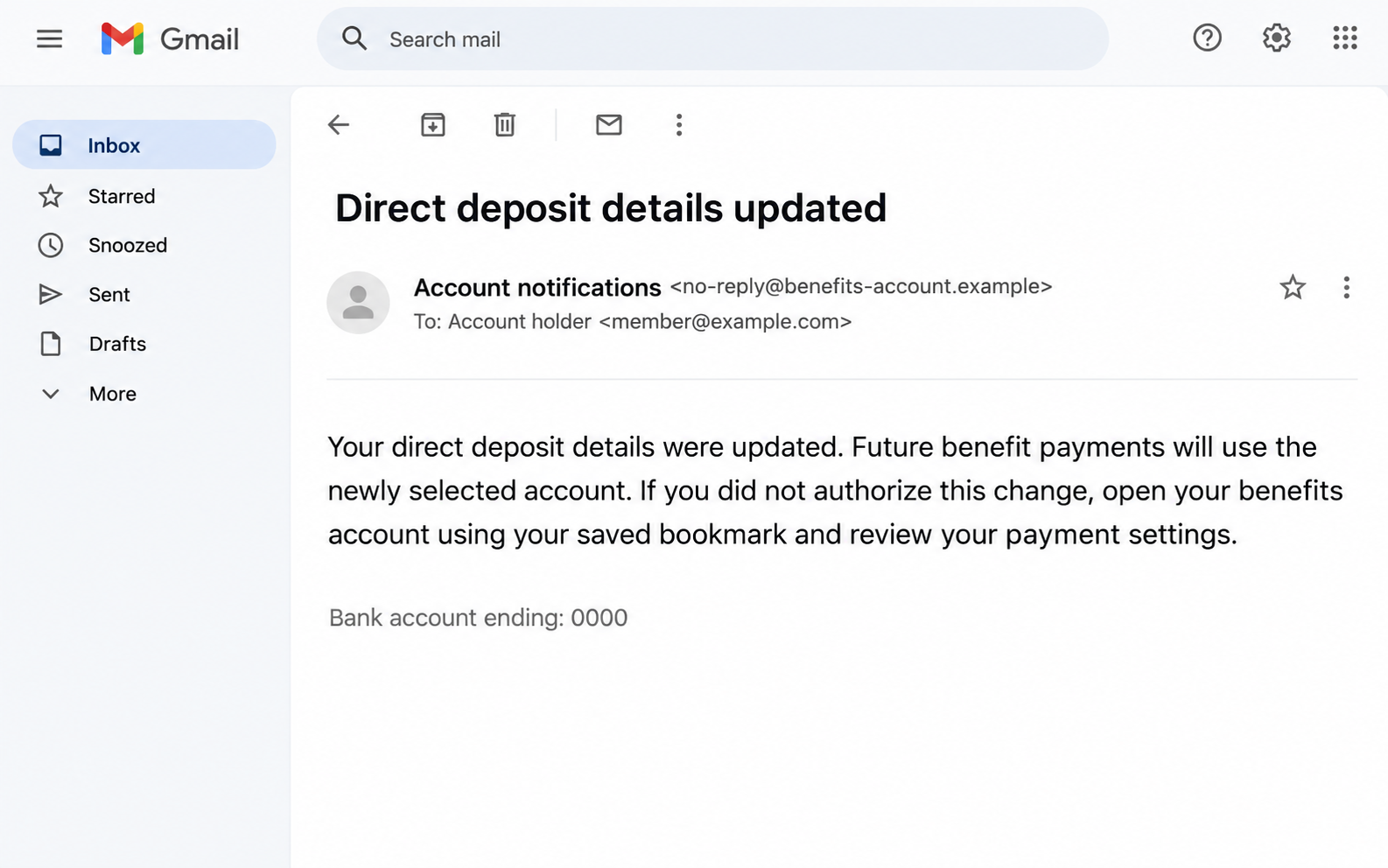
The pictured account-change notice illustrates unauthorized payment settings. It is not an original notification obtained from the Boling criminal case.
Boling pleaded guilty to wire-fraud and money-laundering conspiracies. Sentencing was scheduled for January 14, 2027; the announced maximum penalties are not a sentence already imposed.
The earlier Crawford guilty-plea announcement adds detail about the payment network. Trorice Crawford admitted recruiting at least 30 people who supplied accounts to receive stolen money.
That announcement described unauthorized transfers ranging from $8,000 to $13,000 on average. Crawford retained a share and arranged transmission of remaining funds to the Philippines.
These details show why tracing a loss involves more than identifying the person accessing the account. Different participants could steal the information, take the money, and move it onward.
A separate Brown sentencing announcement places the record theft between July 2014 and September 2015. The broader operation targeted more than 3,300 military-affiliated individuals.
Brown received 151 months in prison in 2021. Those historical findings establish the insider’s role while keeping the later Boling plea in its proper timeline.
Some victims were elderly or disabled veterans. A person receiving help with records can still deserve privacy, independent account control, and assistance that follows the agency’s approved procedures.
How the Veterans Benefits Account Theft Scam Works
Step 1: Personal information leaves a trusted setting
In this operation, the starting point was an insider taking information from medical records. The victim did not need to begin by answering a suspicious advertisement.
The historical announcement lists names, Social Security numbers, dates of birth, contact information, and Defense identification numbers among the stolen details. Those records were valuable beyond the medical setting.
A person using your correct background information therefore still needs independent authentication. Accuracy about your identity does not prove permission to act for you.
Step 2: The information supports unauthorized account access
The conspirators exploited the records to compromise online benefits and bank accounts. An established account became a tool for the theft rather than evidence that the activity was authorized.
The public announcements do not identify every victim’s precise authentication failure. Avoid assuming that the same password, portal, or verification method was involved in every intrusion.
For an affected account holder, the useful questions concern unfamiliar access, altered recovery details, and changes to payment instructions. Those can be checked without knowing the entire criminal method.
Step 3: Access turns into payment or bank-account theft
Benefits information and financial access can expose money that should remain under the veteran’s control. The scheme included stolen benefits payments and money taken from bank accounts.
Current VA guidance explains payment redirection as criminals obtaining account control and changing where benefits are deposited. That general mechanism helps explain what veterans should inspect today.
A benefit award and its destination are different records. Seeing that an award still exists does not establish that the next payment is going to your bank.
Step 4: Receiving accounts help move the proceeds
The operation used money mules with U.S. bank accounts. Receiving money through a domestic account did not make the transaction legitimate or keep it under the victim’s control.
For someone offered payment to receive and forward transfers, the case supplies another warning. Calling the role an assistant or payment processor does not explain the origin of the money.
Do not agree to route strangers’ funds through your personal account. If you have already done so, tell your bank accurately what happened rather than forwarding another transfer.
Step 5: The missing money forces the victim to reconstruct events
A delayed deposit, unfamiliar account change, or unauthorized withdrawal can be the first visible sign. The underlying theft may have begun before that symptom appeared.
Check dates and amounts against official payment history and your bank records. Separate a payment not issued from a payment issued to the wrong destination.
That distinction helps VA and the bank investigate the right problem. Preserve both sets of records instead of relying on a single account screenshot.
Why Knowing Your Service History Proves So Little
A caller who knows your military background can sound like someone already handling your records. The Boling operation shows how that familiarity can come from stolen information.
Do not finish the caller’s identity check by supplying missing details. End an unsolicited conversation and contact the agency through a route you chose independently.
The same caution applies to someone offering to repair a diverted payment. Knowing the amount you lost does not establish that the person works for your bank or VA.
Ask the real agency about the specific account event, rather than asking the stranger to prove familiarity with you. Personal facts can be copied or traded.
Family members helping a veteran should follow that approach too. Assistance should not depend on sharing the veteran’s password with a caller or a social-media contact.
Keep account recovery information within approved processes. Sending photographs of identity documents in an informal conversation can create another exposure without resolving the original one.
The Difference Between a Benefit Decision and a Stolen Deposit
A lower payment, delayed payment, and changed destination are different problems. Start with the official payment record rather than assuming every discrepancy has the same cause.
Confirm whether the payment was issued, when it was issued, and which account was selected. Compare that information with the account you intended to receive it.
If the destination is unfamiliar, report the suspected unauthorized change. Do not replace it quietly and assume that correcting one field has removed the intruder.
Access credentials or recovery information may also need attention. Otherwise, someone retaining access could attempt another change after you restore the original bank details.
If the destination is correct but the funds are missing, ask VA and your bank to trace the payment. A processing problem should not automatically be described as fraud.
Keep your explanation specific: the payment date, expected amount, account ending, and change you did not authorize. Concrete records are easier to investigate than a general suspicion.
How to Check the Current Account Without Following a Message
Enter VA.gov yourself or use a trusted bookmark. Use the sign-in options shown by the official site rather than a login link supplied by an unfamiliar sender.
VA’s direct-deposit guidance explains which benefit payment details can be managed in your profile. Follow the instructions applicable to the benefit involved.
Do not use a historical article’s old portal instructions as today’s recovery procedure. The criminal operation and the current account interface belong to different points in time.
Review the receiving account, contact details, and recent notifications for changes you did not make. Save relevant evidence while keeping full account numbers out of public posts.
If you cannot sign in, seek help through the official agency route. An unsolicited person offering a shortcut should not become the keeper of your recovery codes.
For an unfamiliar bank transaction, use the bank’s own app or the number on your existing card or statement. Do not rely on a number supplied in the suspicious message.
What to Do if You Have Fallen Victim to This Scam
-
Report missing or redirected benefits directly to VA
VA’s fraud-prevention guidance directs veterans with missing payments, discrepancies, or suspicious direct-deposit activity to 1-800-827-1000; explain the particular change you did not authorize.
Ask what information is needed to investigate and protect the next payment. Retain the case reference and any instructions for restoring the correct destination.
Reporting a payment problem and restoring online access are separate tasks. Ask the agency to address both when an account takeover appears to be involved.
-
Notify the bank about unauthorized withdrawals or receiving details
Contact your financial institution through an established channel. Give the dates, amounts, transaction references, and details of any account change you did not authorize.
Ask what protective actions and dispute procedures apply to your actual transaction. Follow the bank’s instructions promptly without assuming a criminal prosecution guarantees reimbursement.
-
Secure the account and its recovery information
From a trusted device, follow the official identity provider’s recovery process and replace exposed credentials. Review the telephone number and email address associated with account recovery.
Protect the email account receiving security notices as well. A benefits password change is less useful if someone else can still receive or redirect its recovery messages.
Do not share new passwords or verification codes with someone claiming to supervise the repair. Use authorized assistance procedures if a caregiver needs to help.
-
Build a record of the theft and identity exposure
Save payment histories, bank statements, unauthorized-change notices, correspondence, and report confirmations. Record when you first noticed the problem and which actions you took.
If identity information was misused beyond this payment, use IdentityTheft.gov for a recovery plan matching the exposure. Keep a separate list of affected accounts and open disputes.
-
Report the crime without paying a recovery intermediary
Report the online financial theft to IC3 and use VSAFE.gov to find the appropriate veterans-fraud reporting route. Include existing agency or bank references where relevant.
Reject demands for a fee to unlock a government payment or recover diverted benefits. Continue through the agency and bank you contacted independently.
Helping a Veteran Without Taking Over Their Identity
A trusted relative can help assemble records, make notes, and locate official contacts. That support does not require sending the veteran’s credentials through a messaging app.
Let the veteran use approved agency procedures for representation or account assistance. A scammer’s claim that family help requires sharing passwords should not define the process.
When reviewing statements together, focus on what changed and when. Avoid blaming the account holder for a theft that may have begun with information taken elsewhere.
The Boling case involved stolen records from a trusted setting. That fact is a reason to investigate carefully, rather than assume the victim knowingly authorized the loss.
Frequently Asked Questions
Did the victims have to answer a fake VA advertisement?
The documented operation began with stolen records supplied by an insider. The public case does not require an advertisement response as the starting point for every victim.
Does a caller knowing my military details prove they work for VA?
Stolen records can supply convincing personal information. Verify the caller through the agency’s independently obtained contact route rather than completing their request for additional details.
Was Boling sentenced when his guilty plea was announced?
The October 2026 announcement scheduled sentencing for January 14, 2027. It described maximum possible penalties, not a prison term already imposed on Boling.
Should I report a missing benefit to VA or my bank?
Contact VA about the payment record and destination, and your bank about its receipt or unauthorized transactions. Different records can reveal different parts of the same theft.
Does correcting direct-deposit information finish the recovery?
Account access and recovery details also need review when a takeover occurred. A corrected destination alone does not establish that unauthorized access has ended.
Does this case prove my own payment problem is fraud?
A payment discrepancy needs investigation on its own facts. Check the official history and receiving account, then report any change or withdrawal you did not authorize.
The Bottom Line
Do not let someone who knows your military background control your account or payment instructions. The Boling case shows how stolen identity records can become stolen benefits.
If a deposit disappears or the destination changes unexpectedly, contact VA and your bank promptly. Secure account access, preserve the records, and refuse paid recovery shortcuts.

Join the discussion
0 commentsShare your experience or ask a question about this article.
Community experiences
Did this happen to you?
Your experience could help someone recognize the same scam. Submit a private report for our team to review.
I experienced this tooReports are reviewed before publication. Sharing publicly is always your choice.
Discussion
Start the conversation
Have a question or something useful to share? Add the first comment.