

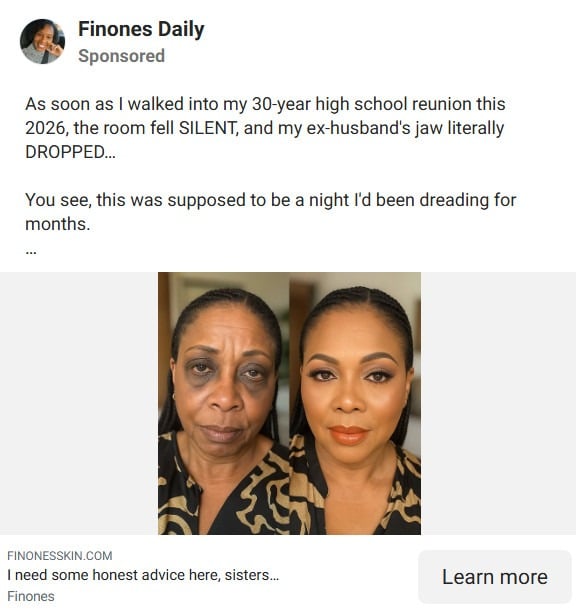
You are scrolling, you see a sponsored post from “Finones Daily,” and the story is designed to hit an emotional button: a high school reunion, a dramatic “before and after,” and the promise of visibly younger-looking skin without Botox.
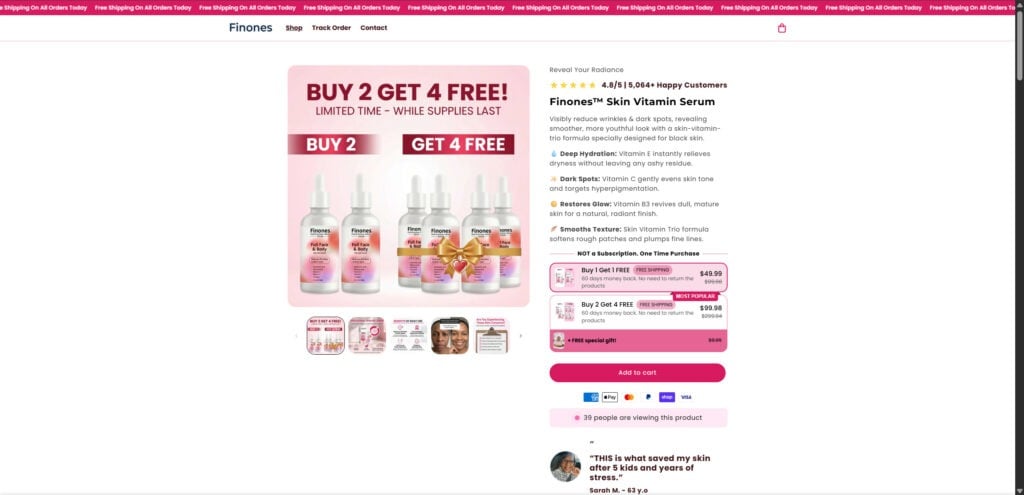
Then you click and land on a polished sales page for Finones Skin Vitamin Serum, complete with bold claims, a “4.8/5” rating, bundle discounts like “Buy 2 Get 4 FREE,” and a reassurance that it is “NOT a Subscription.”
If you are wondering whether Finones Skin Vitamin Serum is legit or just another trendy dropshipping offer with inflated marketing, this guide breaks down what the brand is promising, what the funnel is doing, where the red flags show up, and what to do if you already placed an order.
Overview
What Finones Skin Vitamin Serum is selling
Finones Skin Vitamin Serum is marketed as a “skin vitamin trio” cosmetic serum built around Vitamin C, Vitamin E, and Vitamin B3 (niacinamide). On the product page, it is positioned as a formula that can “visibly reduce wrinkles & dark spots,” deliver a “smoother, more youthful look,” and is “specially designed for black skin.”
The page also highlights very specific concerns, including dryness that leaves an “ashy residue,” uneven tone, hyperpigmentation, dullness, rough texture, and fine lines.
At face value, the ingredient theme is not unusual. Vitamin C, Vitamin E, and niacinamide are common skincare ingredients, and many reputable brands use them.
The legitimacy question comes from how Finones is marketed and sold, not from the fact that “vitamins” exist in skincare.
What the Finones pages explicitly promise
Based on the product and advertorial pages shown in the screenshots, here are the explicit promises a buyer is likely to see during the journey:
- “Visibly reduce wrinkles & dark spots”
- “Smoother, more youthful look”
- “Skin-vitamin-trio formula” (Vitamin C, Vitamin E, Vitamin B3)
- “Specially designed for black skin”
- “Deep Hydration: Vitamin E instantly relieves dryness without leaving any ashy residue”
- “Dark Spots: Vitamin C gently evens skin tone and targets hyperpigmentation”
- “Restores Glow: Vitamin B3 revives dull, mature skin”
- “Smooths Texture” and “plumps fine lines”
- “Sold out 33 times in 2 years”
- A “30-day clinical study” with dramatic percentages
- “NOT a Subscription. One Time Purchase.”
- “60 days money back” with “No need to return the products”
- High-pressure bundles like “Buy 2 Get 4 FREE”
When you line these up, the pattern becomes clear. The funnel is not just selling hydration. It is selling transformation, and it is doing it with certainty language.
The marketing style: advertorial first, product second
Finones does not lead with transparent product information the way an established skincare brand usually would. Instead, the funnel relies heavily on long, magazine-like “story” pages that look like editorial content.
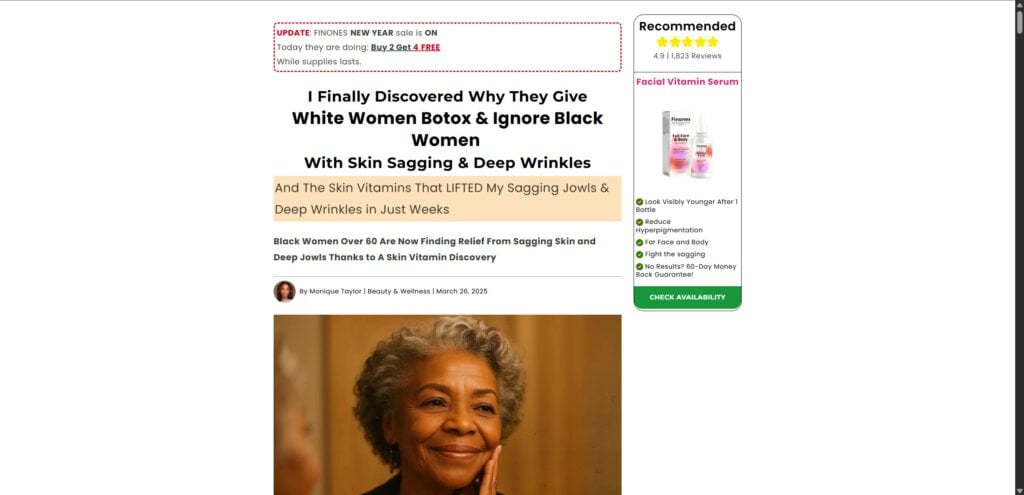
One headline shown in the marketing reads:
“I Finally Discovered Why They Give White Women Botox & Ignore Black Women With Skin Sagging & Deep Wrinkles.”
Another page frames it as a personal confession:
“My Sister got ‘Botox’ but my skin vitamin serum gave me BETTER results… Should I feel Guilty?”
These pages use short dramatic sentences, “discoveries,” and personal struggle narratives to keep you reading.
The purpose is straightforward: move you from emotion to belief to purchase, without giving you much time to pause and compare alternatives.
This is a common direct-response tactic, especially for products that need hype to overcome limited brand trust.
The “skin vitamin deficiency” storyline
A major part of the pitch is an invented-sounding condition: “Skin Vitamin Deficiency.”
The page shows an infographic with a “problem” (loss of firmness) and a “solution” (rejuvenated skin) tied to Vitamins C, E, and B3. It also introduces a named expert, “Dr. Amara Johnson,” described as a “leading skin renewal expert specializing in black skin.”
The copy suggests older skin is “starving for specific vitamins,” cannot “absorb efficiently with age,” and that this deficiency is the hidden reason for wrinkles, jowls, and sagging.
That framing is persuasive because it gives a simple explanation for a complex process. But real skin aging is multi-factorial. It involves collagen changes, elastin, hydration, sun exposure, genetics, and lifestyle factors.
When a sales page reduces a wide range of concerns to one neat “deficiency,” it is usually selling a story, not educating.
The “clinical study” numbers and why they should be questioned
One of the strongest persuasion levers is a “30-day clinical study” focused on Black women aged 60 to 85 with visible sagging, wrinkles, and jowls. The results listed are extremely strong:
- 87% firmer skin within 14 days
- 92% reduced appearance of jowls after 30 days
- 95% looking more lifted, even without makeup
Those numbers sound impressive. They also raise practical questions a careful buyer should ask:
- Who ran the study, and where is it published?
- How many participants were included?
- Was there a control group or placebo?
- Were outcomes measured objectively, or were they self-reported impressions?
- What does “firmer” mean in measurement terms?
- Were the before-and-after photos standardized for lighting and angle?
A legitimate brand can usually provide study protocols, published data, or at least clear documentation that can be checked.
When a page uses big percentages without the underlying study details, treat the stats as advertising, not evidence.
Social proof: the “Recommended” box and review language
The pages shown include a “Recommended” box with a high star rating and a specific review count. It repeats concise benefit claims like:
- Look Visibly Younger After 1 Bottle
- Reduce Hyperpigmentation
- For Face and Body
- Fight the sagging
- No Results? 60-Day Money Back Guarantee!
This is classic on-page reinforcement. It keeps the promise visible even when you are scrolling through long text.
The issue is not that reviews exist. The issue is when reviews become a substitute for verifiable company and product information.
If the site does not make it easy to find a verified ingredient list, the company’s legal identity, a real support address, or plain-English refund terms, a high star rating should not be treated as proof of legitimacy.
Pricing and bundles: anchoring, urgency, and a very specific offer stack
The product page emphasizes:
“NOT a Subscription. One Time Purchase.”
Then it pushes two bundles:
- Buy 1 Get 1 FREE, “Free Shipping,” priced at $49.99 (with a higher “regular” price crossed out)
- Buy 2 Get 4 FREE, “Free Shipping,” priced at $99.98, labeled “Most Popular”
It also advertises a “60 days money back” promise and even says “No need to return the products.”
This offer structure does three things at once:
- It anchors you to a high “regular” price so the current price feels like a steal.
- It increases the average order value by nudging you toward the higher bundle.
- It reduces hesitation by lowering perceived risk with a money-back promise.
This is conversion engineering. It is not automatically fraudulent, but it is a common design in dropshipping-style offers where speed matters more than long-term brand trust.
The sourcing question: why it looks like a private-label product
Another red flag is how generic the physical product presentation looks. In the screenshots, the bottle and box follow a standard “dropper serum” template with broad claims like “Full Face & Body.”
This matters because the same style of product appears all over wholesale marketplaces where factories sell ready-to-brand skincare products. In the wholesale screenshot provided, similar “vitamin C” and “niacinamide” serums appear priced around $0.38 to $1.67 per unit depending on quantity, with large minimum order requirements.
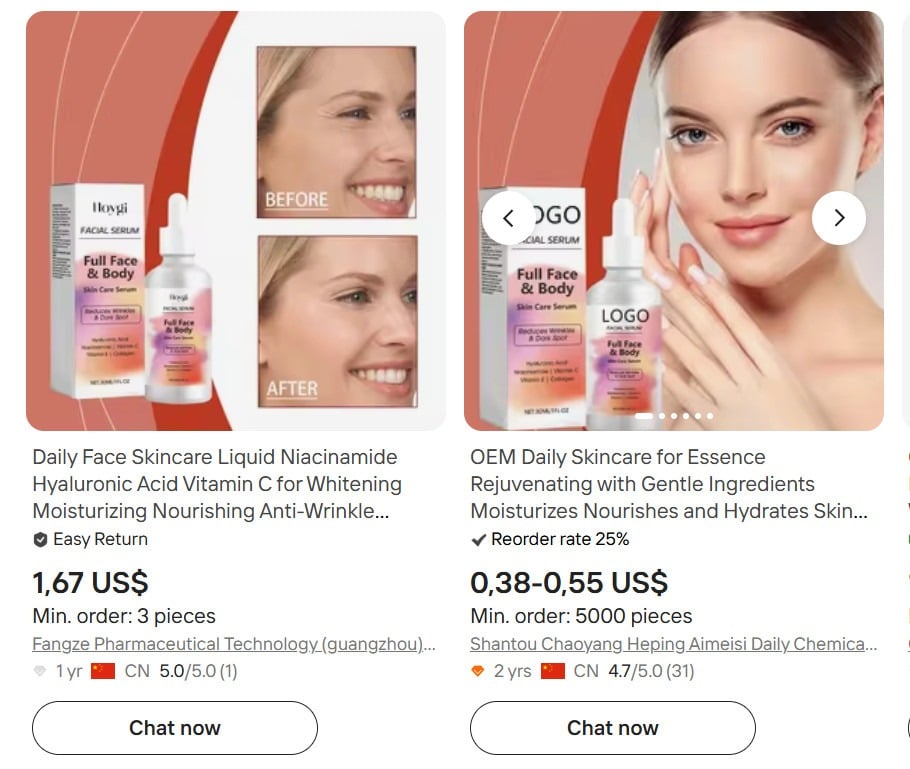
That does not prove Finones is buying from any specific listing. But it strongly suggests the product category is commodity-grade and easy to private label.
When a product is likely sourced as a generic OEM formula, the marketing story becomes the real “product.” The serum itself is often interchangeable.
What these ingredients can realistically do, and what they cannot
If you strip away the story, the formula concept is simple: a cosmetic serum using common “vitamin” ingredients.
Here is the practical reality.
Vitamin C: potentially helpful for brightness, limited for deep wrinkles
Vitamin C is commonly used to help brighten the appearance of skin, support a more even-looking tone, and provide antioxidant benefits.
But results depend on the form of Vitamin C, its concentration, how stable it is in the bottle, and whether it is paired with compatible ingredients. Low-cost Vitamin C formulas can oxidize quickly if packaging or stabilization is weak.
Even a well-made Vitamin C serum will not “lift” sagging skin the way the advertorial implies. It can improve glow and help with the look of dullness over time. It is not a facelift.
Vitamin B3 (niacinamide): solid ingredient, but not a miracle
Niacinamide is widely used because it can support the skin barrier and help the look of uneven tone for many people.
It can be a good choice for skin that feels dry, irritated, or inconsistent in texture.
What it does not do is create instant structural tightening. If you see language implying dramatic lifting or jowls disappearing, that is exaggeration.
Vitamin E: supportive, but common and not unique
Vitamin E is usually included as an antioxidant and as a supportive ingredient for dryness.
It can help a formula feel more moisturizing and comfortable.
But “Vitamin E instantly relieves dryness” is not a unique breakthrough. Many basic moisturizers can reduce the look of dryness quickly, especially when used consistently.
The “anti-ash” angle: a real concern, used as a marketing lever
The funnel references “ashy residue,” which is a common description for what dry skin can look like on deeper skin tones.
This is a legitimate concern. Dryness can be more visible on certain skin tones, and people understandably want products that make skin look healthy and moisturized.
The red flag is not acknowledging the concern. The red flag is using it to justify extreme claims, like Botox-like outcomes or an invented deficiency narrative that suggests only this product solves the issue.
Dryness and “ashiness” can often be improved with a simple routine:
- Gentle cleansing
- A moisturizer that supports the barrier
- Daily sunscreen on exposed skin
- Targeted ingredients used consistently for weeks, not days
A single serum is rarely the whole solution, especially when it is being sold as a miracle.
Why the identity-based positioning can be manipulative
Finones positions the serum as “specially designed for black skin,” and the advertorial headline directly contrasts “White women Botox” with the needs of Black women over 60.
There are legitimate differences in skincare concerns across skin tones, especially around hyperpigmentation and irritation response.
But credible brands handle this carefully and respectfully. They explain ingredients, disclose testing, and avoid sensational conflict-driven headlines.
When a funnel uses identity-based framing to increase emotional impact, it is often trying to lower skepticism, not improve transparency.
The biggest tell: extraordinary results without extraordinary proof
If a product truly had the power to transform visible sagging and deep wrinkles in weeks, it would not need an advertorial funnel to sell it.
It would typically be supported by:
- Published studies
- Dermatologist partnerships that are easy to verify
- Clear manufacturing information
- Consistent distribution through reputable retailers
- Straightforward customer support and returns
The pages shown rely on storytelling, authority cues, and deal stacking instead.
That does not automatically mean the product is fake. It does mean the claims should be treated as high-risk.
The business risk: fulfillment, refunds, and customer support
Where dropshipping-style operations tend to fail consumers is not only the product. It is what happens after you click “Buy.”
Common friction points include:
- Long shipping times and vague tracking updates
- Customer service that responds slowly or with scripted messages
- Refunds that require hoops, conditions, or “approval”
- Return instructions that involve international shipping, sometimes to Asia, which is expensive and discouraging
- Policies that promise “money back” but still deny refunds based on timing or technicalities
Even when a website advertises “easy returns” or “money back,” the fine print and the actual support behavior can feel very different.
Multiple bottle charges and “subscription” style billing
Finones explicitly says “NOT a Subscription.” That language appears because buyers are often worried about recurring charges.
So how do people end up feeling like they were charged for multiple bottles or enrolled in something they did not want?
In funnels like this, it often happens through patterns such as:
- Default quantity is higher than expected, and the buyer does not notice
- Post-checkout upsells add additional bottles with a single click
- The checkout includes pre-selected add-ons or “free gift” offers that change the total
- Buyers assume a subscription because the funnel resembles other continuity offers they have seen
You should not assume a subscription exists just because the marketing is aggressive.
But you should review your order confirmation carefully, because bundles and upsells can create a higher bill than you expected.
A practical way to evaluate “Scam or Legit” for this type of offer
For skincare offers like Finones, “scam” is not always the perfect word, because some buyers do receive a product.
A more useful question is: is it a high-trust brand experience, or a high-friction funnel that makes accountability difficult?
Use these questions:
- Do you know who the seller is, legally, and where they operate?
- Can you contact support and get a human response quickly?
- Are return instructions domestic and reasonably priced?
- Does the site clearly explain shipping times and fulfillment locations?
- Are the key claims supported with details, not just percentages?
- Would you feel comfortable giving this merchant your card details again?
If you cannot confidently answer those, it is safer to avoid the purchase.
How The Operation Works
Finones follows a pattern that has become very common in dropshipping and direct-response skincare. Understanding the mechanics helps you spot the pressure points and avoid getting boxed into a purchase you did not intend.
Step 1: The social media ad hook
The first contact is often a sponsored post that looks like a personal story.
In the example shown, the “Finones Daily” ad starts with a dramatic moment at a reunion and implies a stunning transformation. The copy is written in a conversational voice and invites curiosity.
Social ads rarely sell product details. They sell emotion and attention.
The goal is to get you off the platform and onto a page the advertiser controls.
Step 2: An advertorial that looks like editorial content
After clicking, buyers are often routed to a long-form page that resembles a blog post or magazine feature.
Instead of leading with product specifics, it leads with a problem, a personal struggle, and a “discovery.”
Headlines like the Botox comparison are designed to create a strong contrast: traditional solutions failed, but this is different.
This is persuasive because it feels like advocacy. But it is still a sales page.
Step 3: A simple villain and a simple diagnosis
The funnel introduces a villain, which can be “harsh ingredients,” “creams that block absorption,” or a made-up idea like “Skin Vitamin Deficiency.”
The goal is to make you feel ordinary skincare is not just ineffective, but actively wrong for you.
Then it offers a clean diagnosis: your skin is missing these vitamins, and the serum delivers them.
When the diagnosis is too neat, it is usually marketing.
Step 4: Authority stacking with experts, charts, and pseudo-clinical visuals
Next comes authority stacking. This can include:
- A named doctor or “leading expert”
- Scientific-sounding phrases like “bioavailable forms”
- Infographics and diagrams that imply a mechanism
- Claims about years of research and a breakthrough
The visuals and language do most of the credibility work.
If the site does not provide verifiable credentials or published research, treat the authority cues as persuasion design.
Step 5: Social proof stacking: transformations, testimonials, and “review counts”
Once you accept the premise, the funnel adds social proof.
You may see:
- Before-and-after photos
- Quotes that mention age and dramatic results
- Statements like “sold out 33 times”
- Precise star ratings and large review totals
Some of this content can be real. Some can be cherry-picked, edited, or unverified.
The key is that it is presented as overwhelming evidence so you stop asking basic questions like: Who runs this company? Where is the product made? What are the real refund terms?
Step 6: The offer stack that makes “no” feel irrational
Then comes the offer stack.
Finones uses a high-discount structure that makes buying a small amount feel like a bad decision.
If you can “Buy 2 Get 4 FREE,” why would you buy one?
This is intentional. Large bundles reduce refund rates because:
- The sunk cost feels higher
- The buyer has more product to “try longer”
- The buyer may forget the exact terms before deciding to dispute
The “60 days money back” language is also critical because it lowers resistance right at the point of purchase.
Step 6A: The “NOT a Subscription” line and why it is there
It is worth calling out the line “NOT a Subscription. One Time Purchase.”
That is not standard language for a normal skincare brand. Most brands do not need to reassure you in bold text that you are not being enrolled.
This line exists because the audience for these funnels is increasingly aware of subscription traps and surprise rebills.
It is also a way to reduce last-second hesitation right before checkout.
Even if there is no subscription, the reassurance can create a false sense of safety that makes people click through without checking:
- Whether they selected the correct bundle
- Whether they added an upsell
- Whether shipping protection or priority processing was added
- Whether the merchant name on the statement matches the brand name
Step 7: Checkout mechanics where surprise charges can happen
Even without a subscription, checkout mechanics can still create surprise charges.
Common sources include:
- Quantity set higher than expected
- A pre-selected add-on that increases the total
- A post-purchase upsell that looks like part of the order flow
- Shipping protection and “priority processing” fees
If you buy any product through a high-pressure funnel, slow down and confirm:
- Quantity
- Total charged today
- Shipping cost
- Any recurring charge language
- The exact merchant descriptor that will appear on your statement
Screenshot the final checkout page before you place the order.
Step 8: Fulfillment via third parties and overseas logistics
Dropshipping operations frequently use third-party logistics partners. The store sells under a polished brand name, but fulfillment can come from warehouses that may be domestic or overseas depending on inventory.
The buyer experience often includes:
- A tracking number that updates slowly
- Multiple carriers (international carrier, then a local carrier)
- Vague delivery windows that stretch into weeks
Shipping delays are not always evidence of fraud. But they become a problem when the merchant uses delays to run down your refund or dispute window.
Step 8A: Why international returns become “practically impossible”
Even when a refund is theoretically available, international returns often become a practical barrier.
If a product is fulfilled from overseas or through overseas partners, returns can involve:
- Return shipping costs that approach the product price
- Long transit times and inconsistent tracking
- Strict return authorization requirements
- Deadlines that require the return to be received, not just sent
This is why buyers often say “returns are impossible.” The process may exist, but it is designed in a way that makes completing it unreasonable.
Step 9: Customer support friction and refund resistance
If you ask for a refund, low-trust merchants often respond with friction tactics, such as:
- Offering a partial refund to keep the product
- Asking for more photos, more details, and more forms
- Insisting on a return even when the site implied you would not need one
- Providing a return address that is expensive to ship to
Sometimes this is malicious. Sometimes it is just a thin operation with outsourced support.
Either way, the effect is the same: many buyers give up.
Step 9A: How people end up with more bottles than expected
When buyers say they were charged for multiple bottles, the cause is often structural.
Typical scenarios include:
- You intended to buy one bottle, but the page’s base option is already a multi-bottle bundle.
- The “Most Popular” option is highlighted, and you clicked quickly.
- A “free gift” changes shipping fees or the order total.
- A post-purchase upsell makes it easy to add more bottles without thinking.
The takeaway is simple: if you buy through this style of funnel, take screenshots and confirm the exact order breakdown immediately after purchase.
Step 10: Why this pattern keeps working
Funnel operations like this succeed because they combine:
- A relatable emotional hook
- A simple story that sounds like science
- A high-discount offer that feels like a rare opportunity
Most people do not buy because they carefully evaluated ingredient stability or study quality. They buy because the funnel made the purchase feel safe and urgent at the same time.
What To Do If You Have Bought This
If you already purchased Finones Skin Vitamin Serum and you are uneasy about it, focus on practical steps. The goal is to stop future charges, document what happened, and maximize your chance of a refund.
- Find your order confirmation and save it
- Search your email for “Finones,” “Skin Vitamin Serum,” and the merchant name on your card statement.
- Save the confirmation email as a PDF.
- Screenshot the product page and the refund promises you saw at purchase time.
- Check exactly what you were charged
- Look at the total amount, not just the advertised bundle price.
- Confirm whether you were billed once or multiple times.
- If you see multiple charges, note the timestamps and amounts.
- Look for any language about recurring billing
- Check the order confirmation and any receipts.
- Review your statement over the next 30 days for new charges.
- If you see unfamiliar billing descriptors, call your bank and ask who the merchant is.
- Contact customer support in a clear, written message
- Keep it short and specific: “I want to cancel and receive a full refund.”
- Ask for written confirmation that no additional charges will occur.
- If you have not received the product, request cancellation before shipment.
- Use precise wording when you request a refund
- “I am requesting a full refund for order [ORDER NUMBER]. I do not consent to any additional charges. Please confirm in writing that my order is canceled (or refunded) and that no future billing will occur.”
- “No. I am requesting a full refund under your guarantee. Please process the refund and confirm in writing.”
- If support delays or refuses, escalate to your card issuer
- For credit cards, ask about a chargeback for goods not received, misrepresentation, or billing issues.
- For debit cards, ask about dispute options and stop-payment tools.
- Provide screenshots of the offer terms and your support messages.
- If you used PayPal, use PayPal’s resolution tools
- Start the dispute process promptly if delivery is delayed, the product is not as described, or billing was unexpected.
- Upload screenshots of the claims and guarantee language you relied on.
- If you suspect a subscription or continuity charge, take proactive steps
- Ask your bank what merchant descriptor is attached to the transaction.
- Ask whether the merchant can rebill your card without re-entering details.
- Consider requesting a new card number if you see repeated attempts.
- If the product has not arrived, do not wait too long to act
- If tracking shows “label created” with no movement for an extended period, request cancellation or a refund in writing.
- If support does not respond within 48 to 72 hours, escalate to your card issuer.
- Watch for “replacement shipments” and keep records
- Some buyers receive multiple packages or follow-up shipments.
- Keep every label, tracking number, and email update.
- If you received the product and still want to try it, protect your skin
- Patch test first, especially if you have sensitive skin.
- Stop using it immediately if you feel burning, itching, swelling, or a rash.
- If irritation is severe or persistent, contact a medical professional.
- Keep the packaging
- If there is an ingredient list, take a clear photo.
- If there is a batch code or manufacturer info, keep it. It can help if you need to report an issue or support a dispute.
- Monitor for “small test charges”
- Some merchants run small charges (for example, $1.00) before additional charges.
- If you see anything suspicious, call your bank immediately.
- Report deceptive ads
- Report the ad on the platform if it implied medical outcomes, used manipulated before-and-after imagery, or presented advertorial content as news.
- Set reminders for refund windows
- Mark day 30 and day 60 after purchase.
- Act early. Do not wait until the last day if you already see warning signs.
- Reduce risk for future purchases
- Use a credit card for online purchases when possible.
- Use virtual card numbers for unfamiliar merchants.
- Avoid buying skincare through story-style advertorial funnels.
- Buy from retailers with clear return policies and independent reviews.
The Bottom Line
Finones Skin Vitamin Serum looks less like a traditional skincare brand and more like a direct-response, dropshipping-style offer built around an advertorial funnel.
The marketing materials shown lean heavily on sensational story headlines, identity-based emotional framing, and extraordinary “clinical study” percentages without transparent supporting documentation. The product itself may be a real cosmetic serum, likely similar to widely available private-label formulas, but the big promises are doing far more work than the underlying product.
If you want a low-risk purchase, choose a reputable skincare brand with clear ingredients, realistic claims, and a return process that is easy to complete.
If you already bought Finones, act quickly: document what you saw, monitor your charges closely, and use your payment provider’s dispute tools if the merchant does not honor the guarantee you relied on.

Join the discussion
0 commentsShare your experience or ask a question about this article.
Reader experiences
How was your purchase experience?
Bought Finones Skin Vitamin Serum? Rate ordering, delivery, billing or returns. This is not a rating of health benefits or safety.
Share your experienceRatings appear after moderation and reflect readers’ experiences, not an editorial verdict.
Have firsthand experience?
Your review can help the next reader.
Discussion
Start the conversation
Have a question or something useful to share? Add the first comment.