

“Lymphatic drainage earrings” are being sold as a beauty and weight-loss hack you can wear all day. The ads promise less puffiness, less water retention, better circulation, and even “weight loss support” through magnets, germanium, and “lymphatic stimulation.”
It sounds scientific. It looks harmless. It is also a common scam pattern: cheap jewelry marketed with medical-style claims, sold through disposable websites, and backed by fake authority signals that fall apart when you look closely.
This guide explains how the lymphatic drainage earrings scam works, why the claims are so misleading, what red flags to watch for across different websites and brand names, and what to do if you already bought a pair.
Scam Overview
What are “lymphatic drainage earrings” supposed to do?
These products are typically marketed as earrings that improve lymphatic flow, reduce swelling, and help your body “eliminate toxins.” Some listings go further and claim the earrings can support weight loss by reducing water retention and “boosting circulation.”
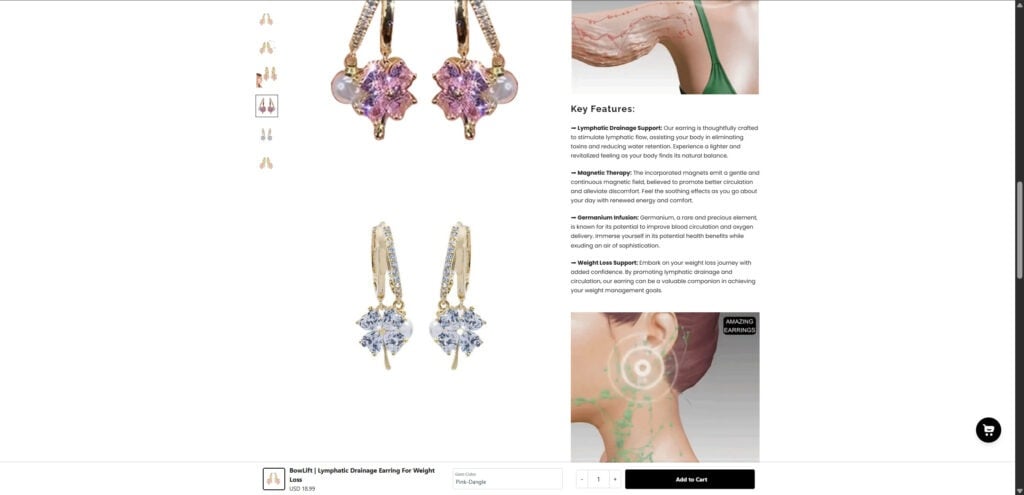
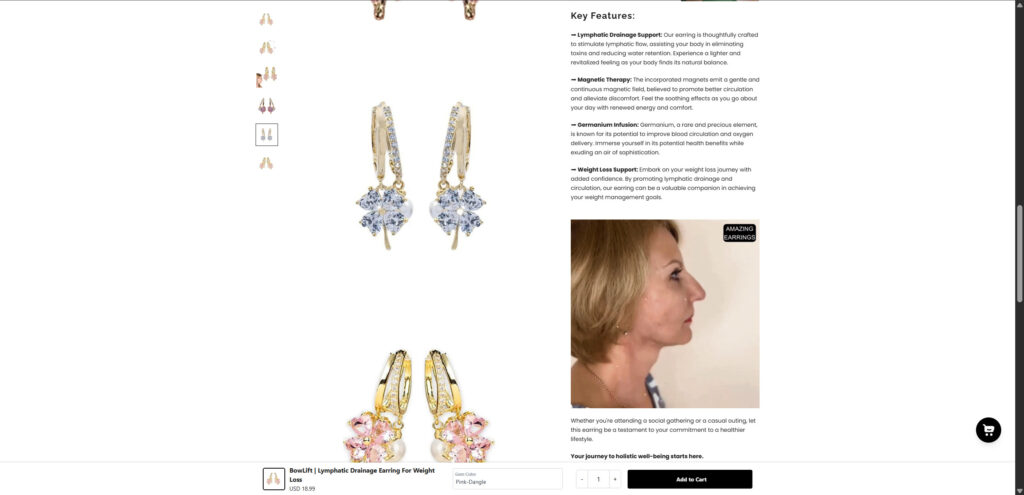
A typical product page highlights “key features” such as:
- Lymphatic Drainage Support: claims that wearing the earrings “stimulates lymphatic flow” and helps eliminate toxins and water retention.
- Magnetic Therapy: claims that magnets create a gentle magnetic field that boosts circulation and reduces discomfort.
- Germanium Infusion: claims that germanium improves oxygen delivery and circulation.
- Weight Loss Support: claims that improved lymphatic drainage and circulation helps with weight management.
These claims are written to sound like wellness support, but they are often framed with the urgency and confidence of a medical treatment.
That is one of the first red flags.
Why the claim is fundamentally misleading
Your lymphatic system is real. It is part of your immune system and fluid balance. Lymph moves through lymph vessels and lymph nodes, and it helps remove waste products from tissues.
But the lymphatic system does not work the way these ads suggest.
Lymph flow is driven mainly by:
- Movement of your muscles
- Breathing and pressure changes in the chest
- Normal body motion and posture
- Manual lymphatic drainage performed by trained professionals in specific cases
There is no credible mechanism where wearing earrings on your earlobes reliably “drains lymph” from your face or body in a way that creates meaningful fat loss or detox.
Even if an earring contains a small magnet, a weak magnetic field near the ear does not equal targeted lymphatic drainage. “Magnetic therapy” is often used in scam marketing because it sounds technical while being hard for the average buyer to evaluate.
The claim is built for persuasion, not for accuracy.
How the “lymphatic” angle is used to sell weight loss without saying “fat loss”
This scam often uses a careful language pattern.
The page may avoid a direct promise like “burn fat” and instead uses:
- “reduce water retention”
- “support circulation”
- “help detox”
- “support metabolism”
- “weight management”
This is an effective trick because water retention and swelling are real experiences. People can feel puffy, especially after salty foods, hormonal changes, long flights, or poor sleep.
The scam connects that real feeling to a product that cannot realistically solve it.
Then it adds a second psychological hook: if water weight can change quickly, buyers assume the earrings will create quick, visible results.
That is the entire point of the pitch.
The product is usually cheap jewelry sold at a premium price
Many of these earrings are mass-produced, low-cost accessories. They are commonly sourced from overseas manufacturers and resold through drop-shipping style stores.
The scam economics are simple:
- The product costs very little to source.
- The story and claims create “medical value.”
- The earrings are priced at $20 to $40, sometimes more with bundles.
- The profit comes from marketing, not from craftsmanship or verified benefits.
In other words, you are not paying for technology. You are paying for a conversion funnel.
Why it appears on many different sites
A major hallmark of this scam is the number of sellers.
The same earrings, or very similar designs, often appear on multiple “brands” and websites. Each one uses slightly different wording and visuals, but the structure stays consistent:
- A dramatic headline
- A list of health-related claims
- Stock-style imagery of lymph nodes or “flow” lines over the neck
- A “doctor recommended” or “clinically proven” tone without verifiable sources
- A discount timer or limited stock pressure
- A “money-back guarantee” that becomes hard to use in practice
This happens because the product is not a unique invention.
It is a commodity item that can be rebranded quickly.
If one store gets too many complaints, the seller can rotate to a new domain and a new name while running the same ads again.
Fake doctors, fake celebrities, and fake endorsements
These campaigns often use credibility props that are either misleading or outright fabricated, such as:
- “Doctor recommended” headlines with no real doctor identity
- Photos of people in lab coats that are not linked to a real clinic or medical institution
- “As seen on” style logos that are not backed by coverage
- Celebrity-style name drops or lookalike creatives on social media ads
- Claims that a “medical breakthrough” was “hidden from the public”
The goal is to create authority quickly.
Scam ads have one job: convert a scroll into a purchase before the buyer has time to verify anything.
The medical-claim escalation trap
Another common pattern is escalation.
The product starts as “beauty” and “puffiness relief.”
Then it escalates into:
- “toxin removal”
- “immune support”
- “circulation improvement”
- “weight management”
- sometimes even claims that imply help with serious health issues
That escalation is not subtle. It creates urgency.
It turns a shopping decision into a fear-based decision.
If someone believes they are “retaining toxins” or their “lymph is blocked,” they are more likely to buy immediately.
Why buyers call it a scam
People usually do not call a product a scam because they disliked it.
They call it a scam when the sales experience feels designed to mislead.
With lymphatic drainage earrings, the most common complaints typically fall into a few buckets:
- The product is ordinary costume jewelry, not a “health device.”
- The promised benefits do not happen.
- The website’s support is slow, vague, or unresponsive.
- Returns are difficult, expensive, or routed to an overseas address.
- Buyers are pushed into bundles, and some report being charged for multiple units.
- Some stores attach unwanted continuity billing or subscriptions through fine print.
Not every buyer will experience every issue.
But the pattern is consistent enough that the product category has become a repeatable scam template.
The “returns to China” problem
One of the most painful parts of these operations is the return process.
Many drop-shipping stores advertise a “money-back guarantee,” but the policy often includes friction such as:
- requiring authorization before returning
- short windows that start from the order date, not delivery date
- “unused” or “unopened” conditions that make returns unrealistic
- return shipping paid by the customer
- a return address that is overseas
When the return address is in China, the cost of tracked shipping can be high enough that many buyers give up.
That is not a mistake.
Return friction is often part of the business model.
What a legitimate product would do differently
If a product truly influenced lymphatic flow or weight management, you would expect:
- clear, testable claims
- transparent clinical evidence tied to the exact product
- a real company identity you can verify
- realistic safety guidance
- transparent refund terms with practical return logistics
Most lymphatic drainage earring stores do not provide those fundamentals.
They provide a story, a discount, and a checkout button.
How The Scam Works
Below is the step-by-step playbook that shows up again and again with “lymphatic drainage earrings” and similar wellness jewelry scams.
Step 1: Social media ads target a very specific insecurity
These ads are designed for people who feel:
- puffy or swollen in the face
- self-conscious about jawline or neck appearance
- frustrated with weight that feels “stuck”
- tired of diet advice that takes months to show results
The ad often uses language like:
- “drain lymph naturally”
- “reduce water retention”
- “detox your body”
- “lift and sculpt”
- “wear it and forget it”
This framing matters because it offers an effortless solution to a problem people have been battling for years.
Step 2: The ad uses medical-looking visuals to simulate credibility
Many creatives include:
- green “flow” lines around the neck
- lymph node graphics
- before-and-after images
- anatomical illustrations
- “magnetic therapy” icons
The visual language signals: medical, clinical, proven.
But visuals are cheap.
They cost nothing to add to a marketing video.
Step 3: The landing page is built to keep you scrolling, not to inform you
Once you click, you often land on a page that reads like a story:
- a dramatic setup about toxins, swelling, or blocked lymph
- a “discovery” of the earrings
- a simple explanation that sounds scientific
- testimonials and claims that build momentum
- repeated calls to action to buy now
This is direct-response copywriting.
It is structured to prevent the buyer from pausing long enough to ask the obvious questions.
Step 4: Key claims are framed as “support” while implying medical outcomes
The page often uses careful wording:
- “supports lymphatic drainage”
- “assists circulation”
- “helps eliminate toxins”
- “reduces water retention”
- “supports weight management”
These words are chosen because they sound safer than direct medical claims.
But the implication is still strong: your body will change if you wear the earrings.
That implication is what drives purchases.
Step 5: “Magnetic therapy” is used as the magic mechanism
Magnet claims are common in scams because they are hard to disprove in a quick scroll.
You might see phrases like:
- “gentle continuous magnetic field”
- “promotes better circulation”
- “reduces discomfort”
- “balances the body”
The problem is that these claims are rarely tied to any verifiable evidence for the specific earrings being sold.
They are general wellness phrases reused across many products.
Step 6: “Germanium infusion” adds a second layer of pseudo-science
Germanium is sometimes marketed in wellness products with claims about oxygen delivery and circulation.
In scam marketing, it functions as a fancy ingredient that most people do not understand.
That is the point.
When a product includes a term that feels scientific, buyers assume research exists.
But the store usually does not provide:
- dosage or composition
- sourcing details
- independent testing
- evidence that the claimed effect applies to the product
Instead, it provides a paragraph of confident language and moves on.
Step 7: Fake authority and fake social proof do the heavy lifting
The page often leans on:
- unnamed doctors
- “clinic” language
- staged testimonials
- dramatic before-and-after stories
- review counts that are hard to verify
Sometimes the page even uses “warning” language like:
- “counterfeits are being sold”
- “only buy from the official store”
- “legal action will be taken against counterfeiters”
That is another manipulation tactic.
It makes the store look like the real brand and makes the buyer feel safer.
Step 8: Pressure tactics push buyers into a fast checkout
Common pressure triggers include:
- “50% off today”
- “limited stock”
- countdown timers
- “only a few left”
- bundle discounts that appear to be a rare deal
Often, the urgency resets when the page reloads.
That is a sign the urgency is a script, not reality.
The goal is simple: buy now, think later.
Step 9: The bundle trap increases the charge and reduces refunds
Many stores highlight bundles:
- buy 1
- buy 2 and save more
- buy 3 get 1 free
Bundle pricing serves two purposes:
- It increases average order value.
- It increases psychological commitment.
If you buy four pairs, you are more likely to keep trying them, and less likely to push hard for a refund immediately.
Step 10: Checkout design can lead to unexpected charges
Depending on the seller, buyers may run into problems such as:
- quantity defaults that are easy to miss on mobile
- add-ons like “shipping protection”
- one-click upsells after purchase
- a merchant name on the statement that does not match the store name clearly
Some buyers also report unwanted subscriptions.
This can happen when the checkout includes fine-print terms, “VIP savings,” or continuity billing disguised as a discount program.
Not every store does this, but it is common enough in scam funnels that you should treat it as a real risk.
Step 11: Fulfillment reveals the drop-shipping model
When the earrings arrive, buyers often notice:
- packaging that looks generic
- no brand documentation
- low-cost materials inconsistent with premium claims
- long shipping timelines and vague tracking
This is where the “$20 to $40 wellness device” starts to feel like what it is: a cheap accessory sold with an expensive story.
Step 12: Support friction and return barriers close the loop
If you try to return, the seller may:
- respond slowly
- ask for repeated photos
- offer partial refunds to avoid returns
- require overseas shipping
- deny refunds under strict conditions
This is the final step in many scam funnels.
The refund process is designed to make giving up feel easier than fighting.
What To Do If You Have Fallen Victim to This Scam
If you already bought lymphatic drainage earrings, focus on practical steps that protect your money and reduce the chance of future charges.
- Take screenshots of everything while it is still online.
Save the product page, the claims, the price, the refund policy, and your order confirmation. Also save the website domain and date. - Check your statement for the exact merchant name and every charge.
Look for duplicate charges, small “test” charges, add-ons, and any recurring billing that you did not expect. - Email the seller once with a short, clear refund request.
Include your order number. Example:
“I am canceling my order and requesting a full refund. Order number: ____. Please confirm within 48 hours.” - Do not get trapped in endless support loops.
If the seller delays or avoids a clear answer, move to the next step quickly. - Contact your card issuer and ask about dispute options.
If the item is not as described, if it never arrives, or if the seller refuses the refund policy they advertised, a dispute or chargeback may be appropriate. - If you see recurring charges, tell your card issuer you want them stopped.
Ask about blocking future payments from that merchant. Consider replacing the card if necessary. - Document what arrived.
Photograph the package, label, and earrings. If the product quality is materially different than advertised, those photos help support a dispute. - Track the timeline.
Many dispute processes have time limits. If you wait too long, you lose leverage. - Avoid shipping expensive international returns unless it makes financial sense.
If return shipping costs nearly as much as the order, your card dispute process may be the better path. - Secure your email account used at checkout.
Change your password and enable 2-factor authentication. Scam funnels sometimes lead to follow-up phishing attempts. - Report the ad on the platform where you saw it.
Report it as misleading health advertising. It does not feel satisfying, but it helps reduce distribution. - If you have swelling, pain, or a medical concern, talk to a professional.
Do not rely on jewelry marketed online for health problems, especially anything related to swelling, circulation, or lymph nodes.
The Bottom Line
Lymphatic drainage earrings are a classic social media scam category: cheap jewelry sold at premium prices using fake or exaggerated health claims. The marketing leans on magnets, germanium, and “lymphatic stimulation” to imply medical benefits that are not realistically supported by a pair of earrings.
The operation usually looks legitimate at first because the website is polished, the language is confident, and the ads repeat until they feel familiar. But the red flags show up quickly: sweeping claims, fake authority, pressure discounts, and refund policies that can become practically unusable when returns require overseas shipping.
If you already purchased, act fast and stay organized. Save evidence, check for extra charges, request a refund in writing, and use your card issuer’s dispute process if the seller does not make things right.
FAQ
What are “lymphatic drainage earrings” supposed to do?
They are marketed as earrings that “stimulate lymphatic flow,” reduce water retention, support circulation, and sometimes even help with “weight loss support.” The pitch usually relies on magnets, “germanium infusion,” and detox-style language.
Are lymphatic drainage earrings legit?
As a health product, the claims are highly questionable. These earrings are typically ordinary fashion jewelry sold with medical-sounding marketing. There is no reliable evidence that wearing earrings can meaningfully improve lymphatic drainage or cause weight loss.
Can magnets in earrings improve circulation or lymphatic flow?
A small magnet near the ear does not equal proven improvements in circulation or lymphatic drainage. “Magnetic therapy” is commonly used in scam marketing because it sounds technical but is hard to verify from a sales page.
Do lymphatic drainage earrings help you lose weight?
Weight loss claims tied to earrings are not credible. Some ads reframe the promise as “reducing water retention” or “detox,” which can sound plausible, but that is not the same as losing fat or achieving lasting weight change.
What does “germanium infusion” mean in these listings?
It is typically used as a scientific-sounding selling point. Many pages claim germanium improves oxygen delivery or circulation, but they rarely provide verifiable composition details, testing, or proof that the earring provides any measurable health benefit.
Why do these ads talk about “toxins” and “detox”?
“Detox” language is a classic persuasion hook. It creates urgency and fear, especially for people dealing with swelling or weight concerns. Most detox claims in products like this are marketing, not medical fact.
Are the before-and-after photos real?
Often they are staged, edited, borrowed, or impossible to verify. Even if a photo is real, it does not prove the earrings caused the change. Treat dramatic before-and-after content as advertising, not evidence.
Why are the same earrings sold on multiple websites under different names?
These are commonly commodity products sold through dropshipping or private-label resellers. When one site gets complaints, sellers often switch domains and rebrand while using the same product photos and claim templates.
Why do some buyers report being charged for multiple units?
Some checkout flows use default quantities, bundles, add-ons, or upsells that are easy to miss on mobile. In scam-style funnels, the cart is often designed to increase the total order value quickly.
Can these sites put you into an unwanted subscription?
Some sellers attach continuity billing through fine print, “VIP savings,” or post-purchase offers. Not every store does this, but it is a known risk with disposable ecommerce funnels.
Why are refunds so difficult with these sellers?
Many sites advertise a “money-back guarantee,” but the actual policy can require overseas returns, strict conditions, and customer-paid shipping with tracking. Return friction is often part of the business model.
What should I do if I already bought them?
- Screenshot the product page, claims, and refund policy
- Save your order confirmation and emails
- Check your statement for extra or recurring charges
- Request a refund in writing once, clearly
- If the seller stalls or refuses, contact your card issuer to dispute the charge
What payment method is safest for sketchy online stores?
Credit cards generally provide better dispute protection than debit cards. Virtual cards can reduce risk. If you already paid, enable transaction alerts and monitor your account closely.
Are these earrings dangerous to wear?
They are usually just costume jewelry, but risks can include skin irritation, allergic reactions to cheap metals, and discomfort. If you experience redness, swelling, or pain, stop wearing them.
How can I spot the next “health jewelry” scam quickly?
Watch for:
- Big health claims without verifiable studies
- “Doctor recommended” language with no real doctor identity
- Detox and toxin removal promises
- Fake urgency timers and constant 50% to 80% discounts
- A store selling many unrelated “miracle” products
- Vague company details and overseas return requirements








