


An old investment chat can come back to life long after everyone has stopped talking about the money. Suddenly someone says there is news worth opening.
For people who put money into Fundsz, the next message can feel like the one they have been waiting for. This time, it matters who sent it.
Overview
The Fundsz case is not a new investment offer
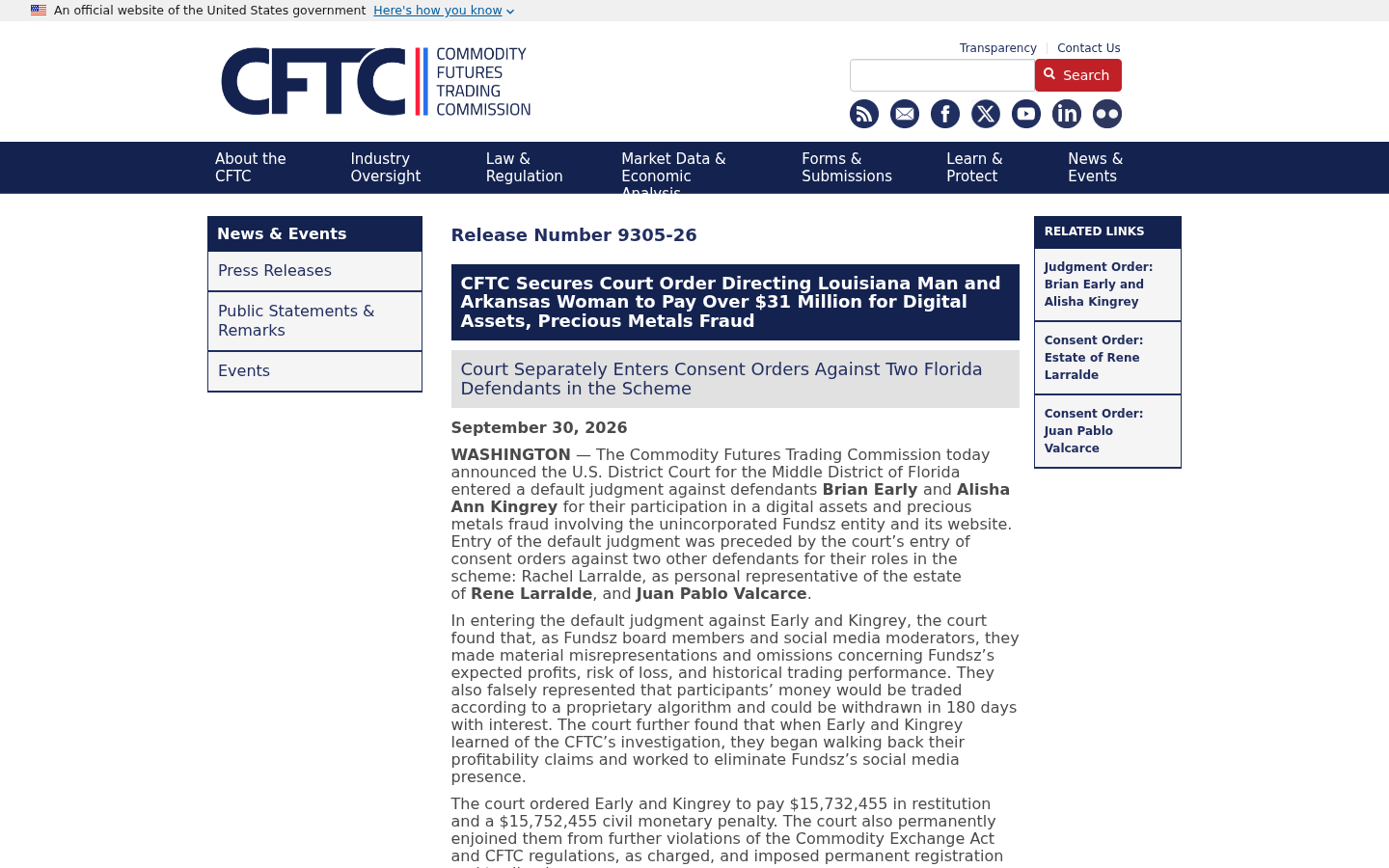
Two real things happened in the Fundsz case. A federal court entered a judgment against two promoters, and the court separately approved a receiver’s plan to distribute money.
The two events answer different questions. The judgment describes what the defendants did and what they owe. The distribution plan addresses money the receiver can actually distribute.
That difference matters when a message says you can apply for your share of the judgment. An impressive number in a headline is not a balance available to you.
The CFTC announcement identifies Brian Early and Alisha Ann Kingrey as Fundsz board members and Telegram moderators. The court entered a civil default judgment against both.
This was not a criminal sentencing announcement. It also does not mean that every chat participant broke the law, or that every person in a screenshot was a promoter.
Where the $31 million figure comes from
The judgment orders $15,732,455 in restitution and a separate $15,752,455 civil penalty, as stated in the CFTC announcement. The two amounts serve different purposes.
The restitution figure is a court order. It is not an announcement that that amount has already been collected, split between investors, or deposited into a particular account.
The civil penalty is not a second pool of investor refunds. A message offering you a share of both is misrepresenting what the numbers mean.
These are the three things to keep apart when reviewing a notice about Fundsz:
- The judgment describes the court’s findings and the amounts it ordered from Early and Kingrey.
- The receiver’s distribution notice applies to holders of allowed claims in the court process.
- A person messaging you privately about opening a claim has not proved any connection to either.
The CFTC also describes separate consent orders involving Juan Pablo Valcarce and the estate of Fundsz founder Rene Larralde. Those orders should not be added to an individual’s expected payment.
Rachel Larralde is identified by the CFTC as the estate representative. That is not the same thing as a finding that she personally ran the investment scheme.
The only useful starting point for a payout question
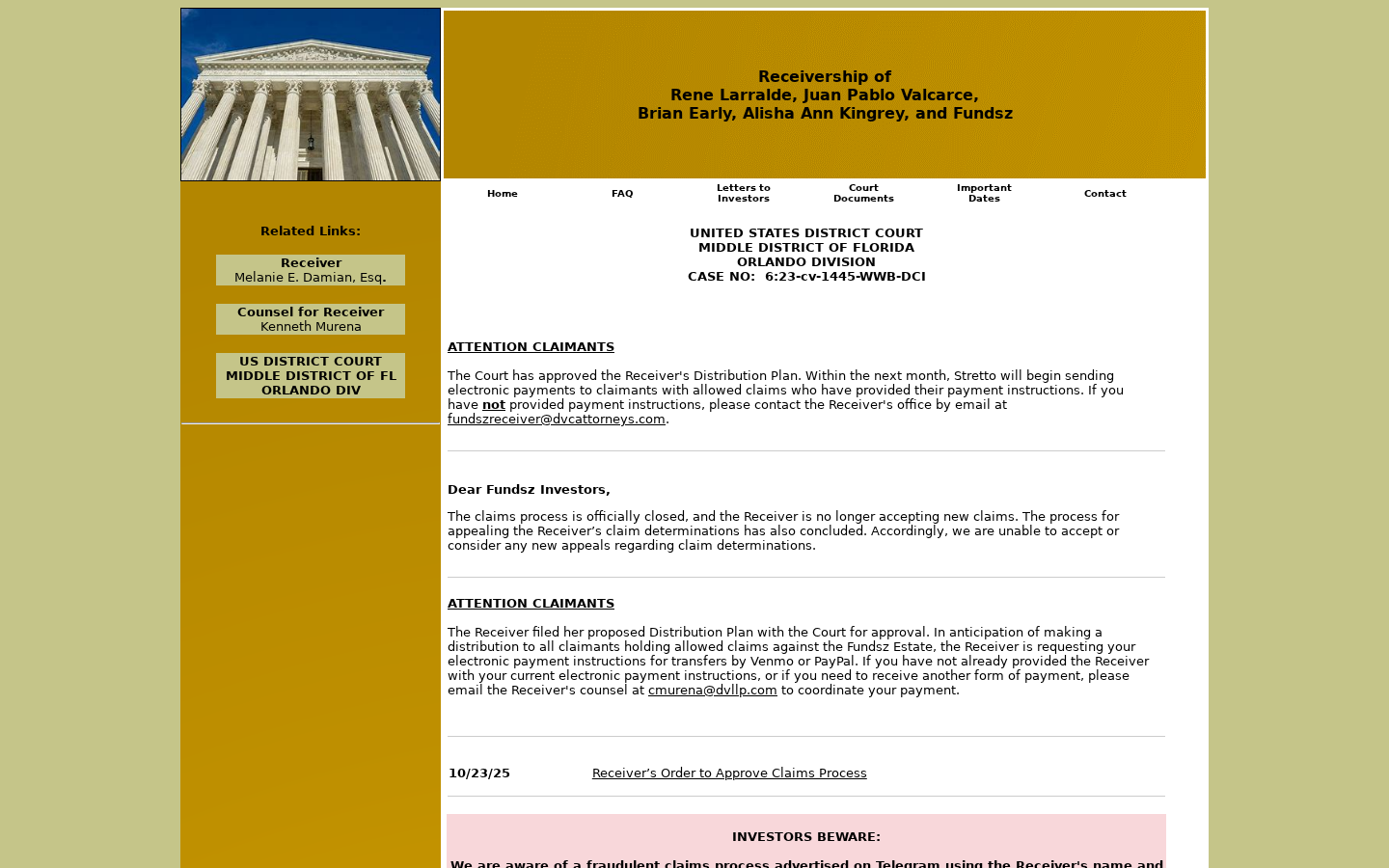
The Fundsz receiver’s website states that the claims process and appeal process are closed. Its payment notice addresses claimants who already have allowed claims.
The receiver names Stretto as the distribution agent. It also provides a route for existing claimants who have not given payment instructions to contact the receiver’s office.
Stretto’s name in a message is not proof the message came from Stretto. A fake sender can copy the name straight from the same public notice.
Use the latest dated court records and the receiver’s own contact details, not a social post quoting an undated summary of the expected payment timing.
How the Fundsz Scam Worked
Step 1: The group sold trading returns as predictable
Fundsz was pitched as a way to profit from crypto and precious metals. The original CFTC complaint announcement describes claims of over 3% in weekly returns.
The sales pitch did not ask participants to judge a conventional portfolio with ordinary market ups and downs. It gave them a story about why the returns would keep coming.
A promised return and an explanation for that return are not independent pieces of evidence. Both can come from the person who needs you to put money in.
If you have preserved an old pitch, note which amount or rate was stated as guaranteed. Keep that wording separate from what a participant guessed in a comment.
The court findings cover material false statements about profits, the risk of loss and historical performance. They also address claims about a supposedly proprietary trading algorithm.
Step 2: The withdrawal promise addressed the hardest question
Even an enthusiastic investor might ask what happens if they need the principal back. The CFTC described a sales claim about withdrawing after 180 days with interest.
That promise sounds like an exit from the arrangement. The court found false or misleading statements about the ability to withdraw, not simply a disappointing run of investments.
When sorting old records, distinguish a stated withdrawal date from a date on which funds arrived. An application confirmation is not a transfer.
The same applies if someone posted that a payout had been approved. A status update in a group is evidence of what was said, not what your bank received.
One small withdrawal, if you received one, should be listed as a real receipt. It does not validate a claim about the rest of the balance.
Step 3: The moderators gave the claims an official voice
Early and Kingrey were more than names on a flyer. According to the CFTC, they had roles in the organization and helped promote the investment through Telegram.
That helps explain why the messages mattered. When someone answering questions also has a board title, an investor may read the reply as an authoritative statement about their money.
Preserve any exchange where someone answered your personal question about when you could take money out. It is often more informative than a screenshot of a busy general chat.
When exporting a message, keep the original date and the context visible. A standalone sentence can leave out whether the speaker was talking about principal, interest or someone else’s account.
The federal court’s finding concerns specific defendants and conduct. It is not permission to label other people in an old chat as accomplices based on their screen names.
Step 4: A copycat claim process reused the same community channel
The original Fundsz pitch and the later recovery impersonation are separate. The receiver publicly warned about a bogus claims process promoted through Telegram using the receiver’s identity.
This time the bait is not a trading return. It is the chance to get back money that the recipient already believes ought to be returned.
The context can make an unsolicited message seem unusually convincing. The person receiving it recognizes the case name and may have real questions about a genuine distribution.
The public warning establishes that a fake claims campaign was advertised. It does not make every unexpected notification fraudulent, or identify who wrote any particular message you received.
You do not need to settle those questions in Telegram. You can confirm whether the message concerns your claim without asking its sender to verify their own identity.
What to Do If You Put Money Into Fundsz
- Open the receiver’s website independently, find Attention Claimants, and compare the notice with the claim determination you already received.
- If your claim was allowed but instructions were never provided, contact the receiver’s office at the address shown in that notice.
- If you already submitted instructions, look in the account designated for the payment and verify any reported transfer there directly.
- If you never filed, or your claim was denied, read the receiver’s closure notice before replying to anyone offering a new filing route.
- If you already sent money to a recovery contact, notify the payment provider and preserve the transaction and conversation records.
- Save the official response and latest claim paperwork together so that you can check any later notification against them.
If the receiver already allowed your claim
Start with the allowed-claim notice rather than a trading summary. Write down the claim reference, name used to file and the most recent instructions you can verify.
In Attention Claimants, the receiver lists fundszreceiver@dvcattorneys.com. Copy that address from the site into a fresh message, rather than pressing Reply on a forwarded payment email.
Mention that you have an allowed claim and say whether you need the approved route for supplying instructions or confirmation of instructions already sent.
Ask how to provide any sensitive information securely if the office requires it. Your first email can explain the problem without including a bank login or a wallet recovery phrase.
For a payment notice, open the nominated payment app or financial account yourself. Look for the posted transaction rather than relying on an image in the message.
If the account shows no credit and you previously sent instructions, ask the receiver whether it can confirm the status. Keep the date of your inquiry.
The receiver’s page says that allowed claimants who provided instructions are the intended recipients of the electronic distribution. That description does not tell you when your particular payment posts.
If the payment method you gave is no longer usable, explain exactly what changed to the receiver. Do not route a claimed payment through a stranger’s account.
If you missed the deadline or someone offered to reopen it
Read the two closure statements on the receiver’s homepage. One concerns new claims and the other concerns appeals of claim determinations.
The receiver’s important dates page lists December 22, 2025 as the claim deadline and May 1, 2026 as the appeal deadline.
Treat offers to bypass either of those deadlines through a chat as unsafe. If you need to understand an old determination, ask the receiver through its own website.
A legitimate question about status is different from permission to file late. Do not send a registration fee or crypto transfer just because a message promises to fix it.
If you gave a recovery contact your financial details, call the provider using a number from your account or card. Tell it exactly what was shared or sent.
For a transfer, ask whether the provider can stop or recall it. For crypto, report the actual transfer reference and receiving address to the service you used.
The FBI’s recovery scam advisory warns that private services may collect advance fees and then seek more money. Do not pay a second person to reverse the first payment.
What a useful file looks like
Keep the original Fundsz deposits, actual withdrawals, claim correspondence and any messages from the new recovery contact in separate groups. These records answer different questions about what happened.
For the investment itself, mark the rows where money left or returned to a real account. Label figures copied from the Fundsz portal separately.
For the later approach, preserve the sender, times, payment demand and transaction reference if you paid. This gives your provider something concrete to investigate.
Keep a copy outside the app if you can. A chat deleted by the sender should not take your only record of the transaction with it.
An old portal screenshot may still be useful evidence of the representation you saw. Just avoid using its total as if it were the money the court allowed.
How to read a distribution status update
Start by separating three dates: when the court approved the plan, when an instruction was sent, and when money appeared in your own account.
A court filing may answer the first question without answering the others. The receiver is the better contact for a question tied to your own claim.
The receiver’s court documents page lists the September 23, 2026 order approving the distribution plan and authorizing Stretto to act as distribution agent.
If you find a newer update, check its date and whether it applies to existing claimants, a particular payment method or everybody with an allowed claim.
A forwarded notice can be genuine but old. Do not use its wording to replace a more recent instruction that the receiver has verified for you.
Frequently Asked Questions
Was Fundsz found to be a scam?
Yes, the federal court entered a civil default judgment in the CFTC case against Early and Kingrey. It found materially false statements connected to the Fundsz investment scheme.
The judgment is a stronger basis for this conclusion than a missing website, a low trust score or a former investor saying withdrawals had stopped.
Can I still submit a Fundsz claim?
The court-appointed receiver’s website says the claims process is closed and that it is no longer accepting claims. It also says the appeal process has concluded.
An invitation to submit details in a chat does not reverse those statements. If the process changes, look for the notice in the receiver’s own records.
Does the $31 million judgment mean everyone gets paid?
No, because that figure includes both an ordered restitution amount and a civil penalty. Neither number by itself tells you what money is available to an individual claimant.
The receiver’s payments are a separate administration process. Check your allowed claim and the distribution notice instead of assigning yourself a share of the judgment headline.
Is Stretto actually involved in the Fundsz distribution?
Yes, the receiver identifies Stretto as the distribution agent. That still does not authenticate an email, direct message or payment page that uses the company’s name.
Verify a notice using the receiver’s published contact information and the account you were expecting the payment to reach. Do not follow an unexpected login link.
What if I never got a payment after providing instructions?
Check the designated account, then ask the receiver’s office about the specific claim and the payment instructions you furnished. Include a reference number where available.
The payment notice is not independent proof that a particular transfer cleared. An absent credit is a reason to check status, not to buy an expedited payout.
Can a Telegram administrator act for the receiver?
The receiver has warned investors about an impostor claims process on Telegram. Do not rely on an administrator’s title, profile image or knowledge of the Fundsz case.
Open a new message through the contact shown on the receiver’s site instead. This keeps your inquiry separate from anyone who contacted you first.
The Bottom Line
Do not send money or personal documents to anyone offering a Fundsz payout through Telegram. The official distribution is for allowed claims, not a new enrollment opportunity.
If your claim was allowed, use the receiver’s website to verify your payment instructions or ask about a missing transfer. If you missed filing, don’t pay anyone to reopen it.

Join the discussion
0 commentsShare your experience or ask a question about this article.
Community experiences
Did this happen to you?
Your experience could help someone recognize the same scam. Submit a private report for our team to review.
I experienced this tooReports are reviewed before publication. Sharing publicly is always your choice.
Discussion
Start the conversation
Have a question or something useful to share? Add the first comment.