


The checkout behind GetPurePod.com’s Order Now button had already swapped a $59 produce cleaner for a $98 two-pack, under a banner saying the sale ends tonight.
We read the checkout’s fine print and every policy behind it, then traced the online shop that carries the same product, and the paperwork named three different companies.
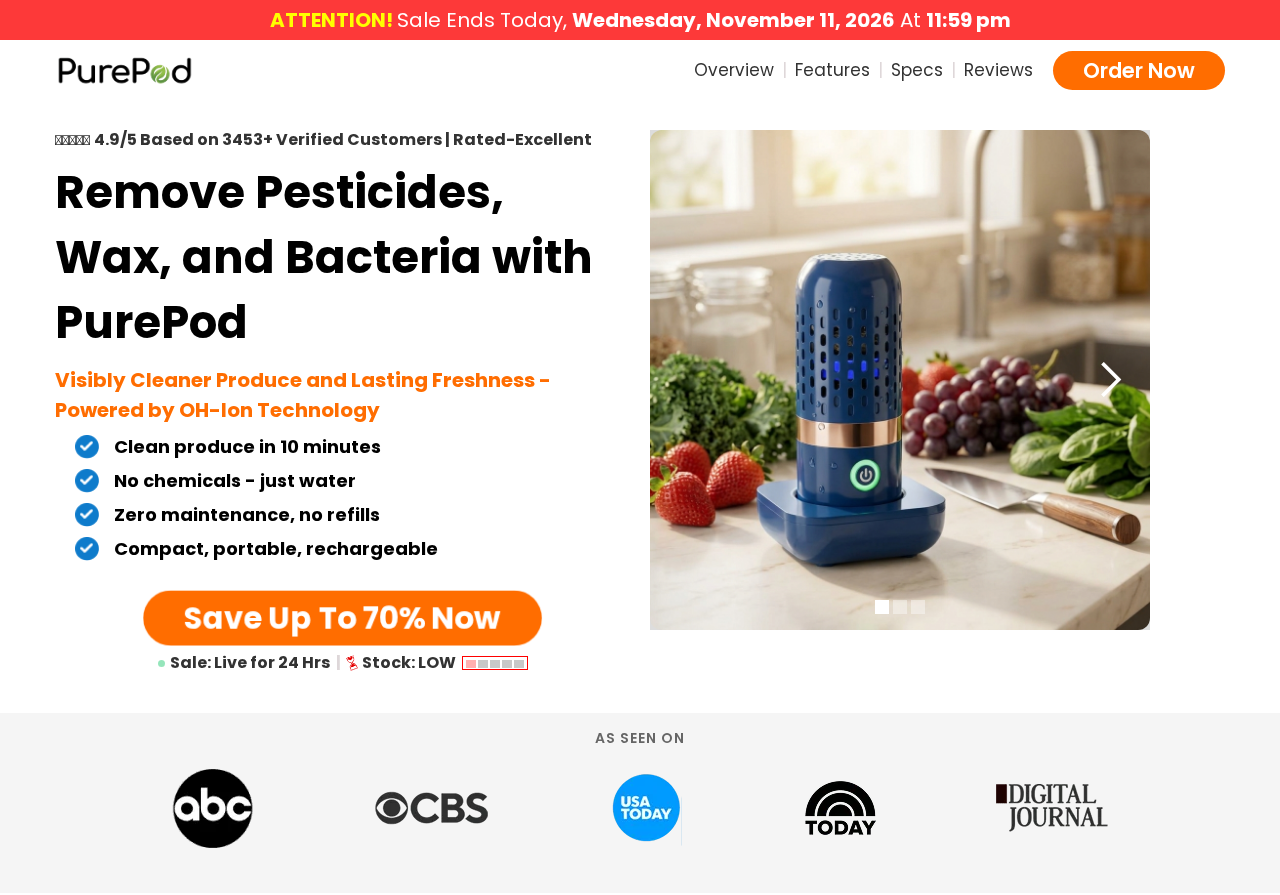
Overview
What the PurePod page promises
PurePod is a rechargeable capsule, smaller than a soda can, that you drop into a bowl of water together with your fruit and vegetables.
The page promises it removes pesticides, wax and bacteria in 10 minutes, with no chemicals, no refills, up to 70% off and a 90-day money-back guarantee.
It also shows a 4.9 rating from 3,453+ verified customers, while the checkout counts 72,251+ shipped orders.
What we found when we checked
The footer, the policies and the terms name three different companies, and the terms add that your card statement will read centerview media or mvfbrands.
The sale banner works out its own deadline from your clock, the crossed-out prices disagree with the shop behind the product, and the default order is a $98 two-pack.
A free-shipping box at checkout also enrolls you in a Rewards Club that bills $31.71 every 28 days, which passes the price of the device by day 42.
What we could and could not verify
Here is where the evidence stands after our checks:
- Verified by us: the page code and policy text, the default checkout view, the registration dates, the sister shop’s 41 listings and the price arithmetic.
- Not found: a lab result, a named test, a registry entry for any of the three companies or a story about PurePod on the outlets whose logos the page shows.
- Not verified: whether the device removes pesticides, what arrives after an order and how refunds are handled, because we placed no order.
Our advice is not to order through this funnel, and the response section below explains what to do if you already did.
A Sale That Ends Today, Every Day
The banner across the top of the page reads Sale Ends Today, followed by the current weekday, the date and a closing time of 11:59 pm.
We read the page code as text, and no date is stored anywhere: a short script takes the clock of whoever opens the page and prints it.
That makes the deadline always tonight, for every visitor, on every day, and when we captured the page on November 11, 2026, it announced that very date.
The earliest archived copy of the page, dated May 13, 2026, contains the same script, so this sale has been ending tonight for at least six months.
The checkout adds a second clock, a cart reservation timer that starts at 10:00 in the page text and ticks down each time the page loads.
We read its code too. The timer only changes the number on screen and stops at zero, and we found no step that reserves stock or locks a price.
The home page also shows the words Stock: LOW beside a small bar, and those words are written directly into the page’s HTML.
Urgency alone is not fraud, and honest shops run real sales, but a deadline that resets for every visitor gives you no reason to rush.
If the offer will still be there tomorrow, as the archive shows it was for six months, you have time to read the terms first.
Two Different Regular Prices for One Device
The checkout lists three bundles, each with a crossed-out price: $129 for one PurePod, $284 for two and $525 for three.
The prices you would pay are $59, $98 and $132, labeled 54%, 66% and 75% off, so the three-pack label already exceeds the 70% the home page advertises.
We divided the crossed-out prices by the number of devices and got $129, $142 and $175 each, so the supposed regular price per unit rises as you buy more.
A normal price list works the other way, with bulk buyers paying less per item, so these reference figures look designed to inflate the discount.
The shop that carries the same product lists another set of regular prices: $124.99 for one, $249.98 for two and $374.97 for three, exact multiples of a single figure.
Against that shop’s own three-pack reference of $374.97, the $132 price is a discount of 65%, not 75%, and the two crossed-out totals differ by about $150.
The habit reaches beyond this product. Of the shop’s 41 listings, 23 carry a crossed-out price, and 21 of those 23 are exactly $124.99 or $125.00.
The same reference price sits on a wrist ball, a deodorizer, a produce cleaner and a power scrubber, items that are hard to imagine sharing one real regular price.
We cannot see what any buyer paid, so we cannot rule out that the crossed-out prices were once charged, but the PurePod listing was created on April 2, 2026.
A product that young has had little time to establish a $525 regular price for three, and nothing on the pages we read shows that it did.
The Proof Wall: Logos, Ratings and Order Counts
The home page carries an As Seen On strip with the ABC, CBS, USA Today, Today and Digital Journal logos, so we checked where the strip leads.
The code holds five image files labeled brand 1 to brand 5 and no links at all, so no logo opens an article, a segment or a press page.
We also searched for PurePod coverage by those outlets and found none. A search can miss things, but a real feature would normally be linked from the strip advertising it.
The footer then declares, in capital letters, that the page is an advertisement and not a news article, a line that sits awkwardly beside five news logos.
The customer counts do not line up either. The home page shows 3,453+ verified customers and the checkout shows 72,251+ shipped orders, about 21 times as many.
If the checkout figure described PurePod alone, it would mean about 325 orders a day since the domain was registered on April 3, 2026, 222 days before our check.
It may cover every product sold under the shop’s brand instead, yet the checkout offers it as a reason to trust this particular purchase.
The page’s own source adds a timing puzzle: a Webflow comment records that it was last published on June 30, 2025, and the footer carries a 2025 copyright.
The domain was registered on April 3, 2026, nine months later, so the text we read, ratings included, was published before this address existed.
The first archived copy, from May 13, 2026, already carries the same stamp, so the page has not been republished since. It was likely built for another address and reused.
Does Colored Water Prove Anything?
The central promise is that the device makes hydroxyl radicals from water at titanium electrodes, and that they break down pesticide residue, wax and bacteria in 10 minutes.
We started with what a buyer could check. The home page, checkout and policies contain no lab result, named test or study; we searched their text for each.
What the page offers as proof is colored water: after 10 minutes the water changes color, and you are asked to read that color as the contaminants on your food.
Color shows that something dissolved or separated in the bowl, not what it was, and it does not show whether any pesticide stayed on or came off the produce.
Pesticide residues are measured in laboratories, and the page publishes no measurement, no before-and-after sample and no untreated bowl run beside the treated one.
To its credit, the FAQ admits that no washing method removes pesticides absorbed inside the plant and that nothing removes 100% of contaminants.
The page also puts a number on plain rinsing, about 20% to 30% of surface contaminants, and we found no source for that figure anywhere on it.
The FAQ repeats that berries can last a full week instead of three days, another figure with no test, photograph series or named source behind it.
We then looked at what regulators publish. The FDA’s produce guidance recommends rinsing under running water and advises against soap, detergent and commercial produce washes.
That guidance does not mention gadgets like this one, so it neither endorses nor rejects PurePod, but it sets the baseline: plain running water is the official advice.
The bacteria promise raises a second question. The EPA’s guide to pesticide devices covers devices marketed as killing bacteria and bars false or misleading statements about them.
Sellers must keep data supporting those promises, and a compliant device carries an EPA establishment number, which is not an approval of the product.
That number belongs on the product label, so our check of the website cannot show whether the box carries one, and we found none on any page we read.
Taken together, the cleaning promise stays a seller’s hypothesis. It may work to some degree, but nothing on the site lets a buyer, or us, confirm it.
What Happens When You Order
Step 1: Order Now leaves the website
The Order Now buttons on the home page all point to the same address, a checkout on purepod.mvfbrands.com, a different domain from the one you were reading.
The address ends in v3-vip-patched-organic, which reads like an internal funnel label, and the file is served from Amazon storage with a last-modified date of September 3, 2026.
This is where a buyer first meets the shop’s own brand, because the checkout page carries no company name, only the PurePod logo and links to the terms.
Step 2: Two devices are already chosen
On a fresh load, the two-pack is the selected option, highlighted in yellow with a Best Seller tag, while the $59 single device sits unselected above it.
The order summary therefore opens at 2x PurePod with a grand total of $98.00, and a $186 saving shown against the $284 reference price.
A shopper who came for the $59 advertised on the home page has to notice the radio buttons and change the choice, because the headline price is not the default.
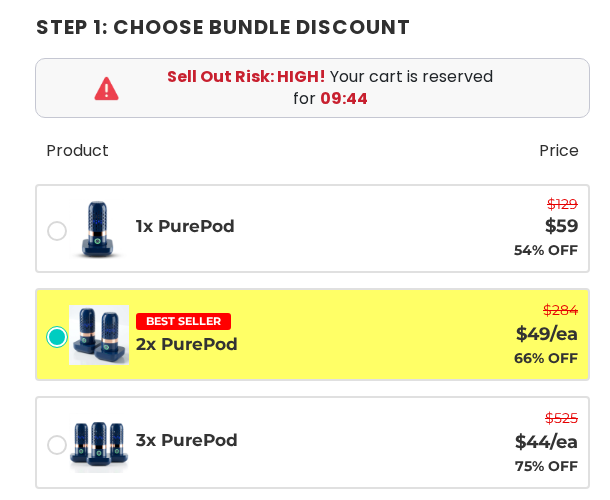
No shipping line appears in the summary at that stage, although the terms list standard shipping at $4.99, so the first total is not necessarily the final one.
Step 3: A warranty with no written terms
Below the card fields sits an unticked box offering a Lifetime Warranty for $9.99, with protection against damage, theft, loss or anything else, plus instant replacement.
We searched the terms for that promise and found none. The terms point the other way: they disclaim all warranties and provide the site on an as is basis.
A paid promise covering theft and loss would normally come with written conditions, and a buyer who ticks this box cannot read any before paying.
The box is unticked by default, which is fair, but the $9.99 buys a promise that the paperwork never defines.
Step 4: A free shipping box that starts a subscription
The next box offers Free Expedited Shipping plus Rewards Club, marked limited time only, and it is also unticked when the page loads.
The words beneath it, in small gray type, enroll you in a subscription: free for 14 days, then $31.71 billed every 28 days.
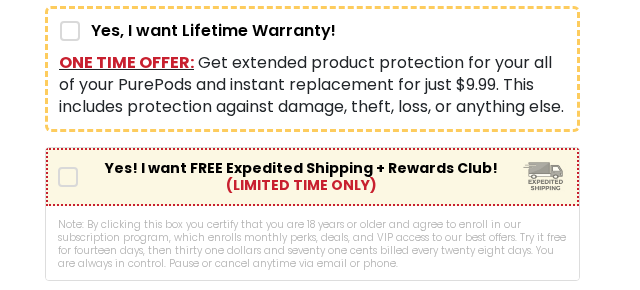
We did the arithmetic. The first charge lands on day 14 and the second on day 42, and by then the club has cost $63.42, more than the $59 device.
Over a full year the same schedule produces 13 charges and $412.23, for a box whose label promised free shipping.
The terms lay out a different plan: $31.73 after 14 days and every 90 days after that, while another section has most subscriptions renewing monthly.
On the 90-day schedule a year would cost $126.92, so the checkout and the terms differ by more than $285 a year for the same membership.
The saving the box advertises is small. The terms list standard shipping at $4.99 and expedited at $9.95, a difference of $4.96, which is what the club trades against.
The checkout code also holds a pre-ticked add-on called Priority Customer Service, flagged as hidden at every screen size, whose label reads Yes, I Priority Customer Service.
We could not see it and could not tell whether it adds a charge, so compare the final total with the summary before you pay.
Step 5: Delivery times that contradict each other
We collected five delivery promises. The home page FAQ has orders shipping within 48 hours and arriving in 2 to 5 business days by USPS.
The returns page promises 7 to 14 business days in the US, and the terms promise 1 to 2 weeks in one place and 12 to 15 days in another.
The terms’ shipping table adds expedited at 10 to 12 days for $9.95 and premium at 7 to 10 days for $12.95.
So even the $12.95 premium tier is slower than the 2 to 5 days the home page offers every order, and the selling page makes the most generous promise.
Step 6: A 90-day refund with strings
The terms open the refund section with a 30-day money-back guarantee and, in the next sentence, tell you how to collect your 90 Day Money-Back Guarantee.
The home page, checkout and returns page all use 90 days, so 90 is the likely figure, yet a buyer is left to guess which number a dispute would use.
The terms require you to call or email first, return the product by trackable mail within 90 days of delivery and wait up to 30 days for the refund.
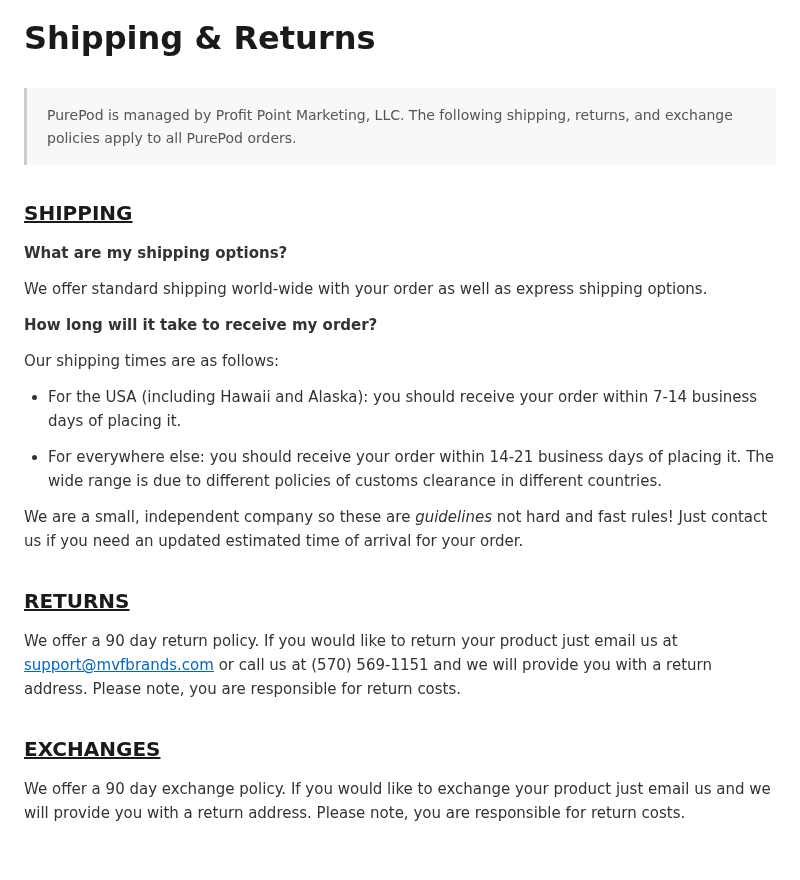
Postage for sending and returning the product is your cost and is not refunded, and incomplete or illegible requests are deemed invalid.
Using the whole window, your money can come back more than four months after the order: 15 days to deliver, 90 to return, 30 to refund.
Who Runs GetPurePod.com?
Three companies on one site
The home page footer names Contagious Content Media, LLC as PurePod’s owner and operator, and nothing else on that page names a company.
The returns, contact and privacy pages instead name Profit Point Marketing, LLC as the manager and operator, with no mention of the first company.
The terms name a third company, Centerview Media LLC, as owner and operator, and add that Profit Point Marketing handles performance marketing.
They also specify that your card statement will read centerview media or mvfbrands, a name that a reader of the footer and policies would not recognize.
A fourth name sits in the checkout code: an image address at the payment software’s host includes a folder called anclote_media_llc, probably the account that built the funnel.
We do not know who that is, and a folder name is not a company filing, so we treat it as a lead and not a finding.
The privacy policy places the store on Shopify, yet we read a Webflow site and a separate checkout funnel, so that wording looks borrowed from a template.
A return address at a mailbox store
The terms print one return address: 3145 Geary Boulevard, 265, San Francisco, CA 94118.
We opened the store listing for that street address, and it is a UPS Store that rents private mailboxes with a street address and a box number.
The 265 therefore most likely marks a mailbox, not a suite, and we could not confirm who holds box 265 because mailbox numbers are not public.
A returned parcel goes to a retail counter, and the 30-day refund clock in the terms starts only when the company receives it, which depends on someone collecting it.
The returns page promises an address after you call or email, so you may be given a different one. Ask for it in writing and compare it with the terms.
The domain and the shop behind it
Registry data shows getpurepod.com was registered on April 3, 2026 through GoDaddy, expires in 2027 and has not changed since; the record does not show the registrant.
The support address on every page belongs to a different domain, mvfbrands.com, registered a year earlier, on April 8, 2025, through the same registrar.
That domain is a Shopify store called MVF Brands, and its public product list holds 41 listings, 36 labeled MVF Brands and 5 labeled Centerview Media.
The shop prints the same support email and phone number as PurePod’s pages, which ties the PurePod pages to that shop’s support desk.
PurePod was created on that shop on April 2, 2026 at 6:48 pm Pacific time, two hours and 48 minutes before the getpurepod.com domain was registered.
The shop works as a catalog of rotating single-product offers, and its launch dates show the rhythm of a seller who keeps switching the headline product.
Between November 18, 2025 and September 10, 2026 it added at least ten differently named products, among them NeuroSpin, FreshCore, CloudWave, YukonPad, SpineHero, Pelvie and Spinvera.
A copied listing gives the pattern away: the FreshCore listing sits at the web address neurospin-wrist-ball-copy, which suggests it was cloned from an earlier product.
PurePod itself has several versions there, including the original at $59, an international copy, upsell listings and a PurePod Ultra at $69 added on July 22, 2026.
The original and the Ultra share one description, so a buyer who finds the Ultra at $69 on the shop is reading the same text as the $59 device.
We found no earlier MalwareTips article on PurePod, MVF Brands or any of these sister products, so this is the first look we have taken at the group.
Shared support details and templates show a common back office, a setup fact and not a finding about who owns it or whether the products come from one factory.
What we could not confirm
We could not find Contagious Content Media, Profit Point Marketing or Centerview Media in any public registry we could open without a bot check, so their status is unverified.
One company-search site stopped us with a CAPTCHA, and we did not try to get around it. A search of the right business registry will answer the question for you.
We did not call the phone number, send an email or place an order, so delivery, support replies, cancellations and refunds are all untested.
We also found no buyer experience we could verify, and we did not locate the checkout funnels of the other products, so we cannot predict how they behave.
What to Do If You Ordered PurePod
-
Check the total. Before paying, confirm how many devices the cart holds and untick any extra you did not choose, because the two-pack is preselected.
-
Leave the club box empty. If you ticked it, expect the first $31.71 charge on day 14 and the next about four weeks later.
-
Save the pages. Capture the checkout, the order summary, the terms and the returns page with the date, because the wording can change after you pay.
-
Read your statement. Look for charges labeled centerview media or mvfbrands, and for amounts of $31.71, $31.73 or $9.99 that you did not expect.
-
Cancel in writing. Email support@mvfbrands.com, the address on every policy page, to end the Rewards Club, and keep the reply and the time you sent it.
-
Start the refund clock. Ask for a return authorization in writing, photograph the device and box, ship by trackable mail within 90 days of delivery and keep the receipt.
-
Dispute if it stalls. A card dispute letter must reach the issuer within 60 days of the first bill containing the error.
-
Tell the FTC. File at ReportFraud.ftc.gov and name the domain, the company names you saw and the promises you relied on.
Frequently Asked Questions
Is GetPurePod.com a scam?
We found no proof of fraud, but a deadline that resets daily, three company names and a hidden subscription cost are reasons enough to skip this offer.
Does PurePod really remove pesticides?
We could not confirm it, because the page publishes no lab result and colored water shows that something dissolved, not that a pesticide came off your food.
Is the sale really ending tonight?
Nothing suggests so, because the banner prints each visitor’s own date and an archived copy from May 13, 2026 contains the same script.
What is the Rewards Club and how do I cancel?
It is a subscription enrolled by the free-shipping box, billed $31.71 every 28 days at checkout and every 90 days in the terms. Cancel by email or phone.
Who owns PurePod and where do I send a return?
The pages name three companies and the terms give a San Francisco mailbox address. Ask support for the return address in writing before you ship anything.
Can I get my money back?
The documents promise 90 days from delivery, though one heading reads 30. You pay postage both ways, and the refund can take 30 days after the parcel arrives.
The Bottom Line
Do not order PurePod through this funnel: its deadline resets for every visitor, its crossed-out prices disagree with its own shop and its owner is named three different ways.
If you want cleaner produce, rinse it under running water, which is the FDA’s advice, and treat any gadget’s colored water as unproven until someone publishes a residue test.
If you already ordered, check your statement, cancel the Rewards Club in writing, ask for the return address and dispute the charge within 60 days if the refund stalls.

Reviews & discussion
0 commentsShare a firsthand experience, or ask a question.
Community reviews
getpurepod.com
Moderated reader experiences, not an editorial verdict.
Start the conversation
Have a question or something useful to share? Add the first comment.