


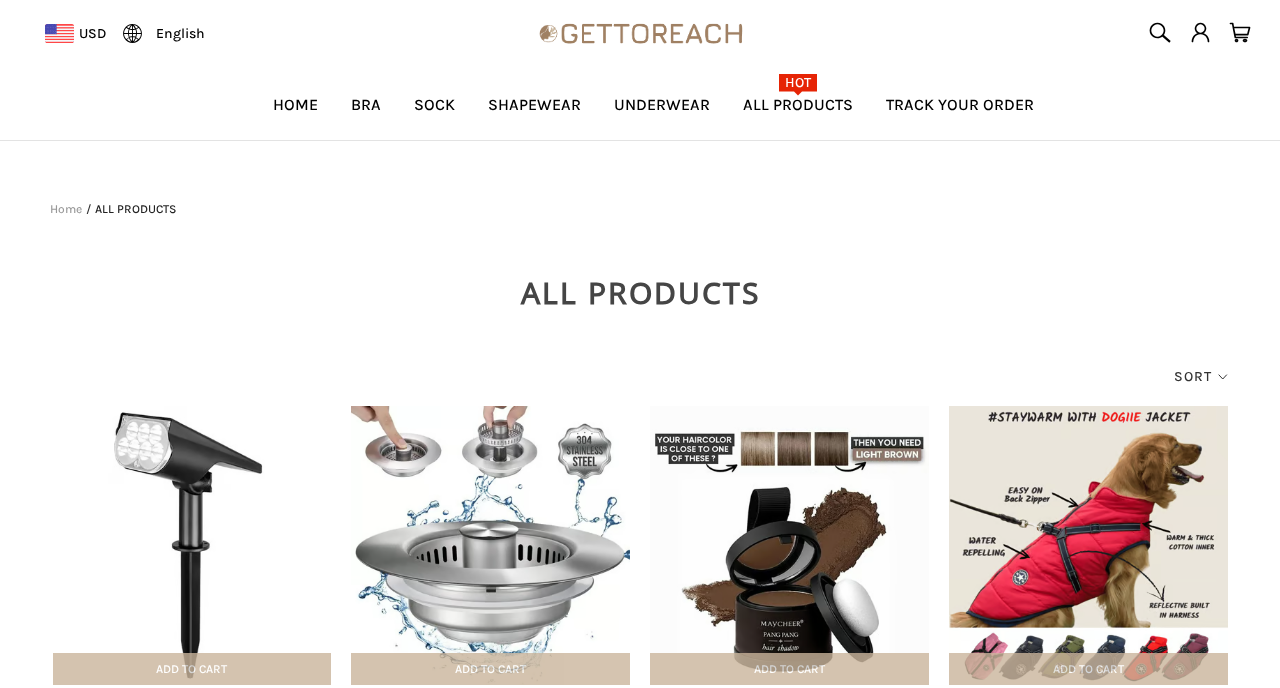
Gettoreach.com opens like a lingerie boutique, with menus for bras, socks, shapewear and underwear. Its “All Products” page is a bargain bin of sink strainers, solar lights and dog jackets.
If you saw a Gettoreach ad or are waiting on an order, here is what the store’s own pages, its ads and its delivery promises show before you spend more.
Overview
What Gettoreach Sells
The homepage pitches “Wear Comfort” underwear and shapewear. The full catalog runs to 124 pages and mixes kitchen gadgets, pet clothing, jewelry, planners, garden lights and beauty products.
Most listings show a sale price beside a crossed-out price roughly twice as high. Many titles carry “Last Day” or “Buy More Save More” labels.
Where Gettoreach Stands Now
gettoreach.com is online and taking orders. The domain was registered on April 28, 2025, through Alibaba Cloud’s HiChina, and runs behind Cloudflare.
The Internet Archive holds only a single redirect from July 2025, so there is no archived history of the store’s earlier catalog or policies.
Is Gettoreach Legit?
Gettoreach is a working shop, but it is an anonymous one. We would not order from it until it names the business behind it.
- No company name, street address or phone number appears on any page.
- Its shipping page quotes up to 37 business days, then limits that estimate to a list without the US mainland.
- Ads run from at least five near-identical Facebook Pages carrying the Gettoreach name.
- Some product photos show other brands’ packaging.
- Its Trustpilot profile has no reviews at all.
Gettoreach Reviews: Trustpilot and Buyer Complaints
Gettoreach reviews are hard to find. The store’s Trustpilot profile exists but holds zero reviews, so there is no buyer history to weigh either way.
One buyer complaint is public. In July 2025 a shopper on the ScamWatcher forum said Gettoreach charged them, never delivered and refused a refund after more than a month.
According to that report, support kept asking whether they had checked the property or with neighbors. That reply shifts the search onto the buyer instead of the carrier.
Search results for the name are dominated by automated site-rating pages, which judge a domain by technical signals rather than buyer experience.
One complaint and an empty review page are not proof of fraud. They do mean that every promise on the site, from delivery to refunds, rests on the seller’s word.
How Gettoreach Sells Its Products
Step 1: Ads From a Family of Pages
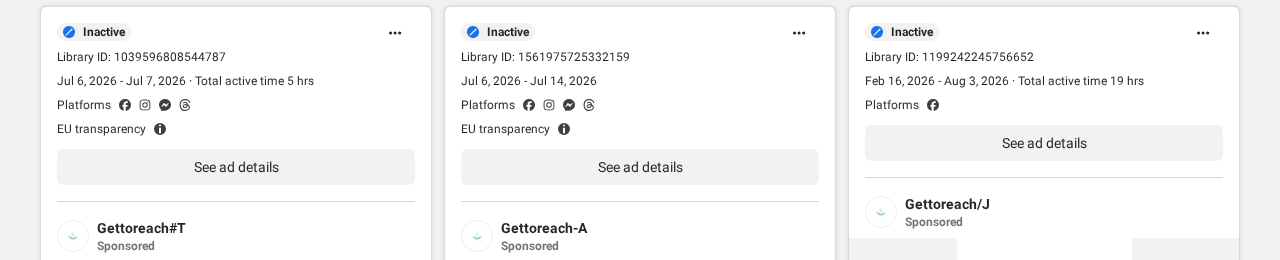
Meta’s Ad Library returns about 4,300 results for the keyword Gettoreach. The ads run from Pages named Gettoreach.W, Gettoreach+F, Gettoreach#T, Gettoreach-A and Gettoreach/J.
Recent ads promote a nativity mosaic art kit, an “eagle beak” nail clipper set, a repair clay and a portable water sprayer. All link to www.gettoreach.com.
The copy leans on big claims. The repair clay supposedly bonds instantly to metal, plastic and wood and stays waterproof and heat-resistant, with no test or brand named.
Many of these ads ran for only a few hours or days. Spreading short campaigns across several Pages can keep a shop advertising even if one Page is reported.
Step 2: A Lingerie Shop Front With Everything Behind It
The store’s navigation and banner sell underwear, but the products in the ads sit in an “All Products” list of more than a hundred pages.
A shop that cannot settle on what it sells often lists whatever its suppliers offer that week, rather than stock it holds and knows.
Step 3: Borrowed Product Photos
One listing is titled “Waverlo Magic Root Cover Up”, but its main photo shows a compact branded Maycheer. A dog jacket listing uses an image captioned “Dogiie Jacket”.
Mismatched branding suggests the photos were copied from other sellers. What arrives may differ from the pictured item, and the brand named in the title may not exist.
Step 4: A Long Wait
The shipping page says most orders are prepared within 48 hours, or 3 to 7 days for some places.
Transit then takes 14 to 30 business days, which the page adds up to a total of 17 to 37 business days.
It then applies those estimates to a list of 99 countries and territories. That list leaves out the US mainland, the UK, Canada and Australia.
Shoppers in those countries therefore get no clear delivery timeline at all, only a promise to “look into it” if a parcel is late.
The list is careless too. It includes “Valis and Fujia Islands (French)”, a garbled Wallis and Futuna. Up to seven weeks of waiting can also eat into card dispute windows.
Step 5: Returns on Narrow Terms
Changing your mind is possible only before the order ships or is “produced”. After delivery, returns must start within 14 days, through an email request for a return address.
The shipping page words cancellation differently. It allows cancelling before the “delivery phase” and within a “cancellation window shown on our website”, but no page states that window’s length.
Gettoreach Timeline
April 28, 2025: gettoreach.com is registered through HiChina. The Internet Archive’s only capture, a redirect, follows on July 11, 2025.
July 23, 2025: a shopper reports on ScamWatcher that a paid order never arrived and that a refund was refused. MalwareTips first reported on the store a week later.
February to October 2026: Meta’s library shows ads from several Gettoreach-named Pages, many marked with EU transparency labels, so the campaigns also reached European feeds.
October 2026: the store remains online, with its lingerie front and a catalog of more than a hundred pages.
Why Gettoreach Looks Convincing
The boutique design is calm and clean, with soft colours and a short brand story about “a feeling of belonging”.
It looks more like a small independent label than a clearance site, which lowers the guard of shoppers who would avoid an obvious discount warehouse.
The currency menu lists 22 currencies and the language menu 12 languages. That makes the shop feel local almost anywhere, although no local address backs it up.
Sentimental products help too. Necklaces for mothers and friends, faith-themed craft kits and pet jackets invite gift purchases, where buyers check the seller less carefully.
The return page adds reassuring lines, such as never charging a restocking fee. Those promises still depend on a business that publishes no name or address.
Who Runs Gettoreach? Missing Company Details
No Company, Address or Phone
The About, Contact, FAQ, shipping, return and terms pages name no company, registration number, street address or telephone number.
The only contact is support@gettoreach.com. The About page is a short text about “a feeling of belonging” with no names, dates or location.
Terms Copied From a UK Template
The terms of service refer to the seller only as “GETTOREACH”. One clause bans breaking “UK’s regulations”, although the shop quotes prices in USD by default.
The same terms ask customers to keep their credit card numbers and expiration dates up to date. That is standard store-template wording, not text written for this shop.
Five Ad Pages, One Name
The ads run from several Pages that differ only by a symbol or letter after “Gettoreach”. One, Gettoreach/J, shows 560 Page likes.
Nothing on these Pages identifies a business owner either. The store and its ads share a name, not an accountable company.
The store’s page code also loads tracking tags from several advertising networks besides Facebook. Each visit shares browsing data with those ad networks as well.
Is Getdrachen Linked to Gettoreach?
People searching for a Getdrachen scam often land here, but the evidence points to two separate sites. getdrachen.com sold Drachen, a male-enhancement supplement, in archive copies from 2022 and 2023.
That site used affiliate tracking links and a single-product sales page, with bottles priced from 69 USD down to 49 USD each in bigger bundles.
We found no shared template, email address, company or store platform with Gettoreach. Its product, a supplement, has nothing in common with Gettoreach’s catalog either.
getdrachen.com has since lapsed and was registered again on December 31, 2024, through DropCatch. It now redirects to a parking-style address. The two names simply look alike.
Gettoreach Return Policy: What It Allows
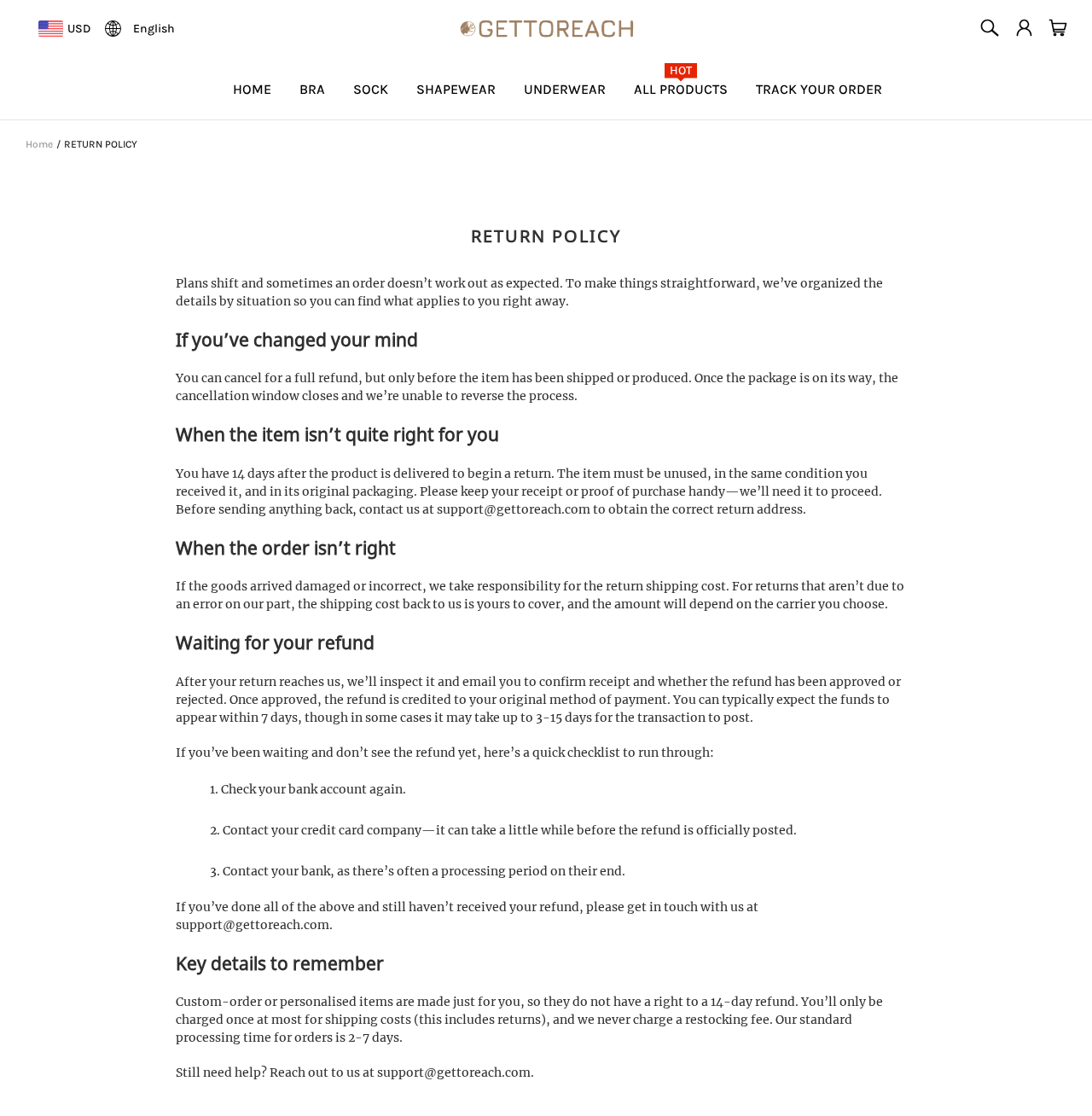
Returns must be unused, in the original packaging and backed by a receipt or proof of purchase. You must email support@gettoreach.com first to get the return address.
If goods arrive damaged or wrong, Gettoreach says it pays the return shipping. For any other return, the postage is yours, and the cost depends on the carrier you choose.
The FAQ gives 30 days from delivery to report a faulty or wrong item, with the order number, product code, a clear photo and a short description.
Refunds follow an inspection. The policy says money usually appears within 7 days but may take 3 to 15 days to post. It promises no restocking fee.
Custom or personalised items have no right to a 14-day refund. The policy does not explain which catalog items count as “produced” or custom.
What to Do If You Ordered From Gettoreach
- Save your order details. Keep the confirmation email, the product page, the ad you clicked and the tracking number.
- Track the parcel. If tracking stops moving, or the parcel has not arrived after the longest stated window, email support@gettoreach.com and keep the reply.
- Photograph what arrives. If it differs from the listing, take clear photos and report it within 30 days, as the FAQ requires.
- Use the tracking link you were sent. The FAQ says there is no separate customer portal, so keep the shipping email that carries your tracking link.
- Get the return address in writing. Do not post anything back until support sends one, and use tracked shipping.
- Raise a payment dispute if needed. If nothing arrives or support stops replying, ask your card issuer or PayPal about a not-received or not-as-described claim. Their rules and deadlines apply.
- Check the charge amount. The shop can display 22 currencies, so compare your statement with the checkout total and ask your bank about any foreign transaction fee.
- Report the ad. Use the menu on the Facebook ad to report it, so other shoppers see fewer copies.
Related Store Investigations
Our Blinky Bot review shows how dropshipped gadgets are sold with bold claims and slow refunds.
The Susan & Margaret London investigation covers a boutique story wrapped around dropshipped stock and difficult returns.
For a policy that also hides its return address until you email, read our VChics review. These are separate merchants, not one network.
How to Spot Fake Gadget Stores
Start by checking who sells the product, how long delivery takes and how a return works. Gettoreach answers the last two only vaguely, and the first not at all.
Fraudulent shopping websites often share common patterns that make them easier to detect once you know what to look for. Before entering personal information or making a payment, take a few minutes to check for these warning signs:
- Unrealistic prices and discounts
If a website offers products at prices far below trusted retailers, it’s often a red flag. Many of these sites advertise luxury or high-demand products at massive discounts to create a sense of urgency. A $300 product listed for $49.99 should immediately raise suspicion. - Recently registered or suspicious domain names
Many fraudulent websites operate on newly created domains that disappear after a few weeks. Look for signs like random characters in the URL, misspellings of well-known brands, or hyphenated domains.
You can check a site’s age with a WHOIS lookup, or run it through our free Scam URL Scanner. - Missing or vague company details
Legitimate businesses clearly display their company name, tax information, phone numbers, physical address, and return policies. Fraudulent sites often provide incomplete, fake, or no company details at all. A lack of verifiable contact information is a major warning sign. - No reliable customer service
Real businesses provide clear ways to contact support—email, phone, live chat, or physical return addresses. Fake stores often list nonfunctional contact forms, invalid phone numbers, or reply with generic automated messages. - Poor website quality and structure
Many fake stores are set up quickly with low-effort templates. Look for poor grammar, spelling errors, low-resolution product images, broken links, or missing legal pages (Terms of Service, Privacy Policy, Return Policy). A sloppy website often signals something isn’t right. - Copied product descriptions and images
Fraudulent sites often lift product listings directly from real retailers or marketplaces. If you reverse image search a product photo and find it on multiple unrelated websites, the listing is likely not original. - Lack of credible reviews or suspicious review patterns
A real store will usually have a mix of customer reviews across different platforms. Warning signs include no reviews at all, obviously fake five-star reviews, or multiple identical reviews posted on the same day. Searching “[website name] reviews” or “[website name] scam” on Google often reveals warnings from other consumers. - Unclear or unfair return and refund policies
Fake stores often use vague language around returns and refunds—or avoid the topic entirely. If you can’t easily find clear instructions for how to return an item or get a refund, proceed with caution. - Aggressive urgency and pressure tactics
Fraudulent websites commonly use fake scarcity (e.g., “Only 2 left in stock!”) or countdown timers (“Sale ends in 10 minutes!”) to push you to buy before you think it through. Legitimate stores don’t rely on fabricated urgency to make sales.
Quick Steps to Verify a Website’s Legitimacy
Before entering payment or personal details on a new shopping website, take a few simple precautions:
- Search for the store’s name along with words like “reviews” or “complaints” on Google and Trustpilot.
- Check the website’s domain registration using Whois.com.
- Use trusted tools to scan for malicious or fraudulent links:
- Malwarebytes ScamGuard – detect scams and unsafe links before they reach you on Android and iOS phone.
- Malwarebytes Browser Guard – block dangerous or fake websites on Windows and macOS browsers.
- Verify the business address on Google Maps to ensure it’s a legitimate location.
- Review the store’s accepted payment methods – credit cards and PayPal are traceable and safer than cryptocurrency or bank transfers.
- Trust your instincts; if something feels off, it’s better not to proceed.
How to Spot Similar Scams on Social Media
Many fraudulent shopping websites rely heavily on sponsored social media ads to draw in large numbers of potential buyers. These ads often promise extraordinary discounts—sometimes up to 90% off—and use emotionally charged language to push users into buying immediately.
They frequently appear on Facebook, Instagram, and TikTok, blending in with legitimate content. However, these ads follow predictable patterns that make them easier to identify once you know what to look for.
Spotting Fraudulent Facebook Ads
Facebook’s advertising platform is a favorite tool for fake online stores because of its massive reach. These ads often feature “unbelievable” offers designed to create urgency and bypass critical thinking. Warning signs include:
- Extreme, unrealistic discounts such as “90% OFF,” “Store Closing Sale,” or “Final Liquidation.” Real retailers rarely discount new products this aggressively.
- Poor grammar, awkward phrasing, or inconsistent language throughout the ad or website, indicating low-effort, mass-produced content.
- Generic stock photos or images with watermarks, suggesting the images were taken from legitimate brands or stolen from other sources.
- Recently created Facebook Pages, which is common for temporary fraudulent campaigns. Check the “Page Transparency” section to see when the page was created.
- Limited or no engagement from real customers. Authentic brands usually have reviews, comments, and visible user interaction.
If an ad raises doubts, search for reviews of the website or reverse image search the product photos to see if they’re copied from elsewhere. Never provide payment information until the site is verified.
Spotting Fraudulent Instagram Ads
Instagram is another major platform used to promote fake shopping sites through eye-catching visuals and short-lived “flash sale” captions. Warning signs to look for:
- New or disposable accounts with few posts and followers, often created just weeks or days before launching ads.
- Lack of tagged users in product posts. Legitimate stores often feature real customers, influencers, or product usage.
- Unsecured checkout pages. If the website linked in the bio does not use HTTPS, do not enter payment information.
- Fake or missing customer reviews. Fraudulent stores rarely have authentic purchase feedback.
- Unclear or restrictive return policies, often hidden or written vaguely to make refunds difficult.
When in doubt, search for independent reviews before buying, and only enter payment details on verified, secure websites.
Catching Fake TikTok Ads
TikTok is increasingly used to promote questionable shopping deals through short, persuasive videos. While many ads look polished, the same red flags apply:
- Links to unknown stores that don’t appear in search results or have no external reputation. Many of these sites are temporary and disappear after a short time.
- No verification badge on the TikTok account. While not every legitimate store is verified, the lack of a badge is one more indicator to check further.
- Aggressive countdown timers or “one-day only” promotions designed to rush decision-making.
- Lack of genuine customer reviews or real user content demonstrating the product in actual use.
- Comment sections filled with complaints or warnings from other users. This is often the first place victims speak up.
TikTok scams often rely on impulse buying. Take a moment to verify the website, read independent reviews, and use trusted browser protection before visiting external links.
Payment and Account Checks After a Gettoreach Order
Check your statement for any charge you do not recognize after shopping at Gettoreach, whatever merchant name it shows. Report an unrecognized charge to your card issuer straight away.
Ask the issuer whether that specific charge calls for blocking or replacing the card. A replacement card is not a refund and is only needed when the card was misused.
If you created a Gettoreach account with a password you use elsewhere, change it on those other accounts and turn on two-factor sign-in.
Sharing your email address with the shop does not mean another account was accessed. Act on real signs, such as unfamiliar sign-ins or changed account details.
Ignore anyone offering to recover your money for a fee or asking for remote access, bank codes or card details. Check any refund inside your own payment account.
US shoppers can report misleading online selling to the FTC at ReportFraud.ftc.gov. Elsewhere, use your national consumer authority. A report does not replace your payment claim.
Frequently Asked Questions
Is Gettoreach legit?
Gettoreach is a functioning online store, but it hides who runs it and has no independent buyer reviews. With vague, slow delivery promises, we advise against ordering.
Are there any Gettoreach reviews?
Its Trustpilot profile has no reviews. The only public buyer complaint we found describes a paid order that never arrived and a refund refused after a month.
Is Getdrachen the same as Gettoreach?
No. getdrachen.com was a Drachen supplement sales site, then lapsed and became a parked domain. We found no shared template, email or company with Gettoreach.
Why does Gettoreach sell lingerie and gadgets?
The menus focus on underwear, while the ads and catalog push household gadgets, pet gear and gifts. That fits a shop listing supplier products rather than its own range.
How long does Gettoreach take to deliver?
Its shipping page quotes 17 to 37 business days, but applies that estimate only to a list of 99 places that omits the US mainland, the UK, Canada and Australia.
How do I return an item to Gettoreach?
Email support@gettoreach.com within 14 days of delivery for a return address. Unless the item was damaged or wrong, you pay the return postage.
The Bottom Line
Gettoreach is open for business, but nobody stands behind it by name. A lingerie front, a sprawling gadget catalog and rotating ad Pages describe a shop built for quick sales.
If you already ordered, keep every record and check your payment provider’s dispute deadline now. If the parcel never comes, file before it passes. Getdrachen is a separate, parked domain.
We advise against ordering from Gettoreach. Look instead for the same gadget at a retailer that names its company, publishes a street address and states clear, realistic delivery times.
This article is for informational purposes only and should not be relied upon for financial or business decisions. We identify potential scams using research, user experiences, and expert analysis. However, all claims should be independently verified. Mistakes may occur, and legitimate products could be flagged. We strive for accuracy but make no warranties regarding the completeness or reliability of the information.

If you are the owner of the website or product in question and wish to offer clarifications regarding your business or website, please reach out to us via our Contact form.

Join the discussion
0 commentsShare your experience or ask a question about this article.
Discussion
Start the conversation
Have a question or something useful to share? Add the first comment.