

A shipment can cross several borders for perfectly ordinary reasons. Problems begin when the paperwork tells a cleaner story than the cargo’s real journey.
Importers may discover the discrepancy only after payment, arrival, or a customs inquiry. By then, a routing shortcut can look very different from the deal that was originally offered.
Overview
Transshipment itself is a normal part of global trade
Transshipment means cargo is transferred from one vessel, aircraft, truck, or rail service to another during its route. Ports and logistics hubs handle lawful transshipment every day because direct service between every origin and destination is impossible.
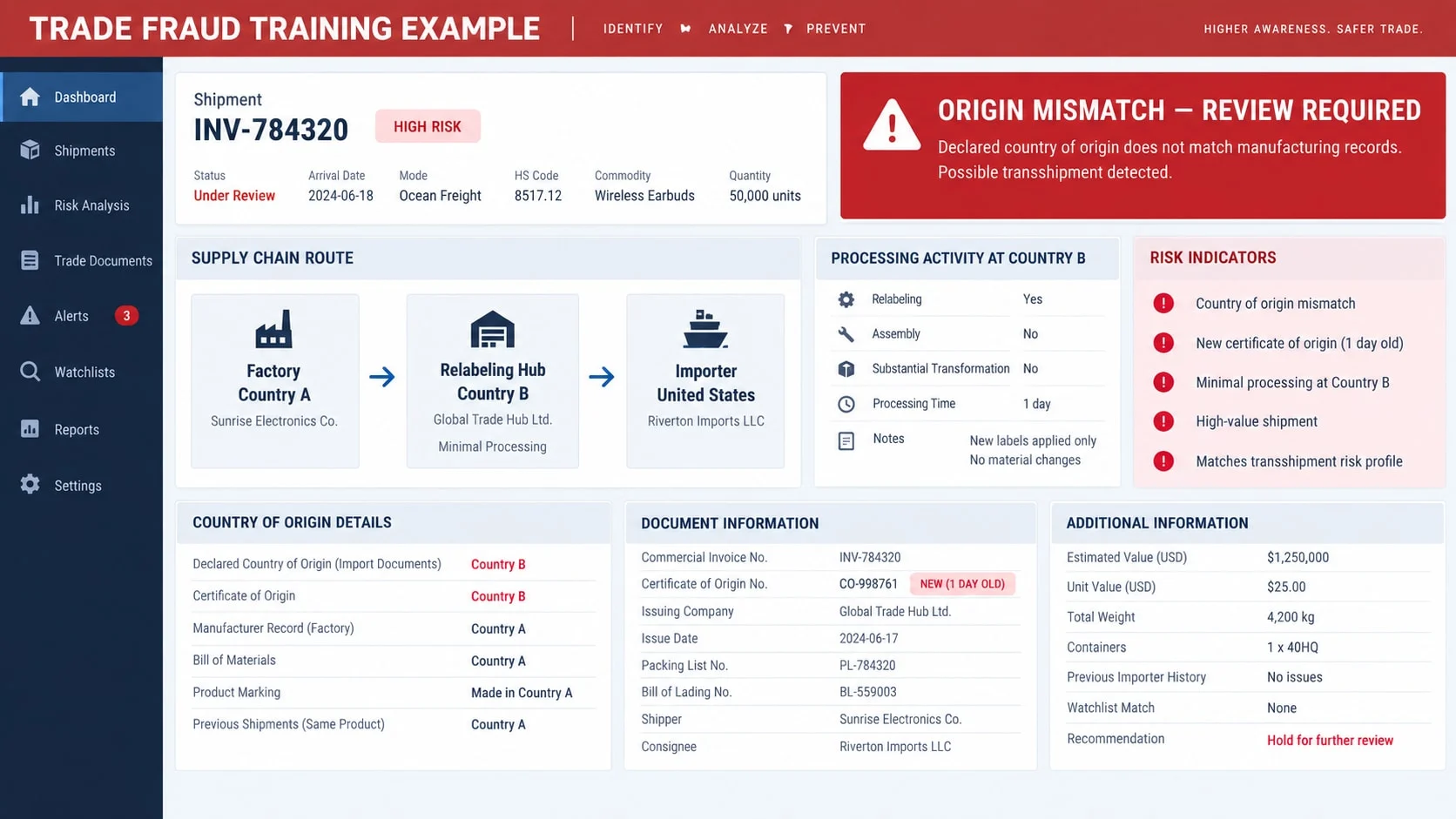
The fraud begins when a route, document, label, or minor operation is used to conceal the true country of origin, producer, value, classification, or trade restriction affecting the goods.
The false origin can change what the importer owes
Duties, quotas, trade remedies, sanctions, product rules, and preferential rates can depend on origin. A supplier may route goods through a third country and claim they were made there even though no substantial transformation occurred.
U.S. officials have described this kind of duty evasion as a major transshipment problem. The important distinction is not whether a container stopped somewhere else, but whether the declared origin accurately reflects the production facts and applicable law.
The importer can face consequences even when a supplier lied
A foreign seller may promise that its paperwork is sufficient or that everyone uses the same route. U.S. importers still have responsibilities for the accuracy of entries made in their name.
Consequences can include:
- Unpaid duties, interest, and monetary penalties.
- Detention, exclusion, seizure, or forfeiture of goods.
- Loss of preferential tariff treatment.
- Supply-chain disruption and missed customer commitments.
- False Claims Act or criminal exposure in serious cases.
- Termination by banks, insurers, marketplaces, or major buyers.
- Reputational damage and costly reviews of earlier entries.
What the Great Transshipment Scam Means
The phrase refers to schemes that disguise a product’s true origin or trade status by moving it through an intermediary country, relabeling it, or creating documents that present the intermediary as the producer.
The label gained public attention in 2026 when the White House used “Great Transshipment Scam” to describe efforts to evade U.S. tariffs through false routing and origin claims. It is a policy phrase, not a separate offense with one universal checklist.
Each case depends on the merchandise, production steps, governing trade rule, entry documents, and what the parties knew. A stop at a foreign port can be lawful, while a certificate hiding the real factory can be fraudulent.
Simple relabeling
Finished goods are shipped to an intermediary location where cartons, labels, or certificates are changed. The products then move onward under a new claimed origin even though their essential manufacturing occurred elsewhere.
A warehouse receipt or local exporter name does not transform a product. Customs authorities look at actual production, not only the last place the goods were stored.
Minimal processing presented as manufacturing
A supplier may claim that repacking, cleaning, testing, sorting, or a minor assembly step creates a new country of origin. Whether processing is sufficient depends on the applicable rule, but a cosmetic operation cannot automatically erase the original source.
Marketing language such as “finished in” or “exported from” can sound persuasive while avoiding the more important question: where was the product actually made?
False certificates and invoices
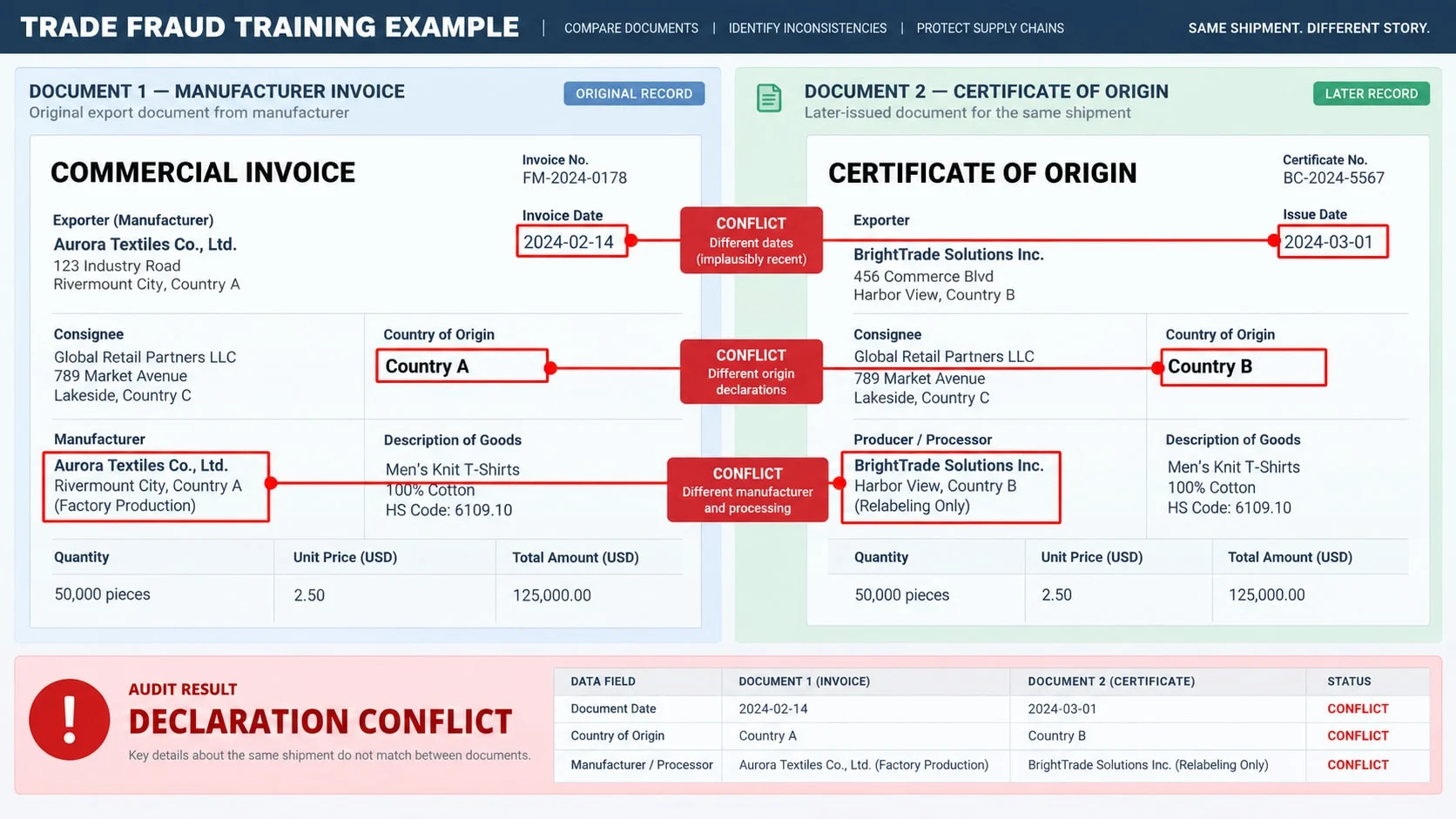
The scheme can involve inaccurate certificates of origin, commercial invoices, packing lists, bills of lading, factory declarations, and supplier affidavits. Different documents may use slightly different company names or addresses.
Documents can appear professionally formatted and still be false. Verification means tracing them to the issuer and comparing them with production and routing evidence.
Split billing and hidden reimbursements
Some transactions separate the visible invoice from side payments or credits, creating an inaccurate entered value. Others use an intermediary to obscure who receives the funds or owns the goods.
Origin fraud and valuation fraud can appear together. A low declared value does not solve an origin problem, and a plausible value does not authenticate the country claim.
How the Great Transshipment Scam Works
Step 1: A supplier identifies a tariff or trade barrier
The goods may face an additional duty, antidumping or countervailing order, quota, sanction, forced-labor restriction, or other trade measure. The supplier recognizes that changing the declared origin could lower cost or allow entry.
An importer may be approached with a quote that is unusually competitive compared with producers in the stated country. The difference is explained as better logistics, a special factory relationship, or confidential routing.
Step 2: An intermediary company is inserted
A trading company, warehouse, or lightly equipped facility in a third country becomes the exporter of record. It may have been formed recently or share directors, email infrastructure, banking contacts, and documents with the original producer.
The intermediary creates distance between the factory and the importer. Communications may be routed through sales agents who refuse to identify the actual manufacturing site.
Step 3: Cargo is rerouted or only the paperwork changes
In one version, goods physically enter the third country, remain briefly, and leave with new labels. In another, routing data or documents are altered even though the cargo does not undergo the claimed journey.
Transloading, consolidation, and repacking can be legitimate services. The warning appears when those activities are described as production without supporting machinery, labor, materials, time, or records.
Step 4: A new origin narrative is documented
The intermediary issues an invoice and certificate stating that the merchandise originates in its country. Factory photographs, audit reports, or bills of materials may be borrowed from another business or fabricated.
Dates can reveal the problem. A large production run may supposedly begin and finish within a period that barely covers the cargo’s arrival and departure from the intermediary port.
Step 5: The U.S. entry relies on the false declaration
The importer or customs broker files entry data using documents supplied by the seller. The declared origin results in a lower duty or avoids a trade restriction.
A broker transmits information but does not replace the importer’s duty to exercise reasonable care. Instructions that omit the real producer or route can place both the shipment and business at risk.
Step 6: The scheme is concealed through explanations and pressure
If questions arise, the supplier describes origin rules as a technicality, says competitors use the same process, or offers a new certificate without addressing the production evidence. It may urge the importer to clear cargo before storage costs rise.
Some operators rotate exporters, factories, tariff codes, or ports after scrutiny. Changing names does not fix the underlying facts and can make the pattern more suspicious.
Step 7: Customs or a competitor exposes the discrepancy
A shipment may be flagged through routing data, intelligence, document inconsistencies, inspections, or an allegation under U.S. enforcement processes. Authorities can request detailed production and accounting records.
The importer then has to explain decisions made months or years earlier. Missing due-diligence records can be nearly as damaging operationally as the supplier’s disappearance.
Identity, Contact, and Payment Checks
Verify the producer, not only the exporter
Obtain the legal name, registration, address, ownership, and capabilities of the actual manufacturer. Confirm that the site exists and has the equipment, workforce, materials, and capacity needed for the stated volume.
A video call, independent audit, or site visit can help, but each must be tied to the exact legal entity and product. A tour of a nearby factory does not prove that facility produced the shipment.
Trace communication and document origins
Compare email domains, phone numbers, document metadata, signatures, seals, and contact names across the producer, exporter, freight forwarder, and certificate issuer. Unexpected overlap may indicate that one group controls the entire narrative.
Contact issuing bodies through independently located details. Do not use only the number printed on a certificate whose authenticity is in question.
Reconcile payments with the commercial story
The beneficiary name and country should make sense for the seller shown on the contract and invoice. Payments to unrelated companies, personal accounts, or a jurisdiction absent from the route require a written explanation and enhanced review.
Watch for side invoices, rebates, service charges, or credits that change the real transaction value. Keep bank records and correspondence with the entry file.
Test the origin claim under the correct rule
Origin rules differ by product and legal purpose. Ask qualified customs counsel or a knowledgeable trade professional to evaluate the tariff classification, manufacturing steps, materials, and applicable rule before relying on a preference or avoiding a trade remedy.
A supplier warranty is useful but not conclusive. The facts must support the declaration, and the importer should be able to show how those facts were checked.
Red Flags in a Transshipment Proposal
- The seller offers to change origin for a small routing fee.
- The stated factory cannot be visited or identified.
- The intermediary country has little known production capacity for the goods.
- Certificates are issued before materials reach the claimed factory.
- Production dates conflict with vessel and port records.
- Cartons show removed labels, double markings, or inconsistent language.
- The invoice, packing list, and bill of lading name different entities.
- Payment goes to a company outside the contract and shipping route.
- The supplier calls the arrangement confidential or “customs optimized.”
- No bills of materials, time sheets, utility records, or production logs exist.
- The exporter repeatedly changes names after enforcement actions.
- The price advantage is close to the duty supposedly avoided.
No single clue proves fraud. A cluster of unexplained inconsistencies should stop the entry until the origin claim is supported.
Documents Importers Should Reconcile
Due diligence should connect the commercial, production, transport, and payment stories. Files should be reviewed together rather than accepted as isolated PDFs.
- Purchase orders, contracts, and commercial invoices.
- Packing lists and carton or product labels.
- Bills of lading, booking records, and container movements.
- Certificates of origin and issuer verification.
- Bills of materials and raw-material purchase records.
- Production logs, payroll, equipment, and utility evidence.
- Factory audit reports and site photographs.
- Payment instructions, bank records, credits, and commissions.
- Broker instructions and entry summaries.
- Prior rulings, scope decisions, or legal analyses relied upon.
Record why inconsistencies were resolved and who approved the decision. A clear file helps the company respond quickly if Customs and Border Protection asks questions later.
Lawful Routing Versus False Origin
A shipment can lawfully pass through Singapore, Mexico, Vietnam, or another hub without becoming a product of that country. Conversely, meaningful manufacturing can sometimes establish origin even when materials came from elsewhere.
The analysis is fact-specific. Storage, repacking, relabeling, or minor finishing commonly will not support the same conclusion as a substantial manufacturing process, but the governing legal test must be applied to the product.
Companies should avoid simple slogans such as “last country wins” or “any assembly changes origin.” If a route was designed principally around avoiding a duty, obtain advice before the first shipment.
What to Do if You Have Fallen Victim to This Scam
- Pause affected entries and payments. Stop new orders, final payments, and use of questionable origin documents until counsel and compliance staff assess the facts. Do not alter or destroy records.
- Preserve the complete transaction file. Save emails, chats, contracts, labels, photographs, payment records, container data, broker instructions, and all versions of certificates. Preserve metadata where possible.
- Notify customs counsel and the compliance lead. Privileged legal advice can help determine the origin rule, exposure, disclosure options, and communications with authorities. A supplier’s informal reassurance is not a substitute.
- Tell the customs broker the entry is under review. Provide corrected facts through an organized channel and ask which entries relied on the disputed documents. Do not ask the broker to repeat an unsupported declaration.
- Map every affected shipment. Identify product, classification, origin, producer, exporter, entry number, value, duty, customer, and current location. Include historic entries using the same supply chain.
- Independently verify production. Commission a qualified audit, contact certificate issuers directly, and reconcile manufacturing capacity with volumes and dates. Avoid auditors selected and controlled solely by the questioned supplier.
- Assess reporting and correction duties. Counsel can advise on post-entry corrections, prior disclosure, protests, enforcement inquiries, and relevant U.S. Customs and Border Protection channels. Timing can materially affect the response.
- Protect business systems. If the supplier sent unusual archives, invoices, or logistics software, isolate them and run a full Malwarebytes scan. Trade fraud investigations can overlap with mailbox compromise and payment diversion.
- Block malicious links without losing evidence. AdGuard can reduce exposure to known phishing domains used in supplier impersonation, but keep copies of relevant messages and rely on verified business channels for future contact.
- Notify financial and insurance partners when appropriate. Ask banks whether pending transfers can be stopped and review trade-credit, cargo, cyber, and crime policies for notice requirements.
- Fix the control gap. Add producer verification, origin review, payment-beneficiary checks, and escalation triggers before onboarding another supplier. Train purchasing teams not to treat tariff avoidance as a sales feature.
Frequently Asked Questions
Is every transshipment route illegal?
No. Transshipment is a routine logistics practice. The legal issue arises when routing or documentation falsely represents origin, value, classification, producer, or compliance status.
Does repacking goods change their country of origin?
Ordinary repacking generally does not by itself establish a new origin. The correct result depends on the product, processing, and governing rule, so obtain a product-specific analysis.
Can an importer rely on a certificate of origin?
A certificate is evidence, not an automatic shield. The importer should verify the issuer and ensure production records, routing, capacity, and commercial facts support it.
What if a customs broker filed the entry?
The broker’s involvement does not eliminate the importer’s responsibilities. Importers should provide accurate instructions, review entries, and escalate unsupported claims.
How can a company report suspected evasion?
U.S. Customs and Border Protection publishes a trade-violation reporting channel, and U.S. law provides mechanisms such as the Enforce and Protect Act process. Legal advice can help select the correct route and preserve evidence.
Should a company contact the supplier first?
Preserve evidence and obtain legal guidance before alerting a suspected operator. An immediate confrontation can lead to deleted records, changed stories, or pressure to clear another shipment.
The Bottom Line
The Great Transshipment Scam is not ordinary cargo transfer. It is the use of false origin stories, intermediary entities, labels, or documents to evade duties and trade rules while leaving importers exposed.
Verify the real producer, manufacturing steps, route, certificate, payment beneficiary, and applicable origin rule before entry. In international trade, a lower quote is never worth more than a supply chain the importer can explain and document.

Join the discussion
0 commentsShare your experience or ask a question about this article.
Discussion
Start the conversation
Have a question or something useful to share? Add the first comment.