

In recent weeks, many users have started receiving notifications and emails claiming that they may be eligible for a payout from the Gregory v. Tubi, Inc. class action settlement. Naturally, this has raised questions: Is this settlement legitimate or just another online scam? Here’s everything you need to know — including who qualifies, how payments are being sent, and how to protect yourself from fake messages.
What Is the Gregory v. Tubi, Inc. Settlement?
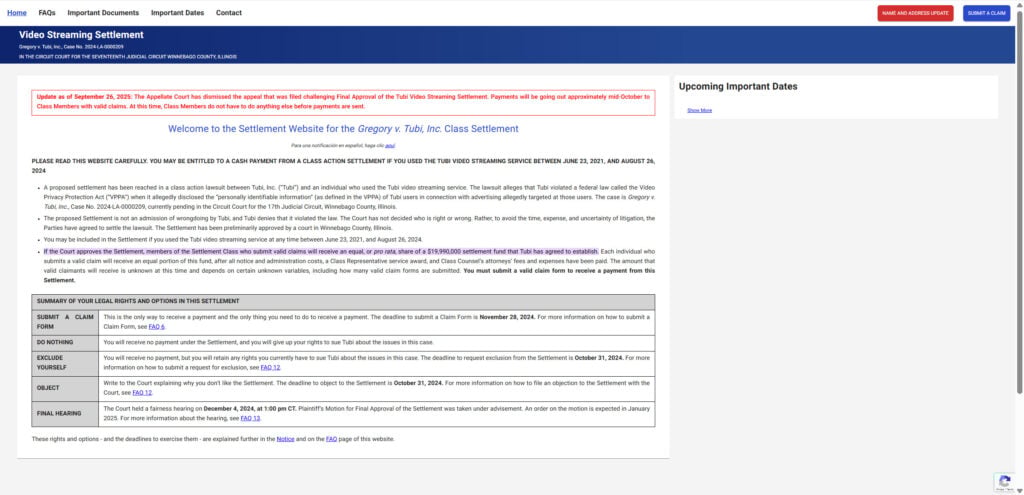
The Gregory v. Tubi, Inc. case (Case No. 2024-LA-0000209) is a class action lawsuit filed in the Circuit Court for the 17th Judicial Circuit, Winnebago County, Illinois.
The lawsuit claims that Tubi Inc., a popular ad-supported streaming platform, violated the Video Privacy Protection Act (VPPA) by allegedly sharing users’ personally identifiable information in connection with targeted advertising without proper consent.
Although Tubi denied any wrongdoing, the company agreed to a $19.99 million settlement to resolve the case and avoid the costs and uncertainties of further litigation.
Important: The settlement does not mean Tubi admitted to violating any laws. It is a legal resolution approved by the court.
Who Qualifies for the Settlement
According to the official settlement notice, eligible class members are:
- Anyone who used the Tubi video streaming service between June 23, 2021, and August 26, 2024.
- Individuals who submitted a valid claim form before the deadline of November 28, 2024.
- Users included in the settlement class who did not opt out or object after the deadlines.
Those who filed valid claims are entitled to an equal, or pro rata, share of the settlement fund after deducting attorneys’ fees, administrative costs, and service awards.
Settlement Timeline and Payout Schedule
An important update came on September 26, 2025:
The appellate court dismissed the appeal that had challenged the final approval of the settlement. This means there are no more legal hurdles preventing payments.
According to the official site, payments are scheduled to go out starting in mid-October 2025 to class members who submitted valid claims.
How Much Money Will Claimants Receive?
Each class member who submitted a valid claim form will receive a payment from the $19.99 million settlement fund. The exact amount depends on:
- The total number of valid claims submitted
- Administrative costs and attorneys’ fees deducted from the fund
- Class representative service awards approved by the court
While the exact payout per person has not been publicly announced yet, many users have already reported receiving payments in varying amounts.
How Payments Are Sent
Payments are distributed through official settlement channels. Claimants may receive funds via:
- Digital payment services (such as PayPal, Venmo, or direct deposit)
- Checks mailed to the address provided on the claim form
If you filed a claim, check your email inbox, spam folder, or any digital payment notifications. Always make sure the messages come from official domains listed on the settlement website.
Beware of Fake Settlement Messages
Whenever large class action payouts occur, scammers often exploit the situation. Fake emails and text messages pretending to be from the Tubi settlement have already surfaced.
Here’s how to spot a scam:
- The message pressures you to “act immediately” or click a suspicious link.
- The sender’s email domain is not associated with the official website www.videostreamingsettlement.com.
- It asks for sensitive personal or banking information.
- It redirects you to unfamiliar third-party sites.
If in doubt, do not click any links and visit the official settlement site directly by typing the URL into your browser.
What to Do If You Receive a Suspicious Message
- Verify the sender — Look closely at the domain name and compare it to the official one.
- Do not provide any personal or financial information.
- Check the official settlement website for updates and payment timelines.
- Report phishing attempts to your email provider or the FTC if you’re in the U.S.
- If you’re still unsure, consult the settlement administrator through the official contact page.
Why This Settlement Matters
The Tubi settlement is one of the largest recent VPPA-related settlements. It underscores growing concerns about how streaming services handle user data for advertising purposes.
This case serves as a reminder of how digital privacy violations can lead to major legal consequences — and why companies must be transparent about how they handle user data.
Frequently Asked Questions (FAQ)
Is the Gregory v. Tubi, Inc. settlement legitimate?
Yes. It is a real, court-approved class action settlement. The appellate court dismissed the final appeal, clearing the way for payments to be made starting mid-October 2025.
How much will I get from the settlement?
The amount varies depending on the number of valid claims submitted and other administrative costs. All eligible claimants will receive an equal share of the $19.99 million fund.
How will I receive my payment?
Payments are sent via digital payment methods or checks. The exact method depends on what you selected when submitting your claim.
What if I missed the claim deadline?
The claim deadline was November 28, 2024. If you did not submit a claim by then, you are not eligible for a payout.
How can I protect myself from settlement scams?
Always verify the sender’s email, do not click suspicious links, and rely only on the official website: www.videostreamingsettlement.com.
The Bottom Line
The Gregory v. Tubi, Inc. settlement is a legitimate legal payout for eligible users affected by alleged privacy violations. Payments are already being distributed to valid claimants in mid-October 2025.
However, as with many high-profile settlements, scammers are trying to take advantage of the situation. Always rely on official sources and never provide personal or financial information through suspicious links or emails.
For accurate and up-to-date information, visit the official settlement site directly: www.videostreamingsettlement.com.








