

If you’ve stumbled across Tanvera Tanning Drops, you’ve probably been intrigued by their bold promise: “The glow you drink.” Imagine skipping the messy mousses, the streaky sprays, and the harmful UV rays, and instead just adding a few drops into your morning coffee or smoothie for a natural sun-kissed tan. It sounds revolutionary, almost too good to be true. But is it really possible? Or is this another product that looks more convincing in ads than in reality?
This detailed review breaks down everything you need to know about Tanvera Tanning Drops. We’ll cover what the product claims, how it supposedly works, the science (or lack thereof) behind it, the red flags surrounding the company, and what you should do if you’ve already placed an order and regret it.
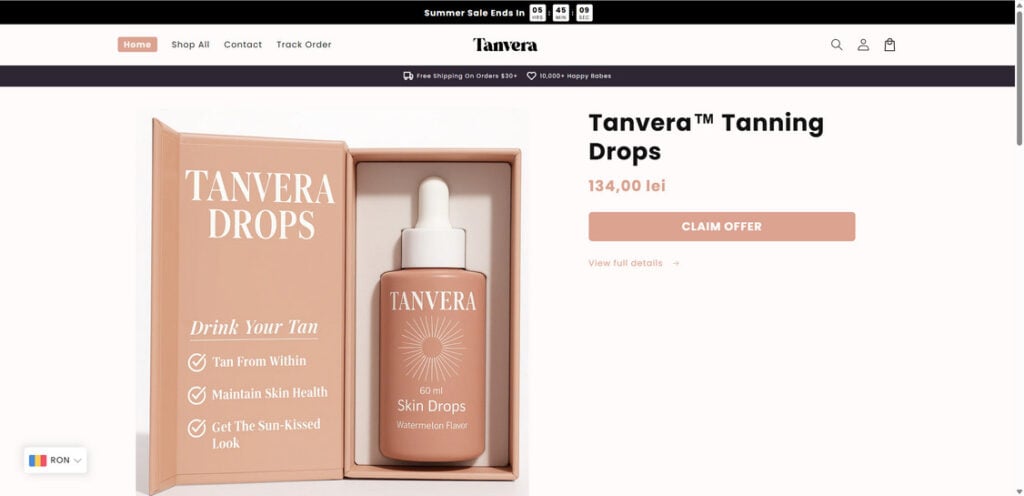
Overview of Tanvera Tanning Drops
Tanvera Tanning Drops are marketed as a unique drinkable tanning solution. According to their official website, this product can:
- Build a natural glow with every sip
- Hydrate and nourish the skin from within
- Provide a vegan, clean, and cruelty-free formula
- Deliver long-lasting results with just a 5-second routine
What Tanvera Promises
The company advertises Tanvera as a safe, science-backed way to achieve a tan without DHA (the ingredient found in most topical self-tanners) and without sun exposure. Instead, their drops are said to “work with your skin’s melanin” to build a glow over time. The marketing leans heavily on words like vegan, clean, and skincare-infused, suggesting it’s not just a beauty enhancer but also a health-boosting supplement.
The before-and-after pictures on their website depict dramatic transformations. They also claim that 97% of users saw natural-looking tans, 94% reported improved skin hydration, and 89% received compliments on their glow after one month.
At face value, Tanvera sounds like a dream product: quick, easy, and effective. But as with most viral beauty products, the fine print and outside research paint a different picture.
The Lack of Scientific Backing
The biggest issue is the science, or rather the lack of it. Human skin darkens in response to ultraviolet (UV) radiation because melanin production increases as a defense mechanism. Drinking a supplement cannot trigger this same process without specific compounds proven to affect melanin.
Tanvera does not list DHA (dihydroxyacetone), which is the gold standard ingredient in topical self-tanners, nor do they provide any evidence of a proven tanning agent. Their formula appears to contain general skincare nutrients such as hyaluronic acid, collagen, and vitamin C—all great for hydration and skin health, but not tanning.
In other words, while Tanvera might help improve skin hydration, there’s no peer-reviewed research proving it can darken your skin tone or create a visible tan.
Customer Reviews – Website vs Reality
On the Tanvera website, the product has over 86,000 glowing 5-star reviews. But when you look at independent platforms like Trustpilot, the story changes dramatically.
Here’s what customers report elsewhere:
- Missing orders – Many claim they never received their package.
- Hidden subscription charges – People were signed up for recurring payments without realizing it.
- Poor customer service – Emails and messages went unanswered.
- Ineffective results – Those who did receive the product said it did not work as promised.
- Side effects – Some mentioned headaches and a metallic taste.
The contrast between the flawless reviews on the brand’s website and the flood of negative ones on external platforms raises major red flags.
Company Transparency Issues
Additional concerns arise from Tanvera’s company details:
- The website was reportedly registered in 2025, making it a very new and unproven brand.
- No physical address or phone number is provided, only a generic contact form.
- Their legal pages are vague and provide little accountability.
- Their branding looks suspiciously similar to other questionable tanning supplements, suggesting possible rebranding or copycat marketing.
These transparency gaps make it difficult to trust Tanvera as a reliable company.
How Tanvera Tanning Drops Claim to Work
Tanvera’s marketing focuses on its three-step simplicity. Let’s break it down in detail and see what’s really going on at each stage.
Step 1: Mix 1 ml into water, juice, or smoothie
The instructions are clear: just drop the liquid into your favorite drink once a day. The dropper is designed to make this process easy and effortless. The brand compares it to taking a vitamin supplement, framing it as part of a daily wellness routine rather than a beauty treatment.
What this means in practice: You are consuming a liquid supplement with hydrating and skincare-related ingredients. While these may improve your skin’s texture and hydration, there’s no known ingredient in the formula that could stimulate tanning from within.
Step 2: Sip daily and let your glow build naturally
Tanvera suggests that the tan builds gradually with consistent daily use. They say results typically appear between 1 to 3 weeks, depending on your skin type.
Why this is questionable: A natural tan happens when melanin is triggered by UV light. Without UV or DHA, there’s no scientific mechanism that would allow these drops to darken skin tone. Any glow users might feel could be from improved skin hydration, giving a subtle radiance, but not an actual tan.
Step 3: Get compliments and radiate confidence
The last step is essentially a promise of social validation. According to Tanvera’s own statistics, most users report receiving compliments within a month.
Why this is misleading: This step relies more on marketing psychology than scientific fact. By presenting confidence and compliments as inevitable outcomes, the company leans on aspirational selling rather than transparent results.
The Core Problem with “Drinkable Tans”
The main problem is that Tanvera sells the idea of tanning without providing proof. Their drops are essentially a beauty supplement, not a tanning solution. While you may see hydration benefits, expecting a sun-kissed glow from a drinkable formula is unrealistic.
What To Do If You’ve Fallen Victim to Tanvera
If you’ve already purchased Tanvera and feel scammed, you’re not alone. Here’s what you should do:
- Cancel Any Subscriptions Immediately
- Check your account and cancel recurring payments.
- Contact your bank or credit card provider to block future charges.
- Request a Refund
- Email the company and request a refund. Save all correspondence.
- If they do not respond, escalate with your payment provider.
- Dispute the Charges
- File a dispute with your bank or credit card company if the product never arrived or if you were billed without consent.
- Provide evidence such as screenshots of charges, emails, and lack of delivery.
- Report the Company
- Report Tanvera to consumer protection agencies in your country.
- Leave honest reviews on independent platforms to warn others.
- Monitor Your Bank Statements
- Keep an eye on your account for unexpected charges.
- In some cases, victims reported needing to change their banking details entirely.
The Bottom Line
Tanvera Tanning Drops make big promises: a natural tan you can drink, a 5-second routine, and glowing reviews from thousands of happy customers. But when you look past the marketing, the red flags are hard to ignore.
- There is no scientific proof that a drinkable supplement can create a tan.
- Customer complaints point to missing orders, hidden subscriptions, and unresponsive support.
- The company provides no transparency about who runs it or where it is based.
While Tanvera might help with skin hydration thanks to ingredients like vitamin C and hyaluronic acid, it is highly unlikely to give you the bronzed, sun-kissed glow it promises. If you’re looking for a safe and effective tan, you’re better off with proven self-tanners or consulting a dermatologist for alternatives.
In short, Tanvera looks more like a marketing gimmick than a legitimate tanning solution.
If you’re tempted by the glossy ads, remember: if something sounds too good to be true, it usually is.
Frequently Asked Questions About Tanvera Tanning Drops
Is Tanvera Tanning Drops a scam?
Based on research and customer feedback, Tanvera Tanning Drops show multiple red flags that suggest it may be a scam. While the company’s website claims over 86,000 satisfied customers, independent platforms like Trustpilot tell a very different story. Many customers report never receiving their orders, being enrolled in hidden subscriptions without permission, and struggling to get refunds. The lack of scientific evidence supporting the product’s tanning claims only adds to the concerns.
Can Tanvera Tanning Drops really make your skin tan?
There is no scientific proof that drinking Tanvera Tanning Drops can change your skin tone. Natural tanning occurs when UV light triggers melanin production, and Tanvera does not contain DHA (the active ingredient in self-tanners) or any other proven tanning agent. While the drops may contain hydrating ingredients like hyaluronic acid and vitamin C, these will not darken the skin. At best, they may improve hydration and skin texture, but they will not create a tan.
What ingredients are in Tanvera Tanning Drops?
The website highlights ingredients such as collagen, hyaluronic acid, and vitamin C. These nutrients can support hydration and skin health but are not capable of inducing a tan. Tanvera does not provide a transparent, full ingredient list, and without published studies or clinical trials, it is impossible to verify the safety or effectiveness of the formula.
Are the before-and-after photos real?
The before-and-after photos on the Tanvera website appear heavily edited or look like stock images. Customers have pointed out inconsistencies in lighting, angles, and even image quality that make the transformations look suspicious. This kind of marketing tactic is common with questionable beauty products that cannot show genuine results.
Why are Tanvera reviews so different on their website versus Trustpilot?
On the Tanvera website, the product has thousands of five-star reviews. However, independent review sites like Trustpilot and Reddit reveal a pattern of negative experiences. This discrepancy suggests that the reviews shown on the company’s website may be fabricated or selectively filtered to mislead potential buyers.
What are the most common complaints about Tanvera Tanning Drops?
The top complaints include:
- Orders never arriving
- Automatic enrollment in hidden subscriptions
- Difficulty canceling recurring charges
- Lack of response from customer service
- No visible tanning results after weeks of use
- Side effects such as headaches and a metallic taste
Is Tanvera safe to use?
Tanvera claims to use vegan, cruelty-free, and dermatologist-approved ingredients. However, there is no independent verification of these claims, and the company does not provide third-party testing results. Customers have reported side effects, which raises concerns about product safety. Without transparent labeling and clinical testing, it is difficult to confirm whether Tanvera is safe for long-term use.
Is Tanvera FDA approved?
No, Tanvera is not FDA approved. While individual ingredients like vitamin C may be considered safe, the product as a whole has not been evaluated or endorsed by the Food and Drug Administration. This is important to note, especially since Tanvera markets itself as a dietary supplement.
How long does it take for Tanvera Tanning Drops to work?
The company claims that results can be seen within one to three weeks. However, based on independent customer reviews, most users did not notice any tanning effect even after consistent daily use. This suggests that the timeline is a marketing tactic rather than a reflection of real results.
Why is the Tanvera website considered suspicious?
Several factors raise suspicion about the Tanvera website:
- There is no physical address or phone number listed.
- The contact page only has a generic form with no direct support.
- The company uses vague legal pages that do not identify who is behind the brand.








