


HashNet pitches Bitcoin mining power that you can resell like a stock, so we tested that pitch against the regulator’s warning and the site’s own code.
The Austrian FMA warns that HashNet has no authorisation for distribution in Austria, and the legal terms never mention mining on a domain registered in February 2026.
Overview
What HashNet Offers
We opened hashnet.ai and found a one-page site selling what it calls Liquid Hashrate: Bitcoin mining power that a buyer owns, earns from and can sell again.
The page promises real hardware owned for its whole life of about 4.5 years, an AI that switches algorithms in 12 milliseconds, and profits paid in Bitcoin.
It shows no price, no contract and no withdrawal rule. The Start Mining button leads only to a sign-in screen, so everything that matters sits behind a login.
What the Checks Found
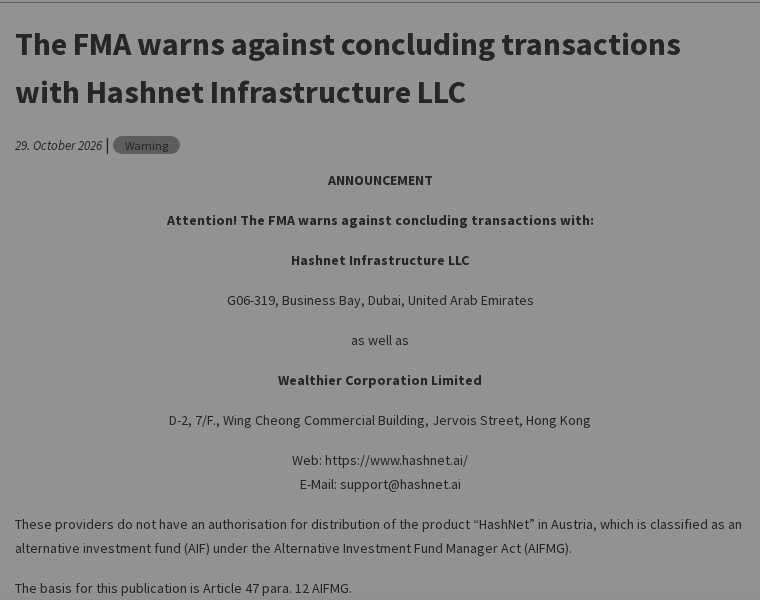
The FMA published a warning on October 29, 2026 about two companies: Hashnet Infrastructure LLC in Dubai and Wealthier Corporation Limited in Hong Kong.
It states that neither has authorisation to distribute HashNet in Austria, where the product counts as an alternative investment fund.
The domain hashnet.ai was registered on February 14, 2026, yet the site’s figures reach $300M+ deployed and 9,400+ BTC mined, with no period given.
By our arithmetic, 9,400 BTC equals about 21 days of new Bitcoin worldwide, and the page’s yield card exceeds the real rate roughly 8,000 times.
The Terms of Service, dated nine days before the domain existed, never mention hashrate, hardware, Bitcoin, withdrawals, risk, returns or buy-backs.
What We Could and Could Not Verify
Here is where the evidence stands after our checks:
- Verified by us: the FMA warning text, the domain dates, the archived page history, the Terms and Privacy Policy, and the figures and code on the home page.
- Not found: a price list, a contract, hardware serial numbers, facility addresses, licence numbers or any proof of the 9,400 BTC and $300M figures.
- Not verified: what buyers receive after signing in, whether withdrawals work, who owns the two companies, and whether either is registered where it claims.
Our advice is not to buy HashNet, and if you already did, to follow the steps below to document your account and protect your money.
What the Austrian Regulator Published
We started with the primary document, the warning on the FMA website, which we read in English on November 11, 2026.
It is dated October 29, 2026, and it names Hashnet Infrastructure LLC at G06-319, Business Bay, Dubai, together with Wealthier Corporation Limited at Jervois Street, Hong Kong.
It lists the website hashnet.ai and the email address support@hashnet.ai, so the regulator and our checks refer to the same site.
The operative sentence is short: these providers have no authorisation to distribute the product HashNet in Austria, which the FMA classifies as an alternative investment fund.
The stated legal basis is Article 47 paragraph 12 of the Alternative Investment Fund Manager Act, known by its German abbreviation AIFMG.
That classification matters because it treats HashNet as an investment fund product, while the website words it as buying and owning mining hardware.
The warning is not a finding of fraud. It does not say that anyone lost money, that withdrawals fail or that the platform does not mine.
It is a regulator telling Austrian investors that nobody is authorised to sell them this product, which is a narrower statement than a ruling on honesty.
The warning ends by pointing to the FMA Company Database for checking whether a business holds an authorisation, and we explain how to use it further below.
We also compared the names. The site’s Terms of Service and Privacy Policy list the same two companies at the same two addresses.
So the warning concerns this site, and the product we examined is the product the FMA describes.
The Promise Visitors See
We read the home page as a buyer would, from the hero video down to the footer, and noted every promise that a buyer could test.
The headline reads Mine what matters, and three counters sit under it: $300M+ Capital Deployed, 9,400+ BTC Mined and Zero Default History.
The features section promises smart mining, an instant start, true ownership and instant liquidity, meaning you can sell your mining power at any time on an open marketplace.
A second block says you own the hardware for its entire lifespan, that old machines automatically fund the newest models, and that the output is converted to Bitcoin.
Three named facilities, Texas, Washington and Ethiopia, appear on a map with no street address, operator name or power capacity.
A section on investor price targets shows seven well-known finance figures with Bitcoin price numbers between $700,000 and $1,500,000, next to their firms’ logos.
The section gives no source, date or link, so we could not confirm that any of those figures is a real forecast.
We found nothing connecting any of those people or firms to HashNet, so the logos should not be read as endorsements.
The one thing the page never shows is a price. There is no rate per terahash, no minimum purchase and no fee table anywhere on the public pages.
A 2026 Domain With Years of Results
We then asked how old the platform really is, because $300M+ deployed and a Zero Default History describe a track record.
RDAP, the public registration record, shows that hashnet.ai was registered on February 14, 2026, through Namecheap, with the owner’s details hidden by a privacy service.
The Internet Archive holds nine captures between February 28 and November 9, 2026, and none is older than the domain.
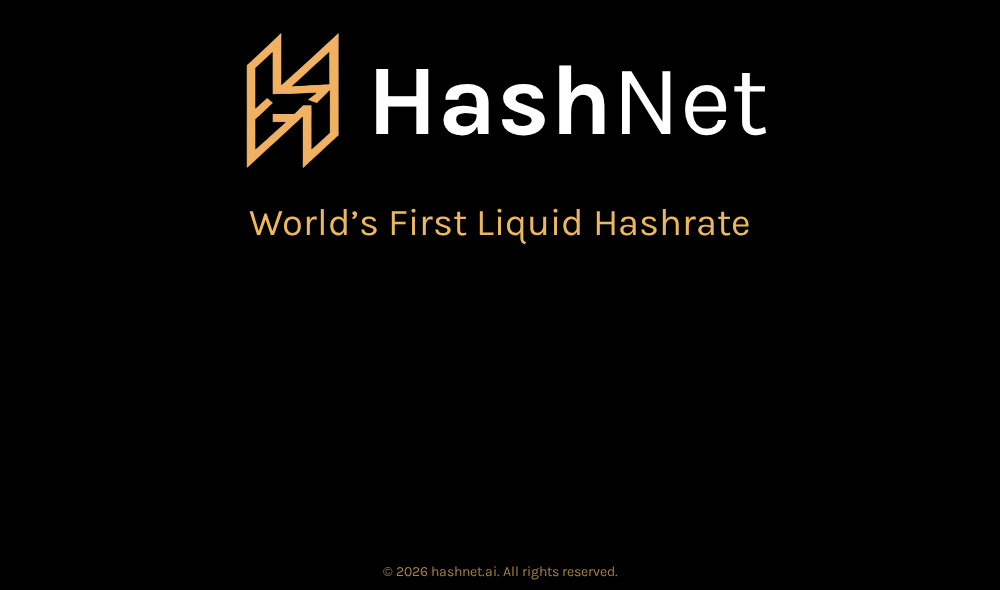
The first capture, 14 days after registration, is a black placeholder with the logo, the words World’s First Liquid Hashrate and a copyright line, and no figures at all.
By April 18, 2026, 63 days after registration, the full page was online, and its source already held the $300M+ and 9,400+ BTC counters.
So the track record appeared on a site that had been public for nine weeks, and the page never says whether the numbers come from earlier operations under another name.
That is a fair possibility, since a new domain can front an older business, but the page names no earlier brand, start date or period for either figure.
Certificate transparency logs, which list public security certificates, show the first certificate for hashnet.ai on February 25, 2026, followed by wildcard certificates issued through October 4.
The Terms of Service and Privacy Policy give an effective date of February 5, 2026, which is nine days before the domain was registered.
A document can be drafted before its website exists, so the gap proves nothing alone.
It does mean the stated date cannot be the day these Terms went live on this domain.
Both documents are dated as last updated on March 20, 2026, and the archived April 18 copy shows the same two dates.
Testing the 9,400 Bitcoin Figure
We tested the 9,400+ BTC Mined counter with the only numbers we could trust, the network constants that the page’s own code uses.
The site’s source, in a calculator section hidden in an HTML comment, uses a network hashrate of 854 EH/s, a 3.125 BTC block reward and 144 blocks a day.
Those constants mean the whole Bitcoin network earns 450 BTC a day in block rewards, before transaction fees.
The page’s 9,400 BTC therefore equals 20.9 days of the entire network’s rewards, claimed by a company whose domain is 270 days old.
If all 9,400 BTC were mined since registration, HashNet would hold 7.7% of all block rewards, which needs about 66 EH/s running nonstop.
If they were mined by April 18, when the figure first appears in the archive, the share would be 33.2%, or about 283 EH/s.
Those numbers do not prove the figure false, because it may cover older operations.
They do show that a site this new owes visitors a period, a source and some proof.
We found no wallet address, mining pool account or block explorer link on the public pages, so a reader cannot check the 9,400 BTC against anything on the blockchain.
The same applies to the three facilities and to the promise that buyers own real hardware: no serial numbers, site addresses or hosting agreements are published.
A Return Calculator Hidden in the Code
Reading the page source as text, we found a full return calculator that visitors cannot see, because the whole section sits inside an HTML comment.
The menu link called Calculator still points at it, so the page advertises a tool that is not there.
The commented section offers a $10,000 minimum investment and three performance tiers: Advanced at 5.00%, Ultra at 5.25% and Enterprise at 5.50%, each labeled monthly.
We worked out what those labels mean for $10,000. At 5.00% a month the return is $500 after 30 days and $1,500 after 90 days.
After 365 days the same tier gives $6,000 without compounding, a 60% gain, and $7,958.56 if each month’s profit is reinvested.
The Ultra tier reaches $6,300 and the Enterprise tier $6,600 over a year without compounding, or $8,478 and $9,012 with it.
A fixed monthly rate is a promise of a set return, and mining does not work that way, because rewards move with Bitcoin’s price, network difficulty and electricity costs.
In our reading, a product that pays a stated rate whatever those inputs do behaves more like an investment contract than like a hardware rental.
Then we read the calculator’s code, and it does not match its own labels. The formula sets annual profit equal to the investment multiplied by the tier rate.
A 5.00% tier therefore produces $500 a year in the code, which is $41.67 a month and $1.37 a day, while the label says 5.00% monthly.
The labels and the code differ by a factor of 12.
Over 30, 90 and 365 days the code gives $41.10, $123.29 and $500, while the label implies $500, $1,500 and $6,000.
The developer’s own comment above the formula describes a simple model built to match screenshot-like tiers, which suggests the numbers were chosen for appearance, not derived from mining output.
The BTC price target in the calculator, set at $350,000, $450,000 or $570,000 for 2030, only converts the USD result into bitcoin and never changes the profit.
If the label is right, a buyer would recover the $10,000 in 20 months, well inside the 4.5 years of hardware life on the page.
If the code is right, recovery takes 20 years, and the whole 4.5-year life returns $2,250 on $10,000, so the hardware would never repay its price.
We do not know which reading HashNet intends, because the calculator is hidden and the real tiers sit behind the login.
A buyer should ask for the return terms in writing before paying a cent.
A Yield Card That Does Not Add Up
The home page shows a Tradable Position card for 1.00 TH/s, with floating labels reading Daily Yield +0.0043 BTC, Retained Value 78% and Market Buyers 2,847.
We checked how the page builds those figures and found them typed into the HTML as fixed text, not loaded from any live feed.
Using the page’s own constants, one terahash per second earns 0.00000053 BTC a day, because 1 TH/s is about 1.2 billionths of an 854 EH/s network.
The card’s 0.0043 BTC is about 8,160 times that amount. At the page’s lowest price target of $350,000 it would be $1,505 a day for one terahash.
At the same price a terahash earns roughly $0.18 a day by the same arithmetic, or about $67 a year.
The card may be decorative, and its position size and yield may not describe any real contract.
But a buyer who reads it as a sample outcome is being shown a figure thousands of times too high.
The labels Retained Value 78% and +2.4% this week carry no explanation either, and the Terms define neither.
Terms of Service That Skip the Product
We read the Terms of Service and the Privacy Policy start to finish and searched them for the product’s own vocabulary.
The words hashrate, hardware, Bitcoin, withdraw, risk, return, profit, marketplace, buy-back and contract appear zero times in the Terms.
The only mention of mining in the whole document is the Start Mining button in the menu.
So the document that governs the account never describes owned hardware, the marketplace, the instant buy-back, the payout schedule or the risk that mining rewards fall.
What the Terms do cover is narrow. Section 6 puts payments with third-party providers and makes all fees non-refundable unless stated otherwise.
Section 12 caps the company’s liability at the amount you paid, and Section 14 lets it suspend or discontinue the service at any time without liability.
Section 11 disclaims any warranty on the accuracy of information, which covers everything on the home page.
Disputes go to binding arbitration in Hong Kong under Hong Kong law, which is a long way from a buyer in Europe.
Section 2 bars users located in the United States and any jurisdiction where use would break local law. It does not mention Austria, the EU or the FMA.
Whether that clause is meant to turn away Austrian buyers is unclear, and we did not test the sign-up flow.
Compared with the home page, the contract promises nothing: selling anytime, instant buy-back and ownership are marketing, and nothing in the Terms obliges the company to deliver them.
The Privacy Policy adds that Hashnet is the operating brand of Wealthier Corporation Limited, which acts as data controller, while the Dubai company is listed beside it without a role.
Behind the Sign-In Wall
We followed the Start Mining button one hop and stopped. It opens app.hashnet.ai, which redirects to a sign-in screen with username, password and a Continue button.
We did not create an account, so we cannot describe the purchase page, the contract a buyer accepts, the wallet that receives payment or the withdrawal process.
That is the core limit of this investigation, and it matters for you: every real term of the deal sits behind a login that we did not pass.
Public certificate records also name dev, devapi, admin and iq subdomains, so more systems exist than the single page we could read. We did not open them.
We found no analytics or advertising tags in the home page source.
It does hold a commented placeholder address, REF.supabase.co, next to the live address of a function that pulls posts from an X account.
We searched our own archive for the page’s distinctive strings, including Alpha Engine, Liquid Hashrate and both company names, and found no earlier article.
That means we have no evidence tying this page to any other warned platform we have covered, and we draw no such link.
Who Runs HashNet?
The companies named in the documents
The FMA warning, the Terms and the Privacy Policy agree on two names: Wealthier Corporation Limited in Hong Kong and Hashnet Infrastructure LLC in Dubai.
The Terms say HashNet is operated by both, and the Privacy Policy calls Hashnet the operating brand of Wealthier Corporation Limited.
Neither document gives a registration number, a licence number, a regulator or an officer’s name, and the home page names no founder, team or management.
A newcomer therefore cannot tell from the site who is responsible, which company holds the money or which court has authority beyond the Hong Kong arbitration clause.
Where the addresses lead
The Hong Kong address is D-2, 7/F., Wing Cheong Commercial Building, Jervois Street, and the Dubai address is G06-319, Business Bay.
We did not complete a search of the Hong Kong Companies Registry or a Dubai business register, so we cannot say whether either company exists as described.
We also could not confirm what is physically at either address. Anyone sending a written complaint should first ask for a postal address and a registration number.
The domain, the platform and the public record
RDAP lists Namecheap as registrar, privacy-protected registrant details, a registration date of February 14, 2026, an expiry date of February 14, 2028 and a change on August 11, 2026.
The name servers belong to Cloudflare, which hides the hosting origin, and mail is handled by Namecheap’s PrivateEmail, with Mailgun listed for sending.
The SPF record, which lists servers allowed to send mail for the domain, also names two addresses that reverse-resolve to Namecheap shared hosting servers.
These are ordinary commodity services and prove nothing alone, but they give us no sign of a larger corporate infrastructure behind the single page.
A search for HashNet also finds hashnet.com, which is a different domain.
RDAP dates it to June 2025, its name servers belong to a domain marketplace, and we found nothing linking it to this platform.
What we could not confirm
We could not confirm who owns or manages either company, whether either is registered or licensed anywhere, or where the machines are.
We could not confirm that any mining hardware exists, that buyers hold title to it or that payouts have ever been made.
Shared addresses, name servers or code would show a common setup, not common ownership, and we claim no link beyond what the documents themselves state.
How to Check an Austrian or EU Warning
The FMA keeps its notices in a public list of warnings, and each entry names the providers, their addresses and the legal basis.
The FMA Company Database lets you search a firm by name across categories such as banks, investment service providers, fund managers and crypto-asset service providers.
We ran a search for Hashnet there, but the page returned no readable result, so we draw no conclusion from the database and suggest you run your own search.
For warnings from other countries, the I-SCAN alert network of IOSCO gathers regulators’ warnings, and the page notes that entries come from IOSCO members and are not independently verified.
We did not complete a search for HashNet on I-SCAN, so we make no statement about other countries’ warnings.
A warning is not a ban, and the absence of a warning is not clearance, so use both lists and ask your national regulator for the company’s registration number.
What to Do Before You Buy or After You Paid
-
Do not deposit. Do not send money or crypto to HashNet while the FMA warning stands and the terms say nothing about mining.
-
Ask for terms in writing. Email support@hashnet.ai for the purchase contract, price per terahash, fees, withdrawal rules and buy-back terms before you pay.
-
Ask for proof. Request registration numbers for both companies, the address of your machines and wallet addresses that show payouts.
-
Check the registers. Search the FMA Company Database and your own national register, and ask for a licence number you can verify.
-
Save evidence. Screenshot the home page, the Terms with their dates, your account page, every deposit address and every transaction ID.
-
Request a withdrawal. If you hold a balance, ask to withdraw all of it now and keep the reply, and do not top up to unlock it.
-
Tell your bank or exchange. If you paid by card or transfer, ask about a dispute or recall, and report crypto payments to the exchange that sent them.
-
Report it. Contact the FMA if you are in Austria, or your national financial regulator and police cybercrime unit, naming the domain and both companies.
Frequently Asked Questions
Is HashNet a scam?
We cannot call it one: the FMA warns about missing authorisation, not fraud, but the figures lack proof and the terms ignore mining, so we advise against buying.
Is HashNet legal in Austria?
The FMA states that Hashnet Infrastructure LLC and Wealthier Corporation Limited have no authorisation to distribute HashNet in Austria, so Austrian investors should treat it as unauthorised.
Does the warning apply outside Austria?
It addresses distribution in Austria, so it does not bind other countries, but it is a regulator’s warning about the same product, and your own regulator may have a view.
How much does HashNet pay?
No public page shows a price or a return, and a hidden calculator in the code lists 5.00% to 5.50% tiers that its own formula treats as yearly.
Can I withdraw my money?
We could not test it, because every account feature sits behind a login, and the Terms promise no withdrawal and limit liability to what you paid.
Who owns HashNet?
The documents name Wealthier Corporation Limited in Hong Kong and Hashnet Infrastructure LLC in Dubai, but we could not confirm who owns or manages either company.
The Bottom Line
Do not buy HashNet: the FMA lists it as unauthorised in Austria, its contract never mentions mining, and its figures come with no period, proof or price.
If you want mining exposure, choose a provider whose registration you can verify and whose written terms state fees, risks and withdrawal rules.
If you already paid, save your records, request a full withdrawal without adding funds, tell your bank or exchange and report the platform to your regulator or the FMA.

Join the discussion
0 commentsShare your experience or ask a question about this article.
Discussion
Start the conversation
Have a question or something useful to share? Add the first comment.