

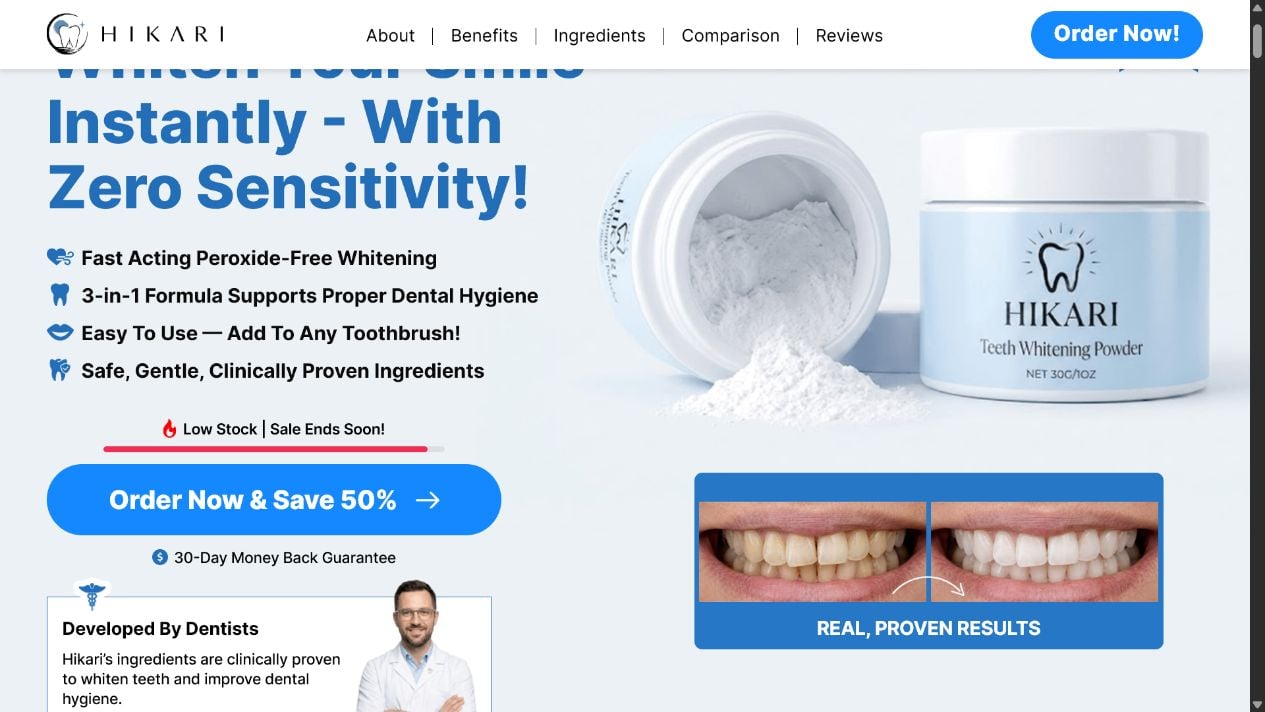
Hikari promises instant, peroxide-free whitening with zero sensitivity. It says the powder is dentist-developed, clinically proven, gentle on enamel, and trusted by more than 1,000,000 customers.
The formula tells a less dramatic story. It uses common powder ingredients that may polish away some surface stains but cannot bleach color from inside a tooth.
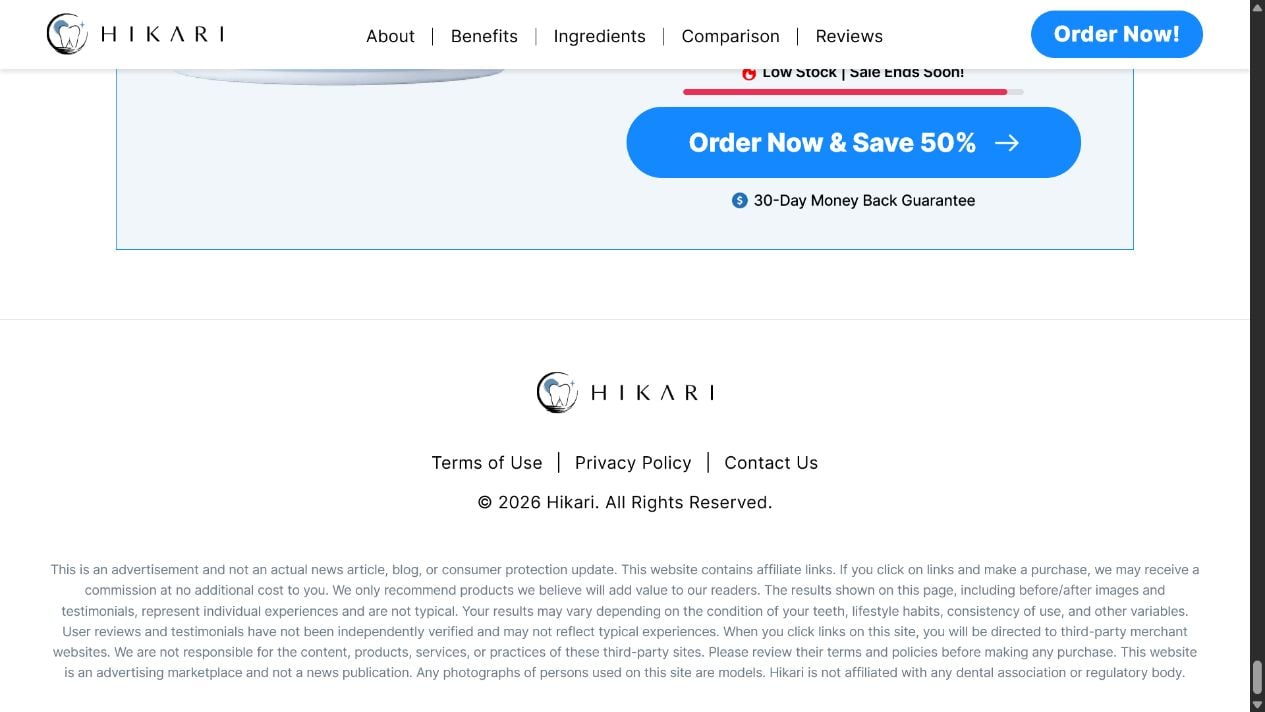
The bigger red flag is the sales setup. Hikari’s fine print says the people shown are models, testimonials are unverified, and buyers are sent to third-party merchants. The legal pages name no company, address, phone number, or return location.
Overview
Hikari is a loose tooth powder that the user applies to a wet toothbrush and brushes with like a polishing product. The U.S.-focused promotional page lists sodium bicarbonate, sodium lauroyl sarcosinate, sorbitol, wheat starch, and magnesium stearate.
The page says Hikari should be used in addition to regular toothpaste rather than as a replacement. That detail matters because the formula is advertised as fluoride-free, while fluoride toothpaste remains an important part of cavity prevention for most people.
What the Ingredients Can Reasonably Do
- Sodium bicarbonate: Helps clean and physically remove some external stains
- Sodium lauroyl sarcosinate: Acts as a foaming and cleansing ingredient
- Sorbitol: Helps with texture and moisture and does not feed oral bacteria like ordinary sugar
- Wheat starch: Serves as a powder base or texture ingredient
- Magnesium stearate: Helps keep powdered ingredients flowing and blended
What the Formula Does Not Automatically Prove
- That the finished Hikari product is clinically proven
- That it can whiten every user’s teeth instantly
- That daily use has zero risk of sensitivity or abrasion
- That it repairs enamel or fills microscopic cracks
- That it prevents cavities like a fluoride anticavity toothpaste
- That before-and-after images show typical, unedited outcomes
A company can accurately say individual ingredients have been studied while offering no controlled trial for its final blend. “Clinically proven ingredients” is not the same claim as “this exact product was clinically proven to produce the advertised result.”
Surface Stain Removal Is Not the Same as Bleaching
Teeth can look darker for different reasons. Extrinsic stains sit on the outer enamel and can come from coffee, tea, tobacco, wine, food pigments, and plaque. Polishing products may reduce some of these stains.
Intrinsic discoloration comes from inside the tooth or from changes in dentin, age, trauma, medication, or enamel thickness. A peroxide-free powder cannot simply scrub away internal color.
That is why a tooth can feel smoother and look slightly brighter after polishing without becoming multiple shades whiter. More brushing pressure does not transform a surface cleaner into a bleaching agent. It only increases the chance of irritation or wear.
How the Hikari Sales Funnel Works
Step 1: The Ad Promises Fast Whitening Without the Usual Trade-Off
Traditional whitening can cause temporary sensitivity or gum irritation. Hikari’s promise of instant results with zero sensitivity directly targets people who want whitening but fear those side effects.
“Zero sensitivity” is too absolute. Even ordinary brushing products can irritate some users, especially when teeth are already sensitive, gums have receded, enamel is worn, or the person brushes aggressively.
Step 2: Big Numbers Create Instant Credibility
The page says Hikari has more than 1,000,000 happy customers, over 1,000,000 units sold, and more than 100 million viral views. It also uses an “America’s #1” badge.
No independent audit is presented beside those claims. Viral views measure exposure, not dental effectiveness, and an “#1” label needs a named market, time period, and measurement method to be meaningful.
Step 3: Dental Language Makes a Simple Powder Sound Advanced
Phrases such as “microfine polish technology,” “dentist-trusted,” “clinically proven ingredients,” and “developed by dentists” make the formula sound proprietary. The page does not clearly name the dentists, show their credentials, or provide a finished-product clinical report.
Sodium bicarbonate is widely used in oral-care products. Giving a familiar ingredient a branded technology name does not prove a breakthrough.
The “Dentist” Image and Media Logos Do Not Prove Authority
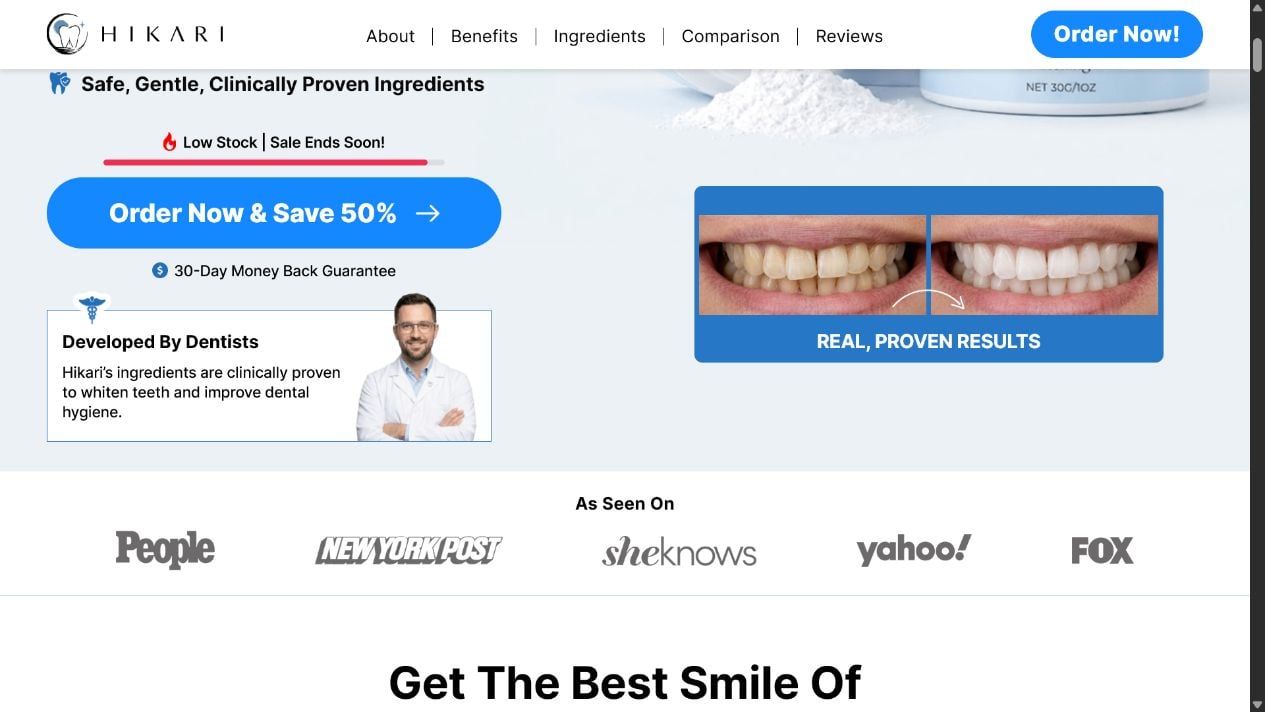
The sales page places an unnamed man in a white coat beside the words “Developed By Dentists.” It provides no name, dental license, clinic, professional biography, research role, or way to confirm that the person helped formulate Hikari.
The portrait looks highly polished and generic, like AI-generated or composited advertising. That impression alone cannot prove AI use. The decisive fact is in Hikari’s own footer: every person shown is a model, so the white-coat figure is not a verified Hikari dentist.
The “As Seen On” strip shows People, the New York Post, SheKnows, Yahoo, and Fox. None of the logos links to an article, review, broadcast clip, or date. Without the underlying coverage, the strip does not prove that any outlet tested or endorsed Hikari.
Step 4: Before-and-After Images Sell the Transformation
The hero section presents dramatically yellow teeth beside a much brighter result. Lighting, exposure, hydration, camera settings, cleaning, editing, and different dental conditions can all change how teeth appear in a photograph.
The site’s own disclaimer says photographs of people are models, that testimonials have not been independently verified, and that the displayed results are not typical. That warning should be weighed more heavily than the oversized transformation image and “verified buyer” graphics.
Step 5: Scarcity and a 50% Discount Push the Click
The page repeatedly shows “Low Stock,” “Sale Ends Soon,” “Save 50%,” and a 30-day guarantee. These prompts appear throughout a very long sales page, making it easy to buy before reading the small-print terms.
Step 6: The Buyer Is Sent to a Third-Party Merchant
The order buttons do not lead to a conventional Hikari shopping cart on the same domain. They use a tracking redirect, and the terms state that the website contains affiliate links and sends visitors to third-party merchant websites.
This separation matters. The page advertises a guarantee while disclaiming responsibility for linked merchants and their products. Before paying, buyers must identify the company taking the money and handling any return.
Who Operates Hikari? The Legal Pages Do Not Identify a Company
Hikari’s Terms name no incorporated company or legal operator. The Privacy Policy also refers only to “Hikari,” while the Contact page provides email support without identifying who receives orders, holds customer data, or carries legal responsibility.
The Terms, Privacy Policy, Contact page, and footer provide no legal company name, registration number, office, business address, telephone number, return warehouse, or named officer. The Terms state no governing law or court jurisdiction, and even the support hours omit a time zone.
The Return Promise Is Missing a Published Return Address
The Terms advertise a 30-day money-back guarantee requested by email. They do not publish a return address, name the company approving requests, or identify the merchant that issues refunds.
Buyers should not discover the contracting company and return destination only after paying. Before ordering, verify the merchant’s legal name, address, support channel, total charge, subscription status, return location, postage responsibility, and dispute process.
The Site Collects Buyer Details Without Publishing Equivalent Business Details
Hikari says it may collect names, email and shipping addresses, phone numbers, payment-related details, device data, and approximate locations. Yet it gives customers no legal entity name or physical address for privacy requests. Email-only contact is weak accountability for an oral-care seller.
Is Hikari Teeth Whitening Powder a Scam or Legit?
Hikari appears to be a real powder, but the promotional page is not a transparent manufacturer storefront. It is an affiliate advertising site built to send shoppers elsewhere, and it uses aggressive claims that are softened substantially in its own disclaimer.
The ingredient list makes mild surface cleaning plausible. It does not support the full sales promise of instant whitening, enamel strengthening, crack filling, cavity protection, all-day breath control, and zero sensitivity for everyone.
The page also lacks the business transparency expected for an oral-care product. Its legal pages do not identify a legal company, company registration number, physical address, telephone number, return address, governing law, named dentist, independent clinical report, or the manufacturer responsible for each jar.
Our Verdict
Hikari is an overmarketed affiliate product, not a proven replacement for established whitening or dental care. It may polish away some external stains, but buyers should not expect dramatic bleaching or medical oral-health benefits.
Do not purchase through the funnel unless the final merchant clearly provides its legal identity, full ingredient label, manufacturing details, total price, subscription status, delivery location, and a usable return address.
Hikari Red Flags
- The site admits it is an advertising marketplace: It earns affiliate commissions and directs orders to third parties.
- The main claims are broader than the disclaimer: The footer says testimonials are unverified and results are not typical.
- The white-coat “dentist” is not identified: The site says photographs of people are models and provides no name, license, clinic, or biography for the person displayed beside “Developed By Dentists.”
- The media logos are unsupported: People, New York Post, SheKnows, Yahoo, and Fox logos appear without links to coverage or endorsements.
- No finished-product clinical trial is presented: Studied ingredients do not prove the final product’s advertised performance.
- The before-and-after result is unusually dramatic: A peroxide-free powder mainly targets surface stains.
- No legal operator is identified: The legal pages provide no incorporated company name, registration number, physical address, telephone number, return location, or governing jurisdiction.
- The purchase path uses a tracking redirect: The final merchant may have different policies from the promotional page.
- Scarcity repeats throughout the page: “Low stock” and 50% savings are used to encourage immediate action.
Can Hikari Damage Enamel?
Every polishing powder has some abrasive effect. Whether that effect is acceptable depends on particle size, concentration, brushing pressure, frequency of use, toothbrush hardness, and the condition of the teeth.
Hikari calls its powder microfine and safe for daily use, but the sales page does not prominently provide an independent abrasivity value for the finished product. Without that information, “gentle” remains a marketing claim rather than a measurement the buyer can compare.
Overbrushing can contribute to wear and gum recession even with ordinary toothpaste. A user chasing a dramatic result may brush harder or more often, increasing risk without changing intrinsic tooth color.
Who Should Avoid Whitening Powders?
Ask a dentist before using Hikari or a similar powder if you have sensitive teeth, gum recession, enamel erosion, untreated cavities, cracked teeth, active gum disease, mouth sores, dental implants, veneers, crowns, bonding, or recent dental work.
Restorations do not whiten like natural enamel. Removing surface stain from surrounding teeth can make color differences more obvious.
Stop using the powder if you develop pain, persistent sensitivity, gum irritation, bleeding, rough tooth surfaces, or a change in how a restoration feels.
How to Evaluate Hikari Before Ordering
Identify the Final Seller
Do not enter payment information until the checkout shows the merchant’s legal name, address, support contact, and return destination. The promotional domain may not be the party processing the order.
Read the Full Ingredient Label
Compare the physical jar with the website. Regional Hikari-branded sites show different ingredient stories, including charcoal, clay, PAP+, and the baking-soda formula. That inconsistency makes it important to verify the exact product being purchased.
Look for Independent Product Testing
Ask for a study on the finished formula, not an article about baking soda in general. Check who funded the work, how many people participated, how whitening was measured, and whether sensitivity and enamel wear were assessed.
Compare With Established Options
A fluoride whitening toothpaste can target surface stains while maintaining anticavity protection. Peroxide products and professional treatment can address deeper discoloration, although they have their own limitations and should be used correctly.
Ignore the Countdown Mentality
A dental-care decision does not need to be made because a sales bar says stock is low. Save the page, ask questions, and return only when the merchant and product are clear.
What to Do If You Already Bought Hikari
1. Identify Who Charged the Card
Check the receipt and card statement for the actual merchant descriptor. Save the affiliate page, checkout page, order email, total, and guarantee shown at purchase.
2. Inspect the Jar Before Use
Confirm the tamper seal, ingredient list, lot number, expiration information, manufacturer or distributor, country of origin, and usage warnings. Do not use a jar with missing or contradictory labeling.
3. Do Not Replace Fluoride Toothpaste
The Hikari page itself says to use the powder in addition to toothpaste. Keep brushing twice daily with an appropriate fluoride toothpaste unless a dental professional has advised otherwise.
4. Use Minimal Pressure
If a dentist says the powder is appropriate, follow the label and use a soft toothbrush. More powder, more pressure, and more frequent brushing do not guarantee more whitening.
5. Photograph Any Adverse Effect
Stop use and document irritation, sensitivity, packaging defects, or a product that differs from the order. Seek dental care for persistent symptoms.
6. Start the Refund Request Promptly
The promotional terms mention 30 days from delivery. Contact both the final merchant and the support address shown in the order paperwork. Ask for authorization, the return address, postage responsibility, and refund timeline in writing.
7. Dispute Material Misrepresentation if Necessary
If the merchant cannot be identified, the product is materially different, or a valid return is blocked, contact the card issuer. Provide the receipt, merchant descriptor, advertisement, disclaimer, correspondence, and tracking.
Frequently Asked Questions
Does Hikari Teeth Whitening Powder Really Work?
Its abrasive cleaning ingredients may reduce some surface stains. The page does not prove that the finished product can instantly bleach intrinsic tooth color or deliver the dramatic result shown for every user.
Is Hikari Peroxide-Free?
The U.S. promotional page describes the powder as peroxide-free and lists a baking-soda-based formula. Verify the physical label because other Hikari-branded regional pages describe different ingredients.
Is Hikari Safe for Daily Use?
The seller says it is, but daily safety depends on the formula’s abrasivity, technique, and the user’s dental condition. Ask a dentist if you have sensitivity, enamel wear, gum recession, cavities, or restorations.
Is Hikari FDA Approved?
The site says the product is made in an FDA-registered facility. Registration of a facility is not the same as FDA approval of the product or its whitening claims.
Does Hikari Replace Toothpaste?
No. The sales page says it should be used in addition to toothpaste. A fluoride-free polishing powder should not automatically replace a proven anticavity routine.
Who Sells Hikari?
The promotional site says it is an affiliate advertising marketplace and that order links direct visitors to third-party merchants. Identify the final seller before paying because that company may control shipping and refunds.
What Company Owns Hikari, and What Are Its Address and Phone Number?
Hikari’s legal pages name no company, registration number, physical or return address, or telephone number. They provide only email contact. Buyers should identify and verify the final merchant before paying.
Are the Hikari Dentist and Customer Photos AI-Generated?
Some images look synthetic or heavily polished, but appearance alone cannot prove AI generation. Hikari’s own disclosure is clearer: the people shown are models. None should be treated as a verified dentist or customer without independent identification.
Was Hikari Really Featured by People, Fox, Yahoo, or the New York Post?
The site displays those media logos, but the logos do not link to supporting articles or broadcasts. Without identifiable coverage, the strip does not prove that the outlets tested, reviewed, recommended, or endorsed Hikari.
The Bottom Line
Hikari combines ordinary polishing ingredients with extraordinary advertising. Surface stain removal is plausible; instant dramatic bleaching, enamel repair, cavity protection, and zero sensitivity are not established by the evidence presented.
The affiliate setup adds risk because the page promising the guarantee may not handle the order. Treat Hikari as an optional cosmetic powder, not a dental breakthrough. Do not buy until the final seller and full product label are clear.

Join the discussion
0 commentsShare your experience or ask a question about this article.
Discussion
Start the conversation
Have a question or something useful to share? Add the first comment.