


An Infomedics email says a healthcare bill is still unpaid. The deadline is close, and paying now seems easier than sorting out a possible collection problem.
That ordinary concern gives an unfamiliar payment request room to slip through. Before settling it, separate the message from the bill it claims to represent.
Overview
The Infomedics email scam impersonates a real billing service
Infomedics handles genuine healthcare billing. Criminals borrow that familiar role to send fake reminders directing recipients toward payments or information requests they shouldn’t trust.
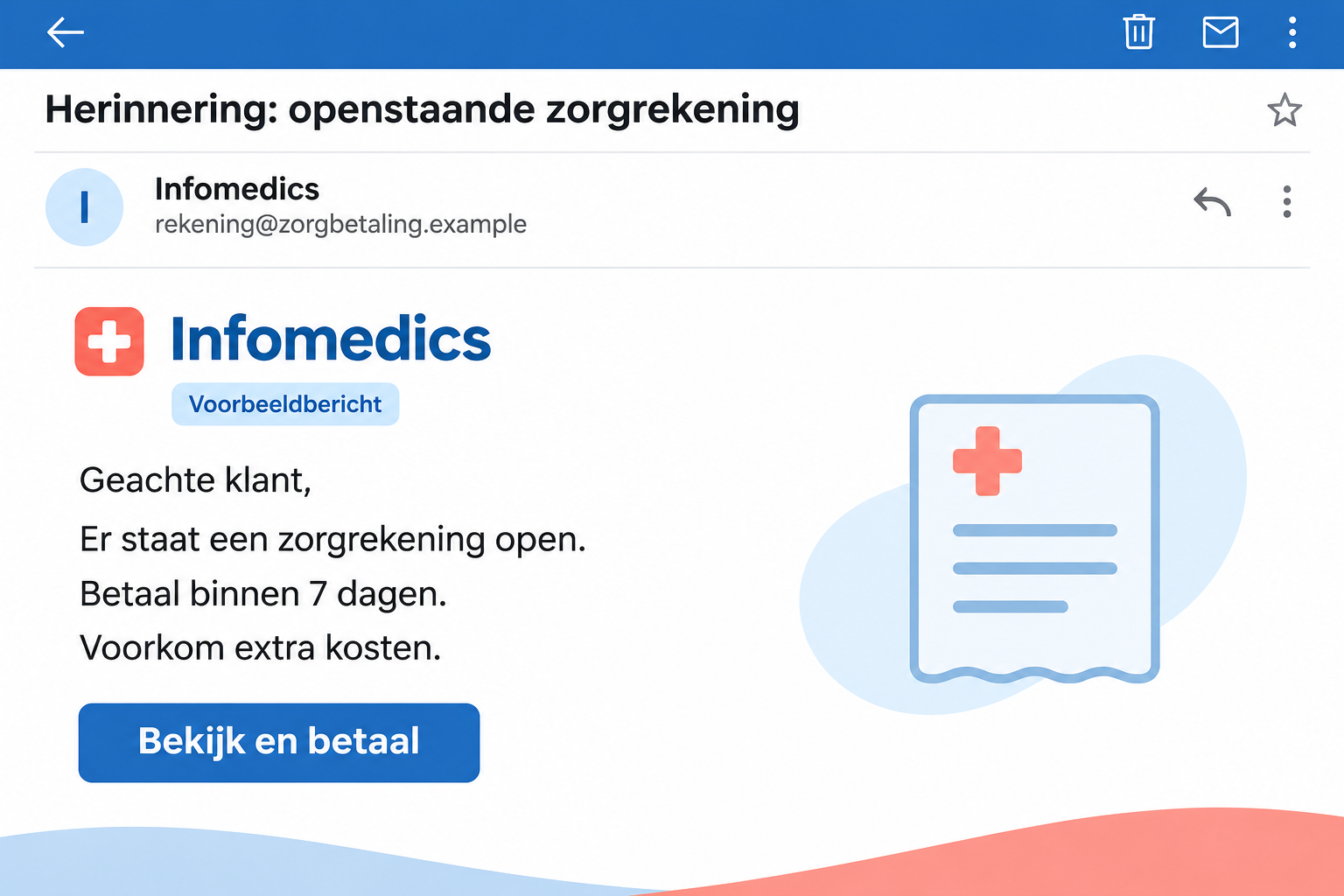
The image above illustrates the approach using a fictional sender. It is not an original patient email or proof of a particular person’s debt.
The impersonation matters because readers may recognize the company without remembering a specific invoice. Recognition can become a shortcut around checking what is actually owed.
A convincing reference number can still belong to someone else
Infomedics identifies a real payment reference as 14 digits ending in 071. Crucially, it warns that fraudulent messages can reuse a genuine reference from another person’s bill.
That makes the format a useful screening detail, not a complete authentication test. A plausible number should send you to independent verification, not straight to payment.
The same principle applies to logos, formal language, and a familiar provider name. Each can look reassuring without proving the destination is legitimate.
Verify the bill outside the message
Open the genuine Infomedics website yourself and use its bill checker or official assistance. Don’t rely on the suspicious email’s button, reply address, or telephone instructions.
- Match the bill to a healthcare service you actually received.
- Check the reference through the real service rather than the linked page.
- Keep an unexpected text payment demand separate from a code you requested yourself.
- If you already paid, contact your bank promptly instead of waiting for another reminder.
How the Infomedics Email Scam Works
Step 1: A healthcare reminder arrives at a believable moment
The message resembles routine administration rather than a spectacular prize offer. It claims a bill is outstanding and presents payment as a simple task you may have overlooked.
Healthcare bills can arrive after an appointment, and people do forget paperwork. The scam exploits that uncertainty rather than needing a perfect record of your treatment.
A message arriving near a real appointment doesn’t, by itself, prove that medical records were accessed. The timing can be persuasive without establishing how the sender found you.
Start with the claimed service, not the emotional reaction. Which provider, treatment, and billing period does this demand actually identify?
Step 2: Familiar billing details lower your guard
The sender name, copied branding, formal signature, and payment reference create the appearance of an established relationship.
A reference is particularly effective because it looks specific. Readers may assume no one would include a structured invoice number unless a real invoice existed.
But a number can be invented or copied. Even one that corresponds to a genuine record doesn’t prove that the email or its payment link belongs to that record.
Keep each piece of evidence in its proper role. A name identifies the claimed sender; an independent account check is what tests the claim.
Step 3: A short deadline makes checking feel expensive
The reminder may threaten additional costs or escalation unless the balance is settled quickly. Paying a manageable amount begins to feel safer than risking a larger problem.
That comparison only works if the debt and penalty are real. The message is trying to make you calculate the cost before confirming the obligation.
Don’t let the email choose your timetable. A brief independent check is more useful than a rushed payment to an unverified destination.
If you are worried about missing an actual deadline, contact the real billing service separately. Explain the disputed reminder without using the contact details embedded in it.
Step 4: The payment button moves you into the criminal’s chosen route
A button can say “View invoice,” “My Infomedics,” or “Pay now” while opening a destination unrelated to the real billing service.
Don’t judge by the words printed on the button. Those words are controlled by the message’s author, just like the amount and deadline.
A familiar payment platform can also receive an illegitimate request. Recognizing its design doesn’t establish that the intended recipient is your healthcare billing company.
Instead of trying to prove an unfamiliar link safe, leave it unused. Navigate independently and find the actual bill there.
Step 5: Payment or additional information completes the trap
Depending on the message, the next page may seek a transfer, card details, login information, or another form of confirmation.
Those are different exposures and need different responses. A paid transfer calls for a bank conversation; a disclosed password calls for account protection.
A page saying “payment complete” is not enough to show that a real healthcare bill was settled. The genuine billing record and your bank’s transaction details matter.
Don’t repeat a payment because the suspicious page reports an error. First check whether anything was debited and who received it.
Step 6: Further reminders can turn one mistake into several
Another email may claim the first payment wasn’t received, an extra fee remains, or personal details need correction before the account can be closed.
Once you have responded, that follow-up can feel like normal customer service. Treat it as unverified until the actual billing service confirms the issue independently.
A previous payment doesn’t validate a new request. Save the correspondence and tell your bank about the whole sequence rather than evaluating each message in isolation.
If a real bill also exists, resolve it through the genuine service. Paying a criminal does not necessarily discharge a separate obligation to your healthcare provider.
What Genuine Infomedics Messages Do Differently
A link isn’t automatically fraudulent, but its destination matters
Infomedics’ official guidance identifies rekening@infomedics.nl as its billing sender and rekening.infomedics.nl as the destination of its genuine blue button.
It distinguishes that billing environment from direct iDEAL or Wero payment links emailed to recipients. Its full invoice is downloaded after an SMS check, not supplied as an attachment.
Don’t simplify this into “every email with a link is fake.” The safer rule is to avoid the disputed link and access the verified billing service yourself.
A lookalike hostname can insert extra words or change a letter. Having “Infomedics” somewhere in an address doesn’t make the site part of the company’s domain.
An unsolicited payment text is different from a requested verification code
Infomedics says it doesn’t send unsolicited SMS payment demands. It describes legitimate SMS use when you request an invoice download or interact with its assistant Ella.
Context matters more than a displayed sender label. A code received during an action you deliberately started is different from a stranger’s instruction to send that code back.
Never let an unexpected caller walk you through someone else’s login or payment process. Read what a verification message says it authorizes before doing anything with it.
A surprise collection call should be checked separately
The company says it doesn’t call people about outstanding bills. Treat an unexpected person or robot demanding payment in its name as an impersonation attempt.
Don’t debate the account with that caller or provide details to help them “find” it. End the call and use the genuine website’s contact options.
Someone repeating your name or the email’s reference isn’t independent confirmation. They may simply be repeating information already contained in the approach.
Checking an Unfamiliar Healthcare Bill Without Sharing More Data
Begin with records you already hold: appointment confirmations, provider correspondence, previous bills, and your own payment history.
If the provider is unfamiliar, do not supply a full medical history to the email sender. Ask the real billing service what information is needed through its secure process.
Write down the claimed amount, provider, reference, and due date. Keeping those details together makes it easier to compare the demand with a genuine record.
Use contact details from a known provider document or the genuine website. Searching for a number and choosing an advertisement can introduce another unverified intermediary.
When asking someone else for help, redact identifying details. A public screenshot should not expose a patient number, address, treatment information, bank account, or working payment code.
Don’t upload an entire healthcare invoice to a random link-checking tool. You can question a URL without publishing the personal information surrounding it.
When reporting, distinguish a copied company logo from personal treatment information. If the message contains genuine private details, tell the real billing service through its secure contact process.
If the official record confirms a bill, check its payment status before paying. A valid reference doesn’t show whether you or an insurer has already settled it.
What to Do if You Have Fallen Victim to This Scam
-
If you only read the message, don’t use its payment route. Preserve a copy if you intend to report it, then mark it as phishing or delete it.
Receiving a fake reminder doesn’t create a debt. Still check any separate genuine bill through the real service if you have an outstanding billing concern.
-
If you opened the link, identify what happened next. Close the page and note whether you typed anything, authorized a payment, downloaded a file, or granted a permission.
A click alone isn’t proof of infection. Additional action changes the response, so describe your actual exposure rather than assuming the worst or ignoring everything.
-
If money left your account, call your bank now. Give the transfer date, amount, recipient details, and the message that led you there.
Explain whether you authorized the transfer under false pretenses. Ask what can still be stopped or recovered; don’t assume a familiar payment interface guarantees reimbursement.
-
If you entered card details, tell the issuer what was exposed. Include the card number, security code, and any approval you supplied without repeating them in public messages.
Ask about blocking further use, replacement, alerts, and disputes for actual charges. Keep tracking the account after the first conversation.
-
If you disclosed credentials or codes, protect the affected service. Use a trusted device and independently opened site to change the relevant password and review active sessions.
Notify the bank if a banking code or approval was involved. Changing an email password doesn’t reverse an authorized transfer or cancel an approval already used.
-
If software was installed or remote access was granted, separate device recovery from billing. Disconnect the affected device and contact trusted technical support.
On an employer-managed system, inform your IT team before cleanup. Preserve the program name and session details so they can assess access without relying on guesswork.
-
Report the impersonation through genuine channels. Use Infomedics’ official website to find its reporting process, and ask your bank about appropriate police reporting after a loss.
Keep the original email available, including its sender details. A screenshot is useful, but it may omit technical information that helps an investigator.
-
Keep the genuine bill and the scam payment separate. Ask the real billing service whether an actual balance exists and how to resolve it safely.
Do not assume Infomedics received money sent through a criminal link. A refund process for a mistaken transfer to the real company is a different situation.
-
Expect possible follow-up approaches. Ignore strangers who promise guaranteed recovery, request another payment, or ask you to approve a refund through your banking app.
Maintain one incident record with receipts, correspondence, bank case references, and next steps. That is more useful than restarting the story with every unsolicited caller.
Frequently Asked Questions
Are all Infomedics payment emails scams?
No. Infomedics sends legitimate healthcare bills. Verify the claimed bill independently instead of accepting or rejecting every message based only on the company name.
Does a reference ending in 071 prove the email is real?
No. Criminals can copy genuine references. Use the official bill checker and confirm the bill belongs to you before treating the number as meaningful.
Does Infomedics ever put a button in an email?
Yes. Its guidance describes a blue button leading to its genuine billing environment. That differs from trusting any button bearing its name or a payment-service logo.
Does receiving a fake bill prove my medical records leaked?
No. The message and its timing alone cannot establish a healthcare data breach. Don’t send the suspicious sender more personal information to test their knowledge.
Should I pay again if the first page showed an error?
Not through that route. Check your bank activity and the genuine bill separately. An error message can coexist with a completed debit or another attempt to collect.
Will deleting the email undo a payment?
No. Deleting removes the message from view, not the transaction. Contact your bank promptly and retain enough evidence to explain how the payment occurred.
The Bottom Line
Don’t settle an Infomedics email scam through the message’s payment button. A believable reminder and plausible reference still need checking against the real bill.
Open the genuine service yourself, confirm the obligation, and pay only through its verified route. Keep unsolicited texts and calls outside that process.
If you’ve already sent money or exposed account information, contact your bank immediately and preserve the email rather than continuing the sender’s instructions.

Join the discussion
0 commentsShare your experience or ask a question about this article.
Discussion
Start the conversation
Have a question or something useful to share? Add the first comment.