


Lotto Hawk charges $197 for a year of lottery number analysis, and its own sales page admits that no tool can predict a draw.
We wanted to know what that money buys, so we ran its method on thousands of real draws and read every policy page and checkout screen.
Overview
What Lotto Hawk actually sells
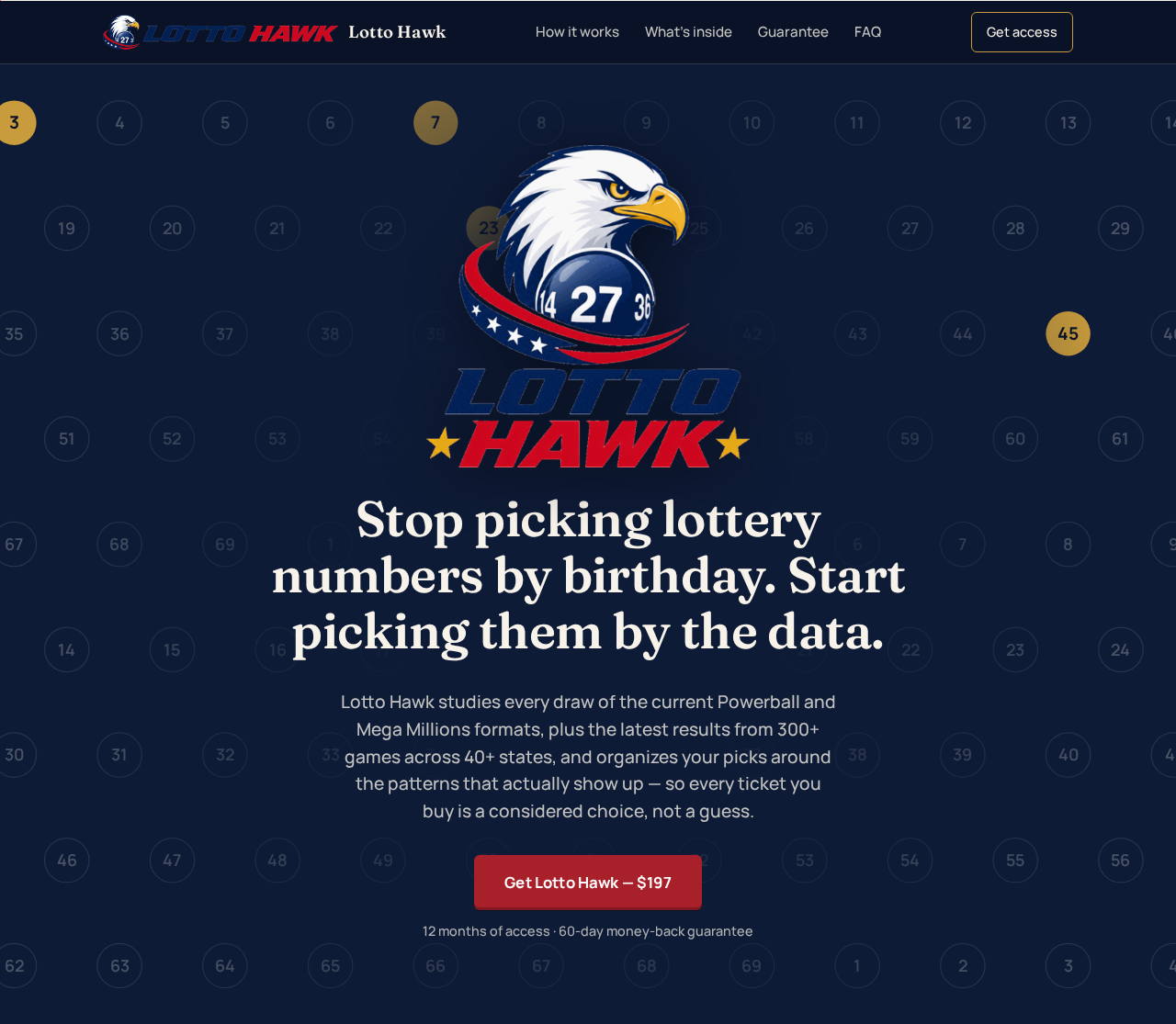
Lotto Hawk is a members area that ranks lottery numbers by how often they have been drawn, how long they have been missing and which ones landed together.
It adds a Smart Pick button that turns those rankings into ticket combinations, plus a ticket log and a results checker, for twelve months and one payment of $197.
The sales page admits that the tool does not predict draws, does not change the odds of any ticket and cannot guarantee a win.
What our own tests showed
We rebuilt the three ranking ideas as simple rules and tested them on 1,431 Powerball draws and 942 Mega Millions draws taken from New York’s open lottery data.
None of the rules beat a blind pick by more than normal luck allows, so the rankings add nothing a buyer could use to choose better numbers.
The checkout, the policy pages and the company trail raised a second set of questions, because the seller appears only at the last step and the legal pages look recycled.
What we verified and what we could not
Here is where the evidence stands after our checks:
- Verified by us: the backtest results, the odds arithmetic, the checkout default state, the game count, the policy dates and the domain record.
- Not found: a company address, a registration number, a named person, any testimonial or any mention of a private group on the pages we read.
- Not verified: the members area itself, the pages after payment, and the identity behind the seller name shown at checkout.
Our advice is not to pay $197 for better odds, because we found none to buy, and to read the response section below if you already did.
We Ran Lotto Hawk’s Method on 1,431 Powerball Draws
The sales page promises to organize your picks around the patterns that actually show up, and its feature list names three of them: frequency, gaps and pairs.
We turned each into a plain rule and tested it on real results from New York’s open data portal, a source the site’s own references page names.
You can open the same files yourself: the Powerball draw history and the Mega Millions draw history.
For every draw after a warm-up of 100 draws, we built a five-number pick using only the results published before that day, then counted how many white balls matched.
The four rules were the five hottest numbers, the five least frequent, the five longest overdue, and a set grown from the pairs that had landed together most often.
A blind pick matches 0.362 white balls per Powerball draw on average, which is 25 divided by 69, and our four rules scored 0.386, 0.351, 0.369 and 0.370.
The best of those sits 1.55 standard errors above blind luck, a gap that chance alone produces about one time in eight and well short of proof.
Across 1,331 tested draws the four rules reached three or more white balls just 1, 2, 3 and 1 times, against about 2.4 for a blind pick.
Mega Millions told the same story: over 842 tested draws since its 70-number pool began in late 2017, the rules averaged 0.360, 0.363, 0.379 and 0.380 against a blind 0.357.
The current Mega Millions format began on April 8, 2025 and holds only 166 draws, yet the site promises every draw of that format.
On those 126 tested draws the best rule scored 0.437 against 0.357, but that sample is far too small to trust, and no rule matched three white balls.
We also ran the simplest test of all: the most overdue Powerball number appeared in the very next draw 111 times out of 1,331, or 8.34%.
A blind pick hits 7.25% of the time, so that gap is ordinary luck, and the hottest number did slightly worse than blind at 7.06%.
Hot and Overdue Numbers Are What Chance Looks Like
Frequency charts look informative because random draws are never perfectly even. Since October 2015, Powerball number 21 appeared 128 times and the rarest only 80, against 103.7 expected.
To judge whether that spread means anything, we simulated 1,500 purely random runs of 1,431 draws and measured the gap between the hottest and coldest number in each.
The typical gap was 46 and nine runs in ten fell between 37 and 58, so the real gap of 48 is exactly what a fair machine produces.
A standard evenness test agrees: it scores 0.22 for Powerball and 0.72 for the Mega Millions pool, both far from the 0.05 level that would hint at a biased machine.
A dashboard that ranks numbers will always crown a hottest ball and an overdue ball, so the real question is whether the crown predicts anything.
In our test it did not, which fits the site’s own references page: every draw is random and independent, and no method changes a ticket’s odds.
That honesty is worth noting, but it also means the $197 buys a presentation of numbers that the seller itself concedes cannot help you win.
What $197 Does to the Odds
The Powerball prize chart lists jackpot odds of 1 in 292,201,338 for a $2 play.
The Mega Millions how-to-play page lists 1 in 290,472,336 for a $5 play.
Our arithmetic agrees: 69 choose 5, times 26, gives 292,201,338 combinations, and 70 choose 5, times 24, gives 290,472,336.
Each ticket holds exactly one of those combinations, however its numbers were picked, so a rule for choosing cannot add or remove any.
That is why the sales page concedes that the tool does not change the odds of any single ticket.
The $197 would instead buy 98 Powerball tickets or 39 Mega Millions tickets, and 98 Powerball tickets carry a jackpot chance of about 1 in 2,981,646.
That chance is still tiny, but it is real, while the app spends the same money before a single ticket exists and raises no ticket’s chance at all.
What 305 Games Really Means
The front page promises more than 300 games across more than 40 states, and the covered games page raises that to 306 games across 44 states, DC and Puerto Rico.
We counted the list itself and found 305 names in total, Powerball and Mega Millions included, so the headline sentence is one higher than the list it introduces.
A one-game difference is minor, but what fills the list matters more: 159 of the 305 names are daily digit games, about 52% of the catalog.
We counted Pick 2, 3 and 4, Cash 3 and 4, Daily 3 and 4, Play 3 and 4, DC-3, DC-4, Win 4, Numbers and Pega games.
We left out every Pick 5 and DC-5 to stay cautious, so the true share of digit-style games may be higher.
A Pick 3 draw picks three digits from 0 to 9, so it has exactly 1,000 outcomes, and Pick 4 has 10,000, each equally likely by design.
A digit missing for twelve draws is not owed an appearance, so gap and pair rankings on these games show the past and nothing more.
A Sales Page That Argues With Its Own Checkout
We opened the checkout in its default state without typing anything, and it belongs to JVZoo, which names the product as Lotto Hawk and the creator as Convex Group.
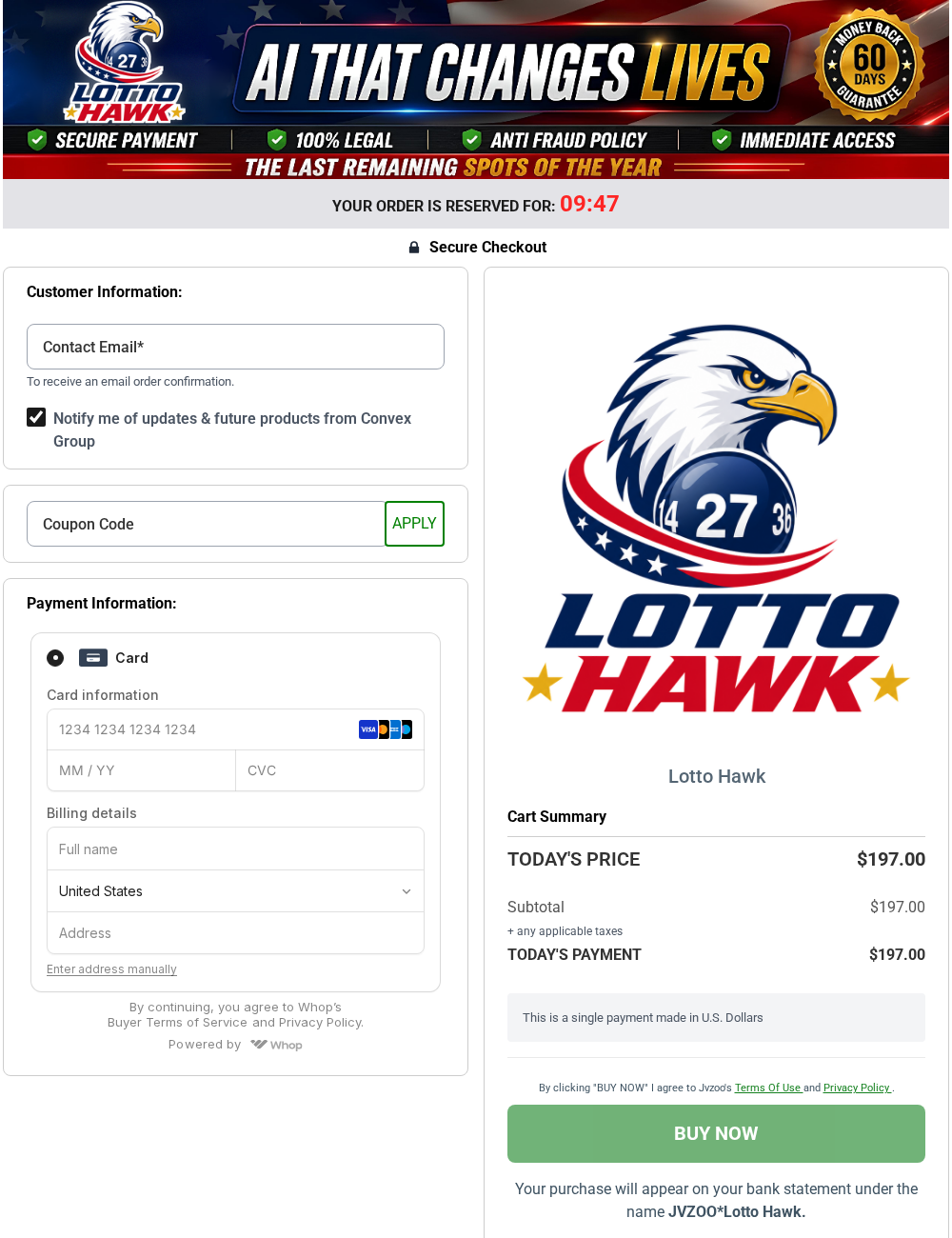
The banner above the form promises AI that changes lives and the last remaining spots of the year, and a reservation timer read 09:47.
The sales page makes none of those promises, since it admits the tool does not predict anything, and the words seats and spots appear on none of the site’s pages.
A web login has no physical seats, so the scarcity line and the timer are pressure with nothing behind them that we could find.
A box offering updates and future products from Convex Group arrives already ticked, so a buyer who does not notice it joins a marketing list at the moment of payment.
The money side is plain: one payment of $197.00 plus any applicable taxes, labeled as a single payment, with the card statement showing JVZOO*Lotto Hawk.
The card form itself is run by a second company, Whop, whose buyer terms you accept by continuing, so three companies touch the order before the seller does.
The refund promise held up in our comparison. The checkout, the sales page and the refund policy all give 60 days, handled by the vendor through the support email.
JVZoo’s checkout text adds its own warning: it reviews pages for compliance but does not verify their accuracy, so its logo is no endorsement.
How the Lotto Hawk Order Flow Works
Step 1: The address sends you to one sales page
Typing lottohawk.com redirects to a single page at the /jv/ path, and there is no separate homepage, blog, pricing page or login that we could reach from the front.
A short script copies any tracking parameters from the link that brought you onto every buy button, a common way to credit whoever sent a visitor.
Step 2: The page sells analysis and disclaims prediction
The page lists what the tool does and what it does not do, and the second list is blunt: no prediction, no guaranteed payout and no change to the odds.
The strongest persuasion is the headline, which tells you to stop picking by birthday and start picking by the data, a claim our backtest shows has no measurable payoff.
Step 3: One click opens the JVZoo checkout
The buy button opens the checkout we described above, where the offer is $197 once, with no recurring charge, no bump offer and no pre-selected extras on that first screen.
The sales page also promises that no add-ons are required to use the core tool, which does not rule out that add-ons exist behind the payment.
Step 4: After payment you set a password
We stopped at the checkout and did not pay, so everything from here on is the seller’s own description and not something we saw.
After payment you set a password on a thank-you page with your payment email and receipt number, then log in from any device for a year.
Step 5: The refund clock runs for 60 days
A buyer paying today would have until January 9, 2027 to email support@lottohawk.com, and the policy promises a refund within 5 to 7 business days and revokes any bonuses.
That window holds about 26 Powerball draws and 17 Mega Millions draws, and a blind pick would expect roughly 0.05 draws with three matching white balls.
So the tool cannot show a buyer anything convincing before the deadline passes, which makes the refund decision a judgment about the price, not the results.
Policy Pages Written Before the Domain Existed
Each of the six policy pages we read ends with the same effective date, 01/26/26, which is 260 days before the domain’s registration on October 13, 2026.
The registry record shows that creation date, an expiry of October 13, 2027, a last change on October 14 and Cloudflare name servers.
A policy can predate a site when it was copied from an older one, and these pages read as if they were written for a different product.
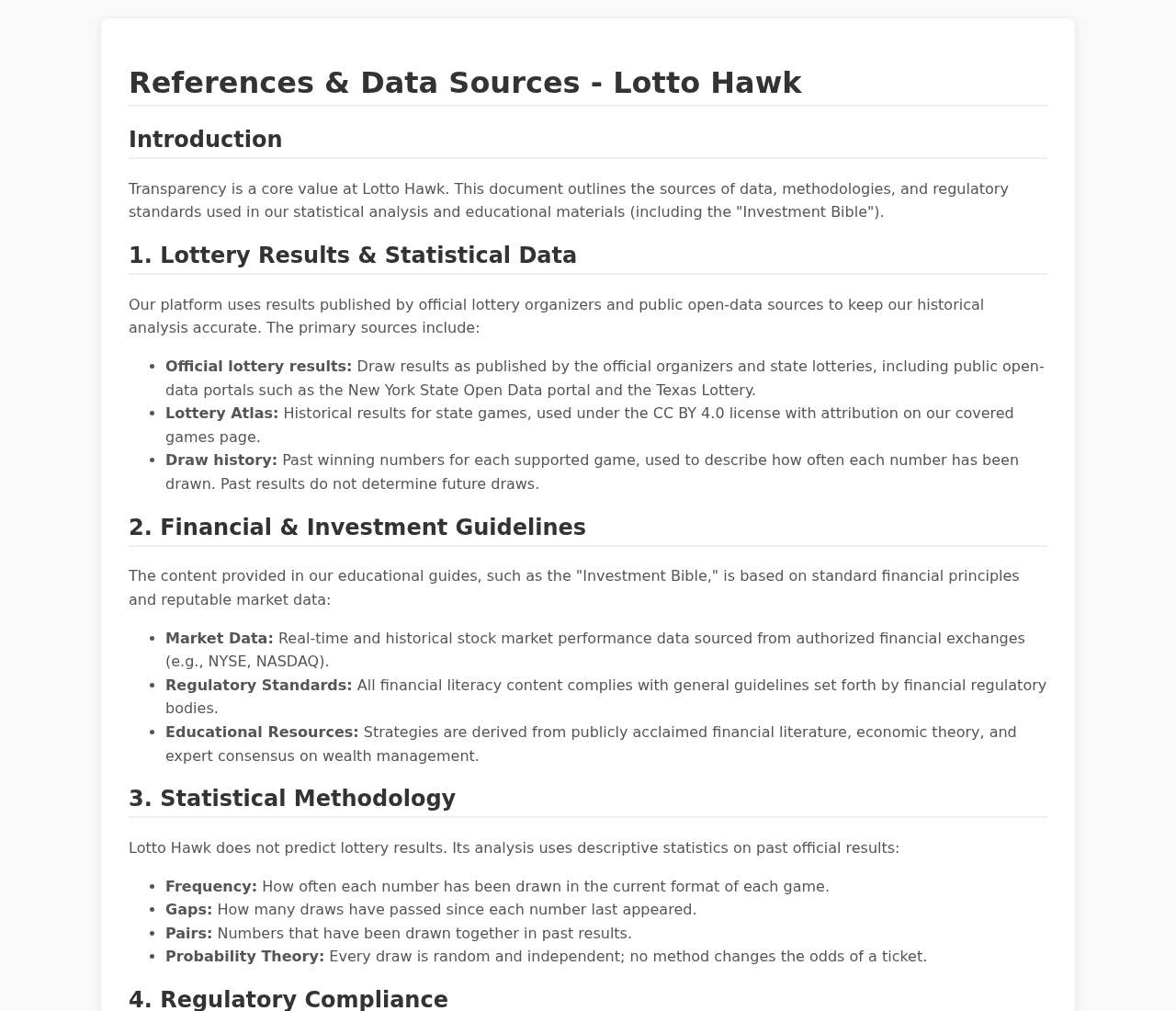
The references page cites an Investment Bible and stock market data from NYSE and NASDAQ, yet no such guide appears anywhere else on the site.
The terms of use forbid manipulating product prices or interfering with other users’ listings, but we found no listings, user accounts or posting sections anywhere on the site.
The sales page footer disclaims any tie to Facebook and warns that results of individuals mentioned are not typical, although no individual and no testimonial appears.
The stylesheet’s first line reads Lotto Champ, front page, which means the design was started from another product’s page and the name was not changed in the file.
We covered a different site called Lotto Champ in 2025, but a leftover comment shows reused design work and does not show common ownership.
Two file details point to a Portuguese-speaking developer: the guarantee badge is saved as garantia-60d.png, and a variable in the page script is named temAlgo.
That hints at who built the page and nothing about where the seller is based, which the site never reveals.
The refund policy lives in these recycled pages and is the one part that matched the checkout, while the ownership details stay generic.
Who Runs Lotto Hawk?
The company named in the documents
The footer, terms, privacy policy and refund policy name only Lotto Hawk, with no legal entity, no postal address, no phone number and no officer.
The checkout is the only place naming a company: Convex Group appears as creator and JVZoo as seller, and the update box repeats the name.
The terms send disputes to United States courts without naming where, so a buyer cannot tell which court, or which law, would apply.
The only contact is support@lottohawk.com, described as available around the clock, and its mail records point to Hostinger’s mail servers.
Where the address and registration lead
No address appears on the site, so there is nothing to check against a business register, and the registry record gives dates and name servers but no owner.
The Internet Archive lists 15 captures of the root page from July 2013 to January 2022, none over 2.4 KB, and the one we could read shows only the name.
A .com creation date normally resets only after a name is deleted and registered again, so the 2026 registrant is probably not the earlier holder, although we cannot prove that.
We found no registry entry or public page we could tie to this Convex Group, and unrelated businesses use similar names, so we link it to none.
The domain, platform and template clues
The setup combines a Cloudflare-fronted site, a JVZoo checkout, a Whop card form and Hostinger mail, which shows how the pieces connect and not who owns them.
We opened the checkout of LottoTracer, an earlier case, and found the same JVZoo system with a different seller and account numbers, so nothing ties the two.
The design remnant and the Portuguese file names show reused work. Shared templates, like shared tracking numbers or name servers, indicate a common setup and not proven common ownership.
What we could not confirm
We could not identify the legal entity behind Convex Group, see the members area, read any page after payment or check how refund requests are handled in practice.
We did not see any video advertising that may bring visitors, so we cannot judge its promises, but a promise to predict numbers would contradict the page where you pay.
How Lotto Hawk Differs From the Lottery Apps We Covered
We covered Lotto Ace and the Lottery Gap AI story for fake winner scenes, invented endorsements and an assured-win promise sold as a hidden shortcut.
Lotto Hawk’s pages carry none of that: no winner, no celebrity, no news-style story, no prediction promise and no mention of a lottery gap.
Its nearest feature counts draws since a number last appeared, the old idea of an overdue number, and our test shows that idea has no edge.
That makes this a different case from the confirmed deceptions we have covered, because the risk is paying $197 for ordinary statistics whose usefulness the seller itself denies.
What to Do If You Are Thinking of Buying or Already Paid
-
Decide what you want. If you hope to improve your odds, skip the purchase, because no ranking rule we tested did better than a blind pick.
-
Try the free version. Open the two New York data files linked above in a spreadsheet to get the same frequency and gap tables at no cost.
-
Save the promises. Capture the sales page, the refund policy and the checkout before paying, because the pages are short and could change without notice.
-
Untick the update box and pay by card. The marketing box arrives ticked, and a credit card gives you a dispute route that a transfer or gift card does not.
-
Mark the deadline. The refund window is 60 days from purchase, so a buyer today should note January 9, 2027 and ask well before it.
-
Email the refund request. Send it to support@lottohawk.com with your order number, name and payment email, and keep a copy of the message and the reply.
-
Escalate if it stalls. Contact JVZoo support for order and billing problems, then send the card issuer a dispute letter within 60 days of the statement.
-
Refuse any extra payment. If anyone connected with the product asks for more money or invites you into a private group, stop, and tell the FTC at ReportFraud.ftc.gov.
Frequently Asked Questions
Is Lotto Hawk a scam?
We found no proof of fraud: the page admits it cannot predict, the checkout shows one payment and a 60-day refund, but the product delivers no edge.
Can Lotto Hawk predict Powerball or Mega Millions numbers?
No. The sales page admits as much, and our backtest on 1,431 Powerball draws found no ranking idea that beat a blind pick by more than luck.
What is the lottery gap and does it work?
The phrase is absent from the site. Its nearest feature counts draws since a number last appeared, and that pick came next 8.34% of the time against 7.25% for chance.
Is the $197 a subscription?
The checkout and the terms show one payment of $197.00 for twelve months with no recurring charge, though we could not see the pages after payment.
Who owns Lotto Hawk?
The site names no company and the checkout names Convex Group as creator, but we found no address or registry record for it, so the owner remains unconfirmed.
How do I get a refund?
Email support@lottohawk.com within 60 days with your order number, name and email, expect 5 to 7 business days, and dispute the charge with your card issuer if nothing arrives.
The Bottom Line
Do not buy Lotto Hawk to improve your lottery odds. Its method failed our test on 1,431 Powerball draws, and the seller’s pages admit it cannot predict.
If you only want tidy statistics, build them free from the New York open data, and keep the $197, since every ticket carries the same tiny chance.
If you already paid, ask for the refund in writing before the 60 days end, and dispute the charge with your card issuer if it stalls.

Join the discussion
0 commentsShare your experience or ask a question about this article.
Discussion
Start the conversation
Have a question or something useful to share? Add the first comment.