

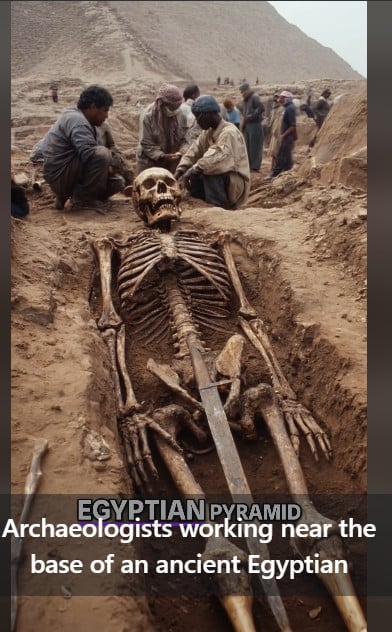
Did archaeologists really uncover a 12-foot human-like skeleton near an Egyptian pyramid with a sword still embedded in it? That’s the shocking claim made by a viral Facebook video from a page called Most Amazing ELITE. The clip shows what looks like a massive skeleton being excavated from sandstone, with captions suggesting it’s a history-changing discovery.
Sounds incredible — like something straight out of Game of Thrones crossed with an ancient Egypt documentary. But is this supposed discovery real, or just another clever AI-generated hoax designed to go viral?
In this article, we’ll break down what the footage shows, why the story doesn’t add up, and how clickbait creators use AI visuals to fuel internet myths about “giants” buried in ancient history.
What the Viral Video Shows
The video begins with shots of workers digging near what is claimed to be the base of an Egyptian pyramid. Suddenly, the camera reveals a giant skeleton measuring over 12 feet long, with a sword still sticking out of its ribcage.
The text overlay frames it as a once-in-a-lifetime archaeological find: proof of ancient giants hidden beneath the sands of Egypt.
For viewers unfamiliar with how misinformation spreads, it looks dramatic — maybe even convincing. But a closer look reveals multiple red flags.
Why the Giant Skeleton Claim Is Not Real
1. No Scientific Reports or News Coverage
If archaeologists had discovered a 12-foot skeleton near a pyramid, it would be the biggest story in archaeology since the discovery of King Tutankhamun’s tomb. Major outlets like National Geographic, BBC, and Smithsonian would be all over it. Instead, there is complete silence outside of viral Facebook and TikTok clips.
2. No Archaeological Evidence of Giants
- Human fossils and skeletal records show that the maximum human height in ancient and modern history rarely exceeds 8–9 feet.
- A 12-foot skeleton would overturn decades of biological and archaeological research — yet no peer-reviewed papers or credible museums have ever confirmed such a find.
3. AI and CGI Artifacts in the Video
The skeleton and excavation site in the viral clip have the telltale signs of AI-generated imagery:
- Overly smooth textures in bones.
- Shadows and lighting that don’t align naturally.
- Workers in the background that look blurred or oddly proportioned, a common AI rendering flaw.
4. The Source Is Clickbait
The page Most Amazing ELITE is known for sensational, unverified videos designed to rack up views and shares. None of their content links to verifiable sources, dig site reports, or museum archives.
The History of “Giant Skeleton” Hoaxes
The viral pyramid skeleton isn’t the first fake of its kind. Similar stories have spread for years:
- 2002 “Giant Skeleton” Photoshop Hoax – Doctored photos of supposed giant skeletons circulated online, later debunked by National Geographic.
- Nepal and India “Giant Bones” Claims – Viral images supposedly showing giant human remains were actually manipulated stock photos.
- TikTok AI Creations – In recent years, AI tools like MidJourney and Stable Diffusion have made it easier to create ultra-realistic fake “giant discoveries.”
These hoaxes play on people’s fascination with hidden history, myths of Nephilim or ancient warriors, and the mystery of lost civilizations.
Why These Videos Go Viral
- Shock Value – A skeleton larger than life immediately grabs attention.
- Mythical Appeal – Legends of giants in biblical and cultural lore make people more likely to believe.
- AI Realism – With modern AI, visuals look convincing enough to fool casual viewers.
- Algorithm Boost – Platforms like Facebook and TikTok reward dramatic, shareable content.
The Truth vs. The Hype
- Truth: No 12-foot skeletons have ever been scientifically documented near Egyptian pyramids — or anywhere else.
- Hype: Viral AI-generated images and videos are being passed off as real archaeology.
- Reality: While Egypt’s deserts have yielded stunning archaeological finds, from royal tombs to ancient temples, giant skeleton warriors with swords remain pure fantasy.
Conclusion
The claim that archaeologists uncovered a massive giant skeleton with a sword near an Egyptian pyramid is 100% fake. The viral footage from Most Amazing ELITE is a textbook example of AI-generated clickbait — designed to trick viewers, spark debate, and generate ad revenue through shares and comments.
Real archaeology continues to uncover incredible truths about Egypt’s past — but none of them involve 12-foot tall warriors buried beneath the pyramids. The next time you see a shocking claim like this online, remember: if it looks like a Netflix fantasy series, it probably is.

Join the discussion
0 commentsShare your experience or ask a question about this article.
Discussion
Start the conversation
Have a question or something useful to share? Add the first comment.