

Online shoppers across the United States, Canada, the United Kingdom, Australia, and Europe are increasingly targeted by fake clothing stores that pretend to be long established boutiques that are closing or relocating. One of the most convincing and widespread examples is the Matthew’s Haberdashery Moving Sale Scam, a fraudulent retail operation that uses AI generated visuals, fabricated backstories, and a false narrative of relocation to lure victims into buying clothing that is nothing like what is advertised.
This complete analysis exposes everything shoppers need to know about the scam, explains in detail how the deception works, outlines how victims can get their money back, and provides practical tools to stay safe online.
Scam Overview
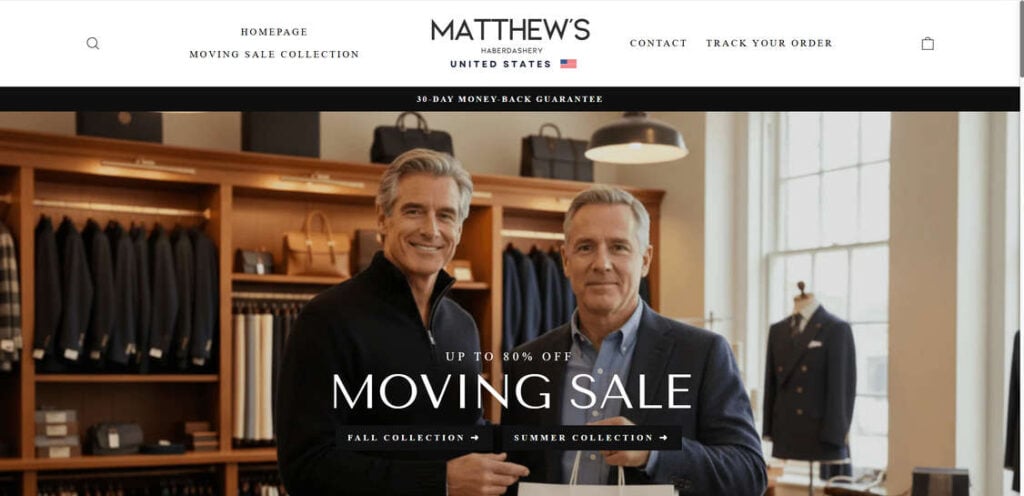
The Matthew’s Haberdashery Moving Sale Scam presents itself as a traditional American menswear shop with a long heritage. The website claims that the brand has existed for many years, often stating origins in Washington or Seattle, or operating as a family run business that is preparing to move to a new location. The site portrays itself as a respected haberdashery that sells sweaters, jackets, cardigans, trousers, and accessories made from high quality materials. This fictional branding is reinforced through professional looking product pages, polished photography, and emotional narratives that describe years of craftsmanship.
However, none of these claims are true. A domain lookup reveals that the Matthew’s Haberdashery website was registered extremely recently. Stores that claim to have existed for decades do not suddenly appear online with a brand new domain and no digital history. This is the first and strongest red flag that the entire operation is fabricated.
The branding used throughout the website is carefully designed to imitate the aesthetic of real boutique menswear stores. The scammers rely heavily on AI generated images to build a false sense of authenticity and tradition. The supposed owners appear as older, friendly gentlemen wearing fashionable outfits inside what looks like a warm, cozy menswear shop filled with racks of wool sweaters and leather accessories. Yet the faces are unnaturally smooth, the symmetry is too perfect, and the background elements lack the imperfections of real environments. These visuals exist only to falsely portray a family owned business that shoppers feel inclined to support.
Product images are also suspiciously stylized. Sweaters appear to be made of luxurious materials like merino wool or cashmere. Cardigans look tailored, textured, and high quality. The clothing is photographed in a way that mimics expensive catalogs. However, these images are either AI generated, scraped from unrelated retailers, or taken from stock libraries and edited. The products delivered to customers rarely resemble what is shown online.
The website’s messaging centers around a fictional moving sale. The store claims it is relocating and must clear out inventory at extremely low prices. Discounts of 60 to 80 percent are displayed across almost every page. Shoppers are told that this is an exclusive liquidation sale that will not happen again. This narrative is used to create urgency and pressure visitors into buying quickly.
This scam model is highly effective because it leverages emotional storytelling. Many shoppers want to support small independent businesses, especially those that appear family operated. The idea of helping a long time local store transition to a new location resonates emotionally. Fraudsters understand this psychology and build their narratives accordingly.
Another key component of the scam is the return policy. The website claims that customers may return items within a set timeframe. However, once victims attempt to initiate a return, they learn that the process is either impossible or intentionally obstructive. Customers must ship the items back to an overseas warehouse, usually in China, at their own expense. The cost of shipping often exceeds the price of the product. Emails to customer support go unanswered or receive responses that delay the process until the refund window expires.
Victims who do receive items often find that the garments are extremely low quality. The sweaters are poorly stitched, thin, synthetic, and dramatically different from the advertised images. Sizing is inconsistent. Colors vary. Labels are generic or missing. The clothing often smells strongly of chemicals, indicating cheap mass production. In many cases, the items shrink or fall apart after a single wash. And in some cases, nothing is delivered at all.
The Matthew’s Haberdashery scam uses fake customer reviews to reinforce its legitimacy. These reviews appear as rotating sliders or static text claiming that various customers praise the quality of the clothing and the kindness of the staff. The names are generic and the faces are AI generated. These testimonials provide social proof for unsuspecting visitors but are entirely fictional.
The scammers heavily promote the store through targeted social media advertising. Platforms like Facebook, Instagram, and TikTok allow them to reach millions of shoppers for a relatively low cost. Ads show elegant sweaters, sophisticated outfits, and heartwarming descriptions of a store closure or relocation. They target demographics that appreciate classic menswear or frequently shop from online boutiques.
Once victims begin to complain online or payment processors start to flag the site, the scammers shut down the domain and reopen the same store under a different name. This cycle has repeated with dozens of scam boutiques that follow the same formula. Matthew’s Haberdashery fits perfectly into this pattern.
There is no physical store. There is no move. There is no clearance. There are no owners. There is no staff. Everything is fabricated to trick customers into making quick purchases before realizing the truth.
How the Scam Works
The Matthew’s Haberdashery Moving Sale Scam follows a methodical structure created to mislead shoppers at every stage of the buying process. Each step is carefully engineered to increase trust, reduce skepticism, and push visitors toward a purchase.
Step 1: Registering a New Domain
The first stage involves registering a new domain name. The scammers choose a name that feels traditional, warm, and British or American in tone. Names like Matthew’s Haberdashery evoke heritage, craftsmanship, and classic menswear. Yet the domain is brand new. This mismatch between claimed history and actual digital footprint exposes the scam.
Step 2: Building a Fake Boutique Website
Next, the scammers launch a visually appealing website using a template-based platform like Shopify. The design mimics upscale clothing brands. They use:
- Clean serif fonts
- Soft backgrounds
- Symmetrical layouts
- Large product imagery
- Warm lighting
- Vintage inspired color palettes
The goal is to create an emotional connection and project the image of a real boutique.
Step 3: Producing AI Generated Storefronts and Staff
Since scammers do not have actual photographs, they generate or steal them. Modern AI tools can create lifelike images of people, clothing stores, and product layouts. These visuals often look realistic at first glance but do not withstand close scrutiny. Common signs of AI involvement include:
- Overly smooth facial features
- Repetitive patterns in backgrounds
- Unrealistic lighting
- Blended edges in clothing
- Identical poses or strangely symmetrical body structures
The store owners appear as kind and trustworthy older men. The shop interior looks meticulously staged. Customer service agents appear as smiling young professionals wearing headsets. None of these people or places exist.
Step 4: Publishing a Fake Moving Sale Story
The moving sale narrative is the central strategy of the scam. The website claims:
- The store is relocating
- They must liquidate inventory
- Prices are drastically reduced
- Stock is limited
- The event is temporary
This story encourages shoppers to buy immediately without evaluating the store’s credibility. It triggers fear of missing out on a rare opportunity.
Step 5: Displaying Fake High Quality Apparel
The product gallery appears to show luxury menswear. Sweaters are marketed as merino, cashmere, or high grade cotton. The photographs show thick, textured materials, elegant stitching, and perfect color tones. The product names are intentionally selected to sound sophisticated.
Examples include:
- Mattson Cashmere Pullover
- Arlington Classic Knit
- Haverton Merino Crew
- Stonemont Heavy Cardigan
- Kensington Shawl Sweater
These names reinforce the illusion of a premium heritage brand.
Step 6: Offering Deep Discounts to Force Quick Purchases
Discounts are displayed across the entire store. A sweater advertised as 149 dollars appears marked down to 39.95. A cardigan once 199 dollars is suddenly 59.95. Every product has dramatic reductions. This is a hallmark of online clothing scams. Real boutiques do not discount all items by 70 percent.
Step 7: Advertising Aggressively on Social Media
The scam relies heavily on social media ads because they reach large audiences quickly. Platforms like Facebook and Instagram allow fraudsters to create inexpensive visual ads that look highly professional. These ads blend into legitimate content and often slip past moderation.
The ads usually feature:
- Cozy sweaters
- Heartwarming stories of relocation
- AI generated owners thanking customers
- Countdown banners
- Phrases like “Clearing stock before the move”
The ads look appealing and harmless, which makes them highly effective.
Step 8: Accepting Payments Through a Polished Checkout Page
The checkout page is designed to feel safe and legitimate. It includes familiar payment logos such as Visa, Mastercard, and PayPal. Sometimes the payment processor icons are simply decorative images, not indications of actual processor partnerships.
The page may also include trust badges saying:
- Secure checkout
- Money back guarantee
- Fast shipping
These claims are false.
Step 9: Shipping Low Quality Products from Overseas
When customers place an order, the scammers immediately process the payment and send an automated confirmation email.
The product shipped to customers is:
- Extremely low quality
- Made from synthetic materials
- Poorly stitched
- Different in color
- Much thinner than expected
- Lacking labels
- Packaged in generic plastic
Victims often report receiving clothing that is completely unusable.
Step 10: Blocking Returns and Refunds
Once the victim complains, the scammers refuse to cooperate.
Tactics include:
- Ignoring emails
- Requesting unnecessary information
- Refusing refunds
- Providing a return address in China
- Claiming the item must be returned at the customer’s expense
Most victims give up once they learn that return shipping may cost more than the item.
Step 11: Closing the Website and Rebranding
When complaints increase and payment processors intervene, the scammers shut down the site and reopen under a new name using the same templates and AI images. This cycle continues indefinitely.
What To Do If You Have Fallen Victim
Victims of the Matthew’s Haberdashery Moving Sale Scam must act quickly to prevent further financial loss. Follow these steps immediately.
1. Contact Your Bank or Credit Card Provider
Explain that you were scammed by an online store that misrepresented its products and identity. Request a chargeback for goods not as described.
Most banks will support you.
2. Collect Evidence
Take screenshots of:
- Product pages
- Checkout confirmations
- Emails
- Order receipts
- The item you received
This strengthens your case.
3. Do Not Ship the Item Back to China
Fraudulent stores often require returns to an overseas warehouse to discourage refunds. This is a common scam tactic. Do not pay for return shipping unless your bank specifically requires it.
4. Report the Scam
Report the website to your country’s consumer protection agencies. In the United States, file a complaint with the FTC and IC3. In the United Kingdom, report the scam to Action Fraud. In Europe, contact your national cybercrime office.
5. Monitor Your Bank Account
Regularly check for unauthorized charges. Some scam stores attempt repeat billing.
6. Replace Your Card if Necessary
If you believe your card details may have been exposed, request a replacement card from your bank.
7. Install Scam Blocking Tools
Tools like Malwarebytes Browser Guard and AdGuard help block malicious ads and prevent exposure to fraudulent online stores.
8. Warn Others
Leave honest reviews on consumer protection sites to prevent additional victims.
The Bottom Line
The Matthew’s Haberdashery Moving Sale Scam is a highly deceptive online clothing scheme that uses artificially generated visuals, fabricated brand history, and emotionally charged marketing to appear legitimate. The website claims to be a long standing American menswear shop preparing for relocation, but every part of the operation is fabricated. The products delivered are cheap and low quality. Returns are impossible. Refunds are denied. Customer support does not exist.
Understanding these tactics is essential for safe online shopping. Always verify domain age, check real customer reviews, look for valid business registration information, and be cautious of stores offering unrealistic discounts.
By staying informed and vigilant, you can protect yourself from scams like the Matthew’s Haberdashery Moving Sale Scam and ensure safer online purchases in the future.








