

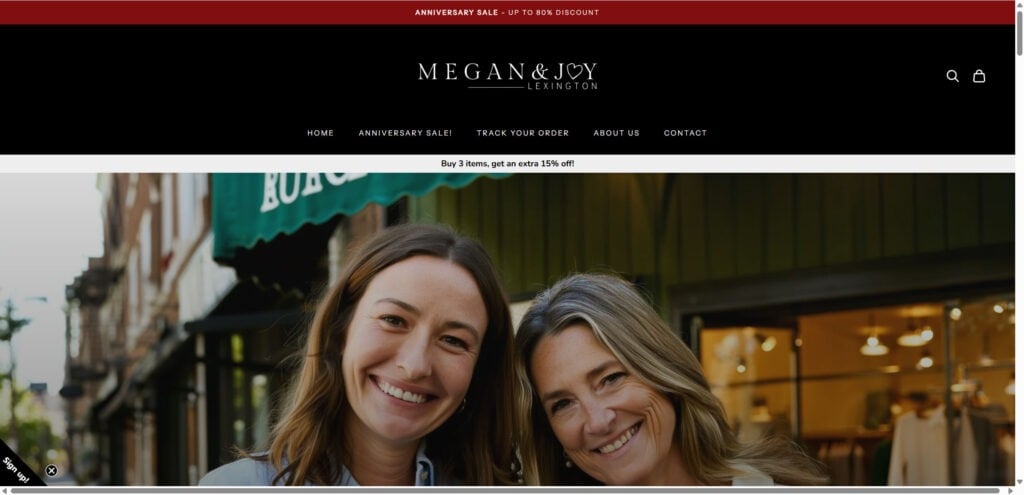
A site called Megan and Joy Lexington looks like the kind of place you stumble on during a late-night scroll and instantly bookmark. Big “anniversary” discounts. Cozy boutique storytelling. Beautiful product photos that make you picture the package arriving and somehow upgrading your whole closet.
Then orders start showing up.
Not always what the listing suggested. Not always the quality you thought you paid for. And when you try to fix it, the conversation often turns into a slow, exhausting negotiation that somehow ends with you being offered 15% to 30% back if you “keep the item.”
If you found Megan and Joy Lexington through an ad, or you already placed an order and something feels off, this guide breaks down the pattern behind stores like this, what to watch for, and what to do next.
Scam Overview
“Megan and Joy Lexington” fits a very common template: a polished storefront built to feel like a real, local brand, paired with deep discounts and a sentimental backstory. The goal is simple. Make you feel safe, make you feel lucky, and get you to checkout before you have time to slow down and verify anything.
This type of operation does not usually look like an obvious scam at first glance. The site can be clean. The product pages can be convincing. The copy can feel warm and personal.
The red flags show up when you zoom out and look at the full customer journey.
The “boutique story” that sells trust fast
These sites often lead with a founder narrative. Something like:
- A small-town boutique
- A family-run brand
- A heartfelt origin story
- A “thank you” sale for loyal customers
- A big milestone like an “anniversary” event
It’s designed to do one thing: create emotional credibility quickly.
In many cases, the “founders” and brand lifestyle photos appear AI-generated or heavily edited. The writing can read like it was produced in bulk, with the same rhythm and phrasing you see across dozens of rebranded storefronts. When scammers change the name, they usually keep the same structure and swap out the people, the town, and the logo.
The pricing and discount pressure that pushes impulse buys
A classic sign is a discount ladder that encourages bigger carts:
- “Buy 2, get an extra 10% off”
- “Buy 3, get an extra 15% off”
- “Up to 80% off”
- “Limited stock”
- “Ends today”
The problem is not that sales exist. Real stores run sales constantly.
The issue is the combination of:
- Extremely high discounts across most of the catalog
- A constant “sale ends soon” vibe
- Extra discounts that reward buying more before you can test quality
That structure increases the odds you buy multiple items, raising the payout for the operator and making chargebacks harder because the transaction amount is larger and the dispute becomes more complicated.
The product photos feel “too perfect” for the price
One of the strongest pattern-matches in these networks is product imagery.
You’ll see:
- Studio-clean photos that look like premium brand shoots
- Perfect fabrics and tailoring in photos, but no detailed material specs
- Listing images that appear reused across unrelated stores
- “Lifestyle” shots that look generated or stock-like
This is often a sign the store is not photographing its own inventory. Instead, it’s pulling images from other sources, then shipping whatever it can source cheaply.
What customers say they actually receive
The most common complaints in this category include:
- Items arriving with noticeably lower quality than advertised
- Materials that don’t match the photos (thin fabric, cheap stitching, odd sizing)
- Products that look like generic mass-market items, not boutique pieces
- Packages arriving from overseas, frequently China, even if the brand story suggests otherwise
- Long shipping delays or confusing tracking updates
In your earlier examples of similar schemes, some shoppers even report receiving cheap substitute items (like low-cost watches) that don’t match what was ordered. That “random cheap item” tactic is used to create a delivery record and complicate refunds.
The “partial refund if you keep it” play
This is one of the most telling behaviors.
When customers complain, support often responds with a script that sounds helpful at first, then pivots into bargaining:
- “We can offer you 15% back and you keep the item.”
- “We can do 20% or 30% as a courtesy.”
- “Returning costs are high, but we can compensate you.”
- “We can refund you partially due to shipping fees.”
Why do they do this?
Because partial refunds:
- Cost them less than a full refund
- Reduce the number of chargebacks
- Make many customers give up, especially when the item is “not worth the fight”
- Create a paper trail that the merchant “resolved” the issue
It’s not customer service. It’s a retention tactic for disputed transactions.
Returns are “possible” on paper, but practically impossible
Another signature of these operations is the return process.
A typical return policy may say returns are allowed within a certain window, but the actual process often includes obstacles like:
- You must email support first and wait for approval
- You must ship the item back to China
- You must use tracked shipping at your expense
- You must label customs forms correctly
- Refunds are only processed after the return is received and inspected
- The return address is unclear, inconsistent, or changes
Shipping an item internationally with tracking can cost a lot. For many customers, the return shipping cost is close to the item price. That is not an accident.
It creates a situation where the “logical” choice feels like accepting 15% to 30% back and moving on.
Why the site feels new, and why that matters
These stores frequently operate on new or recently registered domains. A new domain alone does not prove wrongdoing, but combined with the pattern above it becomes a strong risk indicator.
A new domain helps because:
- It has no long public history of complaints yet
- It can rank quickly with ads even without reputation
- If the brand gets too many complaints, they can pivot to a new name and new domain
This is why you keep seeing “new boutiques” with similar layouts, similar product photos, and similar sales messaging.
“Part of a network” signals
When you see multiple storefronts that share:
- The same site structure
- Similar navigation labels (Track Your Order, About Us, Contact)
- Similar discount ladders
- Similar refund scripts
- Similar product photography style
- Similar claims about being a small boutique
…it strongly suggests you are not looking at one independent shop. You are looking at a repeatable system.
Often, the operation behind the scenes is closer to a “factory” of storefronts than a single brand.
The real risk for shoppers
The damage from a store like this is not only “I got a bad product.”
The bigger risks include:
- Wasted time chasing support emails
- Being pressured into partial refunds that don’t actually fix the problem
- Missing chargeback windows while waiting on responses
- Your payment details being used for future attempts, especially if you paid by card on a site you don’t trust
- Personal data being stored and reused across related sites (name, address, email, phone)
Even when nothing “extra” happens, the business model depends on enough shoppers giving up.
How The Scam Works
Below is the step-by-step playbook behind the Megan and Joy Lexington style of “boutique sale” scam. Not every store follows every step perfectly, but the sequence is consistent enough that you can often predict what happens next.
Step 1: The ad hooks you with a “too good to ignore” offer
Most people discover sites like this through:
- Facebook or Instagram ads
- TikTok ads
- Sponsored posts
- Sometimes Google Shopping style placements
The creative is designed to feel like a real brand promotion:
- Cozy, emotional language
- Big discounts like 60% to 80%
- Limited-time framing
- A “small boutique” vibe
The goal is not to build a long-term customer relationship. The goal is to convert impulse traffic.
Step 2: The homepage builds a fast illusion of legitimacy
The site typically includes:
- A clean logo and professional layout
- A banner for the “anniversary sale”
- Easy navigation (Women, Men, Track Order, About Us)
- Payment icons (card brands, wallet options)
These details create a feeling of “normal store.”
But here’s what matters: a polished template is easy to deploy. It is not proof of legitimacy. Many scam networks use the same ecommerce theme and swap branding in minutes.
Step 3: Product pages prioritize emotion over verification
Product pages often include:
- Beautiful photos
- A high “compare at” price to make the discount look huge
- Vague descriptions
- Limited material detail
- Few or no verified reviews
Sometimes reviews exist, but they:
- Sound generic
- Repeat the same phrases
- Lack specific sizing or fabric details
- Appear across different products with only the product name changed
The objective is to get you to click “Add to cart,” not to inform you.
Step 4: Urgency and stacking discounts inflate cart size
This is where the “Buy more, save more” ladder matters.
It’s common to see:
- Extra % off when you buy 2 or 3 items
- “Selling fast” language
- “Final hours” banners
- “Once it’s gone, it’s gone” claims
This pushes shoppers to:
- Add one more item to qualify for the next discount tier
- Place the order immediately to “lock in” the deal
The scam becomes more profitable when you buy multiple items.
Step 5: Checkout collects payment and locks you into the support funnel
Once you pay, you are now inside their system.
From here, two things often happen:
- You receive an order confirmation email quickly (to reassure you)
- Shipping details become vague or delayed
If you try to cancel quickly, many customers report that the store:
- Claims the order already shipped
- Says it cannot be canceled
- Offers store credit instead of a refund
This is a key pivot point. They want to move you away from a clean refund and into a drawn-out process.
Step 6: Overseas fulfillment begins, often with long delays
The package frequently ships from China or passes through a logistics chain that looks like:
- A label created quickly
- Tracking updates that don’t move for days
- A handoff to a local carrier later
This is typical of low-cost overseas fulfillment.
Some sites will avoid stating where items ship from until after purchase. Others will bury it in policy pages.
Step 7: The delivery arrives, and the quality mismatch becomes obvious
This is the moment many shoppers realize the “boutique” story does not match the product.
Common mismatch points:
- Fabric feels cheaper than shown
- Stitching and finishing look rushed
- Sizing is inconsistent
- Items resemble mass-produced versions of the photos
- The product looks different than the listing
In more aggressive cases, shoppers report receiving:
- Substitute items
- Random low-cost items
- Products that do not match the order
That “cheap item” tactic can create a delivered tracking event that the merchant later uses when disputes are opened.
Step 8: Customer support responds, then redirects you into negotiation
When customers complain, the replies often follow a pattern:
- Apologize briefly
- Ask for photos
- Offer a partial refund (15% to 30%)
- Suggest you keep the product
- Say international returns are expensive
It is framed as a “fair compromise.”
But the structure benefits the seller. They keep most of the money and reduce chargeback risk.
Step 9: If you push for a full refund, the return policy becomes a maze
If you insist:
- They may require you to ship back to China
- They may delay giving a return address
- They may give conditions that are hard to meet
- They may claim damage or “wrong packaging” later
This often drags past key dispute deadlines.
Step 10: Many customers give up, and that is the business model
The scam does not need to “win” every case.
It only needs:
- Enough customers who never complain
- Enough customers who accept partial refunds
- Enough customers who miss dispute windows
That creates predictable profit, even with a steady stream of complaints.
Step 11: When heat increases, the brand name changes
Once a storefront gathers too many negative posts, chargebacks, and warnings, the operator can:
- Launch a new name
- Register a new domain
- Reuse the same templates and product images
- Run a new wave of ads
That is why you keep seeing different “boutiques” with eerily similar sales, stories, and layouts.
What To Do If You Have Fallen Victim to This Scam
If you ordered from Megan and Joy Lexington (or a similar boutique-style sale site) and you suspect you were misled, the most important thing is to move quickly and document everything. Here’s a practical path that works in most countries and with most payment methods.
- Take screenshots now
- The product page you bought from (photos, description, price)
- The cart and checkout totals
- The store’s refund and shipping policy pages
- Your order confirmation and any tracking pages
Save these before anything changes.
- Photograph what you received
- Clear photos of the item
- Close-ups of quality issues
- Photos of tags, labels, packaging
- A photo showing the shipping label and origin if visible
If the item doesn’t match the listing, comparison photos matter.
- Contact the seller once, but keep it short and firm
Ask for a full refund due to misrepresentation or not as described.
Avoid long emotional back-and-forth. Your goal is a written record.Helpful phrases:- “The item received is not as described on the product page. I am requesting a full refund.”
- “If you require a return, provide a prepaid return label or a domestic return address.”
- Do not let the “15% to 30% refund” offer trap you
If you accept a partial refund, you may weaken your dispute later.
Only accept partial refund if you genuinely want to keep the item and close the case. - If they demand return shipping to China, respond strategically
Many buyers win disputes by stating:- “I will return the item if you provide a prepaid label.”
- “I will return the item to a domestic return address.”
- “Return shipping to China costs more than the item and is not a reasonable remedy for misrepresentation.”
- Open a dispute with your payment method quickly
The best option depends on how you paid:- Credit card: Contact your bank and request a chargeback for “item not as described” or “merchandise dispute.”
- Debit card: Disputes are possible, but timelines vary. Move fast.
- PayPal: Open a dispute inside PayPal’s Resolution Center and escalate if needed.
- Apple Pay / Google Pay: The underlying card issuer still handles disputes, but wallet records help.
- Watch your timelines
Dispute windows vary, but many are measured in weeks, not months.
Delays are often used to push you past the point where your bank can help. - Monitor your card for additional charges
If you paid by card on a site you no longer trust:- Watch statements closely
- Consider freezing the card or requesting a replacement
- Enable transaction alerts if your bank offers them
- Report the ad and the store where you found it
If you found it via Facebook, Instagram, or TikTok:- Report the ad
- Report the account running it
- Include “misleading product” or “scam” categories if available
- Warn others with factual details
If you post publicly, stick to specifics:
- What you ordered
- What you received
- Shipping origin
- The refund offer pattern (15% to 30% to keep it)
- Return requirements (shipping to China, at your expense)
Specific details help other shoppers identify the same network when it rebrands.
The Bottom Line
Megan and Joy Lexington checks many boxes that shoppers associate with a repeatable “boutique sale” trap: a sentimental founder story, massive discounts, polished product imagery, overseas fulfillment, and a customer service pattern that tries to settle complaints with 15% to 30% refunds instead of making things right.
If you are considering ordering, slow down and verify the brand outside its own website and ads. If you already ordered and the product is not what you expected, focus on documentation, avoid endless negotiation, and use your payment provider’s dispute process before you run out of time.
FAQ: Megan and Joy Lexington Shopping Scam
Is Megan and Joy Lexington a legitimate store?
Some shoppers report a pattern that does not match a normal boutique experience: heavy “limited time” discounts, questionable product images, items arriving with much lower quality than expected, and refund negotiations that offer only 15% to 30% back if you keep the item. Those signals are commonly associated with high-risk online storefronts.
Why do the product photos look so professional?
Many questionable stores use stock photos, borrowed images, or AI-generated visuals to make listings look premium. The photos can be dramatically better than what’s actually shipped.
Why are they offering only 15% to 30% back instead of a real refund?
Because partial refunds are cheaper for the seller and reduce chargebacks. It’s a common tactic: make the problem feel “resolved” while keeping most of your payment.
They said I can return it, but I must ship it to China. Is that normal?
It can happen with overseas sellers, but it’s also a frequent friction tactic in scam-style shops. International tracked shipping is expensive, slow, and complicated, which causes many people to give up.
What if the item I received is not what I ordered?
Document everything immediately:
- Screenshot the product page
- Photograph what arrived and the shipping label
- Save emails and tracking
Then dispute the transaction as “item not as described” with your card issuer or payment platform.
What if the site shows “delivered” but I got something random or cheap?
That can be used to create a delivery record. Take photos of the item and packaging, keep the shipping label, and file a dispute stating the package contents did not match the order.
How long should I wait before opening a dispute?
Do not wait too long. If the product arrives and it’s clearly not as described, start the dispute process right away. Delays can push you past your protection window.
I paid with a credit card. What should I say to the bank?
Use clear language:
- “Item not as described”
- “Quality and appearance do not match listing”
- “Merchant is refusing a full refund unless I pay costly international return shipping”
Provide screenshots, photos, and the refund offer emails.
I paid with PayPal. What should I do?
Open a dispute in PayPal’s Resolution Center as soon as you suspect the item is not as described. Upload your evidence and escalate if the seller stalls or only offers partial refunds.
Can they keep charging my card after I buy once?
Most merchants will not, but risky sites sometimes lead to additional charges or future attempts. Monitor your statements, enable alerts, and consider replacing the card if you don’t trust the site.
How can I spot similar “boutique sale” scams in the future?
Watch for clusters of red flags:
- New domain and no real brand history
- Huge discounts across the entire store
- “Buy more, save more” pressure
- Vague product details and perfect images
- Return policy that requires shipping to China
- Support that pushes partial refunds instead of returns
Where should I report the site or the ad?
- Report the ad on the platform you saw it on (Facebook, Instagram, TikTok)
- Report to your payment provider
- Optionally file a complaint with your national consumer protection agency
If you’re in the US, the FTC is a common reporting route; in the UK, Action Fraud; in the EU, your local consumer authority.








