

It shows up like any other text. No letterhead, no envelope, no warning.
Just a “Final Notice,” a deadline, and a list of consequences that hit you right where it hurts: your registration, your license, your ability to drive tomorrow morning.
The message sounds confident. It cites an “administrative code.” It offers a simple fix, a single link, a quick payment.
And it leaves you with one uncomfortable question that’s hard to ignore.
What if it’s true?
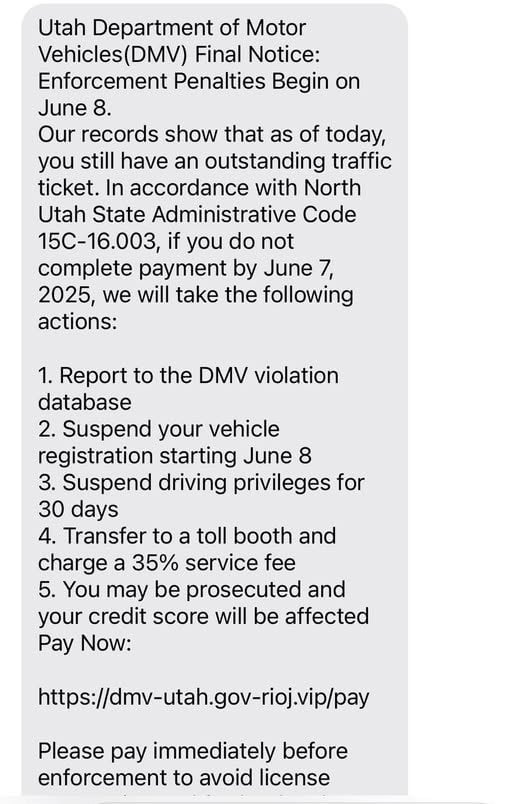
Scam Overview
Over the last year, Utah drivers have been sharing screenshots of a specific kind of message that looks like it comes from the Utah Department of Motor Vehicles. The text claims you have an “outstanding traffic ticket,” warns that “enforcement penalties” are about to begin, and pressures you to pay immediately through a link.
In many cases, the message reads like a government notice that somehow got delivered to your phone instead of your mailbox.
It uses official-sounding language. It includes a deadline that feels urgent. It threatens real-world consequences that are scary enough to make even careful people pause and consider paying just to be safe.
Here is the pattern that makes this scam so recognizable.
The common “Utah DMV Final Notice” template
The text often includes:
- A subject line that sounds official, like “Utah Department of Motor Vehicles (DMV) Final Notice”
- A specific enforcement date, such as “Enforcement Penalties Begin on June 8”
- A claim that “our records show” you have an outstanding ticket
- A legal-sounding reference, often an “administrative code” number
- A numbered list of punishments
- A “Pay Now” link that appears to go to a DMV payment portal
- Sometimes, instructions to reply “Y” if the link is not clickable
In your screenshot, the text includes a link that looks like this:
https://dmv-utah.gov-rioj.vip/pay
At a quick glance, the link appears to contain “dmv-utah.gov,” which can trick the brain into thinking it’s official.
But the real domain in that example is rioj.vip, not a Utah government site.
That one detail is the giveaway, and it’s also the reason this scam continues to work. The link is designed for people who glance quickly, not people who read carefully.
Utah officials have warned about this exact scam
Utah’s Motor Vehicle Division has issued warnings about fraudulent text messages circulating in Utah that falsely claim the recipient has an outstanding traffic ticket and threatens enforcement actions if payment is not made. They advise people to verify suspicious notices by contacting the Utah DMV directly and to avoid clicking links or calling numbers listed in the fraudulent texts.
Local agencies and community channels have echoed the same warning: these DMV-style texts are scams, and the Utah DMV does not text people asking for payment.
This is not a one-off prank. It’s a repeatable fraud template that scammers can deploy in any state by swapping out the state name and adjusting the dates.
Why the scam feels so believable
If you’re wondering why smart, cautious people still get pulled into messages like this, it helps to understand how the text is engineered.
It leans on a few psychological triggers that work fast.
Authority and fear, packaged together
Most of us have been trained to treat DMV-related issues as serious.
Even if you’ve never had a major violation, you know that the DMV can impact your daily life in an instant. Registration problems can lead to fines. License suspensions can lead to bigger trouble. Just the idea of getting pulled over with an unexpected suspension is enough to make your heart rate spike.
Scammers exploit that.
They borrow the authority of “DMV,” then layer in fear:
- Reported to a “DMV violation database”
- Vehicle registration suspended
- Driving privileges suspended for 30 days
- A 35% service fee
- Prosecution and credit score impact
The scary part is that these consequences sound like things that could happen in real life, just not in the way the text describes.
A deadline that steals your time to think
The message usually gives a short window, sometimes 24 hours, sometimes “pay by tomorrow,” sometimes a specific date.
That timeline is not about policy.
It is about preventing verification.
Scammers want you to act before you:
- look up the real DMV website
- call the official DMV number
- check your court records
- ask a friend if the message looks legitimate
Urgency is the scam’s fuel.
Official-looking details that are meant to be skimmed
The message often includes a legal citation or administrative code, like “15C-16.003.”
Most people won’t verify the code. That’s the point.
It’s there to create a feeling: “This must be a real system, written by someone who knows the rules.”
You don’t need to understand it. You just need to feel like it exists.
The “small payment” trick
Many versions of this scam ask for a small payment to “clear” the ticket or unlock your record.
A small amount, like $5 to $15, is an intentional choice.
It’s low enough that people think:
“It’s not worth the hassle. I’ll just pay.”
But the payment itself is not always the main goal.
The bigger goal is the information you type in while trying to pay.
What scammers are really trying to collect
The fake payment site often asks for a combination of personal details and financial details.
That can include:
- Full name
- Home address
- Phone number
- Email address
- Driver license number (sometimes)
- Credit or debit card number
- Expiration date and CVV code
Once scammers have those details, the damage can go in multiple directions.
They can:
- make unauthorized charges on your card
- sell your card details to other criminals
- attempt identity theft using your address and other personal information
- target you again later with more convincing scams
This scam is part of a bigger national pattern
The Federal Trade Commission has warned about texts that claim you have an overdue traffic ticket and threaten the same exact penalties you see in these Utah screenshots, including reporting you to a “DMV violation database,” suspending registration and driving privileges, and charging an extra 35% fee.
National outlets have also covered how these DMV scam texts are hitting multiple states, often with nearly identical phrasing and structure.
So if you feel like you’ve “seen this before,” you probably have.
It’s a template.
And Utah is simply the latest state name dropped into it.
Why the phone number itself can be a big clue
In many screenshots, including the one you shared, the message comes from an international-looking number.
For example, some victims report the sender begins with +63, which is the country code for the Philippines.
That doesn’t automatically prove fraud, but it’s a major red flag for a message claiming to be from a state motor vehicle agency.
Consumer advocates have warned that one way to spot smishing scams is to look closely at the sender number, especially when it has an international country code that doesn’t match the organization being impersonated.
The simple truth behind the Utah DMV “Outstanding Traffic Ticket” text
The message is not trying to help you.
It’s trying to rush you.
It tries to look official long enough for you to click.
Once you click, the real goal starts: getting your personal information and card details inside a fake portal that looks close enough to pass a quick glance.
That’s why understanding the mechanics matters.
Because once you know how it works, you stop reacting, and you start evaluating.
How The Scam Works
This section breaks down the Utah DMV outstanding traffic ticket text scam step by step, in the same order most victims experience it.
If you read it carefully, you’ll start recognizing the scam’s “rhythm,” which makes it much easier to spot in the future.
Step 1: Scammers send thousands of texts at once
These messages are not hand-written and sent one at a time.
They are sent in bulk.
Scammers use automated tools to send the same script to huge lists of phone numbers. They don’t need to know whether you have a ticket. They only need a small percentage of people to believe the message.
That’s why you might receive the text even if:
- you haven’t been pulled over in years
- you don’t live near toll roads
- you just renewed your registration
- you’ve never had a “traffic ticket” in Utah
It’s not about your record.
It’s about volume.
Step 2: The message hits you with a “Final Notice” tone
The scam text usually starts with wording that sounds like enforcement is already underway.
Phrases like:
- “Final Notice”
- “Enforcement begins on…”
- “Our records show…”
- “If you do not complete payment by…”
This is designed to create the feeling that you’re already late.
And when you feel late, you’re more likely to act quickly.
Step 3: It adds legal-looking language to sound legitimate
Next comes the “administrative code” line.
This part is meant to override your skepticism.
Even if the code is fake or irrelevant, it creates the impression of official procedure.
It’s the equivalent of a uniform in a text message.
Most people won’t take the time to verify a statute number, especially when a deadline is staring at them.
Step 4: The scam stacks consequences to raise the emotional stakes
Then you get the list.
This is where the scam goes from “annoying” to “urgent.”
Most versions include five main threats:
- reporting you to a DMV database
- suspending your registration
- suspending your license or driving privileges
- adding a 35% fee
- prosecution and credit score harm
The FTC has specifically called out this pattern, including the “35% service fee” and “DMV violation database” language, as a hallmark of these overdue ticket scams.
The list is there for one reason: to make doing nothing feel dangerous.
Step 5: The “Pay Now” link appears, and it looks almost real
Now the scam offers relief.
It usually says “Pay Now” and includes a link that looks like it belongs to the DMV.
This is where domain tricks come in.
Let’s use the example from your screenshot:
https://dmv-utah.gov-rioj.vip/pay
Many people see “dmv-utah.gov” at the start and stop reading.
But in a URL, what matters is the registered domain, which is usually the part right before the ending like .com, .org, .gov, .vip.
In this case, the real domain is:
rioj.vip
The “dmv-utah.gov” part is just extra text placed before the real domain to confuse you.
This is one of the most common smishing tactics on the internet.
Step 6: If links are blocked, the scam tells you to reply “Y”
Some phones and messaging apps try to protect you.
For example, certain iMessage settings may not make unknown links clickable.
Scammers have adapted.
That’s why many versions include the instruction:
“Reply ‘Y’ and reopen this message to click the link.”
This is a clever workaround.
It does two things:
- it helps the link become clickable
- it confirms to the scammer that your number is active and responsive
Media outlets have reported that scammers often use “reply to activate the link” instructions as a way to bypass protections and increase engagement.
Step 7: The link opens a fake DMV payment portal
Once you click, you land on a page designed to look official.
Some are crude.
Others are polished enough to fool someone who is already nervous.
These pages often include:
- DMV-like branding and government-style layout
- form fields for identity “verification”
- a fake fine amount
- a payment button that feels simple and urgent
The goal is not to provide a real service.
The goal is to get you typing.
Step 8: The site collects personal details, then payment details
Most people expect a payment form.
What they don’t expect is how much personal data the site requests before payment.
A typical flow looks like this:
- “Verify your identity” page
- Full name
- Phone number
- Address
- “Ticket details” page
- A citation number appears
- A fine amount appears
- A countdown timer may appear
- “Payment” page
- Card number
- Expiration date
- CVV security code
- Billing address
This combination is extremely valuable for fraud.
Even if the scam only charges $10, the card details can be used for much more.
Step 9: The victim sees a “success” message, even though nothing was paid
Many scam sites show a confirmation screen.
It might say:
- “Payment Successful”
- “Transaction Completed”
- “Receipt Generated”
This is not proof of payment.
It’s a delay tactic.
The longer you believe everything is fine, the more time the scammer has to use your card.
Step 10: The scammers move fast with your card details
In many fraud cases, scammers test the card first.
They might run:
- a small charge to confirm it works
- then larger charges later
- purchases that look like online shopping
- digital goods that are hard to trace
If the site also collected your address and phone number, that information can support additional fraud attempts.
Step 11: The scam evolves, and victims get targeted again
Once you respond, click, or pay, you can end up on a list of “responsive” targets.
That can lead to follow-up attempts like:
- “Your payment failed, try again”
- “Refund issued, verify your banking details”
- “Collections notice, pay now to avoid court”
- “DMV suspension confirmed, click to appeal”
It can feel relentless.
But once you recognize the pattern, you can stop the cycle quickly by cutting off engagement and securing your accounts.
What To Do If You Have Fallen Victim to This Scam
If you clicked the link, replied to the message, or entered information, take a breath.
You don’t need to panic. You just need to act in the right order.
Here is a calm, practical checklist you can follow.
- Stop interacting with the text immediately
Do not click again. Do not reply again. Do not try to “fix it” through the link. Close the message. - If you entered card details, call your bank or card issuer right away
Tell them your card information was entered into a phishing website impersonating the DMV. Ask them to:- cancel the card
- issue a replacement
- review recent and pending transactions
- dispute any unauthorized charges
- Check your account for small test charges
Look for unfamiliar charges, even small ones. Scammers often run small payments first to see if the card works. - If you entered personal information, protect your identity next
If you shared your address, email, or driver license details, consider:- placing a fraud alert with the credit bureaus
- freezing your credit for stronger protection
- monitoring your credit report for new accounts you didn’t open
- Change passwords if there’s any chance you reused them
If you typed a password anywhere during the process, or if you reuse passwords often, update them now, especially for:- your email
- your bank
- your mobile carrier account
Turn on 2-factor authentication where available.
- Report the scam text to your mobile carrier
Forward the message to 7726 (SPAM) if your carrier supports it, and use your phone’s “Report Junk” feature when available. - Report the scam to the FTC
Filing a report helps investigators track patterns and issue broader warnings. The FTC has specifically warned about these DMV-style overdue ticket texts. - Verify directly with Utah DMV if you are still worried about a real ticket
Do not use the link in the text. Use official contact information you find independently. Utah officials have advised drivers to contact the Utah DMV directly to confirm authenticity if they receive a suspicious notice. - Save screenshots before deleting the message
Keep:- the phone number or sender ID
- the full message text
- the link shown in the message
This helps with bank disputes and reports.
- Stay alert for follow-up scams over the next few weeks
If scammers got your phone number and personal info, they may try again. Be cautious with “refund” messages and “collections” threats.
The Bottom Line
The Utah DMV outstanding traffic ticket text scam is designed to hijack your attention, trigger fear, and push you into a quick decision before you verify anything.
Utah agencies have warned residents about fraudulent DMV-style texts and advised drivers to avoid clicking links, and to verify concerns by contacting the Utah DMV directly through official channels. The FTC has also flagged this exact “overdue ticket” script, including the 35% fee and the “DMV violation database” threat, as a common nationwide scam pattern.
If you received the message, the safest move is simple: don’t click, don’t reply, and verify through official sources you find on your own.
And if you already interacted with it, don’t dwell on the mistake. Handle your accounts, lock down your information, and move forward a little wiser. The moment you slow the scam down, it starts losing power.
FAQ: Utah DMV Outstanding Traffic Ticket Text Scam
What is the Utah DMV “Outstanding Traffic Ticket” text scam?
The Utah DMV outstanding traffic ticket text scam is a phishing scheme where scammers send fake SMS or iMessage alerts claiming you owe a traffic ticket. The message threatens penalties like registration suspension and license suspension unless you pay immediately through a link. The link leads to a fraudulent website designed to steal your personal information and credit or debit card details.
Is the Utah DMV actually texting people about unpaid traffic tickets?
No. A surprise text demanding immediate payment, especially with a “Pay Now” link and threats of enforcement within hours or a day, is a major red flag. Utah officials have warned about fraudulent DMV-style text messages and advise people not to click links and to verify through official channels.
What does a typical Utah DMV scam text message look like?
Most versions follow a similar format:
- “Final Notice” or “Enforcement Penalties Begin on [date]”
- “Our records show you still have an outstanding traffic ticket”
- A legal-sounding “administrative code” reference
- A list of penalties (registration suspension, license suspension, 35% fee, prosecution, credit impact)
- A “Pay Now” link
- Sometimes: “Reply Y and reopen the message to click the link”
Why does the link look like a government website?
Because scammers design it to be skimmed, not studied. A link like https://dmv-utah.gov-rioj.vip/pay looks official at first glance because it includes “dmv-utah.gov,” but the real domain is the ending part, in this example .vip. Real Utah government websites use official domains, and scammers often use lookalike links to trick people who read quickly.
What are the biggest red flags that the Utah DMV text is a scam?
Common warning signs include:
- A short deadline like “pay within 24 hours” or “pay by tomorrow”
- Threats of immediate suspension or prosecution
- Mentions of a 35% fee or “toll booth” payment
- A link that ends in unusual domain extensions like .vip, .win, .xyz, or similar
- Instructions to “Reply Y” to activate the link
- A sender number that looks random or uses an international country code
Why does the message mention a “DMV violation database”?
It is meant to sound official and intimidating. The FTC has warned about overdue traffic ticket scam texts that use this exact kind of language, including threats about a “DMV violation database,” registration suspension, driving privilege suspension, and extra fees like 35%.
Can scammers really suspend my license or vehicle registration?
No. Scammers do not have DMV authority. They use fear to push you into paying or entering information. Real license or registration actions happen through official state processes, not surprise texts with payment links.
What happens if I click the link but do not enter information?
Clicking alone can expose you to risks like tracking, aggressive redirects, or additional scam prompts. The risk is much higher if you enter personal or card details, but even if you only clicked, you should close the page and watch for follow-up scam attempts.
What happens if I enter my credit card information on the scam site?
If you entered card details, scammers may:
- Run small “test” charges first
- Follow with larger unauthorized purchases
- Sell your card information to other criminals
If this happens, contact your bank immediately to cancel the card and dispute any fraudulent charges.
Why do scammers ask for a small payment?
Many phishing scams request small amounts, often $5 to $15, because it feels believable and people are more likely to pay quickly without verifying. The real goal is often to capture your card details and personal data, not the small initial amount.
What should I do if I already paid or entered my information?
Take these steps right away:
- Call your bank or card issuer and report your card as compromised.
- Cancel the card and request a replacement.
- Review recent and pending transactions and dispute anything you do not recognize.
- Consider placing a fraud alert or credit freeze if you entered personal identity details.
- Change passwords if you entered any login information or reuse passwords elsewhere.
- Report the scam text to your carrier and to the FTC.
How do I report the Utah DMV scam text?
You can report it by:
- Forwarding the text to 7726 (SPAM) to report it to your mobile carrier (if supported)
- Filing a report with the Federal Trade Commission (FTC), which has warned about these ticket-related scam texts
- Reporting it through Utah consumer protection or local law enforcement channels if money was stolen
How can I check if I really have a traffic ticket in Utah?
Do not use the link in the text. Instead:
- Look up official Utah court or Utah DMV resources by typing the address into your browser yourself
- Call official phone numbers you find on legitimate government sites, not numbers provided in the text
Utah officials specifically advise verifying suspicious messages by contacting the Utah DMV directly through official channels.
Why am I getting this text if I have no tickets?
Because scammers send these messages in bulk. They do not need to be accurate. They rely on volume and fear, knowing that some recipients will assume it might be real and click.
What is the safest rule to follow with DMV text messages?
If a text claims you owe the DMV money and includes a link, do not click it. Verify independently using official sources you find yourself. That single habit prevents most DMV smishing scams from working.









My wife received this scam message on her phone #435-841-1797. Should report this to the DMV and if so what number should we call?
Hi Chauncey, thank you for reporting this.
Yes, you can report it, but do not call any number from the message itself. For DMV-related scams, the safest approach is to check your state DMV’s official website and use only their official contact information.
You can also report the scam text to the FTC (reportfraud.ftc.gov) and forward the message to 7726 (SPAM), which helps mobile carriers investigate scam texts.