


In 2025, Memo Core was sold as memory drops at $49 a bottle with a 180-day guarantee. Yet the same sales page told buyers the drops were outdated.
If you’re reading Memo Core reviews, comparing its drops on Walmart or asking whether Memo Flow is a scam, here’s what changed and what to do.
Overview
What Memo Core promised
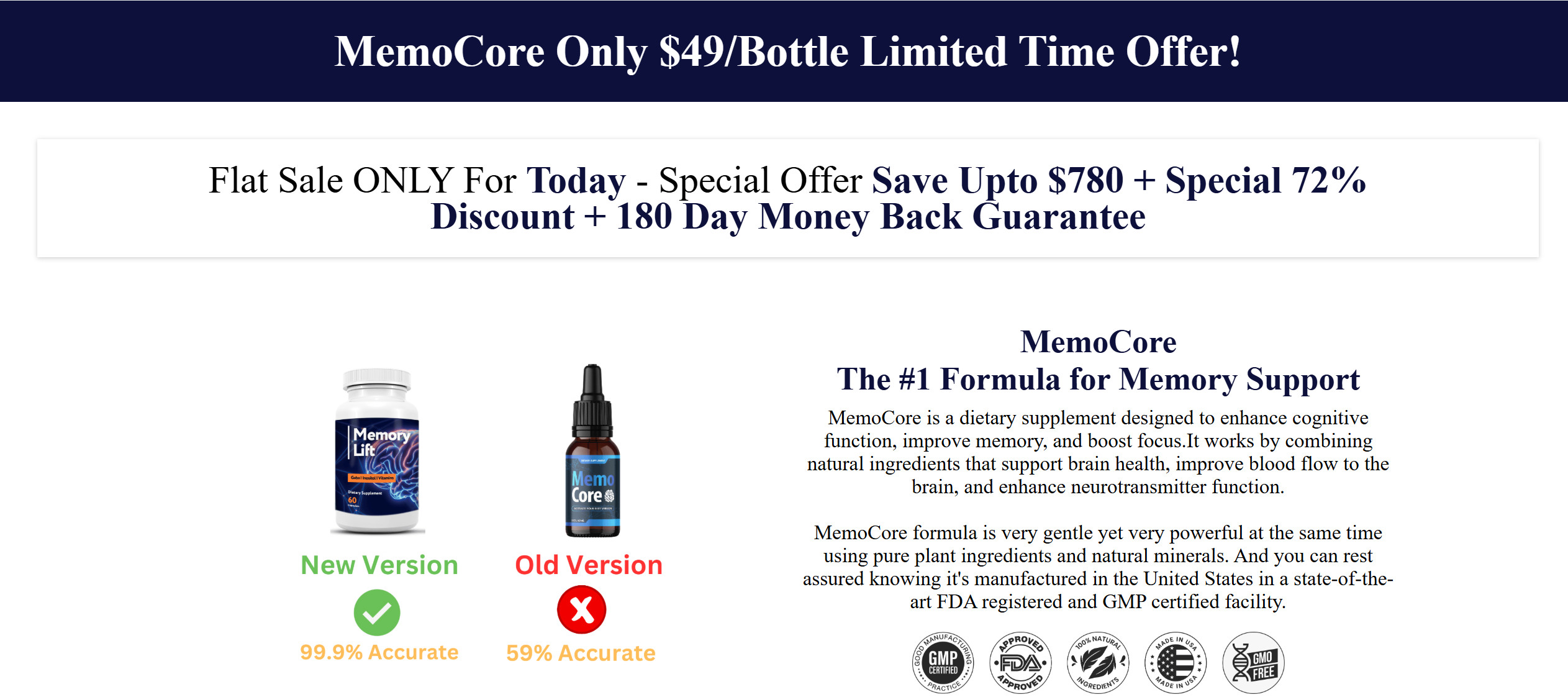
In July 2025, a sales page titled MemoCore, The #1 Formula for Memory Support, said the dietary supplement would enhance cognitive function, improve memory and boost focus.
The page offered a flat sale only for today, with savings of up to $780, a special 72% discount and a 180-day money-back guarantee alongside the $49 bottle price.
What changed since 2025
Today the name shows up in Walmart marketplace listings from three different sellers, at lower prices than the 2025 offer.
The obvious address for the brand, memocore.com, is listed for sale by a domain broker. No official Memo Core site currently shows a formula or a company contact.
Is Memo Core legit?
Memo Core comes with no clinical evidence and no named manufacturer or company address. These are the main reasons for caution:
- Product switch: the page called Memo Core the old version and pushed different capsules.
- Numbers: it rated the two products 99.9% and 59% accurate, which means nothing for a supplement.
- Badges: it showed an FDA approved seal, though the FDA doesn’t approve dietary supplements.
- Sellers: the current listings come from three marketplace sellers whose details name no manufacturer.
- Evidence: federal health researchers say proof that supplements prevent dementia is lacking.
The Old Version Graphic That Sold a Different Product
The most revealing part sat under the price banner: two bottles side by side, one with a green check and one with a red cross.
The capsule bottle, Memory Lift, was marked New Version. The dropper, Memo Core, was marked Old Version, even though the page was named after it.
Under Memory Lift, the page printed 99.9% Accurate. Under Memo Core, it printed 59% Accurate. It never explained what was being measured, who measured it or how.
Accuracy describes a test or a measuring device, not a supplement. Drops can’t be 99.9% accurate, so the figures only nudge buyers toward the capsules.
Someone who clicked an ad for Memo Core drops could end up looking at a different product, in a different form, with no explanation of how the two formulas differ.
The page text still described MemoCore as the formula, made with pure plant ingredients and natural minerals. The top of the page didn’t name those ingredients or their amounts.
The Same Graphic on Other Supplement Pages
Our Mind Honey 60 report shows the same layout: Brain Savior marked as the new version, with identical 99.9% and 59% figures.
Our Glycotide Drops report shows Sugar Defender promoted as the new version over Glycotide, again with unexplained accuracy percentages under the bottles.
Our EvoSlim review shows a weight loss page labeling Ignitra the new version, with the same $49 price, $780 saving and 72% discount. Its order button opened Ignitra.
We aren’t saying the same people run these pages. The graphic is a reusable template, and seeing it is a reason to slow down, not proof of ownership.
The pattern does show that the product named in an ad isn’t always the one being sold. Check the name on the order page and bottle before paying.
What FDA Registered and the FDA Badge Really Mean
The 2025 page said MemoCore was made in the United States in a state-of-the-art FDA registered and GMP certified facility. A row of seals underneath included one reading FDA Approved.
The FDA’s consumer guide Is It Really FDA Approved? says that by statute, the agency does not approve dietary supplements for safety and effectiveness.
The same guide says the FDA doesn’t approve manufacturing facilities independently, and that mere registration of an establishment doesn’t denote approval of the establishment or its products.
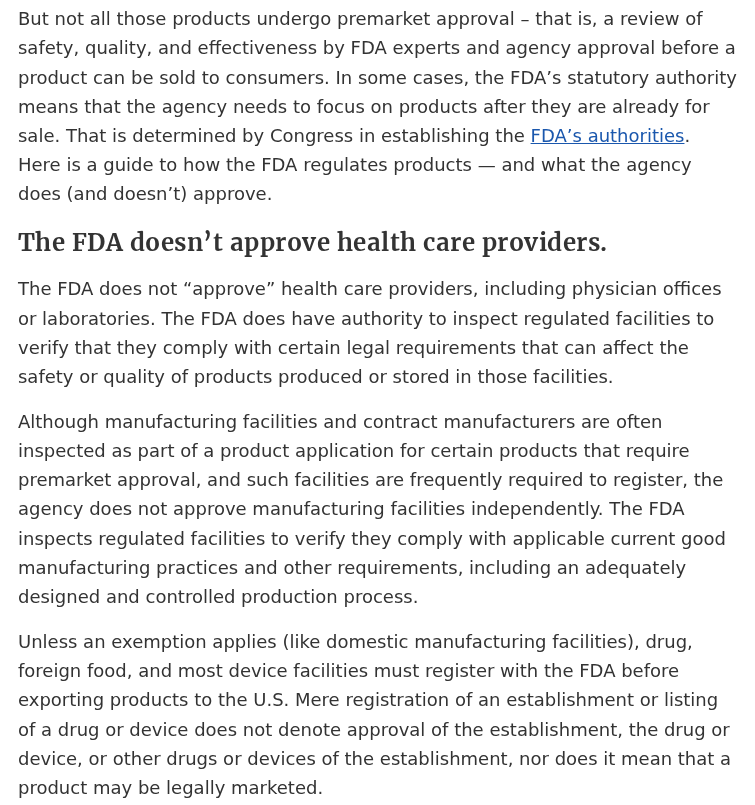
The guide also warns that misusing the FDA logo may violate federal law, and that the logo shouldn’t be used to suggest the FDA endorses a private product.
So an FDA Approved seal on a supplement tells you about the marketing, not the product. A GMP claim needs a named company, and this page named none.
Under FDA rules, supplement companies are responsible for making sure their products are safe and properly labeled. Many supplements can be sold without even notifying the agency first.
Memo Core on Walmart Today
In late October 2026, Walmart’s site had eight Memo Core listings, and none was sold by Walmart itself. All came from third-party marketplace sellers.
Precious Health Shops listed Memocore Advanced Formula Brain Support Drops in 30, 60, 90 and 150 serving sizes, priced at $19.95, $29.95, $39.95 and $59.95.
Fyvus Store listed Memo Core Brain Drop Supplement in a single 2 oz bottle at $19.95, a 3-pack at $39.95 and a 5-pack at $59.90.
Apollo Wholesale LLC listed a 3-pack, sold as a three-month supply of MemoCore Extra Strength All Natural Healthy Organic Support, at $39.69.
Walmart results for memo core brain drops also mixed in MemoCept capsules, a Memo Master supplement and MemoFlow drops marked New.
A Memo Master listing used nearly the same title wording as the Precious Health Shops drops. With look-alike titles, check the brand name before adding anything to your cart.
Who Sells Memo Core?
Neither the 2025 page nor the Walmart search listings name the company that makes Memo Core. That leaves buyers with store names and nothing else to check.
The 2025 sales page
The July 2025 page gave a price, a guarantee and a facility claim, but its top section showed no company name, address or phone number.
Without a named company, the 180-day guarantee had no clear party behind it. A guarantee is only worth something if you know who has to honor it.
Precious Health Shops
This seller had the largest range, with four sizes of the same drops. Each listing showed the same 2.5-star average from just two ratings, too few to judge anything.
The two bullets shown for its listings didn’t mention memory. They said Memocore helps maintain a sense of balance and vitality, and that the drops support a comfortable feeling.
Fyvus Store and Apollo Wholesale
Fyvus Store’s listing named L-Arginine, L-Carnitine and green tea extract as ingredients, chosen to support balanced energy. That’s an energy pitch inside a memory product title.
Apollo Wholesale’s listing called its product a dietary supplement presented as a potential addition to your daily regimen. Neither seller had any customer ratings at the time.
What none of them show
None of the listings links its seller to the 2025 sales page or to the other sellers. The products may not even share a formula.
That’s the problem with a brand name nobody owns publicly. Anyone can list drops under it, and a buyer can’t tell which version is in the bottle until it arrives.
What the Evidence Says About Memory Supplements
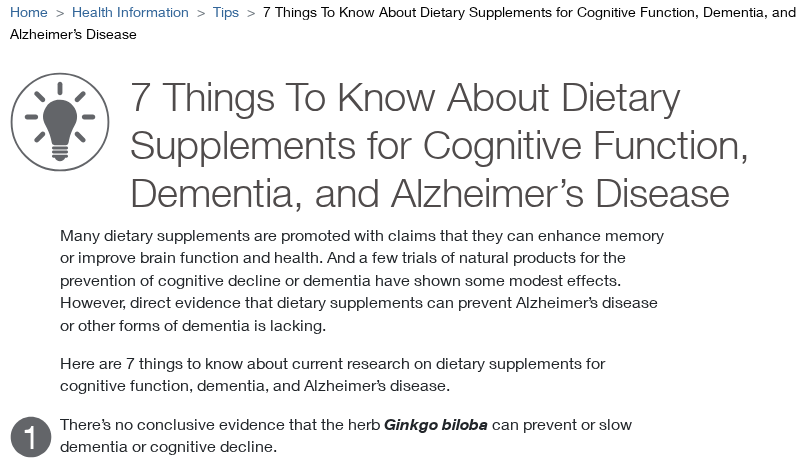
The National Center for Complementary and Integrative Health (NCCIH) has a short guide to what research shows about supplements for memory, dementia and Alzheimer’s disease.
It says a few trials of natural products have shown modest effects. But direct evidence that supplements can prevent Alzheimer’s disease or other dementia is lacking.
The guide adds that there’s no conclusive evidence that ginkgo biloba can prevent or slow dementia, and that the evidence on curcumin is too limited for any conclusions.
Short-term use of vitamins B6, B12 and folic acid hasn’t been shown to improve thinking in older adults, and too much B6 can cause serious side effects.
Omega-3 fatty acids, mostly measured as fish in the diet, have the most consistent positive findings for preventing decline. Omega-3 supplements haven’t been shown to help treat Alzheimer’s disease.
None of that supports a drop or capsule promising better memory and focus. A product that refuses to name its formula gives you even less to weigh.
Memory Changes Deserve a Check-Up
The same NCCIH guide makes a point every Memo Core shopper should hear. Don’t use supplements as a reason to put off seeing a health care provider about memory loss.
It lists treatable conditions that can impair memory, including depression, bad reactions to medications, and thyroid, liver or kidney problems. A doctor can test for these.
If you’ve been taking Memo Core drops or Memory Lift capsules, stop. Keep taking any treatment your doctor prescribed, and show the bottle to a pharmacist or your doctor.
That matters if your version contains green tea extract. NCCIH says liver injury, though uncommon, has been reported with green tea extracts, which can also interact with medicines.
Call 911 right away if memory problems start suddenly or come with confusion, one-sided weakness, trouble speaking or a sudden severe headache. These can signal a stroke.
How the Memo Core Pitch Works
Step 1: A memory promise
The page opens with a simple promise: better memory, sharper focus and improved cognitive function from a natural formula, aimed at people worried about forgetting.
Step 2: A one-day sale
A flat sale only for today, savings of up to $780 and a 72% discount push buyers to decide quickly, before they can compare or ask anyone.
Step 3: Official-looking seals
An FDA Approved seal, a GMP badge and a Made in USA stamp borrow the look of regulation. None of them identifies a company you could hold to account.
Step 4: The version switch
The page then calls its own product the old version and promotes Memory Lift with an invented accuracy score, steering buyers toward a different bottle.
Step 5: The name outlives the page
When the sales page disappears, the name keeps selling through marketplace listings with new sellers, new prices and different descriptions, and no clear owner.
Is Memo Flow a Scam?
Memo Flow is a separate memory supplement. People searching for Memo Core often see it too, and it showed up in the same Walmart results as Memo Core drops.
No evidence ties Memo Flow to Memo Core beyond a similar name. Sharing a results page doesn’t mean sharing a company.
Our MemoFlow report explains how its bottle, merchant, membership terms and refund language didn’t line up. Read it before ordering, and check any subscription terms.
Is Bigowex.com Connected to Memo Core?
Some people searching for Memo Core also look up bigowex.com, but no evidence connects the two. Bigowex.com presents itself as a crypto gaming platform, not a supplement seller.
Our Bigowex.com report covers its promo bonuses and the problems users describe when they try to withdraw funds or verify an account.
Memo Core Reviews and Complaints
There’s very little independent feedback on Memo Core. The Walmart listings showed just two ratings for one seller and none for the other two.
Our earlier Memo Core ads report covers the memory-cure videos and news-style pages used to sell these products, from golden recipes to Harvard doctor claims.
With so few reviews, a clean record means little. Two ratings can’t tell you how the drops work or how a seller handles returns.
What to Do if You Bought Memo Core
- Stop taking it.
Stop using Memo Core drops or Memory Lift capsules until a pharmacist or doctor has seen the label, especially if you take other medicines.
- Keep your prescribed treatment.
Don’t stop or change any medicine your doctor prescribed. If memory loss worries you, book an appointment to check for treatable causes.
- Check what you actually received.
Compare the name on your order confirmation, card statement and bottle. A 2025 order may show Memory Lift or another name instead of Memo Core.
- Ask about a refund.
Start a Walmart Marketplace return from your Walmart account. Card disputes often close after about 120 days. PayPal’s 180-day limit has passed for 2025 orders.
- Report problems.
Report side effects to FDA MedWatch and misleading sales pages to the FTC. Don’t pay anyone who offers refund help for a fee.
Frequently Asked Questions
Is Memo Core a scam?
The marketing was misleading, and we don’t recommend buying it. No maker or clinical evidence stands behind it, and its 2025 page called its own product outdated.
Is Memo Core FDA approved?
No. The FDA doesn’t approve dietary supplements for safety and effectiveness, and registering a facility doesn’t mean approval. An FDA Approved seal on a supplement is misleading.
What’s the difference between Memo Core and Memory Lift?
The 2025 page showed Memo Core as drops and Memory Lift as capsules, calling Memory Lift the new version. It never explained how their ingredients differed.
Is Memo Flow a scam?
Memo Flow is a separate product with no known link to Memo Core. Our MemoFlow report describes mismatches between its bottle, merchant, membership and refund terms.
Is bigowex.com connected to Memo Core?
There’s no known connection. Bigowex.com presents itself as a crypto gaming platform, and our separate report covers the withdrawal problems its users describe.
Can I get my money back for Memo Core?
Possibly, for a recent order. Use Walmart’s returns for marketplace orders, or ask your card issuer. PayPal’s 180-day limit has already passed for 2025 orders.
The Bottom Line
Don’t buy Memo Core. Its 2025 sales page called its own drops the old version, and the listings selling it now name no manufacturer and describe different formulas.
If you’re taking it, stop and show the bottle to a pharmacist. Keep your prescribed treatment, and see a doctor about memory changes, since some causes are treatable.
If you paid for a recent order, start a Walmart return or contact your card issuer, and keep your order confirmation.

Join the discussion
0 commentsShare your experience or ask a question about this article.
Discussion
Start the conversation
Have a question or something useful to share? Add the first comment.