

The message lands with the confidence of a bank notice: an account has supposedly been opened in your name and credited with $1.5 million. All that stands between you and the money is one small code.
That code is not the key to a fortune. It is the first purchase in a carefully staged advance-fee scam that can keep inventing costs until the victim finally stops paying.
Overview
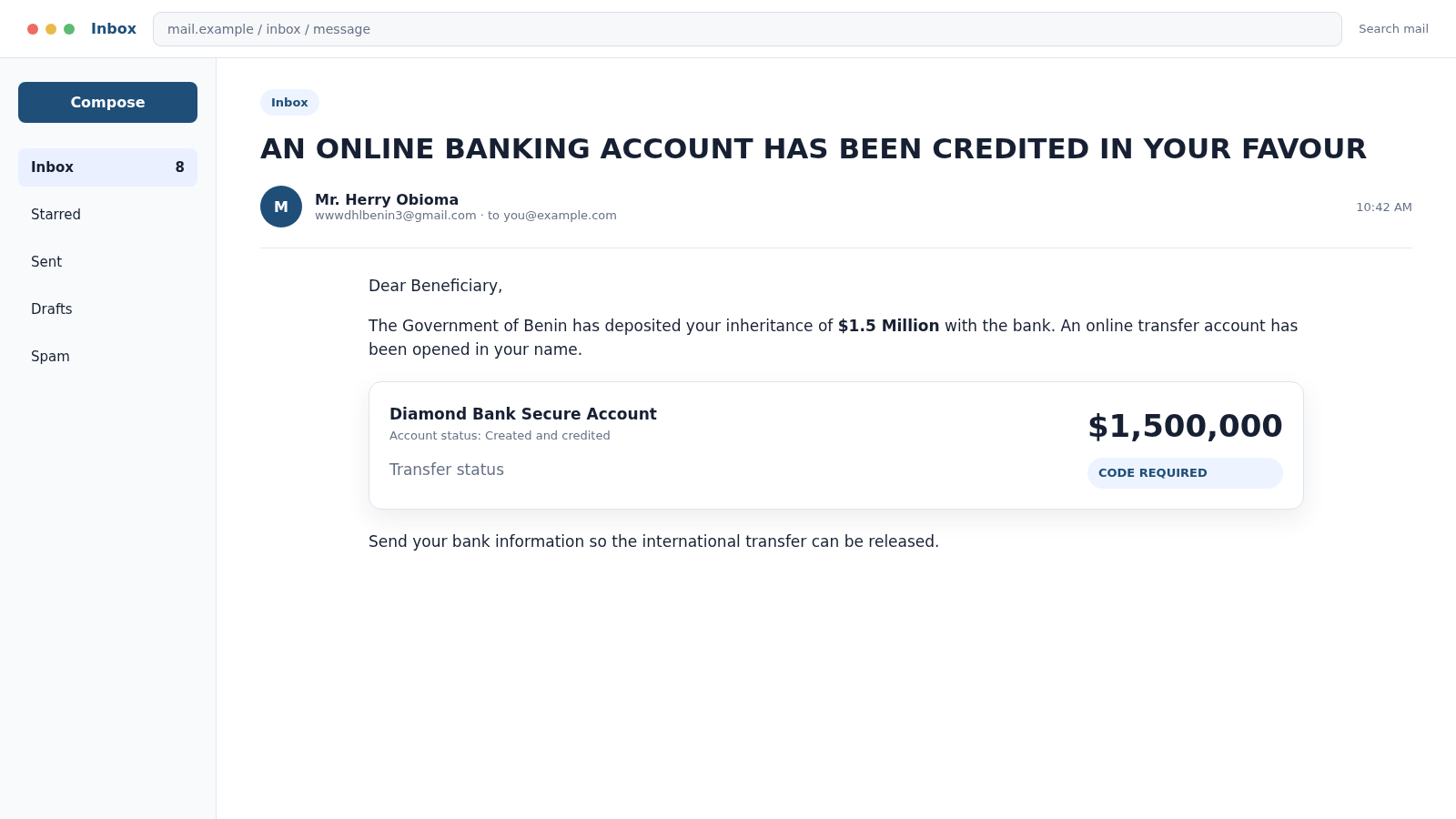
The email invents a $1.5 million inheritance
The Mr. Herry Obioma email claims that the Government of Benin deposited a large inheritance into a bank account created for the recipient. The message may name Diamond Bank, display account details, and present an impressive balance.
The recipient never applied for the account and has no verified connection to the supposed estate. Those contradictions are buried beneath official language, international banking terms, and a promise that the funds are already waiting.
No legitimate government or bank selects a stranger by email and quietly credits that person with an unexplained inheritance. The balance exists only inside the scammer’s story.
The $87 transfer code is only the opening fee
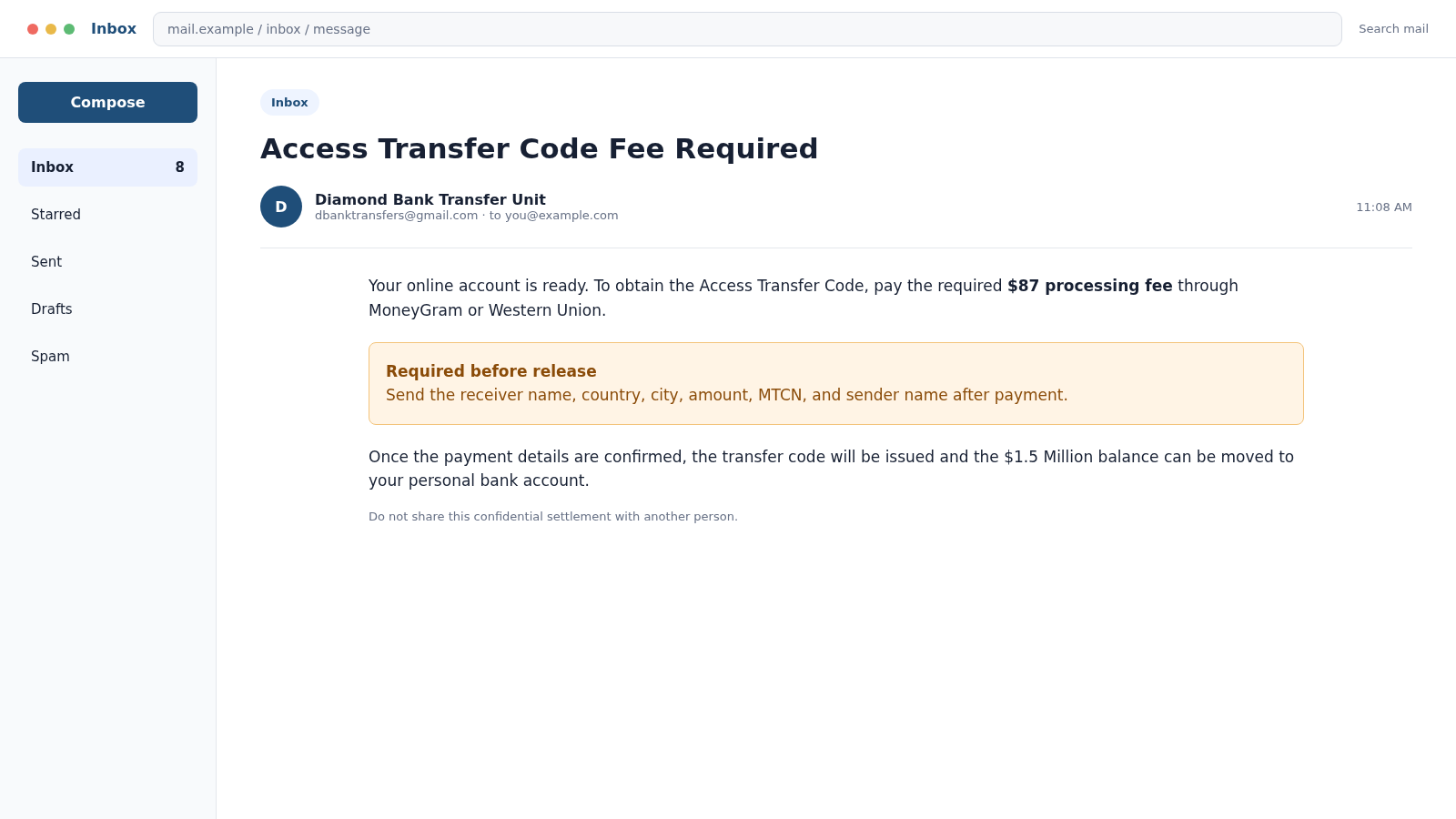
The message says the money cannot move until an Access Transfer Code is issued. To obtain it, the recipient is told to pay $87 through MoneyGram or Western Union and send the transfer reference back to the sender.
The relatively modest amount is deliberate. Someone who would reject a demand for thousands may risk $87 for a chance at $1.5 million.
Paying rarely ends the process. A victim may soon hear about tax certificates, anti-money-laundering clearance, insurance, courier charges, legal stamps, currency conversion, or a final release fee.
The criminals also want identity and banking information
The email asks for bank information so the inheritance can supposedly be transferred. Follow-up messages may request a passport, driver’s license, address, date of birth, telephone number, signature, and proof of account ownership.
That data can support identity theft even if the victim refuses to pay. It may also help criminals tailor future emails, impersonate the victim, or create convincing stories for banks and payment providers.
The scam can pursue several forms of value at once:
- Advance fees sent by wire or money-transfer service
- Bank account and routing information
- Copies of government-issued identity documents
- Signatures and personal contact details
- Email and online banking credentials
- One-time security codes requested during a call
- Additional victims found through the recipient’s contacts
- Payments to fake recovery agents after the loss
Why the Message Can Feel More Convincing Than It Looks
Read calmly, the email contains obvious problems. It mixes government, inheritance, banking, and courier language without explaining why the recipient is legally entitled to anything.
Under emotional pressure, however, the detailed account numbers can feel like proof. They are not. Anyone can type a bank name, SWIFT code, balance, and transaction reference into an email.
The sender may claim to be a chief executive, transfer officer, diplomatic courier, or government representative. A title in a signature block is not an independently verified identity.
Public email accounts are another warning. A genuine bank transfer department would not conduct a confidential $1.5 million transaction through an unrelated Gmail address.
The writing may contain grammar errors, inconsistent dates, or strange capitalization. Those signs help, but polished grammar would not make the offer legitimate. The impossible financial premise is the central problem.
The Psychology Behind the Access Transfer Code
A scammer does not begin by asking most strangers for their life savings. The first goal is to secure a small act of commitment.
Once a person answers, shares details, or pays $87, walking away becomes emotionally harder. The victim may feel that stopping now would waste the money and lose a rare opportunity.
This is the sunk-cost effect at work. Each new fee is presented as the final obstacle, while the promised inheritance remains just out of reach.
Secrecy strengthens the trap. The recipient may be told not to discuss the transfer because of banking rules, government confidentiality, or fear that another claimant will seize the funds.
That instruction isolates the victim from friends, relatives, bank employees, and lawyers who would recognize the fraud. Legitimate advisers do not need a beneficiary to conceal an inheritance from trusted people.
Company, Address, and Fulfillment Checks
Check the bank through an independent source
Do not call a number or open a banking page supplied in the message. Find the institution independently, then ask its fraud department whether the account, employee, and transfer procedure described in the email exist.
Compare every sender and reply address
A government settlement, law office, and bank should not all conduct a multimillion transfer through free or unrelated mailboxes. Expand the sender details and compare the visible name with the actual address and reply destination.
Verify the estate through your own legal professional
A genuine inheritance creates documents and contacts that can be checked outside the claimant’s instructions. An independently selected attorney can contact the relevant court, insurer, executor, or probate office without using the supposed agent as a gatekeeper.
Question how the money is supposedly released
Legitimate estate costs are documented and handled through formal accounts. A demand for an $87 transfer code through MoneyGram or Western Union does not fit a lawful banking process, especially when secrecy and urgency accompany it.
How the Mr. Herry Obioma Email Scam Works
Step 1: A mass email announces an unexpected fortune
Criminals send the same inheritance story to many addresses. The recipient is told that an online bank account has been opened in their favor and already holds $1.5 million.
The sender may use the name Mr. Herry Obioma and claim authority connected to the Government of Benin or a bank transfer unit. The recipient’s actual family history is irrelevant.
Step 2: Banking details create a false sense of reality
The email supplies account numbers, sort codes, SWIFT details, a creation date, or a balance table. These fields resemble online banking and make the promise feel operational rather than imaginary.
None of the details prove that an account exists or belongs to the recipient. Verification must come through independently sourced bank contacts, not the people making the promise.
Step 3: The recipient is asked to provide personal data
The fraudster requests a name, address, telephone number, bank details, and identity documents. The request is described as beneficiary verification or preparation for an international transfer.
Every answer makes the next message more personalized. The scammer may repeat the victim’s bank name, address, or account ending to appear informed.
Step 4: An $87 code fee becomes the first payment
The sender says a transfer code is required before the online balance can be accessed. The code supposedly costs $87 and must be paid through a money-transfer service.
The payment method matters. Wire-style transfers can be collected quickly and may provide less practical recovery than a credit-card purchase.
Step 5: New officials introduce new fees
After payment, another person may appear as a banker, attorney, tax officer, courier, or anti-fraud investigator. Each role introduces a document or clearance that must be purchased.
The names change, but the criminals may be working together or using several identities. The victim is kept busy solving one invented problem after another.
Step 6: Pressure rises when the victim hesitates
The sender may warn that the account will close, the government will reclaim the funds, or another beneficiary will be selected. A deadline is used to prevent independent checks.
The scammer may also appeal to sympathy, saying a bank employee will lose a job or a transaction will be investigated unless the fee arrives immediately.
Step 7: The criminals pursue larger payments or account access
Once the victim is invested, the requested amounts can grow. The scammer may ask for thousands in taxes, legal fees, or insurance and may direct the victim to log in to online banking.
A link or attachment can also lead to credential theft or malware. The inheritance email is therefore both a payment scam and a possible route into the victim’s accounts.
Step 8: Recovery scammers return after the loss
If the victim stops paying, someone may later claim to be a government investigator, compensation office, or asset-recovery lawyer. That person says the stolen money has been located.
The recovery offer requires another tax, retainer, or release payment. It is often the same criminal group using the victim’s history to begin the scheme again.
How to Check an Unexpected Inheritance Claim
Start with the basic question: why would this person know you are the beneficiary? A legitimate executor can identify the deceased, the estate, the court, and the documented family relationship.
Do not use the phone numbers, email addresses, websites, or lawyers supplied by the sender. Independently find the relevant probate court, insurer, bank, or regulator and contact it through published channels.
The U.S. Federal Trade Commission warns that unsolicited letters about a long-lost relative’s multimillion insurance policy or inheritance are scams designed to obtain money and personal information.
A real estate process may involve legal and administrative costs, but an unknown beneficiary is not asked to transmit an untraceable fee to a private individual before the estate can even be verified.
Ask a licensed local attorney to examine original court records. Verify the attorney in the regulator’s directory and call the firm using a number found independently.
If the sender forbids independent contact, demands secrecy, or becomes hostile when you ask for verifiable records, stop communicating.
Red Flags in the Benin Inheritance Email
- You are promised money from an estate you do not recognize
- A foreign government supposedly opened a bank account in your name
- The sender uses a free or unrelated email service
- The message displays impressive account details without legal proof
- You must pay $87 to receive a transfer code
- MoneyGram or Western Union is required
- Bank details and identity documents are requested by email
- The sender insists that the transaction remain secret
- A deadline appears before you can verify the claim
- Every completed requirement produces another fee
What to Do if You Have Fallen Victim to This Scam
- Stop all communication and payments. Do not send a final fee to protect earlier payments. Block the addresses and phone numbers after preserving the messages.
- Contact the payment provider immediately. Give MoneyGram, Western Union, your bank, card issuer, or crypto exchange the transaction details and ask whether the transfer can be stopped, recalled, or flagged.
- Notify your bank’s fraud team. Explain exactly which account numbers, statements, login details, and security codes were disclosed. Ask whether the account should be monitored, restricted, or replaced.
- Secure your email account. Change the password from a clean device, enable multi-factor authentication, remove unknown recovery methods, and check for forwarding rules or unfamiliar sessions.
- Replace exposed passwords. Change any password reused on banking, email, social media, or cloud services. Use a unique password for every important account.
- Protect your identity. If you sent a passport, driver’s license, Social Security number, signature, or birth date, create a recovery plan through IdentityTheft.gov and consider credit freezes.
- Inspect the device. Delete suspicious downloads and run a full scan with Malwarebytes. If remote access occurred, disconnect the device and consider professional inspection.
- Reduce future exposure. Report malicious pages and use a reputable blocker such as AdGuard to reduce known scam links. A blocker cannot recover money or protect details already shared.
- Preserve evidence. Save full email headers, attachments, receipts, transfer references, account details, chat logs, and phone numbers. Do not edit the originals.
- File official reports. Report the fraud to the FTC and the FBI’s IC3 in the United States, or the appropriate national cybercrime and consumer authority where you live.
- Warn trusted contacts. If criminals accessed your mailbox or address book, tell contacts not to trust unusual money requests from your account.
- Refuse recovery offers. No private agent can guarantee the return of a wire for an upfront payment. Share new approaches with the investigator or financial institution handling the original report.
What Evidence Helps Banks and Investigators
Keep the original email instead of relying only on a screenshot. Its full header can show the sending infrastructure, reply-to address, routing path, and authentication failures that are invisible in the message window.
If you replied, export the entire conversation in its original format. A scammer may change names, job titles, banks, and countries as the story develops. Those inconsistencies can help connect the messages to other complaints.
For every payment, record the date, amount, currency, recipient name, destination account, reference number, and service used. If cryptocurrency was involved, preserve the wallet address and transaction hash exactly as shown.
Do not edit suspicious attachments or forward them casually to friends. Save them in a separate folder, note where they came from, and tell the investigator if you opened them or enabled any content.
- The sender, reply-to, and return-path addresses
- Full email headers and original message files
- Receipts, wire instructions, and transfer references
- Names and numbers used by supposed bank officials
- Copies of identity records that were disclosed
- Dates of calls, messages, threats, and fee requests
A clear timeline is often more useful than a long narrative. Begin with the first email, list each reply and payment in order, and note when the explanation changed or another supposed official joined the conversation.
Act quickly, but do not destroy evidence after reporting. Banks and law-enforcement agencies may request additional information later, especially when a destination account appears in several fraud reports.
Frequently Asked Questions
Is the Mr. Herry Obioma $1.5 million inheritance real?
No credible evidence supports the unsolicited offer. A stranger cannot establish inheritance rights through a mass email, and the demand for an upfront transfer-code fee is a defining warning sign.
Why does the email include real-looking bank codes?
Bank names, SWIFT codes, and account numbers are easy to copy or invent. Their presence makes the story look detailed but does not prove that the displayed account exists or contains money.
What happens if I pay the $87 fee?
The promised transfer will not arrive. The scammers will likely invent another charge for taxes, legal documents, insurance, or clearance because paying once marks the recipient as a responsive target.
Is it safe to reply without sending money?
No. A reply confirms that the address is active and gives the sender another opportunity to collect personal information. Preserve the message, report it, and stop communicating.
Can my bank verify the inheritance account?
Your bank can help assess suspicious transfer instructions, but do not rely on contact details from the email. A legitimate estate must be verified through independent legal and court records.
Can anyone recover money sent through a transfer service?
Recovery is not guaranteed, but speed matters. Contact the provider and your bank immediately with the transfer reference. Ignore anyone demanding another fee for guaranteed recovery.
The Bottom Line
The Mr. Herry Obioma email turns a fictional $1.5 million inheritance into a real request for $87, bank details, and identity records. The small transfer-code fee is only the first step.
Do not reply, pay, or send documents. Verify unexpected estate claims through independent courts and licensed professionals, and remember that a genuine inheritance does not begin with a stranger demanding money through email.

Join the discussion
0 commentsShare your experience or ask a question about this article.
Discussion
Start the conversation
Have a question or something useful to share? Add the first comment.