

A $750 Lululemon gift code sounds unusually generous, but MyReviewPerks.com presents it as something almost anyone can unlock in a few minutes. The page looks polished, uses familiar branding, and says only a handful of partner deals stand between the visitor and the reward.
The important conditions become clear only after following the claim button. What appears to be a simple Lululemon promotion turns into a separate affiliate reward program with far more required deals, possible purchases, identity verification, and a much longer timeline.
Overview
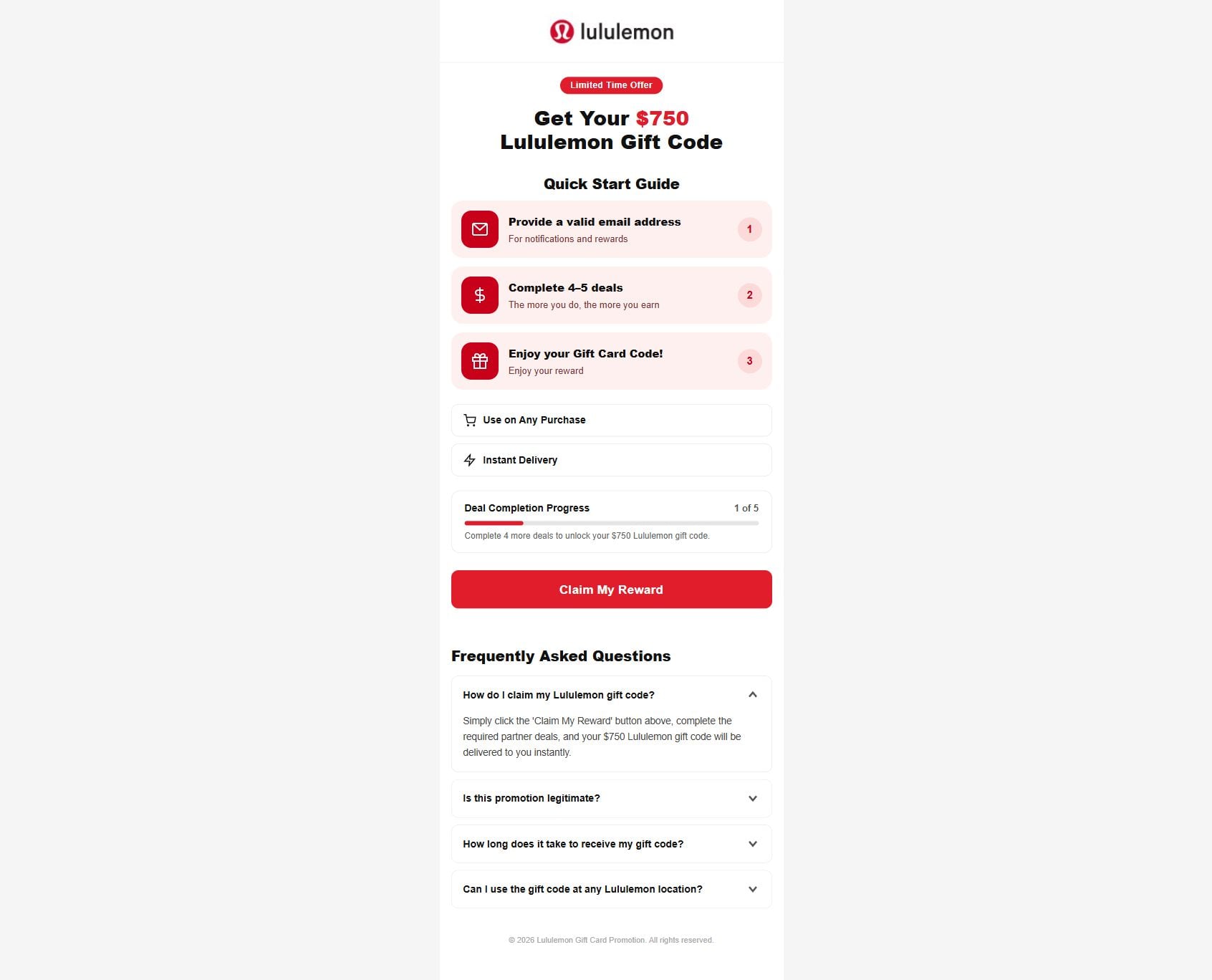
The MyReviewPerks.com scam is a misleading affiliate reward funnel currently built around a supposed $750 Lululemon gift code. It is not hosted on Lululemon’s official domain, and the claim button sends visitors through rewardsblitz.com to a program operated on other websites.
The landing page makes the offer sound straightforward. Its “Quick Start Guide” tells visitors to provide a valid email address, complete 4–5 deals, and enjoy the gift card code. A progress display is already set to “1 of 5” and says only four more deals are needed.
The site also describes the reward as suitable for any purchase and promises “Instant Delivery.” Its frequently asked questions claim that most users complete the process within minutes and that a $750 code will be delivered as soon as the required partner deals are finished.
Those statements do not match the terms shown at the actual destination.
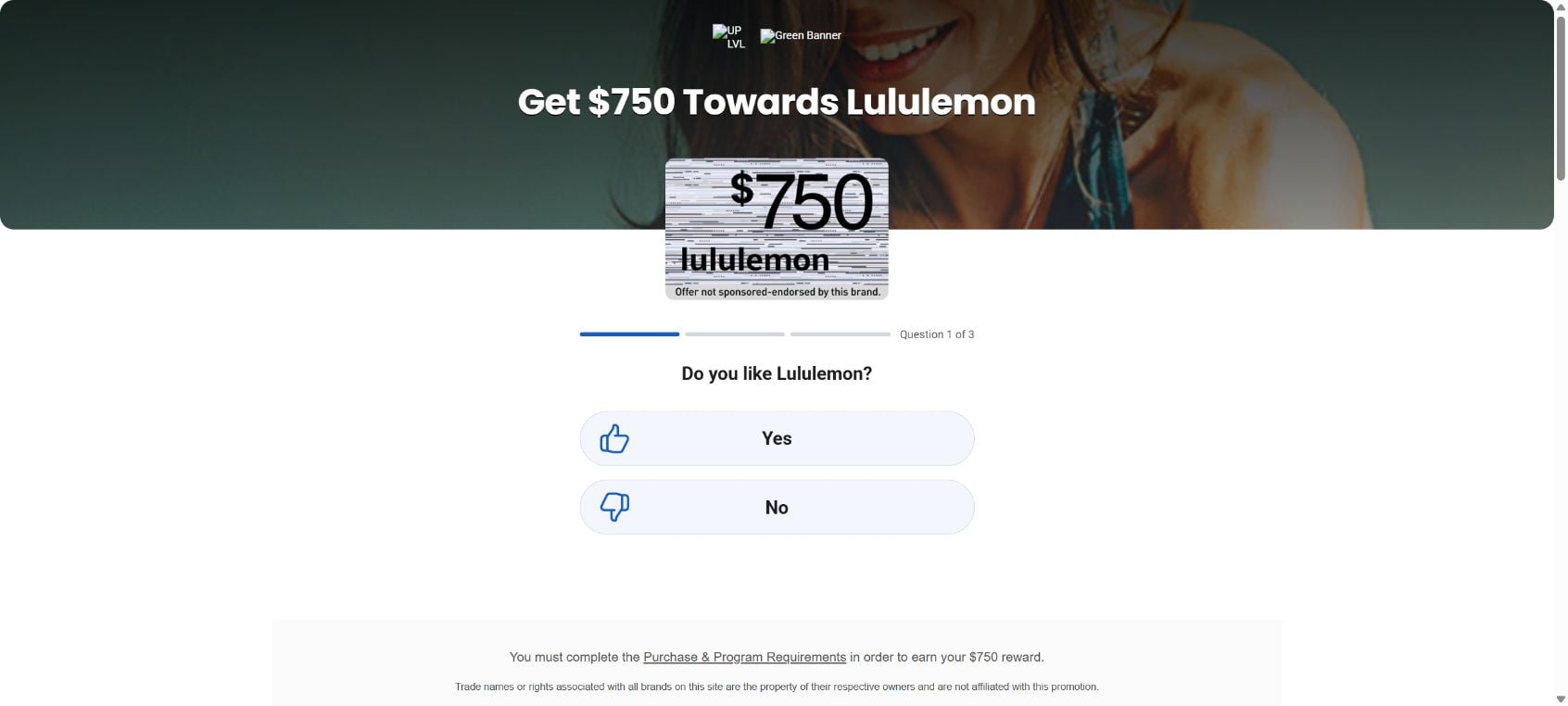
After we followed the claim button, the browser arrived at a RewardZone USA page on retailproductsusa.com. A notice there said visitors must complete the Purchase and Program Requirements to earn the $750 reward and explicitly stated that brands on the site are not affiliated with the promotion.
The destination explained that a $750 reward requires one Level 1 deal, one Level 2 deal, three Level 3 deals, five Level 4 deals, and ten Level 5 deals. That is 20 deals in total, not 4–5.
It also said many partner deals require payments, some can take up to 60 days to complete, and the claims process requires identity verification. This is a very different commitment from the simple, near-instant path described by MyReviewPerks.
MyReviewPerks is not an official Lululemon promotion
The current landing page places the Lululemon logo at the top and calls itself a “Lululemon Gift Card Promotion” in the footer. That presentation can easily give visitors the impression that Lululemon is sponsoring, approving, or fulfilling the offer.
However, the destination’s own disclosure says trade names and brand rights belong to their owners and that those owners are not affiliated with the promotion. The reward program is identified in the footer as RewardZone USA, LLC, not Lululemon.
Consumers should verify Lululemon promotions through the official lululemon.com domain or the company’s official app. MyReviewPerks.com is a separate domain and provides no prominent evidence on its landing page that Lululemon authorized the campaign.
The featured brand has already changed
MyReviewPerks did not always promote Lululemon. Search-engine records and independent website snapshots from earlier in 2026 show the same domain advertising a $750 Target gift card.
The earlier page told visitors to provide an email address, complete 4–5 deals, and receive a Target gift card. The current page keeps almost the same structure and replaces Target with Lululemon.
That change matters because it shows the visible retailer is interchangeable. A genuine brand-run reward campaign would not normally switch from Target to Lululemon while preserving the same affiliate claim flow.
The domain was registered on February 5, 2026. A young domain alone does not prove misconduct, but its short history and rapid brand change are important context when the page presents itself as a high-value national retail promotion.
The most important contradiction: 4–5 deals versus 20
MyReviewPerks repeatedly emphasizes 4–5 deals. The number appears in the quick-start guide, progress box, and FAQ. A reasonable visitor could conclude that completing four more modest actions will unlock $750.
The downstream program uses a level structure. According to the requirements visible during our test, a participant needs 20 total deals for the $750 tier. The Level 5 count distinguishes the higher reward amounts, and ten Level 5 deals are required for $750.
Some deals may be free, but the destination plainly says many require payment for products or services. It lists mobile games, apps, subscription products, free trials, and other sponsored deals.
This is not a minor detail. The number of required deals, the possibility of spending money, the time needed for credits to appear, and the identity-verification requirement all affect whether an average person can realistically complete the program.
“Instant” delivery is also misleading
MyReviewPerks says the gift code is delivered instantly and that most users finish within minutes. The reward destination gives a longer and more complicated timeline.
It says the sponsored deals can typically be completed within 5–7 days, while some may take up to 60 days. After the deals, the customer must complete a claims process that includes identity verification. The page says verification and delivery typically take another 1–3 days.
It also reports that customers who actually received a reward did so in an average of 6–10 days after registration. Even that average applies only to recipients, not every person who started.
A promotion can have legitimate terms and still be marketed misleadingly. Here, the front page compresses a potentially long, paid, multi-level process into a few friendly cards and the phrase “Instant Delivery.”
What the reward destination discloses
The RewardZone USA page provides more detail than the MyReviewPerks landing page. It says a participant can complete fewer deals for a smaller reward, while higher tiers demand progressively more actions.
- A $5 reward requires one Level 1 deal and one Level 2 deal.
- A $100 reward adds three Level 3 deals.
- A $250 reward adds five Level 4 deals.
- A $500 reward requires five Level 5 deals.
- A $750 reward requires ten Level 5 deals.
- A $1,000 reward requires fifteen Level 5 deals.
The site also states that about 0.1% of customers who registered received a $1,000 reward during the referenced period. It does not present an equivalent prominent success percentage for the $750 tier on the landing screen we reviewed.
This does not prove that no one can receive a reward. It does show why the front-page promise should not be understood as a simple free $750 Lululemon card for completing four quick surveys.
Why people call this a scam
Many consumers use the word “scam” because the advertisement and the actual requirements create sharply different expectations. The page uses a famous retailer’s identity, a fixed high-dollar amount, a limited-time badge, and an almost-complete progress meter before the visitor has done anything.
Once the person clicks, the campaign changes from a Lululemon-themed promise to a separate reward program. The number of required deals increases, payment may be necessary, and the timeline expands from minutes to days or weeks.
The problem is not simply that there are terms. The problem is that essential terms capable of changing a person’s decision are not given equal prominence before the click.
The Federal Trade Commission warns that affiliate marketers can publish exaggerated or misleading claims to generate clicks. It also advises consumers to examine free-trial terms, automatic renewals, cancellation procedures, and payment requirements before enrolling.
Risks beyond not receiving the $750 reward
The effort required to qualify can expose a participant to several costs that are easy to underestimate at the start.
- Subscription charges: A free or discounted trial may convert into recurring billing if it is not cancelled on time.
- In-app spending: Mobile game deals may require reaching a level or making purchases within a time limit.
- Multiple accounts: Completing 20 deals can create many separate logins and customer relationships.
- Personal data sharing: Email addresses, phone numbers, demographic details, and browsing identifiers can pass through several companies.
- Identity verification: Claiming a high-value reward may require documents or other sensitive information after substantial effort has already been invested.
- Tracking problems: Cookie blocking, ad blockers, missed attribution, or unmet fine-print conditions can prevent a deal from receiving credit.
- Cancellation workload: Each paid trial must be identified and cancelled through the correct provider before its billing deadline.
Even if every individual offer comes from a real company, the combined time, cost, and tracking risk can make the promised reward far less attractive than the headline suggests.
Warning signs on MyReviewPerks.com
- The domain is not owned by or visibly connected to Lululemon.
- The same site previously used Target branding for a similar $750 offer.
- The footer names the page like an official Lululemon promotion without a clear nearby non-affiliation disclosure.
- The page says 4–5 deals, while the destination requires 20 for $750.
- The page says delivery is instant, while the destination describes a 6–10 day recipient average and possible 60-day deal completion.
- The progress meter starts at “1 of 5” before the visitor has completed a sponsored deal.
- Many critical conditions appear only after the affiliate redirect.
- Some required deals may involve payments, subscriptions, or free trials that renew.
Taken together, these are strong reasons not to pursue the MyReviewPerks $750 gift code offer.
How The Scam Works
MyReviewPerks uses a more sophisticated version of the affiliate reward model than a simple fake survey. Understanding each stage helps explain where the misleading impression is created.
1. An advertisement promises a popular $750 retail reward
The visitor may encounter the offer through social media, a display ad, search results, or a shared link. Lululemon is a valuable and recognizable brand, so a $750 code creates immediate interest.
Earlier visitors saw Target instead. Changing the retailer allows the campaign to match different audiences while keeping the same underlying conversion goal.
2. A branded landing page simplifies the process
MyReviewPerks shows only three main steps. The user provides an email address, completes 4–5 deals, and enjoys the reward. Icons and short sentences make the process feel easy to scan and low risk.
The page does not give the 20-deal breakdown beside the main claim. It also does not explain the possible 60-day completion period or identity verification at the point where the visitor decides to continue.
3. The visitor is shown artificial progress
The meter begins at 1 of 5 and says four more deals remain. That visual can create a sense that the person has already started and is close to the goal.
In reality, opening the landing page has not satisfied one of the destination program’s required sponsored deals. The progress display is a marketing element on MyReviewPerks, not a verified account record from the reward operator.
4. The claim button passes the referral to an affiliate tracker
The button points to rewardsblitz.com/o/32/572779. The path identifies the campaign and referral before redirecting the browser to the reward operator.
This structure lets the referring marketer receive attribution when a visitor registers or completes qualifying actions under the affiliate program’s rules.
5. The visitor enters a separate reward ecosystem
Our session landed on RetailProductsUSA, branded as UP LVL and linked to RewardZone USA policy pages. The original MyReviewPerks domain was no longer controlling the process.
The destination first asked whether the visitor liked Lululemon. Such simple questions keep engagement moving before the more demanding offer levels appear.
6. Personal details and consent are collected
Reward programs commonly request an email address, name, phone number, date of birth, address, and marketing consent. The exact fields can depend on the flow and location.
Providing accurate contact information may be required for credit and fulfillment, but it also makes the visitor more valuable to advertisers and follow-up campaigns.
7. The deal levels become progressively harder
Early deals may look quick or inexpensive. Higher levels can involve longer trials, purchases, subscriptions, app activity, or waiting periods.
The visitor has already invested time by the time the ten Level 5 deals required for $750 become relevant. This sunk cost can encourage continued spending even when the original “4–5 deals” expectation has disappeared.
8. Tracking determines whether a deal counts
Affiliate systems rely on cookies, tracking links, offer requirements, and advertiser confirmation. A deal may fail to credit if the user was previously registered, used a different email, missed a deadline, blocked tracking, cancelled too soon, or did not complete every required action.
Participants should never assume that a payment automatically means a deal has been credited. They must monitor the reward account and keep proof for each offer.
9. Trials and paid services create real financial exposure
A “free” trial can require a card and begin charging when the introductory period ends. With many simultaneous deals, cancellation dates can become difficult to track.
The total cost is not limited to the small amount shown on the first offer. Several subscriptions, in-app purchases, or product orders can add up before the reward claim is even eligible.
10. A separate claim and identity check follows
After all qualifying deals receive credit, the participant must complete the reward claims process. The destination says this includes identity verification and an additional review period.
Someone who expected an emailed code within minutes may only discover this stage after spending days completing offers.
11. The affiliate is paid for valuable actions
The economic engine is the collection of registrations, purchases, subscriptions, and other advertiser conversions. The $750 headline motivates those actions.
A visitor can generate affiliate value without ever finishing all 20 deals or successfully claiming the full reward. That imbalance explains why the easiest promise appears on the front page while the hardest conditions appear later.
What To Do If You Have Fallen Victim
If you started the MyReviewPerks process, do not feel pressured to finish. Pause, identify what you agreed to, and protect your accounts and payment methods one step at a time.
- Stop opening new deals. Do not complete additional offers simply to recover the time or money already spent. More deals can create more subscriptions and more personal-data exposure.
- Make a complete offer list. Review email receipts, browser history, app installations, and card transactions. Record the merchant, date, price, trial deadline, login email, and cancellation method for each deal.
- Cancel unwanted trials directly with each provider. MyReviewPerks cannot cancel third-party services for you. Use the official provider’s account or customer-support channel and save screenshots or emails proving cancellation.
- Check whether a cancellation also requests a refund. Ending future billing does not always reverse an existing charge. Ask the merchant clearly about both issues and keep the response.
- Contact your card issuer about unauthorized or misleading charges. Use the phone number printed on the card. Explain what happened, identify the transactions, ask about charge disputes, and discuss replacement if card details were entered on an untrusted page.
- Monitor statements for several months. Free trials can convert at different times. Look for small unfamiliar charges, altered merchant names, and recurring payments that continue after cancellation.
- Secure the email account used in the funnel. Change the password if it was reused, enable multi-factor authentication, and review recent sessions and forwarding rules. The email account controls many password resets.
- Remove apps you no longer need. Cancel any associated subscription first, then uninstall the app and revoke permissions such as contacts, location, notifications, or tracking.
- Protect sensitive identity information. If you uploaded identification to a page you cannot verify, monitor for misuse and follow the tailored steps at IdentityTheft.gov.
- Report misleading advertising. Report the original ad to the social platform and submit the experience to ReportFraud.ftc.gov. Include MyReviewPerks.com, the tracking URL, destination, dates, and any charges.
- Keep evidence if you pursue reward support. Save the full program requirements, deal confirmations, credit status, receipts, and conversations. Do not send additional money to anyone who promises to force approval.
- Watch for recovery scams. Fraudsters may contact people who complained publicly and offer guaranteed refunds for an upfront fee. Your bank, card issuer, actual merchant, and official agencies are the appropriate recovery channels.
The FTC’s guidance on free trials and subscriptions recommends checking cancellation terms, monitoring statements, and disputing unauthorized charges with the card company.
If you only visited MyReviewPerks and did not enter information, install anything, or start an offer, you generally only need to close the page and avoid the advertisement. A page visit alone does not mean you owe money or have enrolled in the reward program.
The Bottom Line
MyReviewPerks.com is not a simple or official $750 Lululemon giveaway. Its front page says 4–5 deals and delivery within minutes, while the linked reward program requires 20 deals for $750, says many offers require payment, and describes a process that can take days or longer.
Do not pursue the offer based on the headline. Read the complete downstream requirements first, verify retail promotions on the brand’s official domain, and never spend money on multiple trials merely because a progress bar says a large reward is close.








