

It lands like a punchy, official warning.
“Final Notice,” the text says, with a date attached, like the system has already decided what happens next. It claims you have an outstanding traffic ticket. It lists penalties. It offers one quick way out.
A link.
And for a few seconds, that link feels like the fastest path back to normal.
That is exactly why this NC DMV text scam is spreading so fast.
Scam Overview
The NC DMV text scam is a smishing campaign, which means phishing delivered through text message. Instead of hacking a system, scammers hack your attention. They send a message that looks authoritative, sounds urgent, and pressures you to pay immediately through a link that leads to a fake website.
North Carolina’s Division of Motor Vehicles has warned residents about a surge in fraudulent text messages that request payment for fees, fines, or tolls and appear to come from NCDMV. The agency has been clear that these texts are scams and that NCDMV does not and will never request payment via unsolicited text messages.
More recently, the North Carolina Department of Justice has also warned about a new wave of DMV text scams targeting North Carolinians, using threats like license suspension and penalties to push people into clicking.
What the NC DMV scam text usually says
The wording varies:
- “North Carolina Department of Vehicles (DMV) Final Notice: Enforcement Penalties Begin on June 6”
- “Our records show you still have an outstanding traffic ticket”
- A legal-sounding reference such as “North Carolina (NC) State Administrative Code 15C-16.003”
- A list of consequences:
- report to a “DMV violation database”
- suspend vehicle registration
- suspend driving privileges for 30 days
- transfer to a toll booth and charge a 35% service fee
- prosecution and credit score impact
- A “Pay Now” link, often using a suspicious domain
One widely reported clue is that the message refers to “15C-16.003,” a code section that does not exist, which is why multiple outlets have highlighted it as a tell.
Why the scam feels so believable
This scam works because it uses a set of persuasion triggers that hit fast, especially on mobile.
It borrows authority you already trust
“DMV” is one of those agencies most people do not want to ignore. Even if you have never had major issues, you know DMV-related problems can affect your ability to drive, renew tags, or stay compliant.
Scammers exploit that built-in respect. They do not need you to love the DMV. They just need you to fear the consequences of ignoring it.
It creates urgency that blocks verification
The text almost always includes a near-term deadline:
- pay by tomorrow
- pay within 24 hours
- enforcement begins in 1 to 2 days
That timeline is not about how government enforcement actually works. It is about forcing a rushed decision.
The Federal Trade Commission has warned about overdue traffic ticket texts that push you to react quickly and click before you realize it is a scam.
It stacks scary consequences to make “doing nothing” feel dangerous
The scam message does not just say you owe money.
It threatens:
- registration suspension
- license suspension
- collections and extra fees up to 35%
- prosecution
- credit reporting
That combination is meant to overwhelm your ability to calmly evaluate the situation.
It is also a known national pattern. The FTC has called out this style of message, including the “DMV violation database” threat and the 35% fee language, as part of these traffic ticket smishing scams. (
It uses official-sounding “legal language” to lower your guard
The “Administrative Code 15C-16.003” line is there to sound precise, even if it is fake.
Most people will not fact-check a code number in the moment. They will assume the sender knows what they are talking about, because the message sounds like it was written by an agency.
That is the point.
It makes the payment feel small and easy
Many versions of these DMV-style scams request a modest payment, sometimes framed as a fee, a ticket, or a processing charge.
Small amounts reduce suspicion. People think:
“It’s not worth the hassle. I’ll just pay it.”
But the payment is not the real objective.
The real objective is your card data and personal information.
What the scam link is really doing
The link in these texts often looks “DMV-ish,” like it contains:
- nc
- ncdot
- dmv
- gov
But that is just decoration. Scammers can place those words anywhere inside a URL.
What matters is the actual domain, which is the part right before the ending like .com, .org, .gov, .cc, .vip, and so on.
The link ends with .cc, which is not a North Carolina government domain. That’s a common sign of a scam link.
This is why NCDMV’s warning focuses on behavior: do not click links and do not send payment through a text that claims to be the DMV.
Why North Carolina is being hit so hard
Two reasons.
First, scammers can copy-paste this template into any state, and North Carolina is a large enough population that even a tiny success rate makes the campaign profitable.
Second, the scam script has been circulating nationwide, and news outlets have reported that multiple states have issued warnings about similar DMV text scams.
So when you see the same structure, the same list of penalties, and the same 35% fee threat, it is not a coincidence.
It is a template.
What NCDMV and NC officials want residents to know
North Carolina officials have made two points very clear:
- NCDMV is seeing a surge in fraudulent texts that appear to request payment for fees, fines, or tolls.
- The North Carolina Attorney General’s office has warned this is a new wave of scam texts impersonating the DMV and threatening penalties.
If you received one of these texts, the safest assumption is that it is not an official DMV notice.
And the safest move is to slow down, verify, and never use the link inside the message.
How The Scam Works
This scam is not a single trick. It is a full funnel designed to move you from surprise to payment, with as little friction as possible.
Here is how it usually unfolds, step by step.
Step 1: Bulk texts go out to thousands of numbers
Scammers do not need to know who has a ticket. They send the message to huge lists and rely on probability.
That is why people who have:
- no recent tickets
- no registration problems
- no reason to expect a DMV notice
still receive the message.
It is not targeted enforcement. It is mass marketing, just criminal.
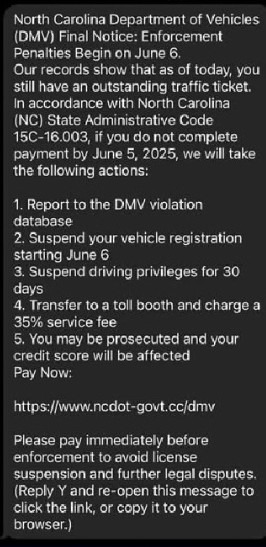
Here’s the full text of the scam message:
North Carolina Department of Vehicles (DMV) Final Notice: Enforcement Penalties Begin on June 6.
Our records show that as of today, you still have an outstanding traffic ticket. In accordance with North Carolina (NC) State Administrative Code 15C-16.003, if you do not complete payment by June 5, 2025, we will take the following actions:
- Report to the DMV violation database
- Suspend your vehicle registration starting June 6
- Suspend driving privileges for 30 days
- Transfer to a toll booth and charge a 35% service fee
- You may be prosecuted and your credit score will be affected
Pay Now:
https://www.ncdot-govt.cc/dmv
Please pay immediately before enforcement to avoid license suspension and further legal disputes.
(Reply Y and re-open this message to click the link, or copy it to your browser.)
Step 2: The message opens with “Final Notice” to trigger panic
Words like “Final Notice” are designed to create the feeling that you are already late.
Late means:
- you missed earlier notices
- consequences are about to happen
- you need to act now
It is emotional priming. Once your nervous system is activated, logic takes a back seat.
Step 3: A fake code reference adds credibility
The scam inserts a legal-looking reference, like “15C-16.003,” because it sounds official.
Multiple reports have noted that this code reference is made up, which is one reason the text is considered a clear scam indicator.
This is a common phishing technique: cite something that sounds real, because most people will not verify it, especially under time pressure.
Step 4: Consequences are stacked to overwhelm skepticism
Next comes the list of enforcement actions.
It usually includes:
- “reporting to the DMV violation database”
- registration suspension
- driving privilege suspension for 30 days
- a 35% fee
- prosecution and credit score impact
The FTC has highlighted this exact pattern in their consumer alert about overdue traffic ticket texts, including the “DMV violation database” language and a 35% fee threat.
This list is not meant to be realistic. It is meant to be intimidating.
Step 5: The link provides the “escape hatch”
Right when your brain is loud with “what if,” the text offers relief:
“Pay Now.”
That is a classic scam structure:
- problem
- panic
- quick solution
The link is the solution. But it is also the trap.
Step 6: The scam site mimics a real payment portal
Once you click, you are sent to a phishing page designed to look official enough at a glance.
These pages often include:
- DMV-like branding
- government-style fonts and layouts
- headings like “Violation Payment” or “Ticket Portal”
- form fields that imply you are confirming your identity
Some sites are sloppy. Others are surprisingly clean.
Either way, the goal is the same: get you typing.
Step 7: The site collects personal details first
Many victims assume the site will ask only for a payment card.
Instead, it often asks for:
- full name
- address
- phone number
- email address
Why?
Because the more data scammers have, the more valuable you become.
Personal data can be used for identity theft attempts or resold to other scammers as part of a “profile” that makes future fraud easier.
Step 8: The site asks for payment details
Then comes the real prize:
- card number
- expiration date
- CVV security code
- billing address
The “small fee” is often a psychological trick. It makes the payment feel harmless.
But once your card details are entered, the scam has succeeded.
Step 9: A fake confirmation screen buys the scammer time
Many scam sites show a “payment successful” message.
This is not proof of anything. It is a delay tactic.
If you feel relieved, you are less likely to call your bank immediately, which gives scammers more time to use your card.
Step 10: Fraud happens quickly, often with test charges first
Scammers frequently start with a small charge to confirm the card works.
Then they move to larger charges, digital goods, or purchases that are harder to reverse.
If they collected enough personal information, victims may also see follow-up fraud attempts that have nothing to do with DMV.
Step 11: Repeat targeting and “refund” scams can follow
Once a scammer knows your number is active and responsive, you may get more messages.
Common follow-ups include:
- “Your payment failed, try again”
- “Refund issued, confirm your bank details”
- “Collections notice, pay now”
That is why cutting off engagement matters.
Do not reply. Do not click again. Verify through official channels you find independently.
What To Do If You Have Fallen Victim to This Scam
If you clicked the link, entered information, or paid, take a breath.
You do not need panic. You need a plan.
Here is a calm, practical checklist you can follow in order.
- Stop interacting with the text immediately
Do not click again. Do not reply. Do not reopen the link to “check.” Close it and delete it after you save evidence. - If you entered card details, call your bank or card issuer right away
Tell them your card information was entered into a phishing site impersonating the DMV. Ask them to:
- cancel the compromised card
- issue a replacement
- review recent and pending transactions
- dispute anything you do not recognize
- Check for small “test” charges
Look for charges you do not recognize, even small ones. Scammers often test the card first.
Also check pending transactions, since some may post later.
- Turn on transaction alerts
If your bank offers alerts, enable them for:
- every purchase
- online transactions
- card-not-present charges
This gives you speed, which matters.
- If you shared personal information, protect your identity
If you provided your address, phone number, or other identifying details, consider:
- placing a fraud alert with the major credit bureaus
- freezing your credit for stronger protection
- monitoring your credit report for new accounts you did not open
- Change passwords if you reused any credentials
If you entered any password, or if your email is at risk, change passwords for:
- email accounts first
- banking and payment apps
- mobile carrier accounts
Turn on 2-factor authentication wherever possible.
- Report the scam text
Use multiple channels:
- Forward the text to 7726 (SPAM) if your carrier supports it
- Report it to the FTC
- Report it to North Carolina’s consumer protection resources
The FTC specifically advises not clicking links in unexpected traffic ticket texts and contacting your DMV using official information, not the text.
- Verify your real status through official channels, not the text
If you are worried you might actually have a ticket, do this safely:
- Search for official NCDOT or NCDMV resources yourself
- Use official phone numbers and websites you locate independently
- Do not rely on the link or phone number provided in the scam message
NCDMV has explicitly warned that these scam texts may appear to come from the agency and request payment for fees, fines, or tolls, and that residents should not engage.
- Save screenshots before deleting
Keep:
- the full text
- the sender number
- the link shown in the message
- any pages you reached (screenshots only, do not revisit)
This helps if you need to dispute charges or file reports.
- Watch for follow-up scams for 30 to 60 days
Be cautious of:
- refund messages
- collections threats
- calls claiming to be a fraud department
- emails referencing your “DMV payment”
If you get a call that pressures you, hang up and call back using a verified number.
The Bottom Line
The NC DMV text scam is designed to feel urgent, official, and personal, even when the details are fake. It pushes “final notice” pressure, threatens suspensions and credit damage, and sends you to a link that is built to steal your payment details and personal information.
North Carolina officials have warned residents about a surge in fraudulent NCDMV text scams requesting payment for fees, fines, or tolls, and the NC Attorney General has warned about a new wave of DMV scam texts targeting North Carolinians. The FTC has also flagged the overdue traffic ticket text pattern as a common scam tactic and advises people not to click links in unexpected texts.
If you remember one move that keeps you safe, make it this:
Do not pay through a link in a DMV text. Slow down, verify through official sources you find yourself, and the scam loses its power the moment you stop rushing.
FAQ: NC DMV Text Scam
What is the NC DMV text scam?
The NC DMV text scam is a phishing scheme where scammers send fake SMS messages claiming to be from the North Carolina DMV or a related agency. The message usually says you have an outstanding traffic ticket and must pay immediately to avoid penalties. The included link leads to a fraudulent site designed to steal your credit card details and personal information.
Does the North Carolina DMV send text messages demanding payment?
No. A text message that demands immediate payment, threatens suspension, and includes a “Pay Now” link should be treated as suspicious. North Carolina officials have warned residents about fraudulent DMV texts requesting payment for fees, fines, or tolls.
What does a typical NC DMV scam text look like?
Most versions include:
- “Final Notice” language and a near-term deadline
- A claim that you have an outstanding traffic ticket
- A fake legal reference such as “Administrative Code 15C-16.003”
- Threats like registration suspension, license suspension, collections, and credit score impact
- A link that looks official but uses a strange domain (often not .gov)
Is “Administrative Code 15C-16.003” real?
This code reference is commonly used in these scam messages to look official, but reports have flagged it as a scam indicator. Scammers often use fake or misleading legal citations to increase pressure and credibility.
Why do these scam texts mention a 35% fee?
Because it sounds like a real penalty. Many DMV-style scam scripts include a line about a “35% service fee” or “fees up to 35%” to create urgency and make the situation feel like it’s escalating quickly. The FTC has highlighted this kind of language as part of common traffic ticket text scams.
The link looks like it mentions “NCDOT” or “gov.” Does that mean it’s legitimate?
No. Scammers often insert official-looking words like “ncdot,” “dmv,” or “gov” into the link to trick people who skim. What matters is the real domain ending. If the link ends in something unusual like .cc, .vip, .win, or similar, that is a major red flag.
What happens if I click the link?
Clicking the link typically opens a fake payment portal. The site may ask you to enter:
- Name, address, phone number, email
- Sometimes vehicle or driver details
- Credit or debit card number, expiration date, and security code
Once entered, scammers can steal your card details, attempt unauthorized charges, and reuse or sell your personal data.
What if I clicked the link but didn’t enter any information?
That’s better than entering data, but you should still be cautious. Close the page, do not return to it, and watch for follow-up scam attempts. If your phone downloaded anything or the site prompted you to install something, run a security scan and remove anything suspicious.
What if I entered my credit card information?
Act quickly:
- Call your bank or card issuer immediately.
- Cancel the compromised card and request a replacement.
- Review recent and pending transactions.
- Dispute any unauthorized charges.
- Turn on transaction alerts so you’re notified instantly.
Why do scammers ask for a small payment?
Small amounts feel believable and low-risk, which increases the chance people pay quickly without verifying. But the real goal is your card information. Once scammers have it, the damage can be much larger than the original “fee.”
Can scammers really suspend my license or registration?
No. Scammers do not have access to DMV systems. These threats are designed to pressure you into paying. Real suspensions and enforcement actions follow official legal processes and are not triggered by a surprise text link.
How do I verify if I actually have a ticket in North Carolina?
Do not use the link in the text. Instead:
- Go to official North Carolina government or court websites by typing the address into your browser yourself
- Call official numbers you find on verified sites
- Check your records through official portals you access independently
How do I report the NC DMV scam text?
You can report it by:
- Forwarding the text to 7726 (SPAM) if your carrier supports it
- Reporting the scam to the FTC
- Reporting it to North Carolina consumer protection resources
- Saving screenshots and filing a police report if money was stolen
The FTC advises reporting suspicious texts and not clicking links in unexpected ticket-related messages.
Why am I receiving these texts if I have no tickets?
Because scammers blast these messages to massive lists of phone numbers. They don’t know your driving record. They rely on fear and probability, knowing some recipients will click “just in case.”
What should I do if I replied to the text?
Replying can confirm your number is active, which may lead to more scam attempts. Block the sender, mark the message as spam, and avoid responding to any follow-up messages. If you clicked links or shared info after replying, follow the steps to secure your accounts.
What is the safest rule to follow with DMV texts?
Never pay through a link in an u








