

In a world dominated by digital screens, it’s no surprise that products claiming to protect our eyes from harmful blue light are gaining popularity. One such product is the NoBlu Vision Glasses. Marketed as a high-tech solution for digital eye strain, these glasses have exploded across social media with glowing endorsements, bold health claims, and urgent calls to action.
But are these glasses truly the eye-saving innovation they claim to be, or just another example of clever marketing masking a cheap, resold product? In this in-depth exposé, we break down what NoBlu Vision is, investigate its legitimacy, and reveal what customers are really getting for their money.
What Is NoBlu Vision?
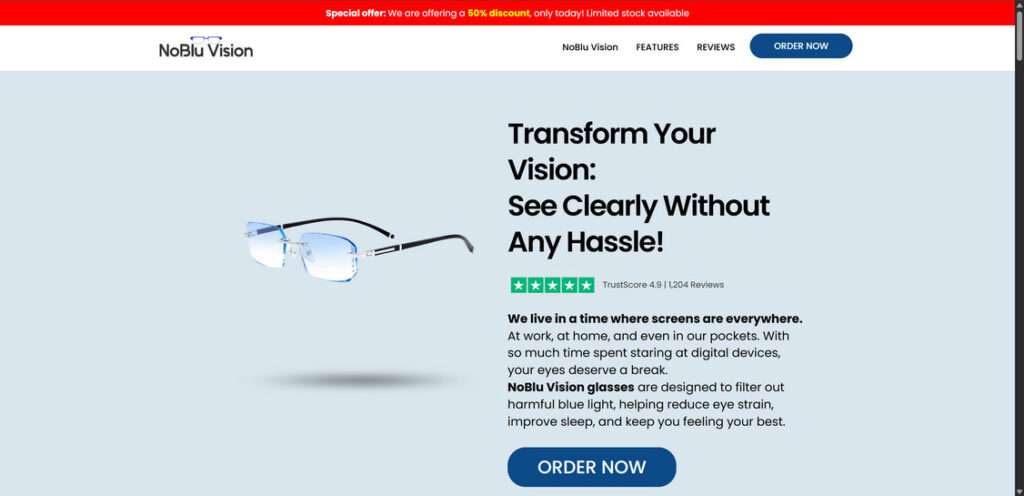
NoBlu Vision glasses are advertised as blue light blocking eyewear designed to relieve eye strain, improve sleep quality, and boost overall comfort during screen time. The promotional content claims they block up to 73% of harmful blue light, reduce dry eyes by 47%, and help users fall asleep faster.
Key Marketing Claims
- Filters harmful blue light
- Reduces eye strain, dryness, and headaches
- Improves sleep by preserving melatonin levels
- Scratch-resistant and anti-reflective lenses
- Lightweight, unisex design
- Suitable for use with contact lenses
- “Endorsed by doctors” and featured in major news outlets
These features are wrapped in slick branding and aggressive marketing strategies, including limited-time offers, countdown timers, and a seemingly endless stream of five-star reviews.
Red Flags and Questionable Tactics
1. Fake Endorsements and “As Seen In” Logos
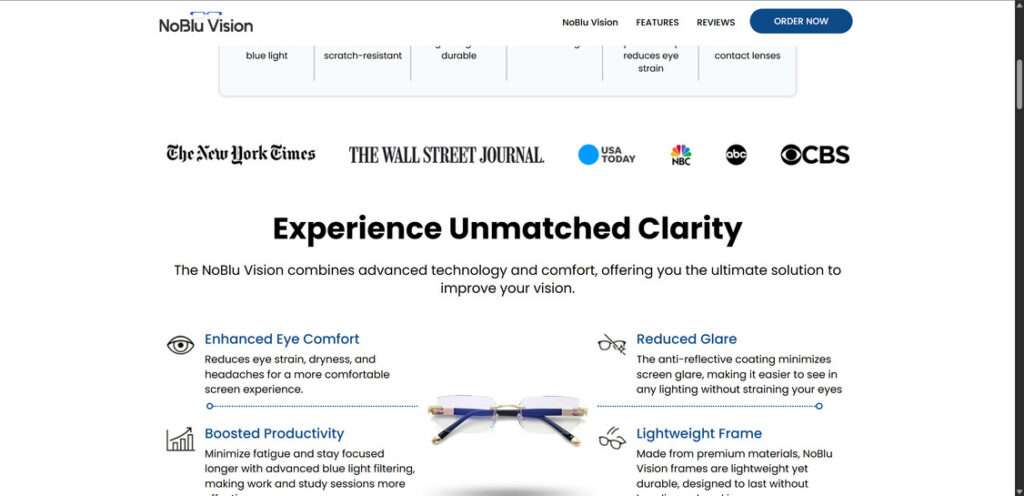
NoBlu Vision’s website prominently features logos of The New York Times, The Wall Street Journal, NBC, USA Today, and other major outlets, implying media coverage. However, there is no evidence these publications have ever mentioned or reviewed NoBlu Vision.
This tactic is common in dropshipping scams, where generic products are dressed up with fake authority to build trust with consumers.
2. Fabricated Reviews and Ratings
The site claims a TrustScore of 4.9 based on 1,204 reviews, but only one real review is visible—and it’s a negative one. The rest appear to be either generic placeholders or fabricated testimonials. This discrepancy raises serious doubts about the authenticity of user feedback.
Many consumers report that their posted reviews never appeared on the site, especially if they were critical.
3. Untraceable “Doctors” and Testimonials
A so-called expert named Dr. Peterson claims to wear and recommend NoBlu Vision glasses. However, there is no verifiable record of this person being a licensed optometrist. The image used for Dr. Peterson appears to be a stock photo.
This is another hallmark of deceptive e-commerce—using fake medical endorsements to lend false credibility to the product.
The Truth About the Product
1. It’s a Generic Dropshipping Product
Upon further inspection, NoBlu Vision glasses appear to be generic eyewear sourced from Chinese suppliers, available for as little as $2 to $5 on wholesale platforms like Alibaba and AliExpress. These same designs have been rebranded and resold under various names using identical website templates and marketing copy.
Consumers are essentially paying up to $80 for a $5 product, repackaged with exaggerated promises and fake testimonials.
2. Not Medical-Grade or Certified
Despite its lofty claims, there is no FDA approval, CE certification, or third-party testing to verify the glasses’ effectiveness in filtering blue light. The website also fails to provide technical specs or scientific data to support its advertised benefits.
This omission is particularly troubling for a product that claims to impact eye health and sleep quality.
3. No Prescription Options
Unlike reputable eyewear brands, NoBlu Vision does not offer diopter strength options or a way to customize the glasses to your prescription. This means the glasses are essentially one-size-fits-all, which is inadequate for users with specific visual needs.
Many users expecting vision correction have found themselves disappointed when the glasses do not improve their eyesight as claimed.
User Experiences and Complaints
1. Product Quality Issues
Dozens of customers have reported that the glasses feel cheap, flimsy, and poorly made. Common complaints include:
- Easily scratched lenses
- Loose hinges
- Weak or missing anti-glare coating
- No noticeable difference in screen comfort or sleep
2. Non-Responsive Customer Service
Customer support for NoBlu Vision is almost non-existent. Emails go unanswered, return requests are ignored, and the advertised “30-Day Money-Back Guarantee” is rarely honored.
Many users report being stuck with a subpar product and no way to get a refund.
3. Shipping Delays and Disguised Origins
While the website claims fast shipping, in reality, many buyers wait 2 to 4 weeks for delivery. The packages often ship directly from China, contradicting the site’s claims of local fulfillment.
Familiar Website Template, Familiar Dropshipping Operations
NoBlu Vision’s website design and marketing style are eerily similar to other known dropshipping operations that have sold everything from posture correctors to miracle pillows.
The structure is formulaic:
- Large hero image with a countdown timer
- Fake media logos
- Dubious medical testimonials
- Inflated discount pricing
- Pushy “limited-time offer” messages
- Fake scarcity (“Only 6 left in stock!”)
This is a classic script for manipulating impulse buyers into purchasing before researching the product.
Who Is Behind NoBlu Vision?
Unsurprisingly, there’s no publicly disclosed owner. Domain records are masked, and there’s no corporate registration info.
Most likely, this is run by a dropshipping operation overseas (commonly in China), leveraging anonymous digital storefronts to make fast profits and disappear before refund claims mount.
Final Thoughts: Avoid the Trap
At a glance, NoBlu Vision may seem like a smart, affordable solution to digital eye strain. But behind the flashy marketing lies a deeply problematic operation built on fake endorsements, deceptive pricing, and empty promises.
You deserve better than a $5 pair of glasses marked up to $40 under a fake “doctor’s recommendation.”
If you care about your eyes, your money, and your trust, avoid NoBlu Vision — and tell your friends too.
Frequently Asked Questions (FAQ)
Q: Are NoBlu Vision glasses legit?
NoBlu Vision glasses are not considered a legitimate or trustworthy product. The company uses misleading marketing tactics, fake customer reviews, and unverifiable claims to promote a low-quality product at a highly inflated price. Most users report that the glasses do not perform as advertised.
Q: Do NoBlu Vision glasses really block blue light?
There is no scientific data, third-party testing, or certification provided to support the blue light blocking claims. Without verified proof, there is no way to confirm that the glasses effectively filter harmful blue light.
Q: Why do NoBlu Vision glasses have so many 5-star reviews?
The large number of 5-star reviews displayed on the NoBlu Vision website appear to be fake or fabricated. Independent review platforms and forums reveal that actual customer experiences are overwhelmingly negative, with many claiming the reviews are dishonest or artificially generated.
Q: Is NoBlu Vision a dropshipping business?
Yes. NoBlu Vision fits the common dropshipping model. The product is cheaply sourced from overseas manufacturers and sold at a high markup through a generic website that uses recycled templates and misleading branding. This approach prioritizes profit over quality or customer satisfaction.
Q: Can I get a refund from NoBlu Vision?
Although the website advertises a 30-day money-back guarantee, many customers report that refund requests are ignored or denied. The refund policy is inconsistently enforced, and the company provides little to no customer support after a sale is made.
Q: Is it safe to order from NoBlu Vision’s website?
While the site may use secure checkout software, ordering from NoBlu Vision carries significant risk. Customers frequently receive a product that does not match the advertised quality, and the lack of transparent customer support or a clear return process makes the purchase risky.
Q: Are there better alternatives to NoBlu Vision?
Yes. Trusted blue light glasses brands such as Felix Gray, Gunnar Optiks, and Warby Parker offer tested and reliable products. These companies provide verified protection, prescription options, and strong customer service.
Q: Why does NoBlu Vision show logos from The New York Times and NBC?
These logos are used without permission to create a false sense of credibility. There is no documented evidence that NoBlu Vision has been reviewed, endorsed, or featured by any of the media outlets displayed on their site.
Q: What should I do if I already ordered from NoBlu Vision?
If you have already placed an order, consider taking the following steps:
- Contact your bank or credit card provider to request a chargeback.
- Save all email communication and receipts for documentation.
- Report the company to consumer protection agencies such as the FTC, BBB, or ScamPulse.
- Leave honest reviews on public platforms to warn others.
Let me know if you’d like this integrated into the full article or exported for publishing.

Join the discussion
12 commentsShare your experience or ask a question about this article.
Discussion
bought these glasses andthey do not do what they claim to do they are blury at all distances do not darkin in sunlight should have known better than to order tv should have not aired these total fakes do not buy
In reply to David
I agree fully… These glasses are not as advertised.
Do not give clear view ,have no effect on sun glare and are cheaply made.
I too,got a different item then the one offered, NoBluVison….
Beware of the scam !!!
In reply to Dean
Receiving a different item from the one advertised is the strongest possible basis for a dispute, so use it. Ring your card issuer, file it as not as described – you were sent a substitute product – and send a screenshot of the offer next to a photo of what arrived. You generally have up to 120 days, and do not post it back at your own expense; only with a prepaid label and tracking.
On the lenses themselves: a genuine blue-light filter is barely perceptible to look through and does nothing at all for sun glare, which requires polarisation – two different properties that these ads routinely merge into one claim. If the lenses make everything slightly blurred, they are uncorrected plastic with a tint, and there is no adjustment period no matter what the follow-up email says.
The brand substitution is also worth reporting at reportfraud.ftc.gov, since shipping a different product under an advertised name is the sort of specific, checkable violation that gets acted on. And if you were ordering these for eye strain or glare while driving, an optometrist is the better answer – both have real causes and real remedies.
In reply to David
Hi David, I’m sorry the glasses did not work as advertised. Blurry lenses and no sunlight darkening are clear product-performance issues. If you paid by card or PayPal, dispute the purchase as item not as described.
NoBluVision glasses are a complete scam. I paid $80 Canadian (with shipping charge) for Clarity Blue Gasses and recieved these this frameless glasses that create blurred vision at all distances. No one at their 1 814 number returns my calls or emails to their customer service desk. Do not order any products from NoBluVision or Clarity. It is a scam!
In reply to Steven Cannon
Thank you for sharing your experience, Steven. Reports like yours are exactly why shoppers need to be cautious with products marketed through exaggerated claims and difficult-to-reach support channels. Blurred vision, poor product quality, and no response from customer service are all major warning signs. I’m sorry you had to deal with that.
I ordered a pair of Clarity Blue Glasses off of TV for $39.95. What I received is something called NOBLU VISION GLASSES, needless to say this is not
what I ordered. I contacted the company and what I was offered was a $19.99 refund. Obviously what this is, is a bait and switch operation.
Truly this is a total scam.
In reply to James Smith Jr
That “wrong item delivered” plus “we’ll refund half if you keep it” offer is a very common bait-and-switch tactic. If the product is not what you ordered, document it (photos of the item, packaging label, and the listing/TV offer) and dispute the charge with your card issuer as “item not as described.” Sellers often use partial refunds to avoid full returns and chargebacks.
I just received my 2pairs today. They are cheap and flimsy. I can’t believe I paid $65 for them both. They can perhaps go for $5 maybe $10. I ordered mine off TV! Quality is very cheap. CVS and the Dollar Tree glasses are better quality.
In reply to LGray
Yes, they are $2 galses from China.
Best next steps:
If you paid by card or PayPal, open a dispute as not as described / misleading advertising.
Save screenshots of the product page and claims, plus your order confirmation and any emails.
If they keep charging or you’re seeing additional attempts, ask your bank about blocking future charges from the merchant.
I cannot find a site for a refund of two NoBlu Vision Glasses. Everything you stated about cheap, unusable and not as stated is true. What a scam especially for those of us hoping for our fading vision to improve.
In reply to Nora O.
Nora, unfortunately this is very common with these “vision glasses” sites: little to no real support, and returns that are expensive or impossible.
Best next steps:
If you paid by card or PayPal, open a dispute as not as described / misleading advertising.
Save screenshots of the product page and claims, plus your order confirmation and any emails.
If they keep charging or you’re seeing additional attempts, ask your bank about blocking future charges from the merchant.