

Nutraville CogniSurge is being promoted as a brain-support supplement that claims to improve memory, mental clarity, focus, sleep, and protection against toxins. The sales page presents it as a breakthrough formula for people worried about forgetfulness and cognitive decline, but several parts of the offer raise concern.
The marketing uses strong memory and “brain detox” claims, emotional testimonials, media-style trust badges, subscription options, multi-bottle discounts, and refund terms that may not be as simple as the guarantee suggests. This article explains how the CogniSurge offer works, the red flags buyers should know about, and what to do if you already placed an order.
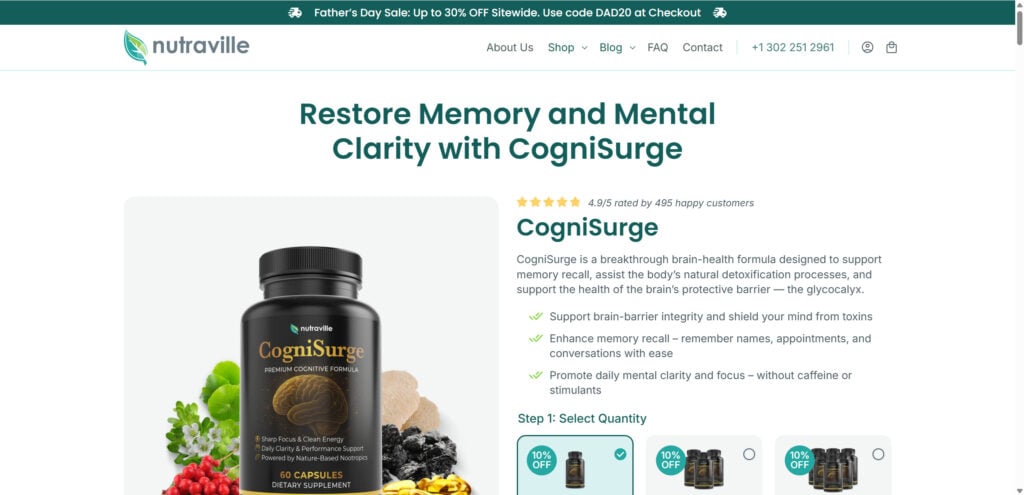
What Is Nutraville CogniSurge?
CogniSurge is sold by Nutraville as a nootropic brain-support supplement. The product page describes it as a “breakthrough brain-health formula” designed to support memory recall, mental clarity, brain detoxification and the brain’s protective barrier, which the page calls the glycocalyx.
The formula is advertised with ingredients such as:
- Shilajit
- Lion’s Mane mushroom
- Schisandra fruit extract
- Bacopa monnieri
- Gotu kola
- DHA omega-3 fatty acid
These are common ingredients in many memory, focus and nootropic supplements. Some have been studied individually, but that does not prove CogniSurge itself can restore memory, rebuild a brain barrier, detox heavy metals, prevent cognitive decline or reverse age-related forgetfulness.
That distinction matters. Ingredient marketing is not the same as clinical proof for the finished product.
Why Nutraville CogniSurge Raises Scam Concerns
CogniSurge raises concerns because its marketing appears to go far beyond standard supplement support language.
The page does not simply say the product may support focus or cognitive wellness. It suggests that memory problems may be caused by toxins damaging a microscopic brain shield, and that CogniSurge was designed to target this “root cause.”
That type of claim is a major red flag.
The product page uses phrases such as:
- Restore memory and mental clarity
- Shield your mind from toxins
- Support brain-barrier integrity
- Rebuild your brain’s protective shield
- Detoxify the brain overnight
- Wake up sharper
- Remember names, appointments and conversations with ease
- Regain control over your cognitive future
- Stay independent and confident for years to come
These are powerful emotional claims, especially for older adults or families worried about memory loss. But the page does not provide clear, product-specific clinical evidence proving that CogniSurge can deliver those results.
Exaggerated Memory and Brain Detox Claims
The biggest red flag is the “brain detox” angle.
CogniSurge’s page suggests that toxins such as lead, mercury or cadmium may damage the brain’s protective barrier and contribute to inflammation, forgetfulness and sluggish processing. It then positions the supplement as a way to support cellular detox and restore this barrier.
This is highly questionable as a supplement sales claim.
Heavy metal exposure and cognitive decline are serious medical topics. A dietary supplement should not be marketed in a way that makes consumers believe it can detox the brain from heavy metals, repair the blood-brain barrier or protect them from long-term cognitive decline unless the company has strong clinical evidence for the exact product.
The page also connects memory lapses, poor sleep, racing thoughts and fear of aging to the product’s mechanism. This can push worried buyers into ordering before asking whether the claims are medically realistic.
AI Videos and Fake-Looking Promotional Content
CogniSurge is the type of supplement that is often promoted through AI-generated social media ads, long-form video sales letters and fake “health discovery” narratives.
These ads may show:
- AI-generated doctors
- Synthetic narrator voices
- Fake news-style presentations
- Stock footage of older adults
- Fake before-and-after memory stories
- Medical animations about toxins and the brain
- Emotional testimonials about forgetting names, getting lost or fearing dementia
This matters because memory decline is a sensitive topic. People may buy quickly if they believe a supplement can protect them from losing independence, forgetting family members or needing care.
A trustworthy health product should not need fear-based AI videos, fake expert-style presentations or dramatic aging stories to sell.
“As Seen On” and Research Logo Red Flags
The CogniSurge page displays media-style logos such as CBS, ABC, NBC and Fox, along with research-related logos such as Harvard, Healthline, Nature and others.
These badges can make the product look more credible than it may be.
The key question is whether those organizations directly reviewed, endorsed or validated CogniSurge. Displaying logos near a product does not prove the product was featured by those outlets or that the formula was clinically tested by those institutions.
This is a common tactic in questionable supplement funnels. A page uses media logos, university logos or journal-style graphics to create instant trust, even when the actual connection is vague or unsupported.
If CogniSurge was truly tested or endorsed by any major institution, the seller should provide direct citations to the exact studies, articles or clinical trials involving the finished CogniSurge product.
The Glycocalyx “Brain Shield” Claim Sounds Scientific But Needs Proof
CogniSurge’s marketing centers on the idea that memory loss may begin with damage to the glycocalyx, a microscopic protective layer associated with vascular and cellular function.
The problem is not that the glycocalyx is imaginary. The problem is that the supplement’s marketing appears to use a complex biological concept to make a simple capsule formula sound like a breakthrough treatment.
Important questions remain unanswered:
- Was CogniSurge itself clinically tested?
- Did testing show it improves memory in humans?
- Did testing measure the brain glycocalyx?
- Did it prove the supplement removes heavy metals?
- Did it show improved blood-brain barrier integrity?
- Was the study randomized and placebo-controlled?
- Were results independently published?
- Were older adults with memory concerns tested?
Without clear answers, the glycocalyx claim should be treated as marketing language, not proof.
Common Ingredients Do Not Prove the Product Works
CogniSurge includes ingredients that are common in nootropic supplements, including Lion’s Mane, Bacopa, Gotu Kola, DHA and Shilajit.
Some of these ingredients have individual research behind them. But supplement marketers often exaggerate ingredient research to imply that their finished formula is clinically proven.
That is misleading.
A study on Bacopa does not prove CogniSurge improves memory. A study on Lion’s Mane does not prove CogniSurge rebuilds the brain’s protective barrier. General research on DHA does not prove this exact capsule can reverse brain fog or cognitive aging.
The final product matters. Dosage matters. Ingredient quality matters. Bioavailability matters. Clinical testing matters.
CogniSurge’s claims would require product-specific evidence, not just a list of popular nootropic ingredients.
Subscription and Recurring Billing Risks
The CogniSurge page includes both a one-time purchase option and a “Subscribe & Save” option.
The subscription offer gives a 10% discount and lets customers choose delivery every 1 month, 3 months or 6 months. The page says customers can cancel or pause anytime, but subscription setups always create risk if buyers do not realize what they selected.
This is one of the biggest concerns with supplement funnels.
A customer may think they are making a one-time purchase, but if the subscription option is selected or pushed as “recommended,” they may later receive repeat deliveries and additional charges.
The subscription policy confirms that subscription purchases involve repeat deliveries, stored payment details and charges for each delivery unless the customer cancels.
That means anyone ordering CogniSurge should carefully check:
- Whether “one-time purchase” or “Subscribe & Save” is selected
- The delivery frequency
- The order confirmation email
- The billing statement
- Any recurring charge language
- Any account link used to manage the subscription
Do not assume the purchase is one-time unless the final checkout clearly confirms it.
Multi-Bottle Pressure
CogniSurge encourages larger purchases by offering quantity discounts:
- One bottle
- Three bottles
- Six bottles
The six-bottle option shows the largest discount. The page also says people who take CogniSurge consistently for 90 days often experience stronger memory, better focus and lasting mental clarity.
This creates the usual supplement-funnel pressure: buy several bottles now because the product allegedly needs months to work.
That is risky for consumers. If the product does not deliver results, the buyer may be left with multiple bottles, a more complicated refund request, and possibly a subscription they did not fully understand.
Large bundles are especially concerning when paired with emotional claims about memory loss and fear of cognitive decline.
Refund Policy Contradictions
The product page advertises a 365-day “Love It Or It’s Free” guarantee and says customers can get a full refund with “no questions asked.”
However, Nutraville’s shipping and return policy contains stricter language. It says all sales are considered final once payment is made. It also says customers must contact support before returning an item, that return shipping is the customer’s responsibility, shipping costs are non-refundable, and returned items must be unused, unopened and in the original packaging.
That creates a contradiction.
The product page makes the guarantee sound simple and risk-free. The shipping and return policy makes returns sound conditional and limited to unused, unopened products.
This is a major red flag because supplement buyers usually need to open and use the product to find out whether it works. If the return policy says the item must be unused and unopened, the practical value of the guarantee becomes unclear.
“No Questions Asked” May Not Be So Simple
Even when a website advertises a long money-back guarantee, customers may still run into problems.
Possible refund issues include:
- Support not responding quickly
- Being told to return bottles first
- Having to pay return shipping
- Shipping fees not being refunded
- Opened bottles being disputed
- Subscription charges continuing
- Refunds being delayed
- Confusion between the 365-day guarantee and the return policy
- The company offering exchanges or other products instead of a refund
The refund policy says customers can email support for a refund, but the shipping and return page includes additional conditions. Buyers should save screenshots of both pages before ordering.
Fake or Unverifiable Testimonials
CogniSurge’s page includes testimonial-style stories from customers who describe frightening memory problems, such as forgetting where they parked, mixing up medications, losing keys, forgetting appointments, getting lost while driving, and fearing they might need 24/7 care.
These testimonials are emotionally powerful, but they are difficult to verify.
Common red flags include:
- First names only
- Dramatic storytelling
- Fear-based memory-loss scenarios
- No independent verified-review platform clearly shown
- No medical testing before or after
- No proof the person used CogniSurge
- No proof the results were caused by the supplement
Testimonials are not clinical evidence. A supplement should not rely on emotional memory-loss stories to imply that it can protect someone from cognitive decline.
FDA Disclaimer Undermines the Strong Claims
CogniSurge’s page includes the standard dietary supplement disclaimer stating that the claims have not been evaluated by the Food and Drug Administration and that the product is not intended to diagnose, treat, cure or prevent disease.
That disclaimer matters.
The sales page uses strong language around memory, brain detox, toxins, inflammation, sleep, brain-barrier integrity and long-term cognitive health. But the disclaimer confirms the product is being sold as a dietary supplement, not an FDA-approved treatment.
Dietary supplements are not reviewed by the FDA for safety and effectiveness before being sold in the same way drugs are. Consumers should not treat CogniSurge as a proven medical solution for memory loss, cognitive decline, heavy metal exposure, dementia symptoms or neurological problems.
“Manufactured in USA” Does Not Prove Effectiveness
The CogniSurge page says the product is manufactured in the USA. That may sound reassuring, but it does not prove that the product works.
A supplement can be manufactured in the USA and still use exaggerated claims. It can be made in a registered facility and still lack product-specific clinical evidence. It can use familiar ingredients and still fail to deliver the promised results.
The issue is not just where the bottle is made. The issue is whether the finished formula has been independently tested and whether the advertising is truthful, realistic and properly substantiated.
Why CogniSurge Looks Like Previous MalwareTips Scam Patterns
CogniSurge follows a familiar supplement-funnel pattern:
- A product is promoted with fear-based health concerns.
- The sales page introduces a scientific-sounding “root cause.”
- Common ingredients are presented as a breakthrough formula.
- Media and research logos are used to build credibility.
- Testimonials describe emotional life-changing results.
- Buyers are pushed toward multi-bottle purchases.
- A subscription option is promoted as a better value.
- A generous guarantee is advertised.
- Policy pages contain stricter return language.
- The product includes an FDA disclaimer saying it is not intended to treat disease.
This is the same structure used by many questionable memory, hearing, weight loss, blood sugar, prostate and anti-aging supplement offers.
Is CogniSurge Legit or a Scam?
CogniSurge should be treated as a high-risk supplement offer.
It may ship a real bottle of capsules. It may contain common nootropic ingredients. Some users may feel some benefit from certain ingredients, placebo effects, improved sleep routines or general wellness changes.
But the marketing is the concern.
The page makes strong claims about memory restoration, brain detoxification, heavy metals, the brain’s protective barrier, sharper thinking and long-term cognitive independence. These claims require serious evidence, especially because they target older adults and people worried about memory decline.
Based on the sales page, subscription setup, emotional testimonials and refund-policy contradictions, CogniSurge is not a product we would recommend buying from social media ads or long-form promotional funnels.
What To Do If You Already Ordered CogniSurge
If you already bought CogniSurge, take these steps:
1. Check whether you selected a subscription
Look at the confirmation email and verify whether you chose a one-time purchase or “Subscribe & Save.”
2. Confirm the delivery frequency
If you selected subscription, check whether delivery is every 1 month, 3 months or 6 months.
3. Save screenshots
Save the product page, 365-day guarantee, refund policy, shipping/return policy, subscription policy and checkout total.
4. Contact support in writing
Use direct wording:
“I do not authorize any subscriptions, recurring charges, repeat deliveries, memberships or additional shipments. Cancel any active subscription and confirm in writing.”
5. Watch your bank statement
Look for repeat charges, duplicate charges, subscription billing or unfamiliar merchant names.
6. Request a refund quickly
If you are dissatisfied, contact support as soon as possible and ask for written confirmation of the refund process.
7. Contact your bank if needed
If the company refuses to cancel recurring billing, charges more than expected or does not honor the advertised guarantee, ask your card issuer about a chargeback.
8. Speak with a doctor for memory problems
If you or a family member has worsening memory loss, confusion, getting lost, medication mistakes, sleep disruption or personality changes, do not rely on a supplement. Seek medical evaluation.
How To Avoid Similar Brain Supplement Scams
Before buying a memory supplement from a social media ad, watch for these warning signs:
- Claims that memory loss has a hidden “root cause”
- Claims about detoxing heavy metals from the brain
- Claims about rebuilding the blood-brain barrier
- AI-looking doctor videos or fake health presentations
- Media logos without direct proof of coverage
- University logos used as credibility props
- Emotional testimonials about dementia-like fears
- Large multi-bottle discounts
- Subscription options marked as recommended
- Refund promises that conflict with return policies
- FDA logos or facility claims used to imply approval
- No clinical trial on the exact finished product
- No independent verified customer reviews
A legitimate brain-health supplement should make realistic claims, avoid fear-based medical language, provide transparent testing, and make cancellation and refunds simple.
Final Verdict
CogniSurge has too many red flags to recommend.
The product is promoted as a breakthrough memory and mental-clarity supplement that can support brain detoxification, protect against toxins, restore a brain barrier, improve sleep, sharpen recall and help users regain control over their cognitive future. Those claims are much stronger than what a typical dietary supplement can prove without clear, product-specific clinical evidence.
The subscription setup is also a concern. The page offers “Subscribe & Save,” stores payment details for recurring deliveries, and allows delivery every 1, 3 or 6 months. Buyers must be careful not to accidentally enroll in repeat billing.
The refund messaging is another red flag. The product page promotes a 365-day, no-questions guarantee, while the shipping and return policy says sales are final once payment is made, returns require prior contact, return shipping is the customer’s responsibility, shipping is non-refundable, and items must be unused, unopened and in original packaging.
For consumers, the main risks are believing exaggerated memory and detox claims, buying multiple bottles, enrolling in a subscription, struggling with refunds, and delaying proper medical evaluation for serious cognitive symptoms.
CogniSurge is best avoided unless the seller can provide clear product-specific clinical trials, transparent proof behind the brain-barrier claims, verified independent reviews, and refund terms that match the “risk-free” promise.








